
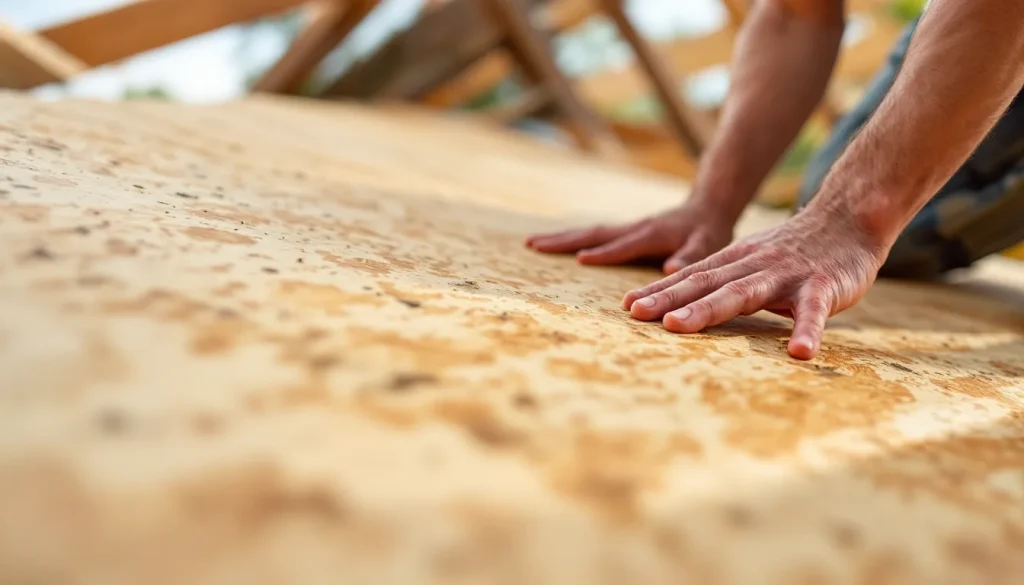
A roof deck repair in 2026 runs anywhere from $50 to $150 to swap a single rotted plywood sheet during a reroof, up to $2,000 to $6,000 to fully re-sheath a 2,400 sq ft house when the entire deck is shot. The repair is almost never quoted as a standalone job. It shows up as a line item inside a roof replacement, usually billed at a per-sheet rate plus a small mobilization fee, and the actual sheet count is discovered after the tear-off when the deck is exposed. The cost (for the full data set, see our the full 2026 Roofing Cost Report) swing depends on three things: how many sheets are bad, whether the existing deck is plywood or OSB, and whether the contractor is patching to code or upgrading sheathing thickness to meet current IRC requirements. The numbers below are what supply houses and crews are actually charging in 2026, not what the calculator on a glossy roofing site spits out.
The short version
- Single sheet patch during a reroof: $50 to $150 in labor plus $35 to $70 for the sheet itself. Most contracts bake in a 1 to 2 sheet allowance.
- Full re-decking on a 2,400 sq ft house: $2,000 to $6,000 added to the reroof. About 30 to 40 sheets at $65 to $150 installed each.
- Plywood vs OSB: 1/2 inch CDX plywood runs $35 to $55 per sheet at the supply house. 7/16 inch OSB runs $25 to $42. Code in most states allows either.
- Standalone deck repair without a reroof is rare and expensive because shingles, underlayment, and ice and water shield all have to come off and go back on.
- Soft decking under your feet during a walk-up is the visible signal. The hidden version is dark staining on the underside visible from the attic.
- IRC 2024 minimum sheathing thickness on a 24 inch rafter span is 15/32 inch plywood or 7/16 inch OSB. Older 3/8 inch panels are technically grandfathered but not on a reroof.
What roof deck repair actually means
The roof deck (see our roof decking replacement cost) (also called sheathing) is the layer of plywood or OSB that sits on top of the rafters and under everything else. Shingles, underlayment, ice and water shield, drip edge, flashing, and ridge cap all attach to or sit on the deck. When the deck rots, no amount of shingle work matters. The new shingles have nothing to nail into, and the next leak is six months away. So when a contractor opens up a tear-off and finds soft spots, those sheets have to come out before the new roof goes on.
The repair is almost always discovered, not predicted. From the ground, and even from a walk-up inspection, the deck is hidden under shingles, underlayment, and a layer of bituminous goop. The only reliable way to know how much deck is bad is to tear off the old roof and look. That’s why almost every reroof contract has a “decking allowance” baked in: usually 1 to 4 sheets included at no extra charge, with anything beyond that billed at a stated per-sheet rate. See how to read a new roof estimate for how this line item shows up in a typical quote.
2026 cost ranges by scope
The table below is what crews from the South, the Mountain West, and the Northeast were quoting through Q1 and Q2 2026. Material prices on plywood and OSB stabilized after the 2022 to 2024 spike but are still 30 to 40 percent above 2019 baselines. Labor is the bigger driver of the per-sheet rate now.
| Scope | What’s included | 2026 cost | Notes |
|---|---|---|---|
| Single sheet patch during reroof | 1 sheet of OSB or plywood, nails, labor | $85 to $220 installed | Most contracts include 1-2 free sheets |
| 5 to 10 sheet patch | Sheets, nails, labor, no additional mobilization | $450 to $1,500 added | Common on 15+ year old roofs |
| Partial re-decking (15 to 25 sheets) | Replaces full slopes, structural inspection | $1,200 to $3,500 added | Often after long-term valley leak |
| Full re-decking 2,400 sq ft house | 30 to 40 sheets, full tear-off, dump | $2,000 to $6,000 added | Adds 1 day to project timeline |
| Standalone deck repair (no reroof) | Tear off shingles in area, patch deck, reinstall | $800 to $3,000 | Roof has to be relatively new |
| Sheathing upgrade (3/8 to 1/2 inch) | Full re-deck plus thicker panel premium | $3,500 to $8,000 added | Sometimes required for code or insurance |
The single-sheet number is the one most homeowners actually see. A typical 2,400 sq ft roof reroof contract will include a clause like “decking replacement up to 2 sheets included; additional sheets billed at $95 each.” That $95 covers the sheet, nails, and the labor to swap it in. It does not cover the cascading work if a structural rafter underneath is also rotten, which is a different conversation.
Why deck rot happens
Deck rot has three main sources. The first and most common is long-term leakage at a penetration: a failed pipe boot, a cracked skylight gasket, a chimney flashing that’s been dripping for three years, or a missing kickout flashing where the roof meets a sidewall. Water gets through, soaks the deck, and rots it from the underside. The shingles can look fine while the deck behind them is mush. Our rotted roof decking diagnostic guide walks through how to spot this from inside the attic.
The second source is condensation from inadequate attic ventilation. When warm humid air from the house leaks into a cold attic, it condenses on the underside of the deck and runs down to the eaves. Over years that condensation rots the deck along the eave line. A roof can fail from the inside even with no exterior leak.
The third source is ice dams on the eaves. Snow melts on the warm part of the roof, refreezes at the cold eave, and backs water up under the shingles into the deck. The repair is usually a strip of deck along the eave plus a peel-and-stick ice and water shield extending two feet inside the warm wall line. See roof repair cost for itemized ice dam repair pricing.
OSB vs plywood for deck repair
Older homes, especially those built before the 1970s, were often decked with solid roof boards rather than panels. Most homes built before 1990 have plywood decking. Most homes built after 1995 have OSB. Both are legal under IRC and both are accepted by every major shingle manufacturer. The decision usually comes down to what’s already on the roof, what the supply house has in stock, and price.
Plywood specs
- CDX grade is the standard. C-face, D-back, X for exterior glue.
- 1/2 inch (actually 15/32 inch) is the most common thickness on residential roofs with 24 inch rafter spacing.
- 5/8 inch (19/32 inch) is required for some heavy-tile installs and longer spans.
- Supply house price: $35 to $55 per 4×8 sheet in 2026.
- Slightly stiffer underfoot, takes nails better in re-driving situations.
OSB specs
- 7/16 inch is the most common residential thickness.
- 15/32 inch and 23/32 inch available for heavier loads.
- Supply house price: $25 to $42 per 4×8 sheet in 2026.
- Cheaper but absorbs water more aggressively and swells at the edges if exposed.
- Most OSB sold today is rated APA 24/16, meaning it spans up to 24 inches with a 16 inch live load rating.
For a patch on an existing plywood roof, contractors usually buy plywood to match. For a full re-deck, OSB wins on cost unless the homeowner specifically asks for plywood. Performance once installed and dried-in is functionally identical for a residential asphalt shingle roof.
Code minimums and what changes during a reroof
The 2024 IRC R503.2.1 sets the minimum sheathing thickness based on rafter spacing. For 24 inch on-center rafters (the most common residential spacing), the minimum is 15/32 inch plywood or 7/16 inch OSB. For 16 inch on-center rafters, you can technically drop to 3/8 inch panels, though no contractor in 2026 would actually install that thin.
The catch: older homes built in the 1960s and 1970s often have 3/8 inch plywood that meets the code at time of construction. That’s grandfathered as long as the deck stays intact. But when a sheet rots out and gets replaced, the new sheet has to meet current code, which means 15/32 inch minimum. So a patch on an old roof can mix thicknesses, with the replacement sheet sitting slightly proud of the old deck. The roofer feathers it in with the next course of shingles and nobody notices.
For insurance-mandated upgrades after a hurricane (FL, TX coast, SC) or a major hail event (CO, OK, KS), some carriers now require full re-decking to 5/8 inch or 19/32 inch panels with a ring-shank nailing pattern and an upgraded edge nailing schedule. That’s the FORTIFIED Roof program from the Insurance Institute for Business and Home Safety, and it can run $4,000 to $8,000 added on top of a standard reroof but knocks 20 to 30 percent off the windstorm premium in eligible markets.
How to spot a bad deck before the contractor finds it
From the ground, you can’t. From the roof itself during a walk-up, soft decking feels like stepping on a sponge. The sheet flexes under foot pressure. That’s the visible signal. Most homeowners shouldn’t be doing this themselves, but a competent inspector will walk the roof during a 30-point roof inspection and flag any soft spots they find.
From the attic, soft decking shows up as dark staining on the underside of the sheathing, sometimes with visible mold, and in advanced cases with a punky texture if you push a screwdriver into it. Stains are not always rot. A stain without softness usually means a leak that has since been repaired. Softness with or without stain means active deck failure. Take a flashlight into the attic on a hot afternoon and check the underside of the deck at every penetration (pipes, chimneys, dormers) and at the eaves on the north-facing side of the house. That’s where rot starts.
Another tell: missing or popped nails where the shingles attach. If the deck has rotted enough that the original nails no longer hold, the shingles above will lift and the nails will work their way out. See red flags during a roof inspection for how a scammer will try to inflate the deck repair scope.
What the line item should look like on a contract
A clean reroof contract spells out the decking allowance and the per-sheet billing rate before anyone gets on the roof. Vague language here is one of the most common ways homeowners get surprised at the end of a job. The line should read something close to this:
Replacement of roof decking as required: contract includes replacement of up to two (2) sheets of 7/16 inch OSB at no additional charge. Additional sheets, if required after tear-off, will be billed at $95 per sheet (material, fasteners, and labor inclusive). Contractor will document all replaced sheets with photographs prior to installation of underlayment. Replacement of rotted rafters, fascia, or structural framing is not included and will be quoted separately if discovered.
Three things matter in that paragraph. First, the number of included sheets is specified, not vague. Second, the per-additional-sheet price is locked in writing before the contractor has the upper hand. Third, the photo documentation requirement protects you from being billed for sheets that didn’t actually get replaced. Our roofing contract template includes this exact clause as standard language.
When deck repair becomes deck replacement
The break-even point in most markets is around 25 to 30 percent of sheets bad. Below that, patching the rotted sheets and reusing the rest is cheaper. Above that, the labor of selectively replacing sheets, working around old ones, and adjusting for thickness differences makes full re-decking more economical. Some indicators that push the decision toward full replacement:
- The existing deck is 3/8 inch and the homeowner wants a 30 year asphalt shingle with a wind warranty (most manufacturers want 15/32 inch minimum).
- The home is in a high-wind insurance market and needs FORTIFIED certification.
- Multiple slopes have rot, indicating systemic ventilation or flashing failure.
- The homeowner is upgrading to a heavier roofing material (tile, slate, metal standing seam) that needs more substrate stiffness.
- The existing OSB has visible delamination or “OSB pillowing” at the edges from prior moisture exposure.
Full re-decking adds about a day to the project timeline and $2,000 to $6,000 to the price for a typical 2,400 sq ft house. If the homeowner is already planning a tear-off, the marginal cost of going to full re-deck is roughly half what it would cost to deck the roof from scratch, because the tear-off labor is sunk.
Standalone deck repair without a reroof
Most deck repair happens during a planned reroof. But sometimes a homeowner has a relatively new roof (under 10 years old) and discovers a localized rot problem, usually from a known leak that was repaired but left damage behind. Standalone deck repair without a full reroof is technically possible but expensive per square foot because the contractor has to:
- Tear off shingles in a generous area around the rot (usually 4 to 6 feet beyond the visible damage).
- Remove and dispose of old underlayment and ice and water shield.
- Cut out and replace the rotted sheets.
- Install new underlayment matched to existing.
- Reinstall shingles, often having to source matching colors that may no longer be in production.
The cost ranges $800 to $3,000 for a small repair zone, and the new shingles almost never match the existing perfectly because of weathering. This is why insurance adjusters often write a standalone deck repair claim as a partial-slope replacement rather than a true patch. See our filing a roof insurance claim guide for how this gets handled with the carrier.
What gets discovered with deck rot
The deck is the canary. When the deck is rotted, three other things are usually wrong too. Rafters can be rotted underneath the deck if the leak has been there long enough. Insulation in the attic below is almost certainly wet and compressed. And fascia board at the eaves, which the deck overhangs onto, is often rotted too. A contractor who only quotes the deck without inspecting the rafters and fascia is giving you a partial repair.
Rotted rafters add $200 to $800 per rafter sister or replacement depending on length and accessibility. Rotted fascia runs $8 to $20 per linear foot to replace. Wet insulation needs to be removed and replaced at roughly $1 to $2 per square foot if the contractor handles it (most won’t; they’ll refer you to a separate insulation company). Add all of this up and a serious long-term leak can turn a $15,000 reroof into a $22,000 project once the full damage is exposed.
The 2026 supply house numbers
Here’s what crews are paying at the supply house in 2026, broken out so you can sanity-check a per-sheet charge in a contract:
| Panel | Supply house price (per sheet) | Installed cost (sheet plus labor) |
|---|---|---|
| 7/16 inch OSB | $25 to $42 | $75 to $130 |
| 15/32 inch OSB | $32 to $52 | $85 to $145 |
| 15/32 inch CDX plywood | $35 to $55 | $95 to $160 |
| 19/32 inch CDX plywood | $48 to $72 | $110 to $190 |
| 23/32 inch CDX plywood | $62 to $90 | $135 to $225 |
| 5/8 inch ZIP panel | $58 to $82 | $130 to $210 |
ZIP panels (made by Huber Engineered Woods) are pre-coated with a green or red weather-resistive barrier that doubles as the underlayment for the first 180 days. Some high-end builders are specifying them on re-decks because the integrated barrier eliminates a step. They cost about double standard OSB but save the underlayment labor and material on the replaced sections.
Regional cost variation
Deck repair costs vary by region, but less than full reroof costs do because the materials are commoditized and shipped nationally. The labor component is what swings. In low-cost markets (TX, OK, GA, MS, AL) the per-sheet installed rate is $65 to $95. In high-cost markets (CA, NY metro, MA, WA, CO Front Range) it’s $115 to $180. The Pacific Northwest also tends to see higher per-sheet rates because deck rot is much more common in those markets and crews are more practiced at finding it (which sometimes means finding more of it).
For a side-by-side comparison of how deck repair allowances vary across competing bids, see our roof replacement quote comparison guide. The decking line is one of the easiest places for a contractor to lowball the bid and make it back in change orders.
Negotiating the deck allowance
Most homeowners take the contractor’s decking allowance as gospel. It’s negotiable. Three moves work in 2026:
- Ask for 4 to 5 sheets included instead of 1 to 2. On a 15+ year old roof, finding more than 2 bad sheets is common. Negotiating the included allowance up before signing is cheaper than negotiating the per-additional-sheet rate after the tear-off when you have no bargaining power.
- Lock the per-sheet rate at $80 to $100 max. Anything above $130 per sheet for OSB is a markup, not a cost. Crews that quote $175 per “extra sheet” are counting on you having no bargaining power once the roof is half off.
- Demand photo documentation. Every replaced sheet should be photographed before the underlayment goes down. If the contractor pushes back, that’s a tell.
See how to negotiate a roof replacement for the broader playbook, and questions to ask a roofing contractor for the specific deck-related questions every estimator should answer before you sign.
FAQ
How much does it cost to replace one sheet of roof decking?
$75 to $220 installed in 2026, depending on panel type (OSB vs plywood), thickness, and market. The sheet itself is $25 to $90 at the supply house; the rest is labor and the proportional share of mobilization. Most reroof contracts include the first 1 to 2 sheets at no extra charge.
Can you repair roof decking without replacing the whole roof?
Yes, but it’s expensive per square foot because the contractor has to remove and reinstall shingles, underlayment, and ice and water shield around the repair zone. Standalone deck repair runs $800 to $3,000 for a small area and rarely makes economic sense unless the existing roof is under 10 years old.
What’s the difference in cost between plywood and OSB for deck repair?
OSB is 25 to 40 percent cheaper at the supply house ($25 to $42 per sheet vs $35 to $55 for plywood). Installed, the gap is smaller (about $10 to $15 per sheet) because labor dominates. Both are code-legal under IRC 2024 for residential asphalt shingle roofs.
Will my insurance cover roof deck repair?
Only if the deck damage is tied to a covered loss like wind, hail, or a sudden water leak from a covered cause. Rot from long-term leakage or condensation is excluded as wear and tear in every standard homeowners policy. The adjuster will write the deck repair into the claim if a covered storm or impact caused it; otherwise you’re paying out of pocket.
How do I know if my roof decking needs to be replaced?
Three signals: soft spots when walking the roof, dark staining or visible mold on the underside in the attic, and shingles that won’t hold nails because the deck has lost structural integrity. Any one of those, especially combined with a known leak history, points to deck rot. See our rotted roof decking guide for the full diagnostic.
Bottom line
Roof deck repair is a discovered cost, not a quoted one. It almost always shows up as a line item inside a reroof, usually billed at $75 to $150 per sheet installed, with the first 1 to 2 sheets bundled into the base price. The real money question is what the contract says about additional sheets and whether the contractor will document the replacements with photos. Negotiate the included allowance up to 4 to 5 sheets on any roof over 15 years old, lock the per-additional-sheet rate at $100 max for OSB or $130 for plywood, and demand photo documentation. That’s the playbook that keeps an unexpected $400 decking surprise from turning into an unexpected $2,000 one.