
Last reviewed: September 2026.
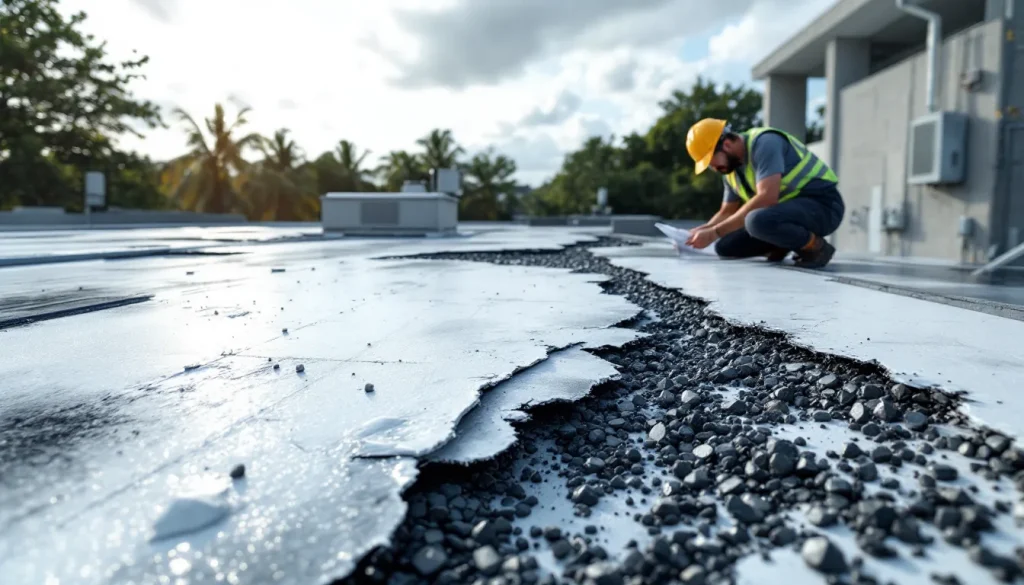
Commercial roof storm damage is where building owners lose the most money the fastest, usually because the first 48 hours after the storm get botched. A torn TPO seam that could have been spot-repaired for $4,000 becomes a $180,000 claim (for the full data set, see our the 2026 State of Roofing Insurance report) and a partial-replacement project six months later because nobody tarped the parapet, nobody filed within the carrier’s notice window, and nobody documented the pre-existing roof condition before the wind hit. This guide is about getting that 48-hour window right, and getting the claim filed in a way that actually pays.
Commercial storms come in two categories that behave very differently: wind (for the full data set, see our the 2026 Severe Weather Roof Damage Report) events (straight-line and tornadic) and hail events. Each leaves its own fingerprint on each membrane type. We’ll walk through what the damage actually looks like, what to document, how the ASCE 7-22 wind-zone analysis drives both the warranty conversation and the insurance claim, and the public-adjuster vs. direct-file decision that determines whether the carrier pays full freight or nickels-and-dimes the file.
Wind Damage: What Actually Fails
Wind failures on commercial low-slope roofs almost never happen in the middle. They happen at the perimeter, the corners, and the rooftop penetrations. ASCE 7-22 (the wind load standard the entire industry designs to) breaks a low-slope commercial roof into three zones: Zone 1 (the broad field of the roof), Zone 2 (the perimeter strip), and Zone 3 (the corners). Design wind uplift pressures in Zone 3 can be 2 to 3 times what they are in Zone 1. Most commercial roof failures happen because the perimeter and corner fastening was specified for Zone 1 pressures.
The failure modes by membrane:
Mechanically fastened TPO and PVC fail at the fastener row. A 90-mph straight-line gust lifts the membrane between fasteners. The membrane balloons, the fastener pulls through the deck (especially in wood nailers or thin metal deck), and the panel peels back like a banana. Once the leading edge is open, every subsequent gust accelerates the failure. A small Zone 3 corner peel can become a 10,000 square foot field failure in a single sustained event.
Adhered TPO, PVC, and EPDM fail at the adhesive bond line. Solvent-based adhesives that weren’t fully flashed off at install lose bond strength over time. A 100-mph wind event finds the weak adhesion areas first. Visible signs: bubbling, wrinkles, and visible delamination at panel edges and around penetrations.
Modified bitumen fails at the laps. Mop-applied mod-bit relies on hot asphalt bond at the lap. If the bond was incomplete (a cold lap, common in shoulder-season installs), wind drives water into the lap and eventually peels it open. Granule loss from heavy rain abrasion is a secondary but common storm (for the full data set, see the 2026 Hail and Storm Loss Database) signature.
Built-up roofing (BUR) is the most wind-resistant flat roof when properly ballasted, but it loses ballast in extreme events. Loose-laid BUR with stone ballast can have entire sections of stone blown clear during tornadic events, exposing the membrane below to UV and physical damage.
For the residential side of the same wind physics, our best roof for hurricane guide covers the steep-slope failures that happen on the same buildings.
Parapet Coping Failure
The single most common commercial wind failure that nobody talks about is parapet coping displacement. Coping is the cap on top of the parapet wall. Most coping is sheet metal attached to wood nailers in the parapet wall.
When wind hits a parapet, it accelerates over the top, creating massive suction on the coping. Coping that was installed with too few clips, or with clips that aren’t engaging the lock seam properly, lifts off. A 16-foot section of coping flying off a 50-foot-tall building causes property damage on the ground and creates a 16-foot section of unprotected parapet that funnels water straight into the building.
The SPRI ES-1 standard governs commercial coping wind resistance, and most major coping manufacturers (Metal-Era, MM Systems, Hickman) publish ES-1 tested assemblies rated by wind speed. A storm-damage assessment should photograph every linear foot of coping on the building, looking for lifted clips, displaced sections, and lap separations.
Mechanical Units and Rooftop Equipment
HVAC units, exhaust fans, satellite dishes, and other rooftop equipment become wind sails in storms. Code requires anchorage to the structural deck, but anchorage details get sloppy during HVAC replacement projects when the roofer isn’t on site. A displaced HVAC unit creates a hole in the roof exactly the size of its curb, plus collateral damage to any membrane it slides across before stopping.
The post-storm walk-through should document every piece of rooftop equipment, photographed in place and verified against the building’s as-built records. Anything moved, tilted, or showing strain on its anchor bolts goes on the damage list.
Hail Damage by Membrane Type
Hail is the other common commercial storm event, and it leaves a completely different signature than wind.
Modified bitumen shows granule loss as the primary hail signature. Granules are the UV protection layer. Hailstones knock granules off in distinct circular patterns, exposing the asphalt below. The asphalt then bakes in UV, oxidizes, and the membrane embrittles. The damage is permanent and progressive: hail today causes leaks 2 to 4 years later as the bare asphalt fails.
Insurance adjusters will often try to limit mod-bit hail claims to “spot repair” of the worst patches. The correct counter is to demand a uniform granule-density assessment. The ARMA (Asphalt Roofing Manufacturers Association) standard for granule loss is that any roof showing more than 30 percent reduction in granule coverage across more than 20 percent of the surface requires full replacement.
TPO and PVC show hail as membrane bruising and fracture. Hailstones hit the membrane and crack the reinforcing scrim below the surface, even when the top surface looks intact. The damage shows up as soft spots when walked, or as visible fracture lines under low-angle sunlight. Bruised TPO/PVC leaks within 1 to 3 years as the reinforcement fails.
The diagnostic for TPO/PVC hail damage is a chalk-line test or a moisture survey. An infrared scan within 30 days of the storm will show wet insulation under the bruised spots before the leaks reach the interior.
EPDM is the most hail-resistant of the common commercial membranes. The rubber surface is elastic enough to absorb most hail impacts without permanent damage. EPDM hail claims are usually limited to fully-adhered systems with hailstones large enough (1.5 inches+) to bruise the substrate below.
Metal panels show hail as dent damage. The damage is cosmetic in most cases; the panels still shed water. Many commercial policies exclude cosmetic dent damage on metal roofs, which is a fight worth having with the carrier if the dents are visible from ground level on an architectural roof.
For the residential side of the hail decision tree, our hail damage replacement threshold guide covers the same diagnostic logic for asphalt shingles.
The First 48 Hours: What to Document
Within 48 hours of the storm, before any repair work is touched, the building owner or property manager needs a complete documentation package. The carrier’s adjuster will use this package to define the scope of the claim, and what’s not documented becomes very hard to add back later.
The documentation package:
Aerial drone imagery of the entire roof. 4K resolution, every section, every penetration, every edge. Most commercial roofing contractors now own DJI Mavic 3 or similar drones for exactly this purpose. The drone footage is the single most powerful piece of evidence in a claim because it’s timestamped and shows the full extent of damage before any repair contaminates the scene.
Ground-level photography of debris, fallen coping sections, displaced equipment, and any interior leak signs. The debris field is part of the claim story. Coping that landed in the parking lot, insulation that blew into the neighbor’s loading dock, all of it documents the storm severity.
Weather data from the nearest NWS station and from a private service like CoreLogic Weather Verification. Wind gust readings, hail size, and storm duration become part of the claim packet. CoreLogic and Weather Decision Technologies will issue certified storm reports for specific GPS coordinates on specific dates for $50 to $200, and the certified report carries weight that a screenshot from a weather app doesn’t.
A copy of the pre-storm roof condition report, if one exists. Buildings on a maintenance program with a roof consultant will have semiannual inspection reports that establish baseline condition. Without a baseline, the carrier will argue that observed damage is pre-existing wear and tear.
Fastener pull-test data from any mechanically fastened system. A pull-test (using a small handheld testing rig) measures the actual fastener holding force in the deck. If the fasteners pulled out at 100 pounds when the design specified 300 pounds, that’s evidence of either improper installation or substrate degradation, both of which affect the claim.
The Claim Filing Window
Commercial property policies typically require notice of loss within 60 to 90 days of the storm, but the practical window for filing a claim that actually pays is much shorter. Adjusters work backlogs. The carrier wants to inspect within 2 to 4 weeks of notice. Roof damage that’s let sit for 60 days while the owner figures out what to do becomes harder to attribute to the specific storm event, and easier for the carrier to argue is pre-existing.
Best practice: notice of loss within 7 days of the storm, supported by the documentation package above. The carrier assigns an adjuster, the adjuster schedules an inspection, and the owner’s contractor or public adjuster meets the carrier’s adjuster on the roof.
For the residential filing process which uses the same logic at smaller scale, our insurance claim filing guide walks through the timeline and the conversation points.
Public Adjuster vs. Direct File
This is the decision that determines whether the carrier pays full replacement cost or settles for a fraction. Three options:
Direct file by the building owner. Cheapest path, no third-party fees, but the owner is going head-to-head with a carrier whose adjusters do this for a living. Direct file works for clean cases with obvious damage and a cooperative carrier. It rarely produces full replacement cost on a contested commercial claim.
Direct file with contractor support. The owner’s roofing contractor (assuming they’re qualified and experienced with insurance work) participates in the carrier inspection, provides the scope documents, and negotiates line items. Contractor-supported claims do better than pure direct file because the contractor speaks the technical language. Risk: contractors are sometimes incentivized to inflate scope, which gives the carrier grounds to dispute.
Public adjuster. A licensed public adjuster (PA) represents the building owner against the carrier. PAs typically take 10 to 15 percent of the settlement on commercial claims. They’re worth the fee on contested or complex claims, particularly tornado damage, large hail events, and any claim above $200,000. PAs typically increase settlement amounts by 20 to 40 percent on contested commercial claims, which more than covers their fee.
PAs are licensed by state. The National Association of Public Insurance Adjusters (NAPIA) maintains a directory. State insurance departments publish license verification tools. A PA who works on commission only (no upfront fee) and who’ll show prior commercial claim settlements is the standard credential set.
The exception: if the building owner has an in-house property risk team (true on REITs, large institutional landlords, and most national tenants), the in-house team handles the claim and PAs add no value.
Tarp Now, Repair Later
Most carriers require the insured to take “reasonable steps to mitigate further damage.” Translation: tarp the open spots, or the carrier will deny the secondary damage from rain entering after the storm. Tarping a commercial low-slope roof is not the same as tarping a residential pitched roof. Tarps blow off in the next event if they’re not properly weighted and tied down.
Best practice for emergency (see our 24/7 emergency commercial roof service guide) tarping on commercial: 20-mil reinforced poly tarp, lapped over the damaged area with 24 inches of overlap onto sound membrane, weighted with sandbags every 8 feet along the perimeter, and tied to roof anchors or HVAC curbs. The contractor invoices for the emergency tarp separately. The carrier reimburses it as part of the claim.
Don’t let the emergency (see our emergency commercial roofing services) tarp become the permanent repair. Carriers will close the claim once the immediate hazard is mitigated unless the owner pushes for permanent repair scope. The conversation has to move from “stop the leak today” to “replace the failed section this quarter.”
Warranty Implications
Storm damage interacts with the existing manufacturer warranty in ways most owners don’t anticipate. NDL (No Dollar Limit) warranties from Carlisle, Firestone (now Holcim), GAF, and Johns Manville cover defects in materials and workmanship but exclude acts of God, including high wind and hail above specified thresholds.
The threshold matters. A 25-year Carlisle Sure-Weld TPO NDL warranty covers wind damage up to a stated maximum (often 55 to 90 mph depending on the system spec). Wind events above that threshold are excluded. The carrier and the manufacturer become joint payers when the wind speed is within the warranty threshold.
The owner should pull the warranty document before the adjuster shows up and identify the wind threshold. If the storm’s certified wind speed is within the warranty range, the manufacturer is on the hook for material defects revealed by the storm (improper seam welds, fastener pull-through from undersized fasteners). The carrier is on the hook for the impact damage itself.
This split-liability negotiation requires sophistication. Most owners don’t pursue it. Most manufacturers don’t volunteer it. A roof consultant or PA with NDL warranty experience is the right resource.
The Reroof Decision
After the dust settles, the question is whether to spot-repair or reroof. The math runs against spot repair on storms that affected more than 25 percent of the roof area. Patches in a 10-year-old membrane don’t match the field, age differently, and become future failure points. A 15-year-old roof with storm damage on 40 percent of the field is almost always better off being fully replaced than patched.
Carriers know this and often offer “Recoverable Depreciation” as part of an ACV (actual cash value) settlement that pays out at replacement-cost value (RCV) once the work is completed. Owners who patch and pocket the difference miss the recoverable depreciation. Owners who use the storm event as the trigger to fully reroof, often with an upgraded system, get the full RCV.
For deeper context on the ACV-vs-RCV question, our ACV roof settlement piece covers the depreciation math.
What This Costs and What to Budget
Emergency tarp: $2,500 to $15,000 depending on roof size and number of failure points.
Drone documentation: $500 to $2,000.
Certified weather report: $50 to $200.
Roof consultant or public adjuster: 10 to 15 percent of settlement on PA basis, or $3,000 to $12,000 flat fee for a consultant.
Spot repair of a single Zone 3 corner failure on a 30,000 square foot TPO: $8,000 to $25,000.
Full reroof of a 30,000 square foot mechanically fastened TPO with new insulation: $200,000 to $400,000.
The right move on most major storm events is to spend the small money on documentation and representation, then let the claim drive the right scope. Carriers settle to the documented evidence. Owners who skip documentation pay the difference out of pocket every time.
Frequently asked questions
What should a building owner do in the first 48 hours after a commercial roof storm?
Before any repair touches the roof, assemble a documentation package: 4K aerial drone imagery of every section and penetration, ground-level photos of debris and displaced equipment, certified weather data, any pre-storm condition report, and fastener pull-test data on mechanically fastened systems. Then tarp open areas, because most carriers require reasonable steps to mitigate further damage.
How long do I have to file a commercial storm-damage claim?
Commercial property policies typically require notice of loss within 60 to 90 days, but the practical window is much shorter. Best practice is notice within about 7 days of the storm, supported by the documentation package. Damage left to sit for 60 days becomes harder to attribute to the specific event and easier for the carrier to call pre-existing wear.
Is a public adjuster worth it on a commercial roof claim?
A licensed public adjuster typically takes 10 to 15 percent of a commercial settlement and, per the guide, tends to increase settlements by 20 to 40 percent on contested claims, which usually more than covers the fee. They are generally worth it on complex or contested files above roughly $200,000, but add little value when the owner already has an in-house property risk team.
Where does commercial wind damage usually start?
Rarely in the field. Under ASCE 7-22, uplift pressure at the corners (Zone 3) can be two to three times the field (Zone 1), so failures concentrate at perimeters, corners, and penetrations. Parapet coping displacement and displaced rooftop HVAC units are two of the most common and most overlooked wind failures.
How does hail damage differ by commercial membrane type?
Modified bitumen shows granule loss that exposes asphalt and leads to leaks 2 to 4 years later. TPO and PVC bruise and fracture the reinforcing scrim below a surface that can look intact, often leaking within 1 to 3 years. EPDM is the most hail-resistant, and metal panels usually show cosmetic dents that many policies exclude.
After a storm, should I patch the roof or fully replace it?
The math generally runs against spot repair once a storm affects more than about 25 percent of the roof area, because patches in aging membrane age differently and become future failure points. A 15-year-old roof with damage across 40 percent of the field is usually better fully replaced. Pursuing recoverable depreciation on an ACV settlement lets the payout reach replacement-cost value once work is completed.