
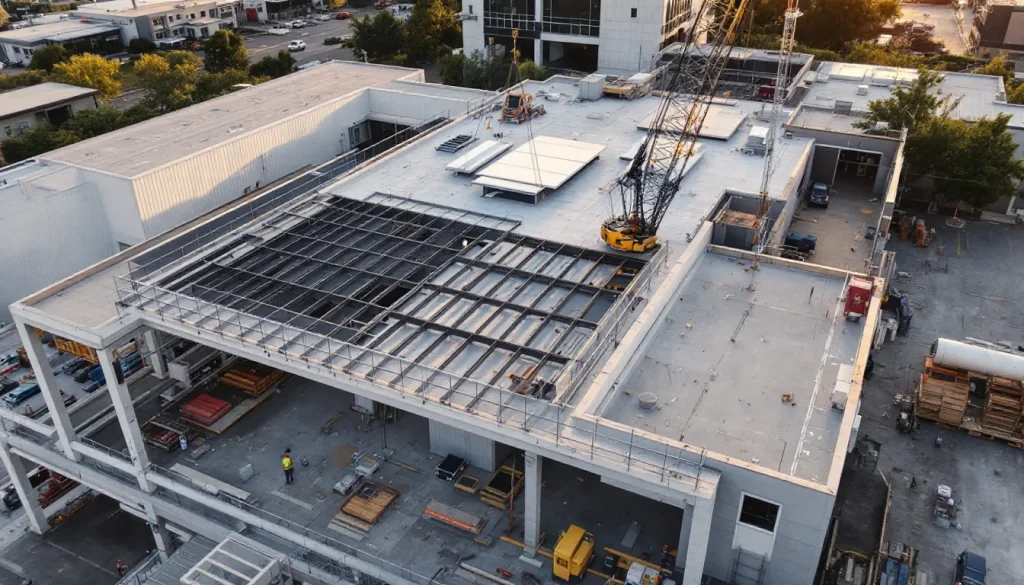
A commercial roof construction sequence on a new build in 2026 starts about 18 to 30 months before the building opens, when the architect picks a roof system in design development. The roofer’s crew (for the full data set, see our the 2026 Roofing Contractor Industry Report) enters the build typically 4 to 8 weeks before substantial completion, but the decisions that determine the roof’s 25-year service life are locked in long before any membrane shows up on site. Deck choice (steel, concrete, wood), insulation R-value, membrane system, parapet detail, drainage geometry, and rooftop equipment layout are all set in design. The contractor’s job is to execute the design, not to fix what the design got wrong. This guide walks the actual sequence on a new-build commercial roof in 2026: who decides what in design, when the roofer engages, what the deck crew does versus what the roofer does, and how the punch list closes.
The short version
- Architect selects the roof system in design development, 12 to 24 months before crew enters the roof.
- Deck type (steel, concrete, wood) is set by structural engineering and drives every downstream roof decision.
- Bidding follows EJCDC or AIA contract documents; submittals package runs 60 to 200 pages on commercial work.
- Roofer crew enters typically 4 to 8 weeks before substantial completion, after deck is dry and inspected.
- Sequence on the roof: deck verification, vapor retarder (climate zone dependent), insulation lay, cover board, membrane, flashing, edge metal, parapet cap.
- Substantial completion triggers warranty start; final punch list closes within 30 to 90 days.
The design-phase decisions that determine the roof’s life
Most building owners do not realize how much of the roof’s outcome is decided in the architect’s office, 18 months before any contractor steps on site. The design-phase decisions that drive everything downstream:
Roof system selection. TPO, EPDM, PVC, modified bitumen, single-ply metal, IMP, or a combination. Each carries different costs, service-life expectations, repair characteristics, fire ratings, and warranty options. The architect typically picks the system based on building type, code requirements, owner preference, and lifecycle cost analysis. The system selection drives the spec, the bidding, and the install sequence. Background on the system options is in commercial building roof types.
Deck type. Steel, concrete (cast-in-place or precast), wood, lightweight insulating concrete, or composite. The structural engineer picks the deck based on building loads, fire rating requirements, sound transmission requirements, and budget. Each deck type drives different roof attachment methods. Steel deck supports mechanically attached or fully adhered systems. Concrete supports both. Wood plank typically requires fully adhered or modified bitumen. Lightweight concrete requires fully adhered.
Insulation R-value and configuration. 2024 IECC sets minimum R-value by climate zone: R-25 in CZ 3, R-30 in CZ 4, R-35 in CZ 5 and above. Higher R-values are common on owner-preference and LEED-target projects. Insulation lay can be flat (over a sloped deck) or tapered (building the slope into the insulation on a flat deck).
Drainage geometry. The roof slopes a minimum of 1/4 inch per foot toward drains, scuppers, or eaves. The drainage scheme is set by the architect and structural engineer working with the plumbing engineer. Primary drains, secondary (overflow) drains, scuppers, and gutter systems all get sized and located in design. Detailed drainage design is in flat roof drainage design.
Parapet height and detail. Parapets are the low walls around the roof perimeter, common on warehouses, retail, and urban commercial. Parapet height is driven by fire-code separation requirements, equipment-screening requirements, fall protection requirements, and aesthetic. Parapet detail (cap, counterflashing, termination bar) is set in design and is the most failure-prone area on most commercial roofs. The detail spec is in parapet wall roofing detail.
Rooftop equipment layout. HVAC units, exhaust fans, plumbing vents, electrical conduit, communication antennas, solar arrays, lightning protection. Each piece of equipment penetrates or sits on the roof and creates a flashing requirement. The mechanical engineer locates the equipment in design; the roofer flashes each penetration during install. A building with 200 penetrations takes 30 to 50 percent longer to flash than a building with 50 penetrations.
Bidding the new-build roof: EJCDC and AIA documents
Commercial new construction (see our residential new construction roofing guide) bidding follows standard contract documents from EJCDC (Engineers Joint Contract Documents Committee) or AIA (American Institute of Architects). The most common contract forms in 2026:
- AIA A101 with A201: Standard Form of Agreement Between Owner and Contractor for stipulated sum
- AIA A102 with A201: Cost Plus a Fee with Guaranteed Maximum Price
- AIA A103 with A201: Cost Plus a Fee without Guaranteed Maximum Price
- EJCDC C-520: Standard Form of Agreement Between Owner and Contractor
On a stipulated-sum bid (AIA A101), the roofing contractor commits to a fixed price for the work as specified. Change orders adjust the price only for owner-requested changes or for genuinely unforeseen conditions. On a GMP project (AIA A102), the roofing contractor commits to a maximum price with shared savings if actual cost comes in below.
The roofing sub-contract typically flows through the general contractor (GC), who holds the prime contract with the owner. The GC issues the roofing scope to roofers via a bid invitation, evaluates returned bids, selects the winning bidder, and assigns the sub-contract. The owner sees the roofing line item as a single number in the GC’s bid; the GC sees three or four roofer bids underneath that line item.
The roofer’s bid is built from the architect’s spec, the drawings, and the addendum items issued during the bid period. The bid covers the membrane, insulation, cover board, fasteners, flashings, edge metal, drains, equipment curbs, parapet detail, and the labor to install all of it. Exclusions typically include: structural deck (provided by structural sub), tapered insulation (sometimes a separate line item), specialty drains (sometimes plumbing scope), and rooftop equipment (mechanical scope).
Submittals: 60 to 200 pages of paper before crew enters the roof
The submittal package is the document the architect and the manufacturer review before crew steps on the roof. The package is built by the roofing contractor and submitted to the GC, who forwards it to the architect for approval. The architect either approves, approves with comments, or rejects the submittal.
A typical commercial new-build submittal package contains:
- Membrane manufacturer’s data sheet, including thickness, color, fire rating, wind uplift rating, and warranty terms
- Insulation data sheet (manufacturer, product, R-value per inch, board size, density)
- Cover board data sheet (manufacturer, product, thickness)
- Fastener spec with FM Global wind ratings (FM 1-60, FM 1-90, FM 1-120 depending on wind zone)
- Adhesive data sheet if fully adhered system (manufacturer, application rate, coverage)
- Vapor retarder data sheet (climate zone 5 and colder typically requires it)
- Drawings of perimeter detail, parapet detail, drain detail, scupper detail, equipment curb detail
- Sample of manufacturer warranty document with term and exclusions
- Proof of contractor certification at the right manufacturer tier
- Sample of installer experience documentation (project list, references)
The submittal package on a 100,000 square foot warehouse runs 80 to 150 pages. On a hospital or stadium it can hit 200 pages. Approval cycles take 2 to 4 weeks. Anything rejected restarts the cycle. The submittal package is what the manufacturer’s NDL warranty is written against; getting it right is non-negotiable.
When does the roofer enter the build?
The roofer enters the build after the deck is complete, dry, and inspected. On a typical commercial new build, that means:
- Steel deck on steel frame: 60 to 80 percent through the construction schedule
- Cast-in-place concrete deck: 70 to 85 percent through the schedule, after deck cure
- Precast concrete deck: 65 to 80 percent through
- Wood plank or wood truss: 75 to 85 percent through
The exact timing depends on the schedule logic and the GC’s sequencing. The roofer’s crew typically needs 4 to 8 weeks on the roof to complete a 50,000 to 100,000 square foot project. Larger projects need more time. Smaller projects can complete in 2 to 4 weeks. Our full commercial roof installation walkthrough breaks the crew-day sequence down phase by phase.
The roofer often enters the building twice. The first visit installs the membrane system, allowing the interior trades to finish out without weather exposure. The second visit (usually 4 to 12 weeks later) completes the punch list, integrates with the equipment curbs as HVAC and other rooftop equipment gets installed by other trades, and finalizes flashings around late-arriving penetrations.
Deck verification and the dry-deck rule
The single biggest source of project failure on a new build is a wet or contaminated deck at the time of the roof install. The dry-deck rule: insulation does not get laid over a wet deck. The membrane does not get welded over a wet system. The warranty does not register on a roof installed over wet substrate.
The roofer verifies deck condition before each section of insulation lay. The verification methods:
Visual inspection. The deck is dry to the eye, with no standing water, no obvious moisture staining, and no debris. Steel deck shows no surface rust beyond the mill finish. Concrete deck shows no efflorescence and no dark zones suggesting moisture migration.
Moisture meter check. An electrical resistance moisture meter (Tramex, GE Protimeter, similar) reads the deck surface. Acceptable readings vary by deck type; the manufacturer’s installation guide specifies the threshold. Typical: less than 4 percent on concrete, less than 18 percent on wood, no measurable moisture on steel.
Calcium chloride test or in-situ relative humidity test. For concrete decks, a calcium chloride test (ASTM F1869) or an in-situ RH test (ASTM F2170) measures actual moisture vapor emission. This is critical on cast-in-place concrete where the deck cure is recent. Concrete decks typically need 30 to 60 days of dry-out before fully adhered roofing can be installed without risk of adhesive failure.
Mock-up adhesion test. On large fully adhered projects, the manufacturer often requires a mock-up adhesion test before full install. A small section of insulation and membrane gets installed using the spec’d adhesive; after cure, the section gets peel-tested to verify bond strength.
If the deck fails verification, the roofer documents the condition, notifies the GC, and waits for remediation. The remediation might be additional cure time, mechanical drying, deck repair, or a system change. The roofer who skips this step and installs over a wet deck is creating a callback and a warranty denial.
The install sequence on a new build
The install sequence on a typical new-build commercial roof, day by day:
Day 1 to 2: Stage materials. Membrane rolls, insulation pallets, cover board, fasteners, adhesives, edge metal, drains, and miscellaneous accessories all get craned to the roof and staged. Material staging takes 1 to 3 days on a 100,000 square foot project.
Day 3 to 5: Deck verification and vapor retarder (if climate zone dependent). Vapor retarder is a polyethylene sheet or self-adhered membrane installed over the deck to block moisture migration from interior to roof system. Required in climate zones 5 and colder, recommended in CZ 4, generally not used in warm climates.
Day 5 to 15: Insulation lay. Bottom layer of polyiso, then top layer with staggered joints, then cover board. On a mechanically attached system, fasteners and plates lock all three layers to the deck on the spec’d pattern. On fully adhered, foam adhesive bonds the layers. Lay rates run 10,000 to 18,000 square feet per day per crew.
Day 15 to 30: Membrane install. Rolls get laid, seams welded (TPO/PVC) or taped (EPDM), and the field membrane completes. Lay rates run 10,000 to 15,000 square feet per day for mechanically attached, 6,000 to 9,000 for fully adhered. Daily progress photos document the lay and verify weld quality.
Day 25 to 40: Detail work. Parapet flashing, perimeter edge metal, drain flashings, penetration flashings, equipment curb flashings. Detail work is slower than field work; a parapet detail crew can complete 200 to 400 linear feet per day. Detail work overlaps with the end of the field install.
Day 35 to 45: Final flashings, terminations, sealants. Termination bars, counterflashings, sealant tooling, scupper outlets, drain bowl integrations. The roof is functionally complete at the end of this phase.
Day 45 to 50: Manufacturer pre-warranty inspection. A manufacturer rep walks the roof, identifies any items not to spec, and issues a punch list. The contractor closes the punch list items.
Day 50 to 60: Punch list closeout, warranty registration filing, final cleanup, roof handover to GC. Final cleanup includes debris removal, drain check, walkway pads if specified, and any owner-requested final inspections.
Crew composition on a new build
The roofer’s crew composition on a typical 100,000 square foot new-build project:
- Project manager: 1, on site daily during install, off-site during pre-install paperwork
- Foreman: 1 or 2, in charge of daily work direction and quality control
- Membrane crew: 8 to 14 men, dedicated to field membrane lay and welding
- Insulation crew: 4 to 6 men, often the same crew that lays membrane on a rotating sequence
- Detail crew: 2 to 4 men, specializing in parapets, penetrations, drains, edge metal
- Service truck driver/helper: 1, handling material runs, equipment moves, debris removal
The crew peaks at 18 to 25 men during the main lay phase and ramps down to 4 to 6 men during the detail and punch-list phases. The detail crew typically includes the most experienced sheet metal mechanics on the project; field membrane lay can be done by less senior crew under foreman supervision.
Coordination with other trades
The roofer does not work in isolation. The other trades intersecting the roof scope:
Steel erection / structural trade. Provides the deck. Roofer cannot start until the structural sub has finished the deck section in question. Coordination on deck-out-of-roof handover is the GC’s responsibility but has to be tightly managed.
Plumbing. Installs the drains, scuppers, and overflow drains in coordination with the roofer. The drain bowl gets set by the plumber; the roofer’s flashing integrates with the drain bowl. Pipe penetrations get located and roughed in by the plumber before the roofer’s flashing.
Mechanical (HVAC). Locates rooftop units and sets curbs. The curb base gets set by the mechanical sub. The roofer flashes the curb. The HVAC unit gets craned onto the curb after roofing is complete.
Electrical. Routes conduit through the roof for rooftop equipment power, antenna feeds, lightning protection, and security cameras. The roofer flashes each electrical penetration after the electrical rough is complete.
Fire suppression. Some buildings have rooftop fire-suppression piping or vent equipment. Coordination with the fire-suppression sub is required for any roof penetration in their scope.
Solar (if applicable). Solar installations may happen during the building construction (integrated) or after substantial completion (added). Integrated solar arrays require the roofer to provide attachment-point flashings and coordinate the membrane layout around the array footprint.
The GC owns the trade coordination, but the roofer manages the relationships day to day. A roofer who does not communicate with the other trades creates schedule slips and detail conflicts. Background on the contractor relationship is in how to choose a roofing contractor.
Substantial completion and the punch list
Substantial completion is the contractual milestone where the roof is weather-tight, the field membrane and flashings are complete, and the building can be occupied or used for its intended purpose. Substantial completion triggers:
- Manufacturer warranty term start date
- Final payment retainage release (typically 5 to 10 percent of contract value)
- Owner punch list inspection
- Architect punch list inspection
- Manufacturer pre-warranty walk
The owner punch list is generated by the building owner or their representative and identifies any work items that the owner wants corrected. The architect punch list identifies anything not built to spec. The manufacturer pre-warranty walk identifies any details that do not meet warranty spec. All three punch lists get consolidated and closed within 30 to 90 days of substantial completion.
Common new-build punch list items: incomplete welds at penetration flashings, missing pitch pockets on conduit risers, gaps in termination bar terminations, exposed insulation at edges, undersized scupper outlets, missing or incomplete pipe boots, debris in drains, sealant overspray on coping, paint overspray on membrane.
Punch list closeout is documented with photos and a signed sign-off from the architect and owner. Only after closeout does the manufacturer issue the NDL warranty document. The warranty officially registers; the contractor’s contract obligations close out; the building enters operations.
Comparison: new-build vs replacement install
| Aspect | New build | Replacement |
|---|---|---|
| Schedule pressure | Set by GC critical path; roof is on critical path 30-60 days | Set by owner’s tenant schedule, weather window |
| Deck condition | New deck, verified dry and clean | Existing deck, condition unknown until tear-off |
| Trade coordination | High, with structural, plumbing, mechanical, electrical, fire sub | Low, mostly with mechanical for HVAC reset |
| Material staging | Crane access plus ground staging available | Often limited by existing building footprint |
| Building occupancy | Vacant during install | Often occupied during install |
| Warranty registration | Tied to substantial completion of building | Tied to project completion |
| Typical install rate | 3,500 to 6,000 sq ft per day per crew (full sequence) | 2,500 to 4,500 sq ft per day per crew (incl tear-off) |
FAQ
When in design should the owner pick the roof system?
Schematic design, typically 14 to 20 months before substantial completion. The system pick drives structural loads (insulation weight, ballast if any), drainage geometry, parapet design, and rooftop equipment integration. Late changes are expensive.
Can the GC self-perform the roofing?
Most GCs do not self-perform roofing. The cert depth and crew specialization required make it more cost-effective to subcontract. A few GCs with strong roofing divisions (Tecta America is sometimes its own GC on industrial projects) can self-perform.
What if the deck shows up wet or behind schedule?
The roofer documents the condition and notifies the GC in writing. Delays roll into the schedule. Wet deck cannot be installed over and requires drying or remediation. The schedule impact is the GC’s problem to manage.
How early should the owner select the roofing manufacturer?
The architect typically specifies the manufacturer or specifies “approved equal” with multiple acceptable manufacturers. The decision happens in design development, before the bid documents go out. Owner preferences should be communicated to the architect during schematic design.
Is solar roofing better installed during new construction or retrofitted?
Integrated solar during new construction is usually less expensive per watt than retrofit. The structural loads can be designed in, the conduit can be roughed in, and the membrane layout can accommodate the array footprint. Retrofit is possible but adds attachment penetrations to an existing roof.
Bottom line
Commercial roof construction on a new build is a sequenced exercise stretching from architect-spec’d design choices through 60-to-200-page submittals, deck verification, vapor retarder, insulation lay, membrane install, detail work, and substantial completion. The roofer’s crew enters the build 4 to 8 weeks before substantial completion and works through a 30-to-60-day install sequence. The decisions that determine the roof’s 25-year service life are made in design development, 12 to 24 months earlier. The roofer’s job is to execute the design to spec, document the work, close the punch list, and hand the warranty to the owner. Build-team coordination across structural, plumbing, mechanical, electrical, and fire-suppression trades determines whether the schedule holds. The right roofer manages the coordination; the wrong roofer slips the schedule and creates change orders.