
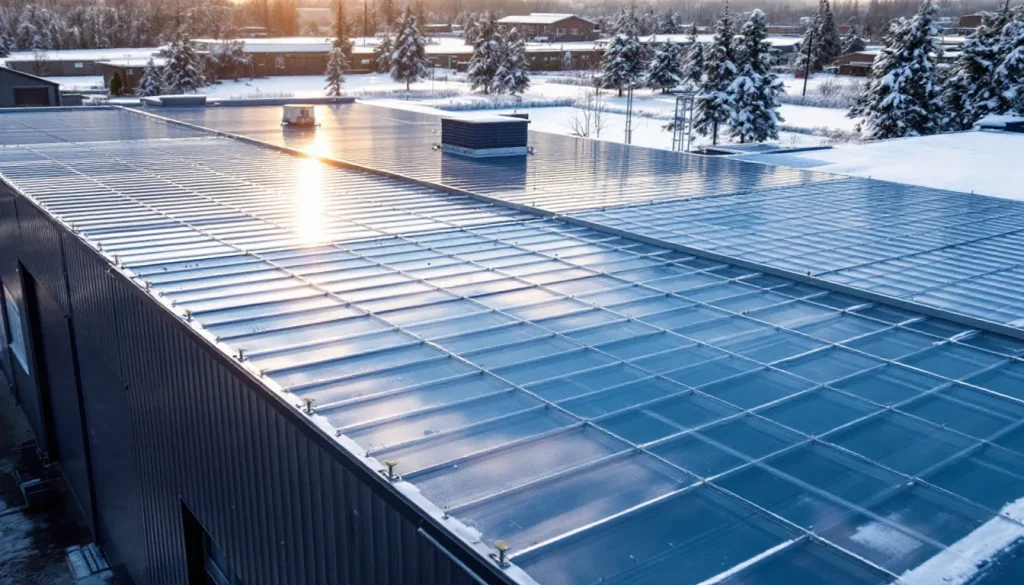
A commercial metal roof is the only system that routinely outlives the building it sits on. Standing seam panels installed in 1995 are still shedding water on warehouses that have been resold three times. The catch is that “commercial metal” covers three very different products with three very different price points, and a building owner who picks the wrong one ends up either overspending on a strip mall or underspending on a cold-storage facility that condenses water all winter.
This guide walks through what’s actually being installed on commercial buildings in 2026: standing seam (the premium option), R-Panel and exposed-fastener systems (the workhorse), and insulated metal panels (the IMP category, which is its own animal). We’ll cover gauges, finishes, fasteners, the perimeter and corner wind-zone math that warranty departments care about, and the installation realities that determine whether the system lasts 20 years or 50.
The Three Categories of Commercial Metal Roofing
Confusion starts with terminology. A roofing salesman will say “metal roof” and mean something completely different from what a pre-engineered building manufacturer means. The three categories are not interchangeable, and they don’t compete with each other on most projects.
Standing seam (SSR) is the architectural-grade product. Panels run from eave to ridge in continuous lengths, joined by raised seams that hide the fasteners. Concealed clip attachment lets the metal expand and contract without binding. Installed cost runs $14 to $22 per square foot depending on panel profile, gauge, finish, and roof complexity. This is what goes on hotels, office buildings, schools, and any commercial structure where the roof is visible from the street.
R-Panel and exposed-fastener systems are the corrugated and ribbed panels you see on warehouses, agricultural buildings, manufacturing facilities, and shed-style commercial structures. Screws penetrate the panel face with rubber washers. Installed cost runs $7 to $12 per square foot. Faster install, cheaper material, but the fasteners are a maintenance item that need to be checked every 5 to 7 years for backed-out screws and degraded washers.
Insulated metal panels (IMPs) are sandwich panels with a foam core (typically polyisocyanurate or polyurethane) bonded between two metal skins. They function as the structural panel, the insulation, and the weather barrier in one assembly. Installed cost runs $16 to $26 per square foot. IMPs dominate cold storage (see our industrial roofing guide), food processing, pharmaceutical, and any building where thermal performance is critical.
Standing Seam Panel Profiles and Manufacturers
The major commercial standing seam manufacturers in 2026 are McElroy Metal, MBCI, Englert, ATAS International, and Berridge. Each has multiple panel profiles aimed at different applications.
McElroy Metal Maxima is a mechanically seamed 1.75-inch tall double-lock standing seam panel rated for low-slope commercial. The seam is rolled closed with a portable seaming machine after panel installation, creating a weathertight joint that doesn’t rely on sealant. Maxima goes on commercial buildings down to a 1/2:12 slope when installed with the recommended underlayment system.
MBCI BattenLok HS is a snap-lock standing seam profile at 2-inch seam height, common on metal building roofs at slopes of 3:12 and steeper. The snap-lock engagement means no on-site seaming, which speeds install. BattenLok HS is what most pre-engineered building (PEB) manufacturers spec on Butler, Varco Pruden, and similar packaged buildings.
Englert A1000 is a 16-inch wide, 1.5-inch tall mechanically seamed panel widely used on architectural commercial: hospitals, civic buildings, transit stations. ATAS Multi-Vee is a 12-inch wide panel with a flat pan and three minor stiffening ribs, often specified where the architect wants a tight, flat appearance rather than a pronounced striated look.
For deep technical breakdowns of seam types and substrate prep, our standing seam metal roof cost guide and metal roof installation guide cover the residential side of the same engineering.
Gauge, Coating, and Why Kynar Matters
Commercial metal panels are almost always 24-gauge Galvalume base metal. 22-gauge shows up on heavy-snow regions or hail-prone markets. 26-gauge is residential-grade and shouldn’t be on a commercial roof at all, though some bargain-bid contractors will quote it.
The finish is where 30-year service-life decisions get made. Two families dominate:
PVDF (polyvinylidene fluoride), sold under the Kynar 500 and Hylar 5000 trade names, is the premium finish. PVDF resin is exceptionally UV stable. Color fade and chalk are minimal over a 40-year exposure. Most commercial standing seam panels with PVDF carry a 35 or 40-year finish warranty, and the panels routinely outlast the warranty.
SMP (silicone-modified polyester) is the budget finish. Service life is 25 to 30 years before noticeable fade and chalk. SMP warranties run 25 to 30 years, often with substantial fade allowances that mean the warranty pays out only when fade is catastrophic. SMP belongs on agricultural buildings and budget commercial. It does not belong on a visible architectural roof where the owner expects the building to still look new in 2056.
The price difference between PVDF and SMP is roughly $0.30 to $0.60 per square foot of installed roof. On a 20,000 square foot building that’s $6,000 to $12,000 to lock in 10 to 15 extra years of finish life. The math is not close.
R-Panel and Exposed-Fastener Systems
R-Panel is the most widely installed commercial metal roof in North America by square footage, and almost nobody calls it by name. The profile is roughly 36 inches wide with major ribs at 12 inches on center and minor stiffening ribs between. McElroy R-Panel, MBCI R-Panel, and ATAS BattenLok (the exposed-fastener cousin to BattenLok HS) are the volume products.
Install is fast: panels go down, screws go in through the panel face into the structural purlin or deck below. Each screw has a bonded EPDM washer that seals the penetration. A crew of three can install 5,000 to 8,000 square feet a day on a clean shed roof. Standing seam, by comparison, runs 2,000 to 4,000 square feet a day with concealed clips.
The trade-off is the fasteners. Every screw is a penetration. Every penetration relies on a rubber washer to keep water out. Rubber washers degrade in UV. Backed-out screws lift the washer off the panel. A 15-year-old R-Panel roof on a high-vibration building (think a warehouse next to a rail line) can have hundreds of screws that need re-torquing or replacement.
For owners who want the cost profile of exposed-fastener with longer fastener life, the move is to spec EPDM-bonded washers with high-grade screws and require a 5 to 7-year fastener re-torque as part of the maintenance plan. That keeps a 30-year R-Panel roof functional through the second tenant.
If you’re comparing R-Panel to lower-end residential metal, our corrugated metal roofing piece covers the lighter-gauge cousins that share the exposed-fastener concept.
Insulated Metal Panels (IMP)
IMPs change the conversation entirely. A standard commercial roof is a stack: structural deck, vapor retarder, insulation, cover board, membrane or metal panel. An IMP roof is one component that does all of that.
The dominant IMP manufacturers in 2026 are Metl-Span (CF Series), Kingspan (KS Series), and Centria (Versa-Cor). Foam cores range from 2 inches (R-14) up to 6 inches (R-42). The metal skins are typically 26-gauge interior and 22 or 24-gauge exterior with PVDF finish.
Where IMPs win is cold storage. A standard built-up commercial roof on a freezer warehouse fights condensation at every thermal bridge: fastener heads, purlin tops, panel laps. IMPs eliminate the thermal bridging because the foam core is continuous and the panel-to-panel joint is a thermally broken interlock.
Food processing, pharmaceutical manufacturing, distribution centers with refrigerated zones, and ice rinks are the IMP markets. The installed cost is high, but the energy savings on a 100,000 square foot freezer over 30 years pays it back in 8 to 12 years.
The IMP install gotcha is panel handling. The foam core is brittle in cold weather. Dropped panels delaminate. A crew that’s installed three IMP roofs will know to pre-stage with caution; a crew that’s never touched IMPs will damage 5 to 10 percent of the order. Crew skill on systems like these is exactly what industry education tracks target, which is why METALCON expanded its 2026 training program. Owner specs should require IMP installer certification from the panel manufacturer.
Wind Zones and the Perimeter Math
Commercial metal roof failures in storms almost never happen in the field of the roof. They happen at the perimeter, the corners, and the parapet transitions. ASCE 7-22 (the current wind load standard) defines three zones on a low-slope commercial roof: Zone 1 (the field), Zone 2 (the perimeter strip), and Zone 3 (the corners). Design wind uplift pressures in Zone 3 can be 2 to 3 times higher than Zone 1.
Standing seam panel manufacturers publish allowable wind uplift tables for each panel profile at each clip spacing. A McElroy Maxima panel at 24-inch clip spacing might be rated for 100 psf uplift in Zone 1 but require 12-inch clip spacing to hit the 240 psf requirement in Zone 3 of a building on the Gulf Coast.
The contractor who quotes uniform clip spacing across the whole roof is either ignoring the wind zone analysis or doesn’t know it exists. Either way, the perimeter and corners fail first in a 100-mph wind event. Insurance adjusters know this. So do the manufacturers’ warranty departments. A wind-zone analysis is not optional on a commercial metal roof in a hurricane or tornado-prone market, and our hurricane roof guide walks through why perimeter detailing wins or loses the storm.
Slope, Substrate, and Underlayment
Standing seam can go down to a 1/4:12 slope with mechanically seamed panels and sealed seams. Below 1/4:12 it’s not a metal roof, it’s a single-ply membrane application. Snap-lock profiles require 3:12 minimum.
Substrate is either solid deck (plywood, OSB, or steel deck) or open purlins. On solid deck, a high-temp self-adhered underlayment is standard. Metal roofs heat to 160 to 180 F in summer sun, and standard 30-pound felt cooks off in 5 to 8 years. Brands like Grace Ice and Water Shield HT, Henry Blueskin RF, and Carlisle WIP 300HT are rated for that temperature exposure.
On open purlins (typical for pre-engineered metal buildings), there’s no underlayment. The panel and the seam are the entire weather barrier. That’s why panel profile and seam type matter more on PEB roofs than on retrofit projects over existing decking.
Condensation: The Cold-Roof Problem Nobody Bids For
Metal panels conduct heat fast. In a heated commercial building with a metal roof and inadequate insulation, the underside of the panel hits dew point on cold nights. Water condenses. It drips onto stored inventory or, worse, onto the structure below the deck, where it causes corrosion and mold.
The fixes are insulation (push the dew point above the panel underside), vapor retarders (keep interior moisture from reaching the cold metal), and ventilation (move moist air out). On commercial retrofits where adding insulation isn’t feasible, anti-condensation membranes like DripStop or CondenStop bonded to the panel underside absorb dew during the day and release it back as humidity.
This is mostly a winter problem in the northern half of the country, but it’s also a year-round problem in cold storage and refrigerated facilities. We cover the diagnostic side in our metal roof condensation guide and the absorber-membrane side in our DripStop vs. CondenStop breakdown.
Retrofit Over Existing Roofs
A common commercial metal install is a retrofit over an existing low-slope membrane that’s reached end of life. Instead of tearing off the old roof and starting over, a sub-purlin structure is built over the existing roof, insulation is added, and a new metal panel system is installed on top.
Advantages: no tear-off, no production interruption inside the building, added insulation R-value, and the existing roof becomes a vapor barrier. Disadvantages: added structural load (typically 2 to 4 psf), eave and rake transitions get architecturally awkward, and rooftop equipment (HVAC, exhaust) has to be raised.
Retrofit pricing runs $9 to $16 per square foot for the metal portion plus $2 to $4 per square foot for the sub-purlin structure. Total project cost is typically 60 to 75 percent of a full tear-off and replacement, with a comparable service life on the new metal.
Snow Retention and Lightning Protection
A commercial standing seam roof sheds snow in slabs. Without snow retention, a 20-foot slide of compacted snow can take out walkways, vehicles, gas meters, HVAC equipment, and people. Snow retention systems clamp to the standing seam (no penetrations) and break up the slide.
Major snow retention manufacturers: S-5! (the dominant clamp-on brand), Berger SnoBlox, and Alpine SnowGuards. Engineered layouts based on roof slope, panel length, and ground snow load are standard practice and required by most manufacturer warranties in heavy snow regions.
Lightning is the other consideration. Metal roofs do not attract lightning, but they do conduct it. Bonded grounding from the panels to the building grounding system prevents arc damage if a strike does hit. UL 96A lightning protection systems are commonly added to tall commercial metal roofs.
What This Costs in 2026
Pricing on a 30,000 square foot single-story commercial building in 2026, including tear-off where applicable:
Standing seam SSR with 24-gauge Galvalume and PVDF finish runs $14 to $22 per square foot, or $420,000 to $660,000 for the example building. Add $1 to $3 per square foot for high-wind perimeter detailing.
R-Panel exposed fastener with 24-gauge Galvalume and SMP finish runs $7 to $12 per square foot, or $210,000 to $360,000. Add $0.50 per square foot for PVDF upgrade.
Insulated metal panels at 3-inch foam core (R-21) run $16 to $26 per square foot, or $480,000 to $780,000. The IMP roof eliminates the need for a separate insulation layer, so the all-in cost is often within 15 percent of standing seam plus separate insulation.
Retrofit over existing low-slope membrane runs $9 to $16 per square foot for standing seam.
The right answer for a given building depends on slope, occupancy, climate, and how long the owner plans to hold the asset. A 40-year hold on a Class A office building points to PVDF standing seam. A 10-year hold on a distribution warehouse points to R-Panel with PVDF upgrade. A freezer facility points to IMP regardless of hold period.
For the contractor selection process itself, our contractor selection guide covers the diligence steps that matter on commercial work. The short version: ask for three references on similar-size commercial metal jobs, ask for the manufacturer installer certifications, ask for the wind-uplift design calcs, and walk away from anyone who can’t produce all three.