
By The Roofing Brief Team | Last reviewed: November 2026
Ribbed vs corrugated metal roofing comes down to rib shape and side lap: a ribbed (trapezoidal) panel such as Metal Sales Classic Rib or PBR covers a full 36 in per sheet, while a corrugated panel with round waves on 2-2/3 in centers loses two corrugations at every roof side lap, so a 25-5/8 in Gibraltar corrugated sheet covers only 21-1/2 in. Both are exposed-fastener panels with the same screw-and-washer leak points, and in Metal Sales load tables the 7/8 in corrugated profile actually carries more load at 3 and 4 ft spans than 26 gauge PBR, while the shallow 1/2 in corrugated carries the least.
The figures below are compiled from maker data sheets (Metal Sales, Western States Metal Roofing, Gibraltar Building Products and McElroy Metal), the 2021 IRC and dated retailer listings. “Ribbed” here means trapezoidal-rib panels: agricultural ribs such as Classic Rib (3/4 in rib on 9 in centers) and R-panel or PBR (1-1/4 in rib on 12 in centers). 5V crimp is a third exposed-fastener profile with V-shaped ribs, covered in the 5V metal roofing guide.
Ribbed vs corrugated metal roofing, spec by spec
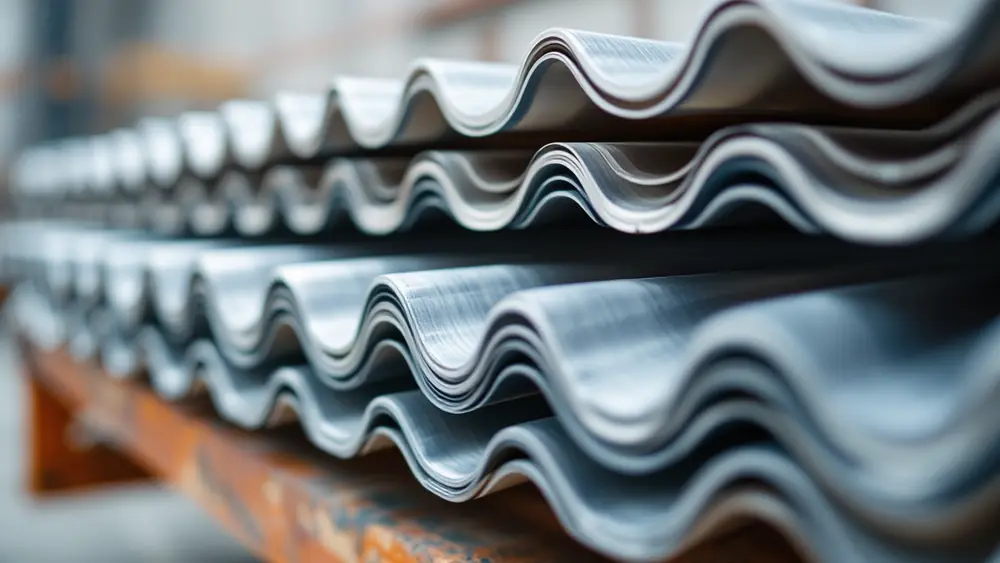
Corrugated comes in two common depths. Metal Sales sells a 7/8 in deep “7/8 Corrugated” and a 1/2 in deep “2.5 Corrugated” (named for its 2-1/2 in nominal wave), both on 2-2/3 in centers, and McElroy Metal makes the same two depths as Multi-Cor (7/8 in) and M-Cor (1/2 in), per its corrugated panel explainer. The table puts each profile next to two ribbed panels from the same maker so the numbers come from one testing and calculation method.
| Panel | Profile | Rib height | Rib spacing | Roof coverage | Gauges | Maker minimum roof slope | Source |
|---|---|---|---|---|---|---|---|
| Metal Sales 2.5 Corrugated | Round wave | 1/2 in | 2-2/3 in | 21-1/3 in | 29, 26 std; 31, 30, 24, 22 optional | 3:12 | Metal Sales data sheet (1-2024) |
| Gibraltar 29 ga Corrugated (Home Depot) | Round wave | Not stated | Not stated | 21-1/2 in from a 25-5/8 in sheet (24 in on walls) | 29 | 3:12 (retail listing) | Gibraltar help center |
| Metal Sales 7/8 Corrugated | Round wave | 7/8 in | 2-2/3 in | 32 in | 26, 24 std; 22, 20 optional | 1:12 | Metal Sales data sheet (1-2024) |
| Western States 7/8 Corrugated | Round wave | 7/8 in | 2.67 in | 34.67 in from a 39 in sheet (37 in on walls) | 26, 24, 22, 20 | 3:12 | Western States data sheet |
| Metal Sales Classic Rib | Trapezoidal (bell-top) rib | 3/4 in | 9 in | 36 in | 29, 26 std; 24 optional | 3:12 | Metal Sales data sheet (1-2026) |
| Metal Sales PBR-Panel | Trapezoidal rib, purlin bearing leg | 1-1/4 in | 12 in | 36 in | 26, 24 std; 22 optional | 1:12 | Metal Sales data sheet (1-2026) |
The coverage column drives most of the price gap. Gibraltar gives up 4-1/8 in of its 25-5/8 in sheet (16%) to the two-corrugation roof lap, and Western States gives up 4.33 in of a 39 in sheet (11%), while both Metal Sales ribbed panels are sold by their 36 in net coverage.
Which is stronger: ribbed or corrugated?
Supplier blogs often say ribbed panels are stronger because the ribs are deeper; Western States, for example, calls 7/8 in corrugated “shallower and so less strong” than R-panel in its corrugated vs R-panel comparison. The Metal Sales allowable-load tables tell a narrower story. All four sheets use the same basis: AISI 2016 section properties, three or more equal spans, deflection limited to L/180, and loads that ignore fastener pull-out and web crippling.
| 26 gauge panel (Metal Sales) | Weight, psf | 2 ft span | 3 ft span | 4 ft span | 5 ft span | Source |
|---|---|---|---|---|---|---|
| 2.5 Corrugated (1/2 in) | 0.90 | 153 psf | 45 psf | 19 psf | Not listed | 2.5 Corrugated sheet |
| Classic Rib (3/4 in) | 0.80 | 125 psf | 56 psf | 32 psf | Not listed | Classic Rib sheet |
| PBR-Panel (1-1/4 in) | 0.84 | 244 psf | 114 psf | 65 psf | 42 psf | PBR sheet |
| 7/8 Corrugated (7/8 in) | 1.02 | Not listed (272 psf at 2.5 ft) | 172 psf | 73 psf | 37 psf | 7/8 Corrugated sheet |
Inward (snow and live) loads are shown; the outward (wind suction) columns on the same sheets are equal for both corrugated profiles and within 15% for Classic Rib and PBR. Three readings follow from the table:
- The shallow 1/2 in corrugated is the weakest panel at every span over 2 ft: 45 psf at 3 ft against 56 psf for Classic Rib, and 19 psf at 4 ft against 32 psf.
- The 7/8 in corrugated beats 26 gauge PBR at 3 ft (172 vs 114 psf) and 4 ft (73 vs 65 psf), largely because it carries 1.02 lb of steel per sq ft against 0.84 lb, about 21% more metal per square foot of roof.
- PBR pulls ahead at 5 ft (42 vs 37 psf) and is the only one of the four with a 6 ft and 7 ft column (29 and 22 psf), which is why metal-building purlin spacing of 4 to 5 ft is PBR territory.
Allowable panel load is not the design answer for a roof. The roof snow load, the wind zone and the screw pull-out value into your purlins all have to be checked, and the roof purlins spacing and span guide covers the framing side.
Coverage, screws and price: a worked gable roof
The example below is a Roofing Brief estimate for a 30 ft by 24 ft gable shed roof with two planes, each 30 ft along the eave and 12 ft from eave to ridge, using 12 ft sheets with no end laps. Panel prices are the 29 gauge listings checked for the 12 ft metal roofing price breakdown: Lowe’s listed Metal Sales Classic Rib 3 ft x 12 ft Galvalume (item 1000421587) at $52.98 when rechecked in November 2026, and Home Depot listed Gibraltar 12 ft Corrugated Galvanized 29 ga (model CR12G-U) at $39.98 to $42.98 each, or $34.38 each at 20 or more, in late October 2026. Prices change by store and week.
| Line | Classic Rib (36 in coverage) | Gibraltar corrugated (21-1/2 in roof coverage) | Metal Sales 7/8 Corrugated (32 in) |
|---|---|---|---|
| Sheets per 30 ft plane | 360 in / 36 = 10 | 360 in / 21.5 = 16.7, round to 17 | 360 in / 32 = 11.25, round to 12 |
| Sheets for both planes | 20 | 34 | 24 |
| Side laps (sheets minus 1, per plane, x 2) | 18 | 32 | 22 |
| Side-lap stitch screws at 12 in on center (13 per 12 ft lap) | 234 | 416 | 286 |
| Panel cost | 20 x $52.98 = $1,059.60 | 34 x $34.38 = $1,168.92 | No retail listing found |
| Panel cost per sq ft covered (720 sq ft) | $1.47 | $1.62 | n/a |
The 12 in stitch-screw spacing comes from the Metal Sales data sheets for all four of its panels; Gibraltar’s help pages do not give a side-lap screw spacing, so the corrugated screw count assumes the same rule. Even with the 20-sheet bulk price, the corrugated roof needs 14 more sheets, 14 more side laps and roughly 180 more stitch screws than the ribbed roof, and each extra lap is another sealant line. Western States puts the overall saving for R-panel over corrugated on a roof at 20% to 25% once overlap waste is counted, consistent with the arithmetic above. Installed, exposed-fastener metal runs about $6 to $10 per sq ft in the 2026 roofing cost report, and the profile choice moves the panel line, not the labor line, by much.
Dated per-panel prices for one common stock length are compared in our 14 ft metal roofing price guide.
Minimum slope: what the code says and where makers disagree
Section R905.10.2 of the 2021 International Residential Code sets the floor for any lapped, exposed-fastener panel, ribbed or corrugated. As reproduced in Florida Building Commission Binding Interpretation 231, it reads: “The minimum slope for lapped, nonsoldered-seam metal roofs without applied lap sealant shall be three units vertical in 12 units horizontal (25-percent slope),” and “The minimum slope for lapped, nonsoldered-seam metal roofs with applied lap sealant shall be one-half unit vertical in 12 units horizontal (4-percent slope).” Standing seam may go to 1/4:12.
Maker minimums sit inside that range and do not split cleanly by profile. Metal Sales lists 1:12 for both its 7/8 Corrugated and its PBR-Panel, which take tape sealant in the laps, but 3:12 for Classic Rib and 2.5 Corrugated; its 2.5 Corrugated sheet repeats the IBC rule that panels without sidelap sealant need 3:12. Western States lists 3:12 for the same 7/8 in corrugated shape. If your roof is under 3:12, the panel has to be one whose maker publishes a low-slope minimum, and the laps have to carry the sealant that minimum assumes.
Leaks, screws and ratings
Neither profile removes the exposed screw. Metal Sales specifies #10-14 wood screws into wood framing and #12-14 self-drilling screws into steel for every panel in the table, each long enough to extend at least 1/2 in past the inside face of the support, and warns that overdriven fasteners distort the panel. Placement differs: Western States puts corrugated roof screws on the crown of the wave and R-panel screws in the flat, with about twice as many screws at panel ends as in the field. Screw spacing by profile is laid out in the screw pattern for metal roofing guide.

Classic Rib also has a formed anti-siphon groove at the side lap, a channel that breaks capillary flow; McElroy notes that its corrugated Multi-Cor and M-Cor laps are a simple rounded lap without anti-siphoning breaks and should get butyl sealant on roofs. On a corrugated roof, the lap itself is the sealing detail, so it should always get the tape or tube butyl the maker specifies.
| Rating (Metal Sales data sheets) | 2.5 Corrugated | 7/8 Corrugated | Classic Rib | PBR-Panel |
|---|---|---|---|---|
| UL 2218 impact | Class 4 | Class 4 | Class 4 | Class 4 |
| UL 790 fire | Class A | Class A | Class A | Class A |
| UL 580 uplift | Not listed | Class 90, construction #649 | Class 90, constructions #560 and #584 | Class 90, construction #161 |
| Texas windstorm evaluation | RC-159 | RC-409 | RC-161, RC-391 | RC-198, RC-265, RC-279 |
| Miami-Dade NOA | None listed | None listed | NOA 21-0629.10, printed expiry 8/24/2026 | NOA 23-1214.05 (roof), expires 4/22/2030 |
The Classic Rib NOA date printed on the 1-2026 sheet has passed, so confirm a renewal before relying on it in Miami-Dade or Broward.
Galvanized corrugated and coating weight
The cheapest corrugated sheets at home centers are often bare galvanized, and the coating class matters more than the wave. Under ASTM A653, a G90 coating carries 0.90 oz of zinc per sq ft (both sides combined) and G30 carries 0.30 oz, one third as much. Metal Sales offers its 2.5 Corrugated in G30, G60, G90 or G100 galvanized, while its painted Galvalume panels use AZ50 and unpainted Galvalume uses AZ55 under ASTM A792. Ask the seller for the G or AZ number; a sheet sold only as “galvanized” does not tell you which.
Which one should you pick?
| If your roof is | Choose | Why (source) |
|---|---|---|
| A house or shed over solid plywood deck at 3:12 or steeper, budget first | 36 in ribbed (Classic Rib, R-panel) | 10 sheets per 30 ft plane vs 17 corrugated; $1.47 vs $1.62 per sq ft covered in the worked example |
| A farmhouse, porch or patio cover where the round wave is the look you want | 7/8 in corrugated, Galvalume or painted | Highest 26 ga load at 3 to 4 ft spans in the Metal Sales tables; budget about 11% to 16% lap loss |
| Open purlins at 4 to 5 ft on a pole barn or metal building | PBR-Panel, 26 ga or heavier | Only profile listed to 7 ft; 42 psf at 5 ft (Metal Sales) |
| Below 3:12 pitch | PBR or 7/8 Corrugated with sealed laps, per maker | IRC R905.10.2 needs lap sealant below 3:12; Metal Sales lists 1:12 for both |
| Purlins at 3 ft or more with snow | Avoid 1/2 in (2.5) corrugated | 45 psf at 3 ft and 19 psf at 4 ft, lowest of the four |
| High-wind coastal county | A panel with a current Florida approval or Miami-Dade NOA for your assembly | PBR NOA runs to 4/22/2030; check every sheet’s approval date |
| A house you will keep 30+ years and want no exposed screws | Neither: standing seam | Both profiles rely on screw washers; see the comparison below |
The concealed-fastener alternative is priced out in standing seam vs corrugated metal roof. Profile-specific dimensions and spans are in the R-panel roofing guide, the PBR panel guide and the corrugated metal panels guide.
Frequently asked questions
Which is better, corrugated or rib type roof?
For most roofs over solid deck, a 36 in ribbed panel costs less per square foot covered because it has no two-corrugation side lap: the worked example above needs 20 Classic Rib sheets against 34 Gibraltar corrugated sheets for 720 sq ft. Corrugated is better when you want the round-wave look, and 7/8 in corrugated carries more load than 26 gauge PBR at 3 and 4 ft spans in Metal Sales tables.
What is the difference between ribbed and corrugated metal roofing?
Corrugated has continuous round waves on 2-2/3 in centers, 7/8 in or 1/2 in deep, and overlaps two corrugations at each roof side lap. Ribbed panels have trapezoidal ribs (3/4 in on 9 in centers for Classic Rib, 1-1/4 in on 12 in centers for PBR) with flat pans between them and cover a full 36 in per sheet. Both are exposed-fastener panels.
Why is corrugated galvanized steel not recommended for roofing?
It can be, but low-cost galvanized sheets may carry a thin zinc coating: G30 has 0.30 oz of zinc per sq ft under ASTM A653, one third of G90. Galvalume (AZ50 painted, AZ55 bare under ASTM A792) is the coating most makers use for roofing panels. Ask for the coating class before buying.
What is the 25% rule for roofing?
It is a Florida Building Code rule: if more than 25% of a roof or roof section is repaired, replaced or recovered within 12 months, the whole roof covering must meet current code, unless the existing roof was built to the 2007 Florida code or later. Most other states have no statewide 25% roof rule.
State-by-state detail on that last rule is in the 25% rule for roofing by state.