
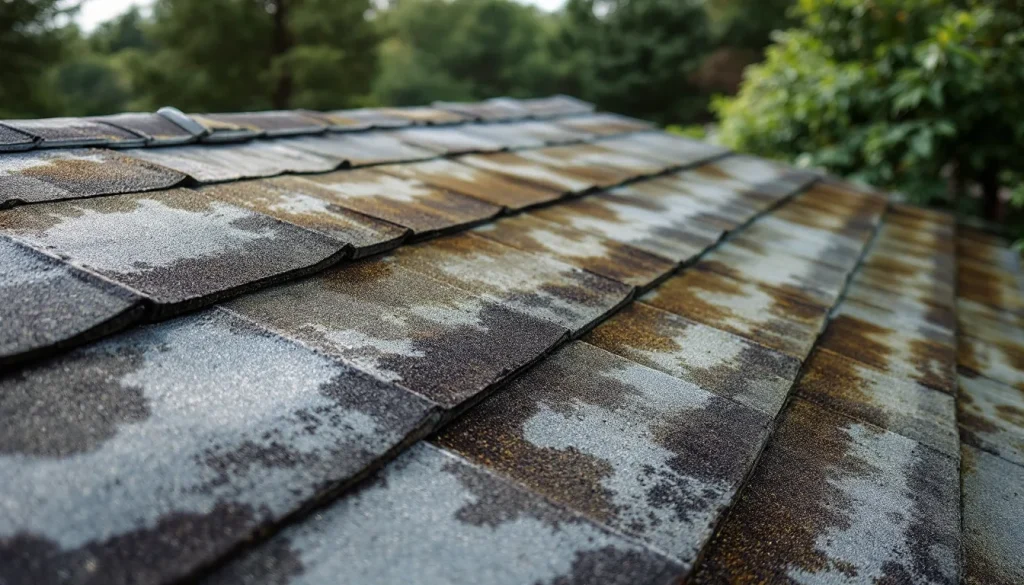
The algae streaks on roof you are looking at are not dirt, not mildew, and not the early sign of a roof failure. They are colonies of a cyanobacterium called Gloeocapsa magma, and they grow on asphalt shingles because the limestone filler in modern shingles is essentially food. The dark streaks always run vertically because rain washes the colony downward across the shingle field. North-facing slopes and shaded slopes stay wetter longer, which is why those slopes streak first and worst. The good news: the algae is mostly a cosmetic problem, the roof is almost certainly fine, and a single soft-wash treatment plus zinc or copper strips at the ridge will fix it and prevent it from coming back.
The short version
- The black streaks are Gloeocapsa magma, a cyanobacterium that eats the limestone filler in asphalt shingles.
- The streaks are cosmetic. They do not shorten roof life by much. They do tank curb appeal and resale value.
- Clean it with a sodium hypochlorite or sodium percarbonate soft wash, $300 to $900 for a typical home. Never pressure wash a shingle roof.
- Install zinc or copper strips at the ridge to stop regrowth. About $200 to $500 installed.
- Next roof: buy algae-resistant (AR) shingles with copper-infused granules. GAF StainGuard Plus, OC Algae Resist, CertainTeed StreakFighter.
- If the streaks have eaten visible granule cover, that is a separate issue. See our roof granules in gutter guide.
What it actually is
Gloeocapsa magma is a photosynthetic cyanobacterium that floats around in the air as airborne spores. When it lands on a wet, shaded asphalt shingle, it sets up shop. It feeds on the limestone (calcium carbonate) used as filler in asphalt shingles. The dark pigment comes from a UV-protective sheath the bacterium produces to survive sunlight. That pigment is what you see as black streaks.
The species shows up across most of the continental United States and is dominant in the humid Southeast, the Pacific Northwest, the Mid-Atlantic, and the Ohio River Valley. It is less aggressive in arid climates like Phoenix, Las Vegas, and Albuquerque, but it still appears on north-facing slopes there.
The reason the streaks always run top to bottom: spores land on the high parts of the roof first, the colony establishes near the ridge, and rainfall washes the dark pigment downward across each course of shingles. That is why a streak almost always starts at the top and tapers as it goes down.
How to tell which case you have
Three things can put dark marks on a roof. The fix is different for each.
- Algae streaks. Vertical, run top to bottom, worst on north and shaded slopes, no surface texture difference. This is the most common case.
- Lichen. Circular crusty patches, often grey-green, slightly raised. Lichen actually attaches to the shingle and is harder to remove. Same chemistry, longer dwell time.
- Moss. Green or green-grey fuzzy growth that holds water against the shingle. This is the only case that does damage the roof, because the moss holds moisture under shingle edges.
If the dark area is a defined patch under a tree branch, that is mildew or organic debris staining and a soft wash will lift it. If the discoloration is uniform across the whole roof with no pattern, that is shingle granule wear and no amount of cleaning brings it back. At that point you are looking at signs you need a new roof, not a cleaning project.
Cost to clean: what a soft wash costs in 2026
A roof soft wash is the only correct method for an asphalt shingle roof. Pressure washing tears granules off and shortens shingle life by years. A professional soft wash applies a low-pressure (under 100 psi) chemical solution, lets it dwell, and rinses with garden-hose pressure.
| Home size | Roof area | Typical soft wash cost |
|---|---|---|
| Small ranch | 1,200-1,800 sf | $300-$550 |
| Typical 2-story | 1,800-2,800 sf | $450-$800 |
| Large home | 2,800-4,500 sf | $700-$1,400 |
| Complex steep roof | any size, 8/12+ pitch | add 30-50% |
The two chemistries used by reputable contractors:
- Sodium hypochlorite (SH) blend. Pool-grade bleach at 3 to 6% strength, mixed with a surfactant. Kills the colony on contact. Cheapest, fastest, most aggressive. Has to be rinsed carefully so it does not damage landscaping. This is the ARMA-approved method.
- Sodium percarbonate. Oxygen-bleach chemistry. Gentler on plants, slower kill, longer dwell. Costs more per gallon. Preferred on homes with delicate landscaping or close neighbors.
The Asphalt Roofing Manufacturers Association (ARMA) explicitly endorses sodium hypochlorite soft washing and explicitly warns against pressure washing. If a contractor pulls out a pressure washer for an asphalt shingle roof, send them home.
DIY soft wash: when it is worth it
You can do this yourself on a low-pitch roof if you are comfortable on a ladder and the roof is reachable from the ground with a pump sprayer. The recipe most pros use:
- 1 gallon of 12.5% pool shock (sodium hypochlorite)
- 2 gallons of water
- 2 to 4 ounces of surfactant (Roof Snot, Apple Wash, or a commercial cleaning soap)
Apply with a pump sprayer or low-pressure pump. Let it dwell 15 to 30 minutes. The streaks will visibly fade. Rinse with a garden hose. Pre-wet and post-rinse the landscaping below to dilute runoff. Do this on a cool, cloudy day with no rain forecast for 12 hours.
What you do not do: climb on a wet treated roof, pressure wash, or use a stiff brush. Walking on a wet shingle roof is the leading cause of homeowner falls in roof-cleaning incidents. If the pitch is over 6/12 or the roof has multiple stories, hire it out. Our roof safety guide covers the basics.
How long the clean lasts (and why streaks come back)
A soft wash kills the existing colony. It does not stop new spores from landing and starting over. In the humid Southeast, untreated streaks return in 18 to 36 months. In drier climates, 4 to 6 years. The only way to prevent regrowth is to put metal at the ridge.
Zinc and copper strips: the prevention fix
Zinc and copper are biocidal to algae and moss. When rain hits a zinc or copper strip at the ridge, it picks up trace metal ions and washes them down the slope. Those metal ions kill spores before they can establish. This is why old farmhouse roofs with galvanized metal ridge caps almost never streak, while the asphalt shingle field below the cap stays clean for the 6 to 10 feet directly downslope.
| Strip type | Effective range | Cost installed | Lifespan |
|---|---|---|---|
| Galvanized steel (zinc-coated) | 6-8 ft downslope | $150-300 typical home | 15-20 years |
| Solid zinc | 15-20 ft downslope | $250-450 | 30-50 years |
| Solid copper | 15-20 ft downslope | $400-700 | 50+ years |
For most homes, solid zinc strips installed at the ridge and at the top of any slope longer than 20 feet is the right answer. Copper is overkill unless you have copper accents elsewhere on the house and want a uniform look.
Algae-resistant (AR) shingles: the next-roof fix
If your roof is already in the back half of its life (see asphalt shingle roof lifespan), spending money on cleaning and zinc strips may not be worth it. The smarter play is to buy AR shingles when you replace.
AR shingles have copper-infused granules baked into the cap layer. The copper slowly releases over time and prevents colony establishment. Every major manufacturer now offers AR as a standard or upgrade option:
- GAF StainGuard Plus. Standard on Timberline HDZ. 25-year algae warranty. Time-Release Algae Defense.
- Owens Corning Algae Resist. Standard on Duration and TruDefinition. 10-year algae warranty (Streak Resist) with 25-year option.
- CertainTeed StreakFighter. Standard on Landmark. 10-year algae warranty.
- Atlas Scotchgard. Uses 3M copper-infused granules. 25-year warranty. Strongest algae resistance per independent testing.
- IKO Algae Defense. Standard on Dynasty and Cambridge. 15-year warranty.
AR shingles cost zero to 8% more than non-AR. There is no good reason to install non-AR on a residential roof in 2026, especially east of the Mississippi or in the Pacific Northwest.
Why north-facing slopes streak worst
This is just sun angle physics. North-facing slopes in the Northern Hemisphere get less direct sunlight, dry slower after rain or dew, and stay damp for more hours per day. Gloeocapsa magma needs moisture to grow. More damp hours equals more growth. South-facing slopes can stay streak-free for years on the same roof where the north slope is heavily striped.
Shade adds to this. A slope partially shaded by an oak tree will streak years before a fully sun-exposed slope on the same house. Trim back tree branches that overhang the roof. The shade plus the dropped organic debris is a one-two punch.
What about chlorine bleach from the grocery store?
Household bleach is 5 to 6% sodium hypochlorite. Pool shock is 10 to 12.5%. The household version works at higher concentrations but you need 2 to 3 times the volume. Pool shock is the cost-effective choice for any roof over 1,200 square feet.
Either way, the working concentration on the roof should be 3 to 4% sodium hypochlorite at the nozzle. Stronger than that risks discoloring shingle edges and burning landscaping. Weaker than that and the colony survives.
Pressure washing: why it is the wrong move
Pressure washers run 1,500 to 4,000 psi. Asphalt shingle granules are held to the shingle mat with asphalt binder. Anything over about 100 psi at close range tears granules off. Once the granules are gone, the asphalt below is exposed to UV and starts oxidizing immediately. A pressure-washed asphalt roof typically loses 30 to 50% of its remaining lifespan.
You will see contractors offer pressure washing because it looks dramatic and works fast. Decline. Insist on a soft-wash chemical clean. Any reputable roofer or roof-cleaning specialist will agree. The ARMA bulletin TB-1 from the asphalt roofing manufacturers explicitly says so.
What about the streaks if the roof is under warranty
If your roof is under an algae warranty (StreakFighter, StainGuard, Scotchgard, Algae Resist), file a warranty claim before paying for cleaning. The manufacturer will typically send out an inspector. If the streaks are severe enough and the roof is within the algae-warranty window (usually 10, 15, or 25 years from install), they will reimburse cleaning costs or replace product. Most homeowners do not know they have this coverage. Check the original installation paperwork or the manufacturer registration.
Will algae streaks hurt resale value?
Yes. A heavily streaked roof reads as “old roof” to buyers and appraisers even when the roof has 10 to 15 years of life left. Real estate agents routinely budget $400 to $900 for pre-listing roof cleaning on homes with visible streaking. The ROI on the cleaning, in terms of faster sale and higher offers, is consistently positive.
If the roof is already at the back half of its life and streaks are heavy, some sellers price in a roof allowance instead of cleaning. That is a judgment call. A roofer can tell you whether the roof reads as “5 years left” or “15 years left” after a soft wash.
Will algae streaks fool a home inspector?
A competent home inspector can tell algae streaks from granule loss in 30 seconds. They will write up the streaks in the report (“organic staining noted, recommend cleaning”) but they will not flag it as a defect. What they will flag is granule loss visible alongside the streaks, which is a separate problem. If you are buying a home with streaks, get a roofer’s opinion in addition to the inspector’s.
Common mistakes that make it worse
- Pressure washing. Destroys the roof. Covered above.
- Walking on a wet treated roof. Fall risk.
- Using too-strong chlorine. Can lift shingle edges and damage skylight gaskets.
- Skipping the landscape rinse. Runoff burns plants. Always pre-wet and post-rinse.
- Hiring a power-washing company that has never done roofs. Get a roof-specific cleaning contractor.
- Cleaning without installing zinc strips. Streaks come back in 2 to 4 years and you pay again.
FAQ
Do algae streaks shorten my roof’s life?
Marginally. The bacterium eats limestone filler, not granules or asphalt. Studies suggest 1 to 3 years of life lost on a 25-year roof if streaks go untreated for the full lifespan. The bigger lifespan threat from algae is indirect: it traps moisture against the shingle and accelerates freeze-thaw damage in cold climates.
Can I just paint the streaks?
No. Roof paint over algae traps the colony and creates moisture issues underneath. The streaks also bleed back through most paints. Clean first, prevent with zinc, repaint never.
How long does the soft wash take?
Most jobs take 2 to 4 hours. You will see streaks start fading within minutes of application. Full color recovery happens over the next 1 to 2 weeks as residual chemistry continues working and rain rinses dead colony off.
Will the chemical hurt my gutters or downspouts?
Diluted sodium hypochlorite at 3 to 4% does not damage aluminum or vinyl gutters in normal application. Reputable contractors flush gutters after cleaning to neutralize any residual chemistry. Copper gutters can patina-spot if not rinsed.
Should I clean before or after replacing the roof?
If the roof is being fully replaced this year, do not bother cleaning. Just replace with AR shingles. If replacement is 3+ years out, clean now to preserve the remaining lifespan and install zinc strips so it does not recur before replacement.
Bottom line
Algae streaks are a cosmetic, fixable problem. Soft wash for $300 to $900, zinc strips for $200 to $500, AR shingles next time around. Do not pressure wash. Do not climb on a wet treated roof. Do not panic. The roof is almost certainly fine. If the streaks are accompanied by granule loss, missing shingles, or interior leaks, that is a different conversation. Check our signs you need a new roof guide and consider getting a quote on roof repair costs. For the algae itself, a 3-hour soft wash and a strip of zinc at the ridge solves it.