
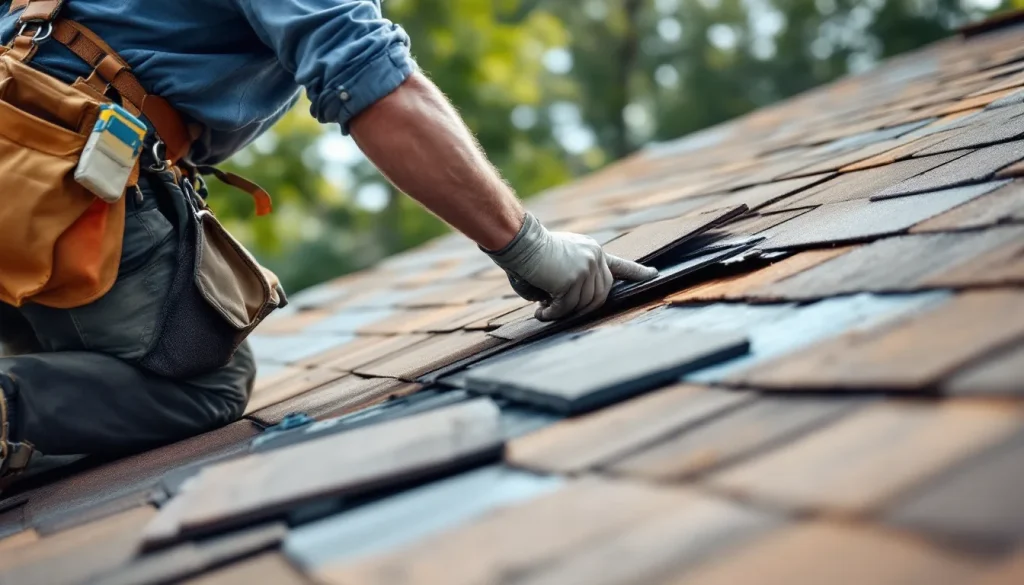
A roof repair cost in 2026 runs from $150 for a simple boot replacement (see our average replacement cost guide) to $3,000+ for valley reconstruction or decking replacement, with the median small repair landing between $400 and $900. The spread is wide because “roof repair” covers everything from a single missing shingle (an hour of work and a few dollars in material) to a structural fix involving rotten decking, ice-damaged sheathing, and re-flashed pipe penetrations. What actually drives the bill is not the visible damage but what the roofer finds underneath: dry plywood means a fast patch, soft sheathing means a half-day job. Below are real 2026 contractor numbers for the 22 most common residential roof repairs, with the math, the typical add-ons, and the warning signs that turn a $300 repair into a $3,000 one.
The short version
- Small leak repair: $150 to $800. Most leaks are flashing or boot related, not shingle related.
- Missing or torn shingle: $200 to $500 minimum trip charge. Shingle itself costs under $5.
- Valley repair: $600 to $2,200 depending on length and whether decking comes off.
- Pipe boot replacement: $150 to $450 each. Boots are the single most common leak source on residential roofs.
- Step flashing or chimney flashing: $300 to $1,200. Add masonry counterflashing and it doubles.
- Decking patch (4×8 sheet of plywood or OSB): $800 to $3,000 once you factor in shingle removal, decking, ice and water, and reshingling.
- Trip charge minimums in 2026 typically run $250 to $450 just to put a truck on your driveway.
The short answer: why “roof repair cost” is a wide range
Roof repair pricing splits into three rough tiers. Tier one is cosmetic and minor: a missing shingle, a popped nail, a torn ridge cap. These run $150 to $500 and are mostly trip-charge driven. Tier two is functional repair: leaks, boot replacements, flashing rebuilds, valley work. These run $400 to $2,200 and depend on how deep the damage goes. Tier three is structural: decking replacement, framing repair, fascia and soffit involvement. These run $1,500 to $5,000+ and often signal that a full replacement is closer than the homeowner wants to admit. The same “leak” diagnosed by three different roofers can land in any of the three tiers depending on what they find when they pull a few shingles back. A detached garage roof commonly lands in this tier once framing or sagging is involved. A slip-on Perma-Boot vent repair often falls in this low-cost tier.
2026 pricing table: 22 common roof repairs
| Repair | Typical 2026 cost | What drives the high end |
|---|---|---|
| Single missing shingle replaced | $200 to $500 | Trip charge minimum, color matching |
| Small leak (under 4 sq ft of damage) | $150 to $800 | Decking condition, access |
| Pipe boot (rubber or lead) replaced | $150 to $450 | Steep roof, multiple boots |
| Ridge cap shingle replaced | $300 to $700 | Length of ridge, color match |
| Hip cap repair | $300 to $800 | Length, accessibility |
| Valley repair (open metal) | $600 to $2,200 | Length, decking, ice and water |
| Valley repair (closed cut) | $500 to $1,800 | Length, shingle matching |
| Step flashing rebuild | $300 to $1,200 | Wall siding involvement |
| Chimney flashing rebuild | $400 to $1,500 | Masonry counterflashing, chimney height |
| Skylight flashing repair | $400 to $1,200 | Skylight age, curb condition |
| Skylight replacement and reflash | $1,200 to $3,500 | Size, glazing type |
| Drip edge replacement (one side) | $200 to $700 | Length, fascia condition |
| Decking patch (one 4×8 sheet) | $800 to $3,000 | Shingle removal, ice and water layer |
| Decking patch (multiple sheets) | $1,500 to $5,000 | Extent of rot, framing damage |
| Soffit and fascia repair (10 ft section) | $400 to $1,800 | Aluminum vs wood, paint, gutter R&R |
| Ice dam damage repair | $800 to $4,000 | Decking, insulation, drywall |
| Hail damage spot repair | $400 to $1,500 | Always check insurance first |
| Wind damage spot repair | $300 to $1,200 | Check insurance for amounts over $500 |
| Tree limb damage repair | $500 to $3,500 | Decking penetration, framing |
| Sagging roof structural repair | $1,500 to $7,000 | Truss or rafter involvement |
| Gutter detachment from fascia | $200 to $800 | Length, fascia rot |
| Vent (turbine, box, ridge) replacement | $200 to $600 each | Type, access |
These ranges are 2026 numbers from working residential contractors in the Midwest, Southeast, and Mountain West. Coastal metros (Boston, NYC, Bay Area, Seattle, LA) run 25% to 40% higher across every line. Rural markets run 10% to 20% lower but trip charges are higher because the truck is rolling further.
The trip charge: why every repair has a floor
Most reputable residential roofers in 2026 will not roll a truck for less than $250 to $450. That floor pays for the driver, the lost time, the insurance, and the warranty risk on any work they touch. A single missing shingle that takes 12 minutes to replace will still cost you $250 because that is what it costs the contractor to be there. Homeowners often misread this as gouging. It is not. It is what it costs to keep an insured, licensed crew operational. If a roofer quotes you $89 to “look at it,” they are either coming out to upsell you on a full replacement or they are uninsured and you do not want them on your roof. Our guide on red flags in a roofing contractor covers the rest of the warning signs.
Leak repair: where most “roof” calls actually go
The single most common roof repair call is “I have a leak.” About 70% of residential leaks have nothing to do with the field of shingles. The leak is at a penetration (pipe boot, vent, skylight), a flashing (chimney, wall, step), a valley, or the drip edge. Diagnosing the entry point is half the cost (for the full data set, see our the full 2026 Roofing Cost Report) of the repair. A reputable roofer will spend 30 to 90 minutes finding the leak before quoting, because the wrong fix will not stop the water.
Typical leak repair scenarios and 2026 pricing
- Pipe boot leak (rubber gasket cracked): $150 to $450 for the boot, plus access cost. Most common single leak source in homes 8+ years old.
- Step flashing leak at sidewall: $400 to $1,200. Usually requires pulling siding back to redo the flashing properly.
- Chimney flashing leak: $500 to $1,500. Brick chimneys need counterflashing reglet cut into the mortar joint, not just caulk over the top of the step flashing.
- Valley leak: $600 to $2,200. If the underlayment is compromised, the entire valley comes off and gets rebuilt with ice and water shield.
- Field leak from a nail pop or wind-lifted shingle: $200 to $600. Usually the simplest fix once located.
For a deeper breakdown of leak repair techniques and what good repair work looks like, see our guide on how to fix a roof leak.
Pipe boot replacement: the $250 fix that should be on every roof
Pipe boots (also called pipe flashings or plumbing vent flashings) are the rubber or lead collars that seal around plumbing vent stacks penetrating the roof. The rubber ones are the leading cause of residential roof leaks, period. Rubber boots typically fail at the 8 to 12 year mark from UV degradation, well before the surrounding shingles. The fix is straightforward: lift the surrounding shingles, pull the old boot, slide a new one in, reseal, replace (see our reshingle vs repair cost) the shingles. A roofer should be able to do four boots in two hours.
2026 pricing
- Rubber pipe boot replacement: $150 to $250 first boot, $75 to $150 each additional.
- Lead pipe boot replacement (longer life, code-required in some jurisdictions): $300 to $450 first boot, $150 to $250 each additional.
- Storm collar style retrofit boot (over existing): $90 to $200 each. Temporary fix only.
If you have four 12-year-old rubber pipe boots and are getting a leak diagnosed, ask the roofer to replace all four while they are on the roof. The marginal cost (see our roof repair costs itemized) is small and the next leak is probably coming from one of the other three.
Flashing repair: the most underdiagnosed roof problem
Flashing repair (see our how much to repair a roof) covers step flashing (along walls), counterflashing (over step flashing, into masonry), chimney flashing (around brick or stone chimneys), apron flashing (at the base of a wall meeting a roof), and kickout flashing (where a roof slope ends at a wall). When a roofer says “this needs new flashing” they could mean any of those, and the cost varies wildly. Step flashing rebuild on a sidewall is $300 to $1,200. Chimney reflash with counterflashing cut into the mortar joints is $800 to $1,800. If the chimney crown is also failing, add $400 to $1,200 for that.
The single biggest flashing scam in 2026 is the “tar over the flashing” repair. A roofer climbs up, slathers black roofing cement over the visible flashing, charges $400, and the leak stops for one rainy season. Six months later the cement cracks and the leak returns, only now the homeowner has to pay double because the cement has to come off before a proper repair can happen. Real flashing repair involves pulling siding or shingles, removing the failed flashing, installing new metal, and reintegrating it with the wall or chimney. If the roofer never gets off the ladder, it is not a flashing repair.
Decking repair: where small jobs become big jobs
Decking (also called sheathing) is the plywood or OSB that the shingles nail into. When a roofer pulls shingles to repair a leak and finds soft, spongy, or delaminated decking, the job changes character. A single 4×8 sheet of decking replaced on a residential roof in 2026 runs $800 to $3,000 because the work is not just the $40 sheet of plywood. The work is: tear off the shingles in that area, pull the underlayment, cut out the bad decking, sister or replace any rotten framing under it, install new decking, install new ice and water shield, install new underlayment, reshingle, and color-match. Two roofers, half a day.
The math gets worse fast with multiple sheets. Three contiguous sheets is rarely 3x the cost of one because the work is more efficient at scale, but six sheets often is, because the roofer hits a point where pulling more shingles to reach the rot makes a full re-roof the cheaper option. Many honest roofers will tell you, when the decking damage approaches one slope, that a partial single-slope replacement beats the patchwork repair on cost and warranty.
Valley repair: harder than it looks
Valleys are where two roof slopes meet at an inward angle and the water funnels down. They are the second-highest water flow zone on a roof (after the eaves) and they fail in three modes: granule loss from the high-flow zone, nail pull-through near the centerline, or underlayment compromise that lets water past the metal. A surface-level valley repair (cap shingles only) runs $500 to $1,000. A full valley rebuild (shingles off, underlayment off, new ice and water shield, new metal if open-valley style, reshingled) runs $1,200 to $2,200 for a typical 12 to 16 foot residential valley. Long valleys on cathedral-style or hip-and-valley homes can exceed $3,000.
Open metal valleys (where you can see the metal between the shingles) are easier to inspect and repair than closed-cut valleys, where the shingles from one slope are woven or cut over the other. Roofers generally agree that open metal is the better install but harder to color-match aesthetically. If your roof has closed-cut valleys and you are repairing one, ask if it makes sense to switch to open metal during the repair.
Hail and wind damage: pause before you pay out of pocket
If the damage is hail or wind related and the repair estimate is over $500, file an insurance claim before authorizing the repair. Most homeowner policies cover wind and hail damage to roofs, and the cost difference between an insurance-paid repair and an out-of-pocket repair is often the entire deductible. Our guide on filing a roof insurance claim walks through the process. A side note: insurance carriers in 2026 are aggressive about denying claims where the homeowner has already paid for the repair, because they cannot validate the damage. Always file first, then repair.
For hail specifically, the threshold question is whether you have enough hits per square to qualify for a roof replacement rather than a repair. See how much hail damage to replace a roof for the carrier rules and adjuster math.
The “is it worth repairing” question
At some point repair stops making sense and replacement is the better economic decision. The rough rule among working roofers: if the repair cost exceeds 30% of replacement cost, and the roof is more than 60% of the way through its expected life, replace it. A $3,500 repair on a 22-year-old architectural roof (with a 25 to 30 year expected life) is almost always money you will throw away when the roof fails completely three years later. The same $3,500 repair on a 10-year-old roof is usually justified.
The other factor is patch matching. After about year 8, shingle color matching gets difficult because the surrounding shingles have weathered and the new shingles will look noticeably different for the first few years. By year 15 the match is near impossible without replacing entire slopes. If your repair will leave a visible patch and you are planning to sell within five years, the cost of buyer pushback may exceed the savings versus replacement.
How to get a repair priced fairly: the three-quote method
Get three quotes from independent roofers, not three quotes from chain-affiliated salespeople. The way to tell the difference: an independent roofer will spend 30+ minutes on your roof, take photos, and write up the repair scope before quoting. A salesperson will spend 10 minutes, talk about your shingles being “shot,” and try to sell you a replacement. Both have a place in the market, but for a repair you want the independent.
Questions to ask each contractor
- What exactly is leaking, and how did you confirm it?
- What are you replacing (shingles, underlayment, flashing, decking)?
- What ice and water shield product are you using under the repair area?
- How will you match the existing shingle color, and what is your tolerance?
- What is the warranty on labor, and how long is it?
The good roofers will answer all five in detail. The bad ones will deflect to “trust us, we have been doing this 20 years.” Our guide on questions to ask a roofing contractor has the longer list for full replacements.
Worked example: a typical 2026 repair invoice
A homeowner in suburban Indianapolis calls about a leak in the master bedroom ceiling. The roofer arrives, inspects, and finds two cracked pipe boots and a compromised step flashing along the bedroom dormer. Decking under the bedroom side is intact. Here is the typical 2026 invoice:
- Trip charge / inspection: $350 (waived if work is approved same visit)
- Pipe boot replacement (two boots, lead replacement): $450
- Step flashing rebuild (8 ft section, including pulling back siding and reinstalling): $850
- Ice and water shield in repair area: $90
- Shingle replacement and color match (8 shingles): $180
- Disposal and cleanup: $80
- Labor warranty (2 years): included
Total: $1,650. This is a typical mid-range repair for a leak with no decking involvement. If decking had to come off, add $800 to $1,500. If the chimney was also leaking and needed reflash, add another $1,200.
Regional pricing: where you live matters
Roof repair costs in 2026 vary by region more than full replacement costs do, because trip charges and minimum charges dominate small jobs. Rough regional adjustments to the table at the top of this article:
| Region | Adjustment vs national median | Trip charge typical |
|---|---|---|
| Bay Area, NYC metro, Boston, Seattle | +30% to +40% | $400 to $600 |
| LA, San Diego, DC, Denver | +15% to +25% | $350 to $500 |
| Atlanta, Dallas, Houston, Phoenix, Chicago | National median | $300 to $450 |
| Indianapolis, Kansas City, Memphis, Birmingham | -5% to -15% | $250 to $400 |
| Rural Midwest, Appalachia, Plains | -15% to -25% | $200 to $350 (but longer drives) |
Common repair scams to watch for
The repair side of the roofing market attracts more scams than the replacement side because the dollar amounts are smaller and homeowners are less likely to vet contractors carefully. Our full roofing scams guide covers the entire landscape, but the three scams specific to repair work:
- “Storm chasers” who knock on your door after a hail or wind event and offer to “inspect for free.” They will find damage whether or not it exists, file the claim, and disappear after taking the deductible.
- “Tar over everything” repair scam: a $400 visit where the roofer caulks every visible flashing and calls it a repair. The fix lasts one season.
- “Decking is rotten” upsell during a small repair, where the roofer claims to find rot that does not exist to justify an expense add-on. Always ask for photos taken from the roof during the work, not after.
FAQ
Can I repair my roof myself to save money?
For a single missing shingle or a popped nail, yes, if you are comfortable on a ladder and the pitch is gentle. For anything involving flashing, decking, or leaks of unknown origin, no. The risk of misdiagnosis is high, the cost of a wrong fix is the same as a right fix plus the original repair, and the warranty implications for a future replacement are real (most manufacturer warranties on new roofs require licensed-installer work history).
How long should a roof repair last?
A good repair on an otherwise sound roof should last as long as the surrounding roof, which is the lesser of 8 to 15 more years or whatever life is left in the field shingles. A repair on a 22-year-old roof is buying you time, not a long-term solution. A repair on a 10-year-old roof should disappear into the lifespan of the roof.
Should I get a roof inspection before assuming I need a repair?
If the visible problem is small and you are not sure if it is the only problem, yes. A licensed roof inspection runs $250 to $600 in 2026 and gives you a full condition assessment plus prioritized repair list. Our guide on how to get a roof inspection covers what to ask for. The inspection cost is often credited back against repair work if you hire the same contractor.
What is the warranty on roof repairs?
Most reputable roofers warranty their repair labor for 1 to 5 years, with 2 years being typical. The materials (shingles, flashing, boots) carry their own manufacturer warranties of 5 to 30 years depending on product. Ask for the labor warranty in writing on the invoice. A “lifetime” labor warranty on a repair is almost always meaningless because the company is unlikely to be in business long enough to honor it.
When does roof repair stop making sense?
When repair costs in the past 24 months exceed 30% of replacement cost, when you have had three or more leaks in different locations, or when the roof is past 80% of its expected lifespan. At that point the math favors full replacement. The roofer should be able to give you a side-by-side comparison: cost of additional repairs you are likely to face vs cost of replacement plus the value of a fresh warranty cycle.
Bottom line
Roof repair pricing in 2026 spans 20x from the cheapest cosmetic fix to the deepest structural rebuild, and most of the cost variability is hidden under the shingles. Budget $400 to $900 for a typical small repair, $1,500 to $3,000 for anything involving decking or major flashing, and reserve the right to walk away if the quote feels off. Get three quotes, ask the five questions above, and check the contractor against our red flags list before signing anything. If the cumulative repair math is approaching 30% of replacement cost and the roof is past its mid-life, you are probably better off pivoting to replacement and starting the warranty clock fresh. For related reading, see our annual roof tune-up cost guide.