
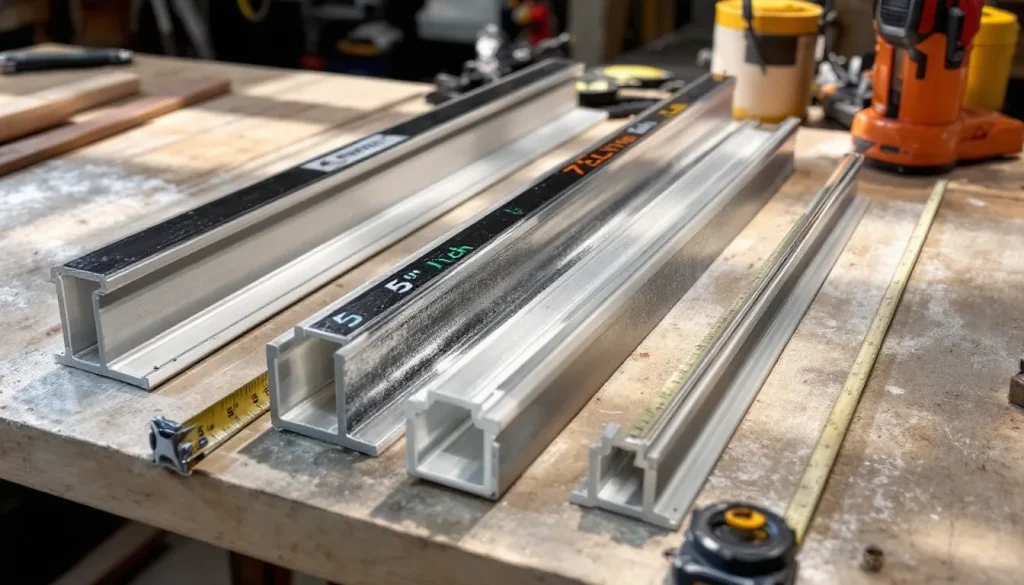
The honest answer on gutter sizes in 2026: 5-inch K-style is the residential default but it is undersized on roughly 30 percent of the houses it gets installed on, 6-inch K-style is the right call for any roof drainage area over 1,200 square feet, and 7-inch K-style is a commercial-grade upsize that makes sense on large modern residential and high-rainfall regions. The capacity differences are not subtle. 5-inch holds 1.20 gallons per linear foot. 6-inch holds 2.00. 7-inch holds 2.80. Each step up roughly doubles the storm-event headroom.
The short version
- 5-inch K-style: 1.20 gallons per linear foot, handles up to 1,200 sq ft of roof drainage area at 1 in/hr rainfall.
- 6-inch K-style: 2.00 gallons per linear foot, handles up to 2,000 sq ft.
- 7-inch K-style: 2.80 gallons per linear foot, handles up to 3,000 sq ft.
- 5-inch half-round: 0.96 gallons per linear foot, handles up to 900 sq ft.
- 6-inch half-round: 1.41 gallons per linear foot, handles up to 1,400 sq ft.
- High-rainfall regions (PNW, Gulf Coast, Southeast) need one size up from the standard table.
- Steep roofs deliver water faster, so a 12/12 pitch roof needs more capacity than a 4/12 of the same area.
- Downspout size has to match: 2×3 inch handles 600 sq ft, 3×4 inch handles 1,200 sq ft.
How gutter capacity actually works
The capacity number for a gutter is gallons per linear foot of trough at the rated flow capacity, where the gutter is pitched properly toward the downspout and water flows out as fast as the roof brings it in. The number tells you how much water is in the trough at peak flow, not how much rainfall the gutter can absorb in total.
The relationship between roof area and required gutter size is driven by three variables: roof area (the surface that delivers water to the gutter), rainfall intensity (gallons per hour per square foot at design storm), and gutter capacity (how fast water can move through the trough). A 5-inch K-style at 1.20 gallons per linear foot is sufficient for roughly 1,200 square feet of roof at 1 inch per hour rainfall. Double the rainfall, halve the supported area. Double the roof, double the gutter cross-section needed.
The math: 1 inch per hour rainfall on 1 square foot of roof produces 0.6233 gallons per hour. A 1,200 square foot roof at 1 inch per hour produces 748 gallons per hour, or 12.5 gallons per minute. A 5-inch K-style gutter pitched correctly with a downspout sized for 600 sq ft on each end can carry roughly that flow. Beyond it, water backs up in the trough faster than the downspout can move it out, the trough fills, and water spills over the front lip.
Capacity table by profile and size
| Profile and size | Cross-section (sq in) | Capacity (gal/linear ft) | Roof area at 1 in/hr | Roof area at 2 in/hr |
|---|---|---|---|---|
| 5-inch K-style | 22 | 1.20 | 1,200 sq ft | 600 sq ft |
| 6-inch K-style | 36 | 2.00 | 2,000 sq ft | 1,000 sq ft |
| 7-inch K-style | 50 | 2.80 | 3,000 sq ft | 1,500 sq ft |
| 5-inch half-round | 17 | 0.96 | 900 sq ft | 450 sq ft |
| 6-inch half-round | 25 | 1.41 | 1,400 sq ft | 700 sq ft |
| 7-inch half-round | 34 | 1.93 | 1,900 sq ft | 950 sq ft |
| 4-inch K-style (small) | 15 | 0.85 | 800 sq ft | 400 sq ft |
The roof area figures are per downspout, not total roof area. A 2,400 square foot roof with two downspouts and proper gutter pitch splits to 1,200 square feet per downspout, which puts a 5-inch K-style at its design limit in 1 inch per hour rainfall. In a region where 2 inch per hour rainfall happens during severe storms, that same setup overflows because each downspout segment is now drained as 1,200 square feet against a 600 square foot capacity.
The takeaway: size the gutter to the heaviest rainfall the region sees, not to average rainfall. The gutter that handles a normal Tuesday afternoon storm and overflows in a once-a-decade tropical system is a gutter that has done its job poorly, because the once-a-decade storm is exactly when water management matters.
Calculating your roof drainage area
Roof drainage area for gutter sizing is not the same as total roof area. The relevant number is the area that drains to a specific segment of gutter (between two downspouts) projected on a horizontal plane.
The horizontal projection matters because rain falls vertically. A 1,000 square foot roof at 4/12 pitch has a horizontal projection of about 950 square feet. The same roof at 12/12 pitch has a horizontal projection of about 700 square feet. From a rainfall delivery standpoint, the 4/12 roof actually delivers slightly more water to the gutter per square foot of slope because the horizontal catchment area is larger.
But pitch affects delivery speed. Water on a 12/12 roof reaches the gutter faster than water on a 4/12 roof. The faster delivery means the gutter sees a higher instantaneous flow rate during a heavy rain event, even though the total volume is the same or less. Pitch correction factors:
| Roof pitch | Pitch factor (multiply roof area by this for design) |
|---|---|
| 0/12 to 3/12 (flat to low slope) | 1.0 |
| 4/12 to 5/12 (medium slope) | 1.05 |
| 6/12 to 8/12 (standard residential) | 1.10 |
| 9/12 to 11/12 (steep) | 1.20 |
| 12/12 and steeper | 1.30 |
For a 2,000 square foot horizontal projection roof at 9/12 pitch, the gutter design area is 2,000 x 1.20 = 2,400 square feet. With one downspout in the middle and gutters draining both directions, each side carries 1,200 square feet of design area. 5-inch K-style works at the design limit. 6-inch K-style provides headroom.
Rainfall intensity by region
The 1 inch per hour reference rainfall in the capacity table is a national-average design rainfall. Real rainfall intensity varies dramatically by region. Storm intensity for a 5-minute peak (the relevant time scale for gutter overflow) in 2026 design storm tables:
| Region | 5-min peak intensity (in/hr) | 1-hr design rainfall (in/hr) | Adjustment factor |
|---|---|---|---|
| Pacific Northwest coastal | 3.5 to 4.5 | 1.0 to 1.5 | 1.5 |
| Pacific Northwest interior | 2.5 to 3.5 | 0.7 to 1.0 | 1.0 |
| Southwest (AZ, NM) | 3.0 to 5.0 | 0.5 to 1.0 | 1.5 |
| Gulf Coast (TX, LA, AL, MS) | 5.0 to 7.0 | 2.0 to 3.0 | 2.0 |
| Southeast (FL, GA, SC) | 5.0 to 7.0 | 2.0 to 3.0 | 2.0 |
| Mid-Atlantic (VA, MD, NJ) | 4.0 to 5.5 | 1.5 to 2.0 | 1.5 |
| Northeast (NY, MA, CT) | 3.5 to 4.5 | 1.5 to 2.0 | 1.5 |
| Midwest (OH, IN, IL) | 4.0 to 5.5 | 1.5 to 2.0 | 1.5 |
| Plains (KS, NE, OK) | 4.5 to 6.0 | 2.0 to 2.5 | 1.75 |
| Mountain West interior | 2.5 to 3.5 | 0.5 to 1.0 | 1.0 |
The adjustment factor in the right column is what you multiply the roof drainage area by before sizing the gutter. A 1,200 square foot drainage area in Atlanta becomes 2,400 design square feet because the storm intensity is twice the national average. That bumps the required gutter from 5-inch K-style to 6-inch K-style, and the downspout from 2×3 to 3×4.
This is why a 5-inch K-style works fine for 30 years in Arizona and fails reliably in the Gulf Coast on the same size house. Same gutter, different climate.
The 5-inch vs 6-inch decision
Before you can make it, you need to measure your existing gutter size. This is the single most common gutter sizing decision homeowners face. The cost difference between 5-inch and 6-inch K-style aluminum is roughly $2 to $3 per linear foot installed. On a 200-foot job, that is $400 to $600. The performance difference is meaningful: 6-inch K-style handles 67 percent more water at the same pitch.
Default to 6-inch K-style when any of these apply:
- Roof drainage area per downspout exceeds 1,200 square feet
- Roof pitch is 9/12 or steeper
- Region adjustment factor (above) is 1.5 or higher
- Property has significant tree cover that contributes leaf debris (reduces effective capacity by 20 to 40 percent)
- Roof has multiple valleys that concentrate water into single gutter sections
- Existing 5-inch gutters have shown overflow in past storms
Default to 5-inch K-style when:
- Single-story house with roof area under 1,500 square feet
- Low to medium roof pitch (4/12 to 7/12)
- Region adjustment factor is 1.0 or 1.0 to 1.25
- Limited tree cover
- Simple roof geometry without complex valleys
The 5-inch is not wrong on most residential roofs. It is wrong on the 30 percent where the math has been ignored. For the broader install context, see rain gutter install guide and gutter installation.
When to consider 7-inch
7-inch K-style is uncommon on residential work. It shows up in three scenarios:
- Large modern residential homes with 3,000-plus square foot drainage areas per downspout
- Coastal or Gulf Coast properties where storm intensity drives design loads higher than 6-inch capacity
- Commercial conversion work where the original gutter system was sized for commercial flows
7-inch K-style runs $4 to $7 per linear foot premium over 6-inch installed. The capacity premium over 6-inch is 40 percent. On a property where 6-inch is at design limit and one storm in five years overflows the system, the 7-inch upgrade is reasonable. On a typical residential property, it is overkill.
7-inch also requires 3×4 inch downspouts at minimum, and often two downspouts where a 6-inch system would have one. The full system upgrade implication needs to be considered.
Half-round capacity is meaningfully lower
Half-round gutter has roughly 20 percent less cross-sectional area than the same nominal-size K-style. A 5-inch half-round handles 900 square feet of drainage area, where 5-inch K-style handles 1,200. The implication for sizing decisions: on a half-round system, size up one nominal size relative to the K-style call, or place downspouts closer together.
For pre-1940 traditional and historic homes where half-round is the architecturally correct choice (see k-style vs half-round gutters for the profile decision), the sizing math has to be adjusted. A 1925 craftsman with a 1,800 square foot footprint that would take 5-inch K-style needs 6-inch half-round to deliver equivalent capacity. The cost difference is meaningful but unavoidable if you want the period-correct look without the overflow problem.
The materials decision interacts with sizing too. See gutter materials compared for the material side and gutter cost per linear foot for the cost implications.
The downspout side of capacity
Gutter capacity is meaningless if the downspout cannot move water out. The downspout sizing has to match:
| Downspout size | Capacity (gpm) | Roof drainage at 1 in/hr | Pairs with gutter |
|---|---|---|---|
| 2×3 inch rectangular | 10 gpm | 600 sq ft | 5-inch K-style |
| 3×4 inch rectangular | 20 gpm | 1,200 sq ft | 5 or 6-inch K-style |
| 4×5 inch rectangular | 30 gpm | 1,800 sq ft | 6 or 7-inch K-style |
| 3-inch round | 12 gpm | 720 sq ft | 5-inch half-round |
| 4-inch round | 22 gpm | 1,320 sq ft | 6-inch half-round |
| 5-inch round | 34 gpm | 2,040 sq ft | 7-inch half-round |
On any roof drainage area over 1,000 square feet, default to 3×4 inch rectangular downspout. The 2×3 standard is undersized for any modern residential application beyond the smallest houses. For the full downspout placement methodology, see downspout placement and sizing.
Downspout spacing and how it affects gutter sizing
Downspout spacing changes the effective drainage area per gutter segment. Tighter spacing = smaller drainage area per segment = smaller gutter needed. Looser spacing = larger drainage area per segment = larger gutter needed.
The standard is one downspout per 35 to 40 feet of gutter run. At 40-foot spacing on a 2,000 square foot rectangular roof (40 by 50 with gutter on two long sides), you have five downspouts, each draining roughly 400 square feet. 5-inch K-style is plenty. At 80-foot spacing on the same roof, you have three downspouts, each draining 670 square feet. Still within 5-inch K-style range but with less headroom.
On long runs where running an additional downspout is not architecturally desirable (the downspout would land in an inconvenient location for landscaping or hardscape), the alternative is to upsize the gutter to handle the longer effective drainage segment.
Valley discharge: the local capacity demand
Roof valleys collect water from two roof planes and discharge into the gutter at a single point. The instantaneous flow rate at the valley discharge can be 3 to 5 times the average flow rate for the drainage area. Even if the whole gutter is sized correctly, the valley discharge can overwhelm a single section.
The right answer: position a downspout within 3 to 5 feet of any valley discharge. The downspout takes the concentrated flow directly to ground. The gutter section between the valley and the next downspout is sized for the rest of the roof drainage, not the valley.
If the architecture does not allow a downspout near the valley, the gutter at that section may need to be upsized locally (6-inch in an otherwise 5-inch system) and the next downspout placed as close to the valley as possible. This is one of the situations where a gutter contractor’s experience matters more than the spec sheet.
The full sizing decision tree
To size a gutter system from scratch:
- Measure horizontal projection roof area by zone. Each gutter run drains a specific zone of roof.
- Apply pitch correction factor from the table above based on roof pitch.
- Apply rainfall intensity adjustment based on your region.
- Divide adjusted area by number of downspouts serving each gutter run.
- Match adjusted area per downspout to the capacity table to determine minimum gutter and downspout size.
- Round up to next standard size for design headroom (gives you margin for once-a-decade storms).
- Verify downspout spacing stays within 35 to 40 feet (closer in heavy rainfall regions).
- Check for valley discharges and locate downspouts within 3 to 5 feet of valleys where possible.
The result is a system sized for the actual loads, not a one-size default that may or may not match the house.
How leaves and debris reduce effective capacity
Gutter capacity assumes a clean trough. Partial clog from leaves, twigs, and shingle granules can reduce effective capacity by 20 to 50 percent within the year between cleanings. The implication: a 5-inch K-style gutter that is at design limit on a clean trough is undersized for half of the year on a heavily wooded property.
Two responses: clean more often (twice a year minimum, more for heavy tree cover, see gutter cleaning cost and schedule), or size up to give yourself headroom for the dirty months. On any property with heavy tree cover, upsize the gutter one nominal size to account for partial clogging.
Gutter guards also factor in here. Quality covers reduce debris accumulation in the trough by 80 to 95 percent. See best gutter guards for the product comparison.
When the math says undersized but the homeowner refuses to upsize
Cost pressure pushes a lot of jobs to 5-inch K-style on roofs that should have 6-inch. The compromise that sometimes works: 5-inch K-style with closer downspout spacing (one every 25 to 30 feet instead of 35 to 40) and 3×4 inch downspouts instead of 2×3. The increased downspout capacity moves water out fast enough that the smaller trough does not back up.
This works in 1 inch per hour design rainfall but breaks down in heavier storms. In Gulf Coast and Pacific Northwest coastal regions, the math really does say 6-inch, and the workaround does not buy enough headroom for a severe storm event.
The honest contractor advises 6-inch and explains why. The homeowner who wants to save the $400 to $600 takes 5-inch and may end up with overflow in 2 or 3 storms a year. The fix at that point is either to live with it, retrofit additional downspouts, or eventually replace the system at full cost.
Capacity in the system context
Gutter capacity is part of a full roof drainage system. The shingle and underlayment deliver water to the drip edge (see drip edge and drip edge installation detail). The drip edge delivers water into the gutter trough. The gutter carries water to the downspout. The downspout delivers water to termination via splash block, extension, or buried drain (see splash blocks vs extensions and french drain gutter integration). On flat roofs where gutters are replaced by scuppers and internal drains, the sizing math is different (see scuppers vs gutters flat roof and flat roof drainage design).
Sizing the gutter without considering the downspout, the termination, the drip edge, and the fascia condition produces a system that fails at the weakest link. The right approach is to size the whole system together. For the broader context, see rain gutter install guide, gutter installation, and gutter installation cost. For pricing context across the full roof, see roofing cost per square. For the broader library, browse learn.
Get the size right once and the gutter handles every storm for 25 to 30 years. Get it wrong and you watch water spill over the front lip every time it rains hard.