
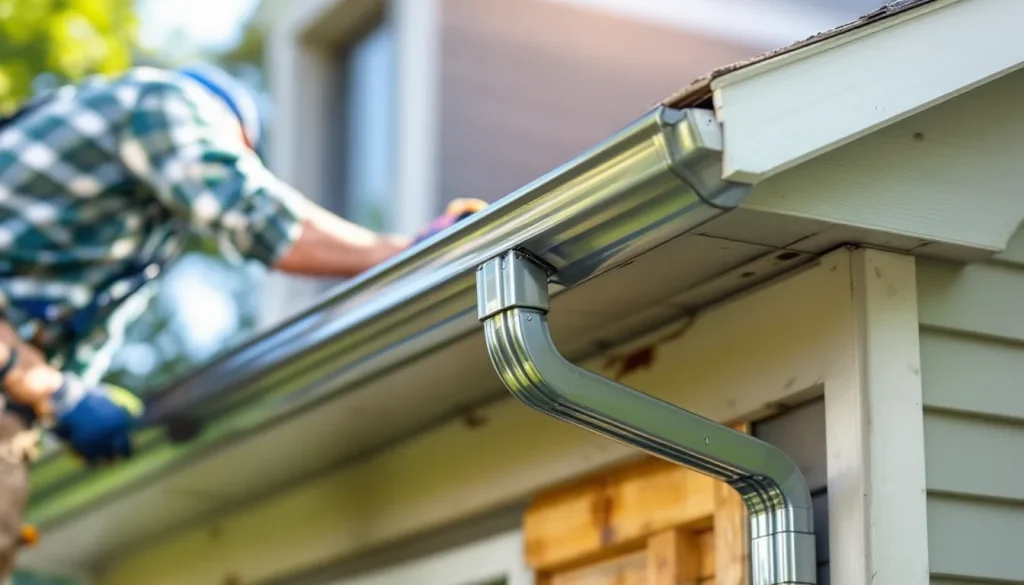
Rain gutter cost in 2026 spans a wider range than most homeowners expect, because the material, the profile, the size, and whether the run is continuous or sectional each move the per-linear-foot number by several dollars. Installed aluminum 5-inch K-style runs $7 to $13 per linear foot. Copper half-round runs $25 to $45. Vinyl sits at the bottom near $4 to $8. Steel falls in the middle at $9 to $16. Zinc lands in copper territory at $25 to $40. A typical 2,000 square foot single-story home needs roughly 150 to 200 linear feet of gutter plus four to six downspouts, so the total spread between the cheapest vinyl job and a copper half-round system on the same house is more than $7,000. This guide breaks down what each material actually delivers, why sizing matters more than most contractors explain, and where the dollars are actually going on your estimate.
What the per-linear-foot number actually includes
A fair installed quote bundles material, hangers, end caps, miters, sealant, downspouts, downspout straps, elbows, and labor for tear-off and disposal of the old system. It does not include fascia repair, soffit replacement, ice and water shield extension, or drip edge correction. Those become change orders once the old gutter comes down and the contractor can see the fascia board. On homes more than 15 years old, plan for at least one or two sections of soft fascia that need to be replaced before the new gutter hangs. Our breakdown of fascia rot from gutters covers what to look for during the pre-install walk-through.
Tear-off and haul-away on a single-story is usually $1 to $2 per linear foot included in the install price. On a two-story or a steep-pitch roof where the crew needs ladder jacks or a lift, expect to add 15 to 25 percent across the board. Working off a 28-foot extension ladder slows the crew down and shifts the math on what a typical day of installation actually completes.
Aluminum 5-inch K-style: the baseline
Aluminum 5-inch K-style is the default residential gutter in North America in 2026 because it is light, paintable, corrosion-resistant, and runs through a portable continuous brake on the truck. Material gauge matters. .027 aluminum is the standard residential gauge. .032 is the premium upgrade and runs about 15 percent more per linear foot but resists denting from ladder strikes and ice loads. Most reputable installers in cold climates default to .032. Installed cost on .027 aluminum 5-inch K-style runs $7 to $10 per linear foot. The .032 upgrade pushes the same job to $9 to $13.
K-style refers to the decorative front face that mimics crown molding. The functional advantage over half-round is capacity. A 5-inch K-style gutter holds roughly 1.2 gallons per linear foot of water column, which translates to coverage for about 600 to 1,200 square feet of roof drainage area depending on pitch, rainfall intensity, and downspout spacing. For most single-story tract homes in zones with rainfall intensity below 7 inches per hour, the 5-inch handles the load. Our deeper dive on K-style vs half-round gutters walks through the profile-to-capacity math.
Aluminum 6-inch K-style: when you should upsize
Six-inch aluminum K-style runs $9 to $15 per linear foot installed. The capacity jump is meaningful. A 6-inch K-style holds about 2.0 gallons per linear foot, which is 60 percent more water column than the 5-inch. That handles 1,400 to 1,800 square feet of roof drainage area cleanly. The cases where the 6-inch is the right call are steep pitches (above 7/12), large continuous roof planes draining to a single gutter, or geographic zones with intense short-duration rainfall (the Southeast and Gulf Coast, parts of the Texas Hill Country, and the Pacific Northwest during atmospheric river events). The 6-inch also pairs with 3×4 downspouts instead of the standard 2×3, and the downspout capacity matters as much as the gutter capacity, which we lay out in gutter sizes and capacity.
The cost of upsizing is not just the per-linear-foot bump. Six-inch gutters and 3×4 downspouts move more than twice the water of a 5-inch with 2×3 downspouts. If your home routinely overflows in heavy rain, that is a sizing problem, not a debris problem, and adding gutter guards will not fix it.
Copper half-round: when budget is not the constraint
Copper half-round gutters run $25 to $45 per linear foot installed, with the spread driven by gauge (16 ounce vs 20 ounce), region (copper labor is regional and copper-specialist crews charge a premium in markets with low copper density), and whether the downspouts are matched copper or aluminum. Match the downspouts. Aluminum downspouts on a copper gutter are a downgrade that no homeowner spending copper money should accept. A 200 linear foot copper job with four downspouts on a high-end home in 2026 typically lands between $7,000 and $12,000 installed.
What copper delivers is a service life that genuinely runs 60 to 100 years in inland climates and 40 to 60 in coastal salt air. The patina shift from bright penny to brown to verdigris green is part of the look. Half-round is the architectural profile copper is most often run in because the seamed corners and round downspouts evoke the early 20th century homes copper is most associated with. K-style copper exists but reads as a mismatch to most architects. For the decision frame on profile, see gutter materials compared.
Galvanized and galvalume steel: the cold-climate option
Steel gutters run $9 to $16 per linear foot installed, depending on coating. Galvanized steel is the cheaper option. Galvalume (aluminum-zinc coated steel) costs roughly 20 percent more but resists corrosion two to three times longer in salt-air or industrial environments. Steel gauges run heavier than aluminum, usually 26 or 24 gauge, which means steel gutters resist ice damming and ladder impact better than aluminum. The trade-off is weight. Steel gutters require closer hanger spacing (every 24 inches vs 32 inches on aluminum) and they will rust eventually, especially at the cut edges where the coating is broken.
Steel is the right call in markets where ice loads are routine and aluminum dents and bends would be a recurring repair cost. Northern New England, the Upper Midwest, and the high-altitude Rockies are the zones where steel pays back its premium.
Vinyl: where it actually makes sense and where it does not
Vinyl gutters at $4 to $8 per linear foot installed are the cheapest option on the market and the worst long-term value in any climate that sees real temperature swings. Vinyl becomes brittle below 20 F and warps above 95 F. UV degradation discolors and weakens vinyl over 7 to 10 years. The sectional joints crack and leak. Replacing vinyl every decade costs more than installing aluminum once, even on a strict cash-flow basis.
Where vinyl makes sense: detached garages, sheds, outbuildings, and rental properties where the owner is intentionally minimizing capital and planning to replace on a short cycle. On the primary residence, the long-run cost math points away from vinyl in almost every case. Vinyl is also sectional only. No one runs continuous vinyl. The joint-frequency problem alone is reason enough to upgrade.
Zinc: the European import that lasts a century
Zinc gutters at $25 to $40 per linear foot installed are the European architectural standard, common on heritage restorations and high-end custom builds. Zinc develops a self-healing patina similar to copper but with a grey-blue color rather than green. Service life runs 80 to 100 years inland. Zinc is softer than copper to fabricate, which means the labor cost is similar but the material cost is slightly lower than copper. In 2026, zinc availability through US distributors is improving but still trails copper in most markets.
If your project is a historic restoration where copper would not be period-correct, or a contemporary build where the patina color suits the architect’s intent, zinc is worth the conversation. For new tract construction, it is overkill.
Continuous vs sectional: the real value of continuous
Continuous gutters are formed on-site from a coil of metal run through a portable brake on the installer’s truck. The result is a single continuous piece per run, with joints only at the corners. Sectional gutters come in 10-foot pre-made sections that join with slip connectors. Every joint is a potential leak. A 200 linear foot home installed sectional has roughly 20 joints. The same home continuous has four (one per corner). Over 20 years, the joint-failure math compounds. Our breakdown of continuous vs sectional gutters covers the failure modes.
Continuous adds roughly $1 to $2 per linear foot over sectional aluminum, and almost every installed aluminum job in 2026 is run continuous. Vinyl is the only material that is sectional-only. Copper and zinc are typically sectional with soldered joints, which behave more like continuous because the solder bond is mechanically and chemically integrated rather than gasket-sealed.
Sizing math: the rule contractors should explain and often do not
Gutter sizing comes from the drainage area, the roof pitch multiplier, and the rainfall intensity in your zone. The simplified rule: take the square footage of roof that drains to a particular gutter run, multiply by the pitch factor (1.0 for flat to 4/12, 1.05 for 5/12 to 8/12, 1.1 for 9/12 to 11/12, 1.2 for 12/12 and steeper), and check against the gutter’s effective capacity per linear foot at your local rainfall intensity. The Plumbing and Drainage Institute publishes the lookup tables, and most installers either know them or have an estimating app that runs the math automatically.
What most homeowners do not realize: pitch increases the effective drainage load. A steep 10/12 roof drains the same square footage faster than a 5/12, which means the gutter sees higher peak flow during a thunderstorm. Steep roofs in heavy-rain markets often need 6-inch gutters even when the square footage would suggest 5-inch was adequate.
Pitch and downspout placement
Gutters install with a slope of roughly 1/4 inch per 10 feet of run toward the downspout. Too flat and water pools and breeds mosquitoes. Too steep and the front face of the gutter visually sags relative to the fascia. Downspouts place every 35 to 40 feet of gutter run for 5-inch K-style and every 45 to 50 feet for 6-inch. Corners and long runs may need additional downspouts to prevent overflow at the low end during peak flow. Our detailed walk-through is in downspout placement and sizing.
Downspout discharge is its own decision. A downspout that dumps water at the foundation is a basement leak waiting to happen. Splash blocks move water 2 to 4 feet from the foundation. Buried extensions running to a daylight outlet or a French drain manage water 10 or more feet away. The trade-off math is in splash blocks vs extensions.
Gutter guards: when to add them, when to skip them
Gutter guards range from $5 per linear foot for basic vinyl mesh to $20 per linear foot for high-end micromesh stainless screens. Quality micromesh in 2026 runs about $7 to $12 installed when bundled with new gutter installation, vs $15 to $20 retrofitted to existing gutters. Bundling saves the second mobilization charge. Our list of best gutter guards covers the products that actually perform.
Guards make sense on homes with significant overhanging tree canopy. Pine needles, oak catkins, and maple seeds clog gutters in spring and fall. Without guards, a wooded lot needs cleaning two to four times a year. With micromesh, the same lot needs cleaning once every two to three years. The break-even on guard cost vs cleaning service is roughly 6 to 8 years on a moderately wooded lot, faster on a heavily wooded lot. Without overhanging trees, guards do not pay back, and our breakdown of gutter cleaning cost and schedule covers what a maintenance cycle actually costs.
Heated cable and ice dams
Heated gutter cable runs $3 to $7 per linear foot of cable installed, plus the electrical hookup. Cable does not prevent ice dams. It melts a channel through the existing ice and gives the meltwater a path off the roof, which prevents the water from backing up under the shingles. The right solution to chronic ice dams is attic insulation and ventilation, and heated cable is a remediation for homes where the insulation upgrade is not yet possible. The full breakdown is in heated gutter cable.
Foundation drainage integration
The next-step decision past downspout discharge is whether to integrate the gutter system with the foundation drainage. French drains, dry wells, and grading swales move water away from the foundation footprint and into the storm system or daylight outlet. On homes with chronic basement moisture, integrated gutter-to-French-drain systems pay back through avoided foundation repair, finished basement protection, and mold remediation avoidance. The execution detail is in French drain gutter integration.
What a fair 2026 estimate looks like
For a single-story 2,000 square foot ranch with 175 linear feet of gutter and five downspouts, a fair installed estimate in 2026 looks like this. Aluminum 5-inch K-style .032 with continuous installation, color-matched: $1,575 to $2,275. Six-inch upgrade adds 30 percent. Standard 2×3 aluminum downspouts included. Tear-off and haul-away included. Fascia repair quoted separately if needed. Micromesh gutter guard add-on: $1,225 to $2,100. Two-story upcharge: 20 percent across the board.
Estimates significantly below this range are usually .025 contractor-grade aluminum with sectional joints and a one-year workmanship warranty. Estimates significantly above this range are either premium gauge with longer warranty (which is fair), or they are inflated. For broader context across markets, see gutter installation cost and gutter prices 2026.
The DIY question
Aluminum sectional gutters in 10-foot lengths from a home improvement retailer cost $0.80 to $1.20 per linear foot in materials, plus hangers, downspouts, elbows, and sealant. A 175-foot DIY job materials-only runs $400 to $700. Compared to a $2,000 installed continuous quote, the DIY savings looks meaningful. The catches: ladder time on a two-story is real risk, gutter slope and downspout placement require measurement and forethought, and the sectional joints will leak within 5 to 8 years vs a continuous professional install that holds for 15 to 25. The detailed installation walk-through is in rain gutter install guide, with the broader install cost benchmark in gutter installation and the per-linear-foot model in gutter cost per linear foot.
The bottom line
In 2026, the right answer for most homeowners is aluminum 5-inch or 6-inch K-style, continuous, in .032 gauge, installed by a contractor with a 10-year workmanship warranty and matching downspouts. That system runs $9 to $15 per linear foot installed depending on size and region, and it lasts 25 to 40 years with routine cleaning. Step up to copper or zinc when the architecture justifies the cost. Step down to vinyl only on outbuildings or short-cycle rental properties. Size the gutter to the actual drainage load, place downspouts every 35 to 40 feet, and route the discharge at least 4 feet from the foundation. Get three quotes, ask each contractor to spell out gauge, profile, and joint count, and verify the workmanship warranty is written rather than verbal. The gutter is one of the cheapest line items on a house and one of the most consequential for preventing water damage to everything underneath it.