
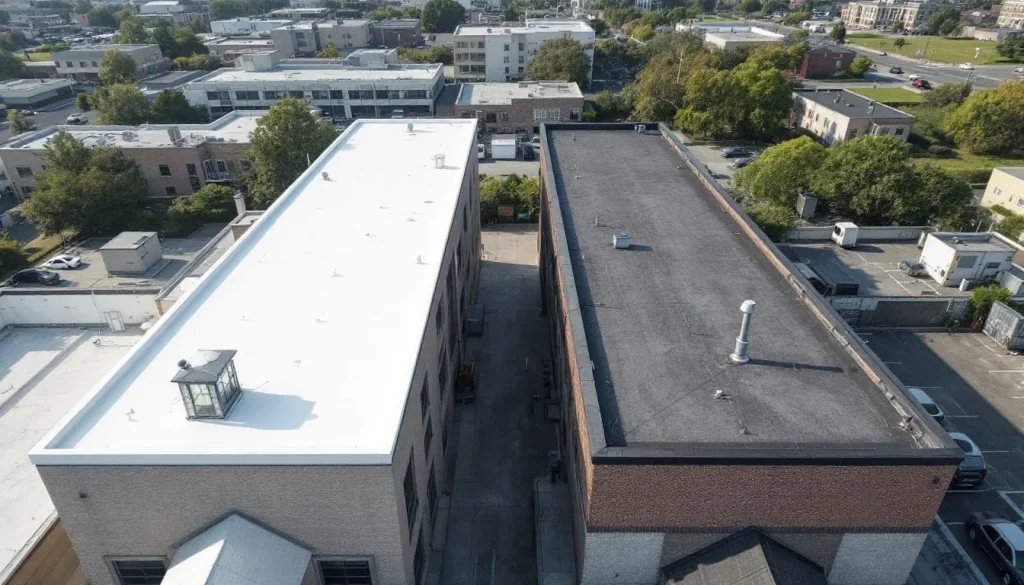
The real flat roof lifespan (for the full data set, see our the 2026 Roofing Material Lifespan Report) in 2026, measured from membrane manufacturer field data rather than marketing brochures, is 20 to 30 years for TPO, 25 to 35 years for EPDM, 25 to 30 years for PVC, 15 to 25 years for modified bitumen, and 20 to 30 years for built-up roofing (BUR). The variance inside each range is driven by climate (UV exposure, freeze-thaw, ponding water), install quality (seam welding, parapet wall flashing detail, drainage), insulation condition, and maintenance frequency. A well-installed Carlisle Sure-Weld TPO in a moderate climate with twice-yearly inspection routinely hits 28 to 30 years. The same membrane on a ponding roof in a Phoenix sun load drops to 14 to 18 years.
The short version
- TPO: 20 to 30 years real-world. Heat-welded seams, 45 to 80-mil thickness, ponding-tolerance is the weak point.
- EPDM: 25 to 35 years. The longest-living flat roof material when seams are detailed properly. Black EPDM outlives white in UV.
- PVC: 25 to 30 years. Best chemical resistance (grease, oil, vent emissions). Plasticizer migration is the long-term failure mode.
- Modified bitumen: 15 to 25 years. Cap-sheet granule loss and torch-down seam degradation drive end-of-life.
- BUR (gravel): 20 to 30 years. Old-school multi-ply asphalt felt and gravel. Going away but still long-lived where it exists.
- Climate matters more than brand. Same membrane in Tucson vs. Boston lives 30-plus percent shorter on UV alone.
Short answer: what kills a flat roof
Every flat roof eventually fails at one of four interfaces: the seam (where two sheets join), the penetration (where pipes, vents, drains break through), the perimeter (parapet wall flashing, edge metal, scuppers), or the field (UV degradation, ponding water erosion, hail puncture).
The field membrane itself is rarely the first thing to fail. TPO, EPDM, and PVC all hold up to UV and weather for 20-plus years in the middle of a roof. The seams, penetrations, and perimeter details fail first, and a roof that has been seam-repaired, re-flashed, and re-detailed at year 15 often runs to year 30 in the field.
This is why install quality dominates the lifespan range. A 30-mil EPDM with poorly detailed parapet flashing fails at year 8. A 60-mil EPDM with manufacturer-spec parapet detail runs to year 35. Same chemistry, half the lifespan, install quality is the variable. See parapet wall flashing for the install detail that drives most of this.
TPO lifespan: 20 to 30 years
TPO (thermoplastic polyolefin) is the dominant new flat roof material in 2026, accounting for roughly 45 percent of commercial flat roof installs. The material has been refined over 30 years of field deployment and the current formulations from Carlisle Sure-Weld, GAF EverGuard, Versico VersiWeld, Sika Sarnafil (PVC, but similar), Mule-Hide, and Johns Manville are all in the same general performance band.
Real-world TPO lifespan ranges by climate:
| Climate region | Typical TPO lifespan (60-mil, draining roof) |
|---|---|
| Mild marine (Pacific Northwest, San Francisco) | 28 to 32 years |
| Northeast and Midwest (NYC, Chicago, Boston) | 25 to 30 years |
| Southeast (Atlanta, Charlotte, Florida) | 22 to 28 years |
| Southwest desert (Phoenix, Las Vegas, Tucson) | 18 to 24 years |
| High elevation (Denver, Salt Lake) | 20 to 26 years |
Thickness matters. The standard TPO comes in 45, 60, and 80-mil. The 60-mil is the modern default for commercial; the 80-mil adds 4 to 7 years of life on high-UV roofs. The 45-mil was historically common but is rarely specified anymore because the lifespan delta vs. 60-mil is significant and the cost difference is small.
The dominant TPO failure modes:
Heat-welded seam degradation. Original installer used too low a weld temperature or moved too fast. The weld bond is incomplete from day one. Failure shows up at year 5 to 12 as seam separation. Repair is heat-weld reseal.
Plasticizer migration (older TPO). Pre-2010 TPO formulations had plasticizer that migrated out over time, causing membrane shrinkage. Modern formulations have largely solved this but legacy roofs from the early 2000s are showing widespread shrinkage failure now.
Ponding water UV acceleration. White TPO reflects most UV, but when standing water sits on the surface, the reflective effect is reduced and UV passes through the water to the membrane. Chronic ponding drops TPO life 30 to 50 percent. See ponding water flat roof.
EPDM lifespan: 25 to 35 years
EPDM (ethylene propylene diene monomer) is the longest-living common flat roof material. The chemistry has been deployed since the 1960s and field data on 40 to 50-year-old EPDM roofs that are still functional is extensive. The Firestone (now Holcim) RubberGard system, the Carlisle Sure-Seal EPDM system, and the Versico VersiGard EPDM system all routinely hit 30-plus years.
EPDM lifespan by climate:
| Climate region | Typical EPDM lifespan (60-mil, draining roof) |
|---|---|
| Mild marine | 32 to 38 years |
| Northeast and Midwest | 28 to 35 years |
| Southeast | 26 to 32 years |
| Southwest desert | 22 to 28 years |
| High elevation | 25 to 30 years |
Black EPDM outlives white EPDM by 3 to 5 years in UV-heavy climates because the carbon black pigment is an excellent UV absorber. White EPDM (rare) is used only when cool-roof reflectance is required, and the trade-off is shorter membrane life.
The dominant EPDM failure modes:
Seam tape degradation. EPDM seams use butyl-based seam tape and primer. The original Carlisle CCW-702 primer lasted 15 to 20 years before reformulation. Pre-2015 EPDM is failing at the seams systematically now. Repair is prime and re-tape.
Termination bar pull-out. The metal termination bar at the parapet wall pulls away from the wall over decades of thermal cycling. Repair is reattach with new fasteners and seal.
Field puncture from foot traffic. EPDM is the softest of the common membranes and is most vulnerable to mechanical puncture. Walkway pads and equipment protection mats are critical on EPDM roofs with rooftop equipment.
For the broader EPDM-vs-TPO trade-off see TPO vs EPDM roofing.
PVC lifespan: 25 to 30 years
PVC (polyvinyl chloride) is the premium single-ply membrane. Sika Sarnafil S327, IB Roof Systems, and Duro-Last are the leading systems. PVC handles grease, oil, and animal fat from kitchen exhaust vents better than any other membrane, making it the default for restaurant, food service, and industrial roofs. It also resists chemical attack from rooftop AC condensate and vehicle exhaust better than TPO or EPDM.
PVC lifespan by climate:
| Climate region | Typical PVC lifespan (60-mil, draining roof) |
|---|---|
| Mild marine | 28 to 32 years |
| Northeast and Midwest | 26 to 30 years |
| Southeast | 24 to 28 years |
| Southwest desert | 22 to 26 years |
| High elevation | 24 to 28 years |
PVC’s dominant failure mode is plasticizer migration. Plasticizer is a chemical added to PVC to keep it flexible. Over 20 to 30 years, the plasticizer migrates to the surface and evaporates, leaving the membrane brittle. Modern PVC formulations (Sika Sarnafil, Duro-Last) have improved plasticizer retention but the problem has not been eliminated.
Brittle PVC fails at the seams first, then at penetrations, then in the field. Cracking pattern looks like a dry creek bed. Once cracking appears, the roof is at end of life and replacement is the only path forward.
Modified bitumen lifespan: 15 to 25 years
Modified bitumen (mod-bit) is asphalt-based, with polymer modifiers (APP or SBS) added to improve flexibility and weather resistance. Polyglass, Soprema, Henry, GAF Liberty, and Johns Manville are the leading systems. Mod-bit comes in a base sheet plus cap sheet system, applied with torch, hot mop, or cold adhesive.
Mod-bit lifespan by climate:
| Climate region | Typical mod-bit lifespan (2-ply with cap sheet) |
|---|---|
| Mild marine | 22 to 26 years |
| Northeast and Midwest | 20 to 24 years |
| Southeast | 17 to 22 years |
| Southwest desert | 14 to 19 years |
| High elevation | 18 to 22 years |
The dominant mod-bit failure modes:
Granule loss on cap sheet. The mineral granules on the cap sheet sacrifice over time, exposing the asphalt below to UV. Once exposed, the asphalt oxidizes and cracks. Granule loss is the visible end-of-life signal on a mod-bit roof.
Torch-down seam separation. Original installer used too cold a torch or insufficient asphalt flow at the seam. Seam separates at year 8 to 15.
Blistering. Trapped moisture under the cap sheet expands in heat, creating blisters that eventually rupture and create leak paths.
Mod-bit is the right choice on residential flat roofs, small commercial, and roofs that need traffic durability (the asphalt-and-granule surface is the most foot-traffic-tolerant of any flat roof). See modified bitumen roof.
BUR lifespan: 20 to 30 years
Built-up roofing (BUR) is the original flat roof system: alternating layers of asphalt-saturated felt and hot asphalt, topped with gravel ballast or a cap sheet. BUR has been installed for over 100 years and well-built systems routinely reach 30 to 40 years. New BUR installs are rare in 2026 because of asphalt smoke regulations, labor cost, and the simpler single-ply alternatives, but a lot of existing commercial roofs are still BUR.
BUR lifespan by climate:
| Climate region | Typical BUR lifespan (4-ply with gravel) |
|---|---|
| Mild marine | 28 to 35 years |
| Northeast and Midwest | 25 to 30 years |
| Southeast | 22 to 28 years |
| Southwest desert | 20 to 26 years |
| High elevation | 22 to 28 years |
BUR failure modes are mostly perimeter and flashing problems. The field gravel-ballasted asphalt is durable. The cant strips at the parapet, the base flashings at curbs, and the gravel-stop edge metal all fail before the field does. Restoration of an aged BUR roof typically involves re-flashing, cricket installation at problem ponding areas, and either a top coat or a single-ply overlay.
What drives the lifespan range within each material
Three factors drive whether a roof lands at the top or bottom of its material’s lifespan range:
Install quality. The single largest variable. A roof with seam welds tested with a probe tool, parapet flashing detailed to manufacturer spec, drainage at code minimum or better, and penetrations boot-flashed properly will hit the top of the lifespan range. A roof with shortcuts in any of those areas will hit the bottom.
Climate. UV is the largest field-aging factor. Desert and high-altitude climates accelerate UV degradation. Freeze-thaw climates stress seams and flashings. Coastal climates accelerate metal corrosion on edge metal and termination bars. Mild marine (Pacific Northwest, Atlantic Mid-Coast) is the most forgiving.
Maintenance. Twice-yearly inspection, drain cleaning, and seam reseal as needed adds 5 to 8 years to any flat roof. The math on a $1,200 annual maintenance contract vs. a 5-year early replacement is overwhelming.
Maintenance impact on lifespan
| Maintenance frequency | Lifespan impact |
|---|---|
| None (install and forget) | Bottom of range, sometimes shorter |
| One inspection per year | Middle of range |
| Twice-yearly inspection plus drain cleaning | Top of range |
| Twice-yearly inspection plus proactive seam reseal | Top of range plus 3 to 5 years |
| Full maintenance contract with documented log | Top of range plus 5 to 8 years, warranty preserved |
A maintenance contract typically runs $0.04 to $0.10 per square foot per year for a commercial flat roof. For a 20,000 sq ft roof, that is $800 to $2,000 per year. The math against a 5-year early replacement on a $200,000 roof is not close.
When the lifespan ends: what failure looks like
The signals that a flat roof has reached end of life:
Multiple seam failures. A single failed seam is a repair. Three or more failed seams in different locations is a system failure.
Widespread membrane brittleness. A field test: pinch the membrane between thumb and forefinger and try to bend it. If it cracks or shows micro-fractures, the plasticizer has migrated out (on TPO and PVC) or the asphalt has oxidized (on mod-bit and BUR). The membrane is at end of life.
Wet insulation across more than 25 percent of the roof area. A moisture survey confirms wet insulation under a significant portion of the roof. Repair patches will leak again because the water under them remains. Replacement is the path forward.
Multiple flashing failures at multiple penetrations. Individual flashing failures are repairs. Systemic flashing degradation across HVAC curbs, drains, scuppers, and parapets indicates the whole system has aged out.
Active leaks that recur after repair. A repair that lasts 6 months before leaking again indicates the substrate has failed below the repair area. The roof needs replacement.
Once two or more of these signals appear, the cost-benefit math favors replacement over continued repair. See flat roof replacement cost.
Extending lifespan: coating restoration
A coating restoration at year 12 to 18 of a flat roof’s life extends total life by 10 to 15 years for roughly half the cost of replacement. Silicone coatings from GACO Western, Henry, and Conklin are the most common restoration system. The coating works only on a sound substrate (dry insulation, intact membrane, no widespread brittleness). See flat roof coating restoration for the full breakdown.
Lifespan comparison: all materials side by side
| Material | Low end | Typical | High end | Cost per sq ft installed | Annual cost per year of life |
|---|---|---|---|---|---|
| TPO 60-mil | 18 yr | 25 yr | 30 yr | $7 to $12 | $0.30 to $0.45 |
| TPO 80-mil | 22 yr | 28 yr | 32 yr | $8 to $13 | $0.28 to $0.42 |
| EPDM 60-mil | 22 yr | 30 yr | 35 yr | $5 to $9 | $0.20 to $0.32 |
| PVC 60-mil | 22 yr | 27 yr | 30 yr | $9 to $15 | $0.36 to $0.55 |
| Modified bitumen 2-ply | 14 yr | 20 yr | 25 yr | $6 to $11 | $0.32 to $0.50 |
| BUR 4-ply | 20 yr | 25 yr | 30 yr | $5 to $10 | $0.25 to $0.40 |
EPDM is the lifespan-per-dollar winner. PVC is the most expensive per year but earns its keep on greasy or chemically exposed roofs.
How install year affects lifespan
The TPO and PVC formulations evolved significantly across the 2000-2010 window. Roofs installed before 2008 with TPO are showing systematic plasticizer migration shrinkage that the modern formulations have largely solved. Roofs installed before 2015 with EPDM seam tape are showing systematic seam failure. The current 2026 generation of single-ply membranes is meaningfully more durable than the 2005 generation.
If you bought a TPO roof in 2007, expect 15 to 20-year life rather than the 25 to 30-year life of a 2024 install. If you are reviewing an existing roof for purchase, look up the year of install and the membrane brand and check if it falls into a known problem batch.
Climate-specific lifespan optimization
If you are picking a new flat roof and want maximum lifespan in your specific climate:
| Climate | Recommended material | Why |
|---|---|---|
| Mild marine (Pacific Northwest) | EPDM 60-mil | Lowest UV, longest EPDM life. Cost-efficient. |
| Northeast and Midwest (cold winters) | EPDM 60 or 90-mil | Best freeze-thaw seam tolerance. Black EPDM absorbs heat for snow melt. |
| Southeast (hot, wet, humid) | PVC 60-mil | Chemical and biological growth resistance. |
| Southwest desert (high UV) | TPO 80-mil or PVC 60-mil | White reflective surface reduces heat. Thickness extends life. |
| Coastal (salt air) | PVC 60-mil with stainless edge metal | Best chemical resistance to salt spray. Corrosion-resistant metal. |
| High altitude (intense UV) | TPO 80-mil or EPDM with UV-rated formulation | Thicker membrane handles UV better. |
FAQs
How long does a flat roof last?
20 to 35 years depending on material and climate. TPO 20 to 30 years. EPDM 25 to 35 years. PVC 25 to 30 years. Modified bitumen 15 to 25 years. BUR 20 to 30 years.
What is the longest-lasting flat roof material?
EPDM, especially black 60-mil installed in a moderate climate with proper detailing. Field-verified roofs in the 35 to 45-year range exist.
Why does ponding water shorten flat roof life?
Standing water accelerates UV damage on TPO, seam degradation on EPDM, and plasticizer migration on PVC. Chronic ponding cuts membrane life 30 to 50 percent. See ponding water flat roof.
Does a 20-year warranty mean the roof lasts 20 years?
The warranty is a financial product, not a lifespan prediction. Manufacturers calculate warranties on actuarial failure rates. A 20-year warranty typically covers material defect. A roof can outlast the warranty by 10 to 15 years if installed and maintained well, or fail before warranty expiration if installed poorly.
Should I pick a thicker membrane?
Yes, almost always. 60-mil is the modern standard for commercial. 80-mil costs 8 to 15 percent more and adds 4 to 7 years of life. The math is overwhelming in favor of the thicker membrane in any high-UV or heavy-traffic climate.
How does insulation condition affect lifespan?
Wet insulation accelerates deck rot and membrane failure. A roof with widespread wet insulation has 5 to 10 years of remaining life regardless of membrane condition. Dry insulation is a prerequisite for hitting the top of any material’s lifespan range.
Can I extend my flat roof past its rated lifespan?
Yes, with a coating restoration at year 12 to 18. Silicone coatings extend life by 10 to 15 years on a sound substrate for roughly half the cost of replacement. See flat roof coating restoration.
Bottom line
Flat roof lifespan in 2026 falls in the 20 to 35-year range depending on material and climate, with EPDM at the top of the durability curve, PVC right behind for chemical resistance, TPO in the middle for cost-efficient performance, modified bitumen at the lower end for residential and small commercial, and BUR holding its own on legacy installs. Install quality dominates the variance inside each range. Climate, ponding water, and maintenance frequency drive the remainder. If you want maximum lifespan, pick the thicker membrane (80-mil on TPO, 60 or 90-mil on EPDM), detail the parapet wall to manufacturer spec, design drainage to code, and inspect twice a year. A coating restoration at year 12 to 18 buys another 10 to 15 years. For the broader cluster see flat roof types 2026, flat roof materials compared, and flat roof replacement cost.
Related reading: all roofing guides | flat roof types 2026 | flat roof materials compared | flat roof replacement cost | flat roof repair cost | flat roof coating restoration | flat roof drainage design | parapet wall flashing | ponding water flat roof | TPO vs EPDM roofing | modified bitumen roof | commercial flat roof overview