
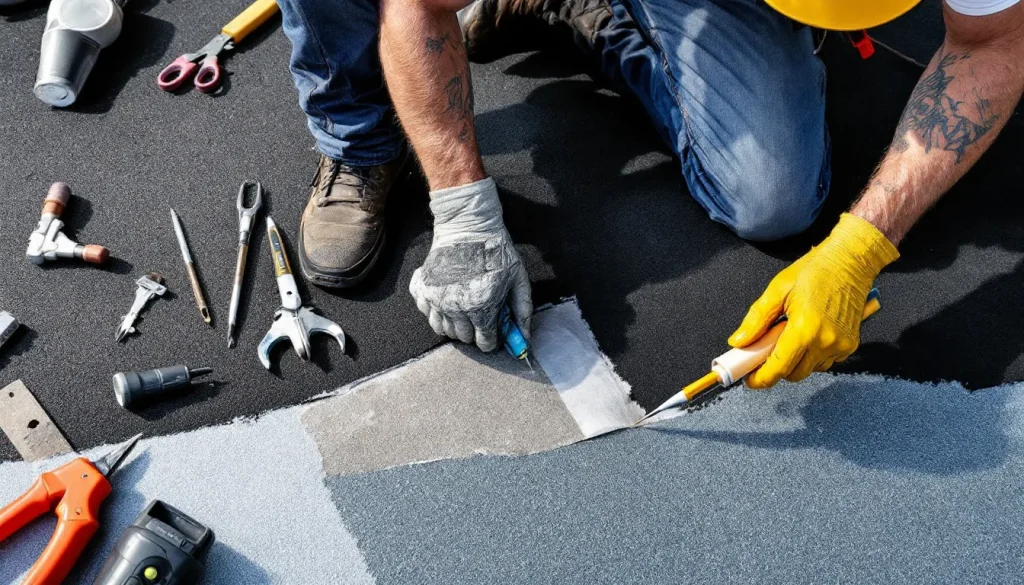
The flat roof repair cost (for the full data set, see our the full 2026 Roofing Cost Report) in 2026 ranges from $150 for a small membrane patch to $5,000 for a full section replacement, with the bulk of jobs falling in the $400 to $1,500 range. A simple membrane patch on TPO or EPDM runs $150 to $500. Seam reseal on a 10 to 20 foot run runs $300 to $800. Flashing repair at a parapet, curb, or penetration runs $400 to $1,200. A full section replacement (10 by 10 feet or larger area) runs $1,500 to $5,000 depending on insulation condition and access. The single largest variable on every job is whether the insulation underneath the failed area is wet, which can double the cost from a clean patch to a tear-back and replace.
The short version
- Membrane patch on TPO, EPDM, or PVC: $150 to $500 depending on size, access, and material.
- Seam reseal: $300 to $800 for 10 to 20 linear feet. Most common on aged EPDM with failed seam tape.
- Flashing repair at parapet, curb, drain, or penetration: $400 to $1,200. Hardest to price because labor varies with detail complexity.
- Full section replacement (10×10 or larger): $1,500 to $5,000, with wet insulation tear-out adding $1 to $3 per sq ft on the affected area.
- Service call minimum for most reputable commercial roofers is $400 to $600 even on a 30-minute job. Residential minimums run $250 to $400.
- Wet insulation under the failed area is the single biggest variable. A moisture survey or infrared scan is worth doing before any patch over 50 sq ft.
Short answer: what drives the price
Flat roof repair pricing flexes on five factors. Membrane (see our commercial roof repair costs) material (TPO and PVC are heat-welded and require a torch or hot-air welder, EPDM is patched with seam tape and primer, modified bitumen is torch-applied). Repair type (patch vs seam vs flashing vs full section). Insulation condition (dry vs wet). Access (single-story vs three-story with crane needed). And the contractor’s overhead structure (a one-truck independent vs a large commercial outfit with a service department).
The cost variance on the same job between contractors can run 2x. A small one-truck operator with low overhead may quote $400 for a TPO patch. A large commercial outfit with a service department, NDL warranty obligations, and a roving service truck may quote $800 for the same patch with documentation. Both can be the right answer depending on what you need.
Patch repair: the cheapest fix
A patch repair fixes a localized tear, puncture, or hole in the membrane. The damaged area is cleaned, the membrane is cut back to sound material, a patch of matching membrane is installed, and the patch is sealed to the field membrane.
TPO patch. $200 to $500. The patch is cut from a roll of matching TPO, primed if required, and heat-welded to the field membrane with a hot-air welder. The weld is tested with a probe tool to confirm a continuous bond. GAF EverGuard, Carlisle Sure-Weld, Versico, Mule-Hide, and Sika are all installed the same way.
EPDM patch. $150 to $400. The patch is cut from EPDM, the substrate is cleaned with EPDM cleaner, primer is applied (typically Carlisle CCW-702 primer or equivalent), seam tape is applied, and the patch is rolled down. Cure-in-place EPDM patches with self-adhesive backing are also common ($30 patch material for a 6×6 inch area, $200 to $400 installed).
PVC patch. $250 to $600. Heat-welded the same way as TPO. PVC requires a hotter weld and slightly different technique. Sika Sarnafil, IB Roof Systems, and Duro-Last are all PVC manufacturers with proprietary patch materials.
Modified bitumen patch. $200 to $500. Torch-applied or cold-adhered. The torch method requires a propane torch and gas cylinder on the roof, which not all building owners allow. Cold-adhered modified bitumen patches (Polyglass, Soprema, Henry) are slower to apply but eliminate the open-flame concern.
Seam repair: where most aged flat roofs fail
Seams are the weakest point on any flat roof. EPDM seams use seam tape and primer, both of which degrade over time. TPO and PVC seams are heat-welded, which is durable but can fail at the edge if the original weld was undersized or incomplete. Modified bitumen seams are torched, and seam failure shows up as edge separation.
Seam repair pricing:
| System | Seam length | Repair cost |
|---|---|---|
| EPDM, prime and re-tape | 10 linear feet | $300 to $500 |
| EPDM, prime and re-tape | 20 linear feet | $500 to $800 |
| TPO, heat-weld field seam | 10 linear feet | $350 to $600 |
| TPO, heat-weld field seam | 20 linear feet | $600 to $1,000 |
| PVC, heat-weld field seam | 10 linear feet | $400 to $700 |
| Modified bitumen, torch re-bond | 10 linear feet | $300 to $550 |
EPDM seam failure is the most common single-cause leak we see on flat roofs over 15 years old. The original Carlisle CCW-702 primer and seam tape lasted about 15 to 20 years before manufacturer reformulation around 2015. Pre-2015 EPDM roofs are seeing systemic seam failures right now.
Flashing repair: the hardest to price
Flashing repair covers any failure at a parapet, curb, drain, penetration, scupper, or wall transition. The price varies more than any other repair category because the labor is detail-driven and every situation is different.
Typical pricing:
| Flashing type | Repair cost |
|---|---|
| Drain flange seal repair | $300 to $600 |
| Scupper sleeve to membrane reseal | $400 to $800 |
| Pipe penetration boot replacement | $250 to $600 |
| HVAC curb flashing repair | $500 to $1,200 |
| Parapet wall base flashing repair (8 to 15 LF) | $600 to $1,500 |
| Counter flashing reglet reseal | $300 to $700 |
| Coping cap re-secure or replace | $400 to $1,200 |
Most flashing repair calls trace back to one of three root causes: original install detail incomplete (the most common), sealant failure at a counter flashing reglet (15 to 20-year cycle), or thermal cycling pulling base flashings off a wall. For the install-side detail, see parapet wall flashing, counter flashing, and apron flashing install.
Full section replacement: when patches stop making sense
A full section replacement removes a defined area of membrane, exposes the insulation and deck, replaces any wet or damaged insulation, and installs new membrane to match the existing field. Common when multiple patches and seam repairs in one area have not solved the leak, when the membrane is brittle and tearing easily, or when wet insulation is widespread.
Pricing for full section replacement:
| Area | Membrane | Cost |
|---|---|---|
| 10×10 ft (100 sq ft) | TPO with new insulation | $1,500 to $2,800 |
| 10×10 ft (100 sq ft) | EPDM with new insulation | $1,300 to $2,500 |
| 10×20 ft (200 sq ft) | TPO with new insulation | $2,500 to $4,500 |
| 10×20 ft (200 sq ft) | EPDM with new insulation | $2,200 to $4,000 |
| 20×20 ft (400 sq ft) | TPO with new insulation | $3,800 to $6,500 |
| 20×20 ft (400 sq ft) | PVC with new insulation | $4,200 to $7,200 |
At about 800 to 1,000 square feet of section replacement, the cost per sq ft converges with full roof replacement and the decision usually flips to replace. See flat roof replacement cost.
The wet insulation question
Every flat roof leak deposits water somewhere. Sometimes that water shows up at the ceiling inside, but often it sits trapped in the insulation between the membrane and the deck. Wet insulation loses 70 to 90 percent of its R-value, accelerates deck rot, and prevents proper bonding when you try to install a patch over it.
The way to find wet insulation:
Capacitance meter survey. Hand-held meter readings on a 5-by-5 foot grid. Cheapest survey method. $400 to $1,200 for a typical commercial roof. Identifies wet areas to within roughly 3 feet.
Infrared scan. Aerial or rooftop thermal imaging at dusk on a sunny day. Wet insulation radiates heat differently than dry. $800 to $3,000 for a typical commercial roof. Maps wet areas precisely.
Core sample. Cut a 6-by-6 inch hole through the membrane, pull the insulation, weigh it dry vs. wet, patch the hole. Definitive but invasive. $200 to $400 per core. Usually done in conjunction with one of the above.
If the moisture survey shows wet insulation, the patch becomes a tear-back. The wet insulation is removed, the deck is dried (or replaced if rotted), new insulation is fastened, new membrane is installed and welded to the field. Add $1 to $3 per sq ft of affected area to the patch cost.
Service call minimums and what they cover
Most reputable commercial roofers have a minimum service call charge that applies whether the job takes 10 minutes or 90. Typical minimums:
Independent residential roofer: $250 to $400 minimum, often with travel charge for jobs over 25 miles from the shop.
Mid-size commercial outfit: $400 to $600 minimum, includes one technician for up to 2 hours.
Large commercial service department (Tecta America, CentiMark, KPost, Korellis): $500 to $800 minimum, includes a service tech, documented inspection, and a written report.
The minimum covers truck rolls, mobilization, insurance, and overhead. Even a 15-minute fix in a busy shop carries the minimum because the shop only generates revenue when techs are on jobs, and dispatch costs are real.
Emergency vs scheduled repair
Emergency (see our emergency service for commercial buildings guide) repair (same-day or next-day, active leak with interior damage) runs 1.5 to 2x scheduled pricing. The premium covers overtime labor, schedule disruption, and the temporary fix that often goes in before the permanent repair.
A typical emergency call:
Day 1. Temporary patch with peel-and-stick membrane or roof cement to stop active water entry. $500 to $1,200 depending on size and access.
Day 7 to 30. Permanent repair installed when weather and schedule allow. Standard pricing for whatever the actual fix requires.
Building owners who only want to pay once should schedule a permanent fix as soon as the temporary holds. Leaving the temporary in place past 30 to 60 days defeats the value of the temporary and risks recurring leaks. See roof leak repair and how to fix a roof leak for the diagnostic side.
Material-by-material repair cost benchmarks
| Repair | TPO | EPDM | PVC | Mod-Bit | BUR |
|---|---|---|---|---|---|
| Small puncture patch (under 1 sq ft) | $200-$400 | $150-$350 | $250-$500 | $200-$400 | $250-$500 |
| Large patch (4-9 sq ft) | $350-$700 | $300-$600 | $400-$800 | $350-$700 | $400-$800 |
| Seam reseal (10 LF) | $350-$600 | $300-$500 | $400-$700 | $300-$550 | $400-$700 |
| Pipe boot replace | $250-$600 | $200-$500 | $300-$650 | $250-$550 | $300-$600 |
| Drain reseal | $300-$600 | $250-$550 | $350-$700 | $300-$600 | $350-$700 |
| HVAC curb flashing | $500-$1,200 | $400-$1,000 | $550-$1,300 | $450-$1,100 | $500-$1,200 |
| Parapet base flashing (10 LF) | $600-$1,500 | $500-$1,300 | $650-$1,600 | $550-$1,400 | $600-$1,500 |
How to read a repair quote
A good repair quote has five sections. The line items to look for:
Diagnosis. What is failing and where. Specific area, specific failure mode, photo documentation. Vague descriptions are a red flag.
Scope. Exactly what work is being performed. Materials specified by brand and product (Carlisle 60-mil TPO with Sure-Weld primer, not “TPO membrane”). Square footage of patch or linear footage of seam.
Exclusions. What is not covered. Wet insulation tear-out priced separately, deck repair extra if rot is found, additional work approved by change order. The honest quote names the unknowns up front.
Warranty. Length and scope of repair warranty. Typical is 1 to 5 years on patches and seams, 5 to 10 years on full section replacements. The warranty is on the repair area, not on the rest of the roof.
Price. Lump sum or time-and-materials. Lump sum is usually preferable on small jobs because it caps the cost. Time-and-materials is reasonable on diagnostic-heavy jobs where the scope is unclear until the contractor opens up the roof.
When to repair vs. when to replace
The repair-or-replace decision usually hinges on roof age, leak history, and dry insulation percentage:
| Roof age | Leak history | Dry insulation | Decision |
|---|---|---|---|
| 0 to 10 years | 1 to 2 leaks total | 95%+ | Repair |
| 10 to 15 years | 2 to 5 leaks total | 85%+ | Repair plus consider coating |
| 15 to 20 years | 3 to 8 leaks total | 75%+ | Coating restoration or partial replace |
| 20+ years | 5+ leaks | Under 75% | Full replacement |
| Any age | Active widespread leaks | Under 50% | Full replacement |
If you are leaning toward restoration instead of replacement, see flat roof coating restoration. If you are headed for full replacement, see flat roof replacement cost.
Insurance and repair
Storm damage repairs (hail, wind, fallen tree) are typically covered by commercial property insurance and homeowners insurance. Wear-and-tear repairs (failed seams, brittle membrane, aged flashing) are not covered, which is a common point of dispute on a commercial flat roof repair.
If you suspect storm damage:
Document the damage with photos before any repair. Include weather event date if known. Save any debris (broken seam material, blown-off flashing).
File the claim before the temporary repair. Insurers want to see the damage in its original state. A temporary tarp or patch over the leak is acceptable but document underneath first.
Get a written report from the roofer attributing the failure to a specific event. A causation letter is what the insurer needs to approve the claim.
See the broader flow at roof leak repair.
FAQs
How much does it cost to repair a flat roof?
$150 for a small patch to $5,000 for a full section replacement. Most repairs fall in the $400 to $1,500 range. Service call minimums run $250 to $600.
How long does a flat roof patch last?
A correctly installed patch on a sound membrane lasts the remaining life of the underlying membrane (often 10 to 20-plus years). A patch over wet insulation or failed substrate fails within 1 to 3 years.
Can I patch a flat roof myself?
Small EPDM patches with self-adhesive material are DIY-friendly if you can access the roof safely. TPO and PVC require a heat welder and welding skill. Most homeowners and building owners are better off calling a pro.
Why is flashing repair so expensive?
Detail labor. A pipe penetration or HVAC curb has many small geometric pieces. The work is fiddly, requires precise fit, and a single missed seam fails the whole repair. The labor time on a flashing repair often exceeds the labor on a much larger field patch.
Should I get a moisture survey before repairing?
For any repair over about 50 sq ft of affected area, yes. A capacitance survey is $400 to $1,200 and prevents the most common failure mode (patching over wet insulation).
What is the difference between patch and section replace?
A patch covers a localized failure (a tear, puncture, or small seam). A section replace removes all membrane in a defined area, addresses the insulation and deck underneath, and re-installs new membrane to match the field. Section replace runs 3 to 10x the cost of a patch but solves a broader failure.
Will my warranty cover repair cost?
Material warranties cover the material, not labor. Labor warranties cover both. NDL (No Dollar Limit) warranties cover both with no cap. Check the warranty type. Most repairs after year 5 to 10 are out-of-warranty even on roofs with 20-year coverage because of warranty type limitations.
Bottom line
Flat roof repair cost in 2026 ranges from $150 patches to $5,000 section replacements, with most jobs landing between $400 and $1,500. Routine flat roof maintenance catches most of these before they spread. The single largest variable is wet insulation under the failed area, which can double the cost from a clean patch to a tear-back. Get a moisture survey on anything over 50 sq ft of repair area. Vet the contractor’s repair warranty and ask for material spec by brand. If the roof is 15-plus years old with multiple leaks, run the math on repair vs. coating restoration vs. full replacement before committing to another patch. See flat roof coating restoration, flat roof replacement cost, and flat roof lifespan for the full decision tree.
Related reading: all roofing guides | flat roof types 2026 | flat roof materials compared | flat roof replacement cost | flat roof lifespan | flat roof coating restoration | ponding water flat roof | parapet wall flashing | roof leak repair | how to fix a roof leak | roof flashing repair