
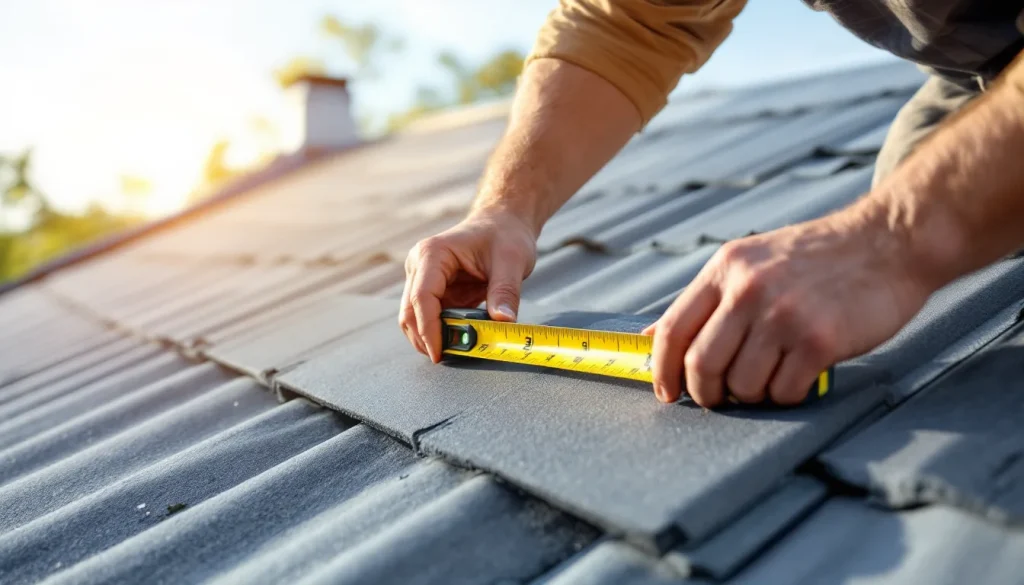
The how to calculate (see our the square footage calculator method guide) roof pitch question has three real answers in 2026: use a level and tape from the ridge or rake (free, accurate within 0.25 inch of rise per foot of run), measure the attic rafter against the floor or ceiling joist (free, accurate within 1/12 of a pitch unit), or use a smartphone app like Pitch Gauge or RoofR (free, accurate within 0.5 degrees). All three methods boil down to the same equation: pitch is the ratio of vertical rise to horizontal run, expressed as X/12. A 6/12 pitch means 6 inches of vertical rise for every 12 inches of horizontal run, which equals 26.6 degrees and a 50% slope. Knowing the pitch is required for any honest roof area calculation, shingle bundle estimate, or material order. Below are the methods, the conversion table, and the most common mistakes.
The short version
- Pitch is rise over run, expressed as X/12. 6/12 = 6 inches rise per 12 inches run.
- Method 1: level + tape from outside (most accurate, requires ladder access).
- Method 2: attic rafter to ceiling joist (works from inside, no ladder).
- Method 3: smartphone app (Pitch Gauge, RoofR, Smart Tool Pitch Locator). Accurate to 0.5 degrees.
- Common residential pitches: 4/12 (low slope), 6/12 (standard), 8/12 to 12/12 (steep).
- Pitch determines shingle type, walkability, code compliance, and roof area.
The math (formula)
Pitch (see our roof pitch calculator method) is simple ratio. The trade convention fixes the run at 12 inches and lets the rise vary.
Pitch = Rise / Run, expressed as X/12
Where Run = 12 inches (the trade standard)
So a 4/12 pitch means: 4 inches of rise for every 12 inches of horizontal run
In degrees: angle = arctan(rise/run). For 4/12: arctan(4/12) = 18.4 degrees
In percent slope: (rise/run) x 100. For 4/12: 33.3% slope
The X/12 notation is the US residential standard. Commercial roofing often uses degrees or percent slope. Steel building codes use percent slope. International roofing standards (Canada uses both, Europe uses degrees) often skip the rise/run convention entirely. The conversion table below covers all four notations.
Conversion table: pitch to degrees to percent slope to multiplier
| Pitch (X/12) | Degrees | Percent slope | Pitch multiplier | Classification |
|---|---|---|---|---|
| 1/12 | 4.8 | 8.3% | 1.003 | Low slope |
| 2/12 | 9.5 | 16.7% | 1.014 | Low slope (shingle minimum with caveats) |
| 3/12 | 14.0 | 25.0% | 1.031 | Low slope |
| 4/12 | 18.4 | 33.3% | 1.054 | Standard slope (shingle code minimum) |
| 5/12 | 22.6 | 41.7% | 1.083 | Standard slope |
| 6/12 | 26.6 | 50.0% | 1.118 | Standard slope (most common US residential) |
| 7/12 | 30.3 | 58.3% | 1.158 | Standard slope |
| 8/12 | 33.7 | 66.7% | 1.202 | Steep slope (walkable with caution) |
| 9/12 | 36.9 | 75.0% | 1.250 | Steep slope (harness required) |
| 10/12 | 39.8 | 83.3% | 1.302 | Steep slope (harness required) |
| 11/12 | 42.5 | 91.7% | 1.357 | Steep slope (harness required) |
| 12/12 | 45.0 | 100.0% | 1.414 | Steep slope (harness required) |
| 16/12 | 53.1 | 133.3% | 1.667 | Very steep (scaffold required) |
| 22/12 | 61.4 | 183.3% | 2.085 | Mansard lower (almost vertical) |
The pitch multiplier column converts horizontal footprint to actual sloped roof area, which is the key number for any material calculation. Our roof pitch chart shows the visual silhouette of each pitch class.
Worked example: 6/12 pitch on a level-and-tape
The cleanest measurement is from outside on the gable end, with a 24 inch level and a tape measure.
Step 1. Hold a 24 inch level horizontally against the rake board (the trim that runs from eave to peak on the gable end).
Step 2. The level extends 24 inches out from the rake. Measure vertically from the bottom of the level’s far end down to the rake surface.
Step 3. If the measurement is 12 inches over 24 inches of level, that is 12/24, which equals 6/12. The pitch is 6/12.
Step 4. Sanity check: 6 inches of rise per 12 inches of run gives a 26.6 degree roof and a 50% slope. That is the most common residential pitch in the US.
Vertical drop / horizontal level length x 12 = pitch as X/12
12 inches / 24 inches x 12 = 6, so the pitch is 6/12
Why use a 24 inch level instead of 12? Because the longer level averages out small irregularities in the rake surface (warped trim, raised nails, rake board butt joints). If your level is 24 inches, divide the measured rise by 2 to express it per 12 inches of run.
Method 1: level and tape from the rake (outside)
The standard pro method. Works from a ladder at the gable end, where the rake board gives a clean vertical reference. Takes 30 seconds once you are on the ladder.
What you need
- 24 inch level (a 12 inch level works but is less accurate)
- Tape measure or carpenter’s ruler
- Ladder
- Pencil and pad to record the number
Step by step
- Set the ladder against the gable end so you can reach the rake board.
- Hold the level horizontally against the rake, with one end touching the rake at the bottom.
- Bubble the level so it reads true horizontal.
- Measure vertically from the unsupported end of the level down to the rake.
- That vertical measurement, scaled to 12 inches of horizontal, is the pitch.
A 24 inch level reading 8 inches of drop is 8/24, which scales to 4/12. A 12 inch level reading 8 inches of drop is 8/12 directly.
Method 2: attic rafter (inside)
For homeowners who do not want to climb on a ladder or walk a roof. Works from the attic by measuring the rafter against a horizontal reference.
The attic workflow
- Find a clean exposed rafter in the attic (one without insulation packed against it).
- Hold a 24 inch level horizontally against the bottom of the rafter, with the level’s heel at the bottom of the rafter.
- Bubble the level true.
- Measure vertically from the unsupported end of the level to the underside of the rafter.
- That measurement, scaled to 12 inches of horizontal run, is the pitch.
The attic method works because the rafter run mirrors the roof slope above. Watch for ceiling joists (horizontal) and collar ties (horizontal near the peak). Measure against the rafter, not the joist.
Accuracy: 1/12 of a pitch unit, usually. Limited by attic clutter and lighting more than measurement error.
Method 3: smartphone app (Pitch Gauge, RoofR, Smart Tool)
The fastest method in 2026. Smartphone accelerometers are calibrated and accurate to 0.5 degrees on a clean surface.
The app options
- Pitch Gauge (free, iOS and Android): reads pitch in rise/run, degrees, and percent. Hold the phone against any sloped surface.
- RoofR app (free with paid Pro tier, $99 per month for Pro): pitch measurement plus satellite measurement and quoting.
- Smart Tool Pitch Locator ($40 to $60, physical tool): magnetic, sticks to any steel rafter or roof deck. Dial reads pitch directly.
- iOS Measure app (built in to iPhone): level/pitch function works in degrees, requires conversion to X/12.
- Bosch GAM 220 MF Digital Angle Finder ($90): digital readout, useful for verifying smartphone readings on high-pitch roofs.
Where to hold the phone
- Against the rake board on the gable end (best, smoothest reference).
- Against a rafter in the attic.
- Flat on the roof deck if you are doing post-tear-off measurement.
- Against a finished shingle surface (works but the shingle texture adds 0.5 to 1 degree of noise).
For homeowners who do not want to climb a ladder at all, the Pitch Gauge app held against a rafter visible from the attic gets you within 0.5 degrees. For homeowners checking a contractor’s quote, that is the easiest path.
How pitch changes everything downstream
Pitch is the input to four other measurements:
| Downstream measurement | Why pitch matters | Example |
|---|---|---|
| Roof area | Footprint x pitch multiplier = roof area | 2,400 sq ft x 1.118 (6/12) = 2,683 sq ft |
| Shingle bundles | Bundles = squares x 3 (or 4 for Class 4) | 27 squares x 3 = 81 bundles |
| Underlayment type | Below 4/12, code requires double-layer felt or membrane | 2/12 = ice/water membrane full coverage |
| Walkability and labor cost | Steep roof labor surcharge above 8/12 | 10/12 adds 25% to labor |
| Wind rating | Higher pitch handles wind uplift differently | 12/12 needs more fasteners per shingle |
| Code minimum | 4/12 minimum for asphalt shingles per IRC R905.2.2 | 3/12 needs special underlayment system |
Get the pitch wrong by 1/12 and your roof area calculation is off by 1% to 4%. Get it wrong by 2/12 and you are off by 5% to 10%. That difference is real bundles of shingles on a quote.
Worked example: how a 1/12 pitch error changes the bid
A 2,400 sq ft footprint house with a roof estimated at 6/12 vs actually 7/12:
- At 6/12: 2,400 x 1.118 = 2,683 sq ft. 27 squares. 81 bundles. With 10% waste: 30 squares, 90 bundles.
- At 7/12: 2,400 x 1.158 = 2,779 sq ft. 28 squares. 84 bundles. With 10% waste: 31 squares, 93 bundles.
The difference is 3 bundles, or about $130 to $180 in shingles. If labor is priced per square, the difference is another $200 to $350. Pitch error of 1/12 costs the homeowner or the contractor $400 to $500 on a typical bid. Worth measuring twice.
What to do if your roof has multiple pitches
Many residential roofs have more than one pitch. Common combinations:
- Main roof at 6/12 with a 4/12 porch addition
- House at 8/12 with a low-slope addition at 2/12
- Gambrel roof: 14/12 lower planes and 4/12 upper planes
- Mansard roof: 22/12 lower planes and 4/12 upper planes
- Hip with a gabled dormer at a different pitch
Measure each pitch zone separately and calculate the area separately. Multi-pitch roofs are where homeowners using the footprint method get into trouble. A satellite EagleView report measures every plane and pitch automatically, which is why it pays for itself on complex roofs.
Code minimums and pitch class
The IRC (International Residential Code, the basis for most US building codes) sets minimum pitches for each roofing material:
- Asphalt shingles: 2/12 minimum, but 2/12 to 4/12 requires double-layer underlayment or fully adhered ice/water membrane (IRC R905.2.2).
- Standing seam metal: 1/4 inch per foot (1/48) minimum for snap-lock, 1/2 inch per foot (1/24) for mechanical seam.
- Exposed fastener metal: 3/12 minimum.
- Clay or concrete tile: 2.5/12 minimum.
- Wood shake: 4/12 minimum.
- EPDM, TPO, PVC single-ply membrane: 1/4 inch per foot minimum (1/48).
If your roof is below the minimum pitch for the material you want, switch material or switch underlayment system. Installing asphalt shingles on a 2/12 roof without a fully adhered ice and water membrane voids the manufacturer warranty.
How pitch ties into the rest of the roof calculation
Pitch is the only variable that touches every downstream measurement, but it does not stand alone. The full chain runs: pitch in, multiplier out, multiplier times footprint, area in squares, squares times bundles per square, bundles times waste factor, bundles ordered. Drop the pitch number into the first slot wrong and the order at the end is wrong by the same percentage.
For a 2,400 sq ft footprint house, here is how each pitch changes the bundle count for standard architectural shingles with 10% waste:
- 4/12: 2,400 x 1.054 = 2,530 sq ft = 25.3 squares = 76 bundles, with 10% waste = 84 bundles
- 6/12: 2,400 x 1.118 = 2,683 sq ft = 26.8 squares = 81 bundles, with 10% waste = 89 bundles
- 8/12: 2,400 x 1.202 = 2,885 sq ft = 28.9 squares = 87 bundles, with 10% waste = 95 bundles
- 10/12: 2,400 x 1.302 = 3,125 sq ft = 31.3 squares = 94 bundles, with 10% waste = 103 bundles
- 12/12: 2,400 x 1.414 = 3,394 sq ft = 33.9 squares = 102 bundles, with 10% waste = 112 bundles
From 4/12 to 12/12, the same footprint produces 28 more bundles, a 33% difference. That is real money in shingles, labor, and tear-off charges. Walk the rest of the math in our how to calculate roof square footage guide, and our shingle bundle calculator for the final bundle order. The roof replacement cost calculator converts the bundle count into dollars by ZIP code.
Reading pitch off a contractor’s quote
A reputable quote should state the pitch (e.g. “Predominant pitch 6/12 with porch (see our porch roof build guide) at 4/12″). If the quote does not state pitch, ask. The pitch number lets you sanity-check the square footage and the steep-slope labor surcharge.
Watch for the steep-slope surcharge. Most contractors charge 25% to 50% more for labor on roofs above 8/12 because the crew works tied off, with toe boards, and slower. A 12/12 roof can easily cost 60% more in labor than a 6/12 roof of the same area. If a quote does not show a steep-slope adjustment on a roof you know is steep, the contractor either absorbed it or did not measure pitch correctly.
FAQ
What is the most common residential roof pitch in the US?
6/12 is the modal pitch on US residential homes. 5/12 and 7/12 are next most common. Anything below 4/12 starts to look obviously low slope. Anything above 9/12 is steep enough that homeowners notice the silhouette.
Can I calculate roof pitch from a photograph?
Within 1/12 if the photo is taken from straight on at the gable end. Use a level overlay or draw the rake angle in image software, then compare to the conversion table. The Pitch Gauge app has a photo-based pitch reader that handles this automatically.
What is the difference between pitch, slope, and angle?
Pitch is rise/run as X/12 (US residential standard). Slope is rise/run as a percent. Angle is the same ratio expressed in degrees. They are three notations for the same physical reality.
Does the eave overhang change the pitch?
No. The overhang is a horizontal extension of the roof past the wall, but the slope of the overhang is the same as the slope of the main roof. Pitch is constant across the entire plane.
Why is residential pitch expressed as X/12 instead of just degrees?
Historical carpentry convention. Framers cut rafters using a framing square, which has a 24 inch tongue and 12 inch heel marked in inches. Marking rise on the tongue against the run on the heel gave a direct cut angle without trigonometry. The convention stuck even as builders moved to digital tools.
Bottom line
Roof pitch is rise/run as X/12, with 4/12 to 6/12 being the most common residential range. Three methods to measure: level and tape from outside (gold standard), attic rafter from inside (no ladder needed), smartphone app like Pitch Gauge (fastest). All three should agree within 0.5 of a pitch unit. The conversion table in this article handles every standard pitch from 1/12 to 22/12, including the multiplier you need for area calculation. Get the pitch right and the rest of your roof math (area, bundles, labor) follows from a single multiplication. Get the pitch wrong and you compound error through every downstream number. Measure twice. Use the smartphone app and the level-and-tape together for any quote above $10,000.