
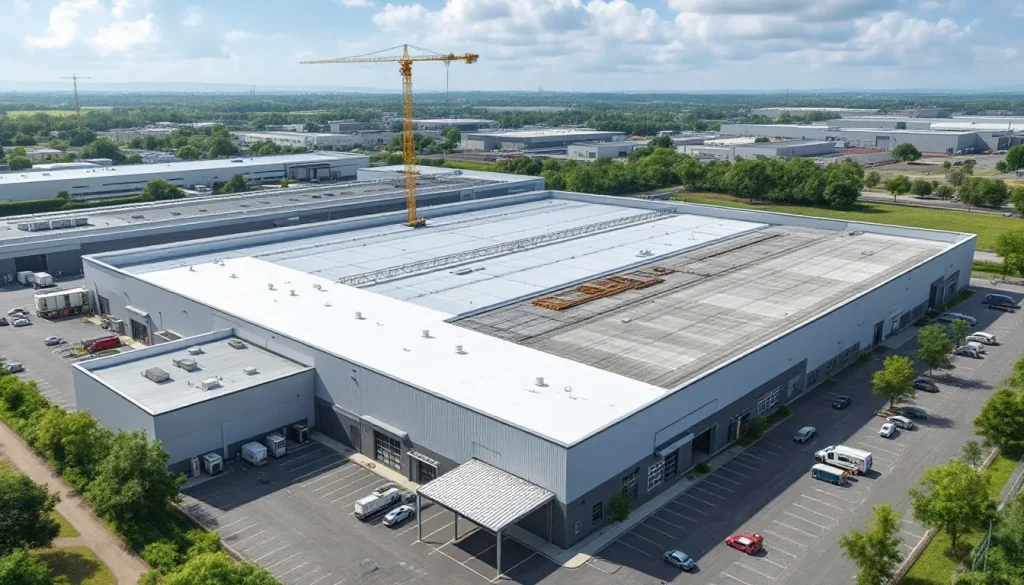
Quoting industrial roof replacement cost in 2026 requires building owners to think in three dimensions at once: the per-square-foot cost of the system itself, the operational continuity cost of working over an active facility, and the phasing logic that lets the project happen without shutting down the building. A warehouse roof replacement at $7.50/sq ft sounds straightforward until the facility manager realizes the tenant runs 24/7 and the project actually needs to be priced as a 14-month phased zone replacement with weekend-only tear-off windows. This guide walks through per-square-foot replacement cost by industrial building type, the phasing logic, the access and crane budget, and the tenant continuity planning that separates honest quotes from underpriced ones.
Last reviewed: August 2026.
Per-square-foot replacement cost by industrial system
The most common industrial roof systems in 2026 are TPO single-ply (warehouses, distribution, light manufacturing), PVC single-ply (food, chemical, pharmaceutical manufacturing), modified bitumen and BUR (legacy industrial, retrofit-over situations), insulated metal panel (cold storage, freezer, refrigerated distribution), and standing seam metal (institutional industrial, long-hold facilities). Pricing varies widely by system, mil thickness, attachment method, insulation R-value, and project size.
Warehouse TPO replacement. $6.00 to $10.00 per square foot for 60-mil mechanically attached TPO over ISO insulation board. Leading systems are Carlisle Sure-Weld TPO, GAF EverGuard TPO, Versico VersiWeld, and Holcim/Firestone UltraPly TPO. Most warehouse replacements in 2026 are landing at $7.00 to $8.50/sq ft on projects over 200,000 sq ft, with smaller projects (under 100,000 sq ft) running 10-15% higher per square foot due to mobilization overhead.
Manufacturing PVC replacement. $9.00 to $15.00 per square foot for 60-mil PVC over ISO insulation. Sika Sarnafil S327 is the dominant spec on high-stakes manufacturing (pharmaceutical, biotech, food processing) and lands at $12.00 to $18.00/sq ft installed. Carlisle Sure-Flex, IB Roof Systems, and Duro-Last PVC run $9.00 to $14.00/sq ft. The cost premium over TPO buys chemical resistance, longer welding integrity, and pre-fabricated detail accessories.
Cold storage IMP replacement. $16.00 to $26.00 per square foot installed. The cost driver is not the panel material (which runs $12 to $22 per square foot of panel face); it is the freezer-down logistics, temperature control, inventory relocation, and re-commissioning. A single freezer warehouse roof replacement can run $20 to $30/sq ft once all operational costs are loaded. For owners with multiple freezer bays, phased replacement one bay at a time keeps unit cost in the $16-22/sq ft range.
Modified bitumen replacement. $6.50 to $9.50 per square foot for two or three-ply mod-bit from Soprema, IKO, Henry, or Polyglass. Often spec’d on retrofit-over-existing scenarios where tear-off is not feasible.
Standing seam metal industrial replacement. $11.00 to $18.00 per square foot installed depending on panel gauge and finish. Used on long-hold institutional industrial buildings, agriculture, and any roof where 40-50+ year service life is the requirement. Our commercial metal roof guide covers the metal market in depth.
| Industrial system | Typical building type | Installed cost per sq ft |
|---|---|---|
| Warehouse TPO (60-mil) | Warehouses, distribution, light manufacturing | $6.00 to $10.00 |
| Manufacturing PVC (60-mil) | Food, chemical, pharmaceutical manufacturing | $9.00 to $15.00 |
| Cold storage IMP | Cold storage, freezer, refrigerated distribution | $16.00 to $26.00 |
| Modified bitumen | Legacy industrial, retrofit-over situations | $6.50 to $9.50 |
| Standing seam metal | Institutional industrial, long-hold facilities | $11.00 to $18.00 |
Warehouse roof replacement: TPO or EPDM, $6-10/sq ft
The typical 2026 warehouse roof replacement is 60-mil TPO mechanically attached over 4 to 6 inches of polyiso insulation, installed over an existing metal deck or concrete deck. The replacement scope includes tear-off of the existing membrane and insulation, deck repair where needed, new vapor barrier (in some climates), new tapered insulation to direct water to drains, new membrane, new edge metal and termination detail, new penetration flashings, and the ten thousand small detail items that determine whether the install lasts 22 years or 14.
For warehouse owners considering EPDM instead of TPO, the math at $7-9/sq ft EPDM vs $7-8.50/sq ft TPO is close enough that the decision usually comes down to climate (EPDM in heating-dominated climates), tenant preference (some tenants will not accept a non-reflective roof for cooling load reasons), and energy code (most jurisdictions now mandate cool roof on commercial new construction and major reroof). The TPO vs EPDM comparison covers the system-by-system decision logic.
The full warehouse replacement cost breakdown including insulation R-value cost premium and phased zone logistics is in our commercial roof replacement cost guide.
Manufacturing roof replacement: PVC dominates, $9-15/sq ft
Manufacturing facilities with chemical exposure (cleaning solvents, machining oils, food processing residues, lab fume hood discharge, kitchen exhaust grease) almost always spec PVC for the replacement system, not TPO. TPO weakens with prolonged chemical exposure; PVC holds up. Sika Sarnafil S327, Carlisle Sure-Flex, IB Roof Systems, and Duro-Last all carry 25 to 30-year manufacturer warranties on properly installed manufacturing roofs.
The PVC manufacturing replacement scope adds two complications beyond a typical warehouse: (1) detail flashing requirements around process exhaust, dust collection ductwork, and chemical vent stacks are tighter than a generic commercial roof and require manufacturer pre-fabricated accessories, and (2) hot work restrictions are stricter. Many manufacturing facilities allow zero daytime hot work and require night or weekend installation windows, which adds 35-50% in labor premium. Our 24/7 emergency commercial roof repair guide covers the off-hours mobilization premium math.
Cold storage replacement: IMP, $16-26/sq ft, the freezer-down problem
Cold storage roof replacement is the most expensive industrial roofing work in the building, and the cost is driven almost entirely by operational logistics rather than by the panel itself. An IMP panel runs $12-22 per square foot of panel face. The installed roof cost is $16-26/sq ft. The remaining $4-8/sq ft on top of installed cost is everything else: temperature control during the work, inventory relocation, third-party cold storage rental during downtime, re-commissioning the refrigeration system, and the operational disruption cost the facility absorbs.
For cold storage owners, the strategic question is not just “how much does the replacement cost” but “what is the freezer-down plan.” Options include: (1) phased bay replacement with operational bays absorbing inventory from down bays (lowest cost, longest schedule), (2) full facility shutdown with inventory relocated to a third-party cold storage facility (highest cost, fastest schedule), or (3) overlay replacement where new IMP is installed over the existing without full tear-off (intermediate cost, requires structural deck assessment).
The right answer depends on tenant flexibility, third-party cold storage availability in the market, seasonal volume cycle (replacing during the tenant’s slow season is meaningfully cheaper), and the structural capacity of the existing deck. Cold storage replacement quotes that do not break out these operational scenarios are not honest quotes. They are placeholders that will change-order on the back end.
Phased zone replacement: how industrial replacements actually happen
The hidden truth of industrial roof replacement in 2026 is that almost no industrial roof gets replaced in a single continuous project. Distribution centers, manufacturing plants, and cold storage all run on operational schedules that cannot accommodate a 250,000-sq-ft simultaneous tear-off. The work happens in phased zones, typically 30,000 to 80,000 sq ft per zone, scheduled around the tenant’s operational calendar.
A 600,000-sq-ft distribution center might be replaced over 18-24 months in 8 to 12 phased zones, with each zone scheduled around dock activity, tenant seasonal volume, and weather windows. The per-square-foot cost on a phased replacement is typically 8-15% higher than a continuous replacement (more mobilizations, more tie-in detail work between phases, more zone-edge weatherproofing). The trade-off is full tenant continuity, no shutdown, and no inventory relocation cost.
The phasing plan should be developed jointly by the roofing contractor, the facility manager, and the tenant operations lead before any work starts. Phasing decisions made by the contractor alone almost always create operational friction that costs more than the phasing premium itself.
Crane and access cost: the line item most quotes hide
Industrial roof replacement requires equipment on the roof: insulation board, membrane rolls, fasteners, edge metal, mechanical equipment if HVAC is being relocated. All of it goes up by crane or by lift, and the access budget is its own line item.
Crane rental with operator. $2,500 to $6,500 per day depending on capacity and reach. A typical industrial replacement uses crane time for material staging on multiple days across the project.
Articulating boom lift. $800 to $2,200 per day for 60-foot reach, $1,400 to $3,500 per day for 80-100 foot reach on tall warehouses or multi-story manufacturing.
Scissor lift for interior tear-off coordination. $400 to $900 per day, used when ceiling tile removal or interior protection requires access from below.
Material conveyor (for high-volume material movement). $1,200 to $3,500 per day, used on large phased projects where crane time per move is uneconomical.
The total access budget on a 200,000-sq-ft phased replacement can run $35,000 to $120,000 spread across the project duration. Quotes that lump access into a single overhead line are hiding this; quotes that itemize crane and lift mobilization by day are being honest.
Tenant continuity planning: water control, hot work, fire watch
An active industrial facility cannot afford a sudden rainstorm hitting an open tear-off zone. Every phased industrial replacement needs a water-control plan, which typically includes: (1) daily tear-off limit (only as much area opened as can be made watertight before end of shift), (2) tarp-and-pump staging for unexpected weather, (3) interior protection at the production floor below the work area, and (4) leak response protocol with notifications to the tenant operations lead.
Hot work permits and fire watch are non-negotiable on most industrial roofs. Torch-down membrane application or hot-air welding above an active production floor requires a permitted hot work area, fire watch personnel (often 1 fire watch per 2-3 roofers), and coordination with the facility fire suppression system. Some tenants (chemical, fuel, food, pharmaceutical) prohibit torch work entirely and require cold-applied or self-adhered systems.
The continuity planning costs $0.20 to $0.65 per square foot loaded across the project. It is a line item that needs to appear on the quote, not a vague allowance. Our commercial roof maintenance program guide covers the full tenant continuity planning workflow.
BAS reroofing: building automation system coordination
Modern industrial buildings have rooftop HVAC, exhaust, dust collection, fire suppression, and lightning protection that are integrated into a building automation system (BAS). Reroofing requires coordinating with BAS for: (1) HVAC unit lift-and-relocate or curb adapter installation, (2) duct seal-off and re-commissioning, (3) fire suppression and life-safety system re-integration, and (4) lightning protection system re-bonding to the new edge metal.
BAS coordination on a 200,000-sq-ft manufacturing reroof can add $50,000 to $200,000 to the project depending on the number of rooftop units, the complexity of the existing integration, and whether new BAS programming is required for relocated equipment. This is a separate budget line item, often handled by the building’s BAS contractor working in parallel with the roofing contractor.
Tear-off and disposal: the line item that swings 15% of cost
Tear-off of the existing roof system and landfill disposal is one of the most variable cost lines on an industrial replacement. Tear-off cost depends on the existing system (single-ply is cheaper to remove than BUR), the number of layers (a single-layer tear-off is much cheaper than a multi-layer tear-off), the deck condition (corroded metal deck or rotted wood requires structural deck repair before new install), and the landfill tipping fee in the local market (varies from $35 to $145 per ton depending on region).
Single-ply tear-off and disposal. $0.65 to $1.45 per square foot. The cheapest tear-off scenario.
Modified bitumen tear-off and disposal. $0.95 to $1.85 per square foot. Heavier material, more disposal volume.
BUR tear-off and disposal. $1.45 to $3.25 per square foot. Multi-ply asphalt-and-felt systems weigh significantly more per square foot than single-ply, and asphaltic material carries higher landfill tipping fees in some jurisdictions.
For industrial roofs where tear-off cost is prohibitive (multi-layer BUR on a sound deck with no moisture issues), recover-over installation can be a viable alternative at significantly lower cost. Recover-over keeps the existing roof in place and installs a new membrane system over the existing assembly with a separator board between. The savings on tear-off and disposal often run $1.50 to $3.50 per square foot, which can fund upgraded insulation R-value or longer-warranty membrane spec.
Insulation R-value and energy code on industrial replacement
Industrial buildings have meaningful heating and cooling loads, and the insulation R-value on a roof replacement drives long-term operating cost as well as initial installed cost. Current 2026 energy code in most jurisdictions requires R-25 to R-30 on commercial roof replacement.
For climate-controlled industrial buildings (manufacturing with temperature requirements, food processing, pharmaceutical), the practical insulation spec is often R-30 to R-38, well above code minimum. The cost premium over code-minimum insulation runs $0.30 to $1.10 per square foot, and the payback in reduced HVAC operating cost typically falls in the 4-8 year range on climate-controlled industrial.
Cold storage replacement is the extreme case, where IMP panels deliver R-32 to R-48 in the panel itself and no separate insulation layer is needed. This is one of the reasons IMP economics work despite the high installed cost: the panel does double duty as weather barrier and primary thermal envelope.
Manufacturer warranty preservation on industrial replacement
Industrial roofs are almost always specified with a 25 or 30-year NDL (no dollar limit) manufacturer warranty. The warranty terms gate on: (1) certified contractor status with the specific manufacturer, (2) manufacturer-specified materials throughout the assembly (no substitute insulation, no off-brand edge metal, no generic fasteners), (3) third-party warranty inspection by the manufacturer or their agent before warranty is issued, and (4) annual or semi-annual inspection by the certified contractor for the warranty term.
Building owners should require in the quote: which manufacturer the certified contractor is certified by, which warranty tier the project is being installed to, what the warranty inspection cost is for the warranty term, and what the warranty preservation obligations are. Our commercial roof warranty guide covers the warranty terms across the major manufacturers.
Replacement vs restoration on industrial roofs
For industrial roofs in the back end of service life but with structurally sound substrate, restoration coating at $2.50-5/sq ft can extend life 10-15 years and defer the replacement capital. The decision turns on substrate condition (less than 15% wet insulation, sound deck, intact membrane), tenant continuity (coating is less disruptive than tear-off), and owner hold period (restoration works best when hold period is shorter than replacement service life). The full restoration cost analysis is in our commercial roof restoration cost guide.
For industrial roofs that have crossed the line (extensive wet insulation, decking corrosion, widespread membrane failure, ponding water across more than 10% of roof area), restoration is throwing good money after bad. Replacement is the financially correct call, and the planning timeline should start 18-24 months before the planned tear-off so phasing, BAS coordination, and tenant continuity planning have time to develop properly. Industrial roof replacement done with adequate planning runs at the lower end of the cost ranges in this guide. Done as an emergency response to systemic failure, it runs at the high end or beyond. Honest industrial roofing contractors will be transparent about which scenario the owner is buying into. The industrial roof replacement overview covers the full planning workflow.
Industrial roof replacement: frequently asked questions
How much does industrial roof replacement cost per square foot in 2026?
It depends on the system and building type. Warehouse TPO runs $6.00 to $10.00 per square foot, manufacturing PVC runs $9.00 to $15.00, cold storage IMP runs $16.00 to $26.00, modified bitumen runs $6.50 to $9.50, and standing seam metal runs $11.00 to $18.00. Smaller projects under 100,000 sq ft run 10-15% higher per square foot due to mobilization overhead.
Why is cold storage roof replacement the most expensive?
The cost is driven by operational logistics, not the panel. An IMP panel runs $12 to $22 per square foot of panel face, but installed cost reaches $16 to $26/sq ft. The extra $4 to $8/sq ft covers temperature control during the work, inventory relocation, third-party cold storage rental, and re-commissioning the refrigeration system after the roof is closed in.
Can an industrial roof be replaced without shutting down the facility?
Yes. Almost no industrial roof is replaced in one continuous project. The work happens in phased zones of 30,000 to 80,000 sq ft, scheduled around the tenant’s operational calendar. A 600,000-sq-ft distribution center might be replaced over 18-24 months in 8 to 12 zones. Phasing adds 8-15% to per-square-foot cost but avoids shutdown and inventory relocation.
Should a manufacturing roof use TPO or PVC?
Manufacturing facilities with chemical exposure such as solvents, machining oils, food residues, or fume hood discharge almost always spec PVC. TPO weakens with prolonged chemical exposure while PVC holds up. PVC runs $9.00 to $15.00 per square foot versus TPO, and the premium buys chemical resistance, longer welding integrity, and pre-fabricated detail accessories around exhaust and vent stacks.
Is recover-over cheaper than a full tear-off?
Yes, when the existing roof is on a sound deck with no moisture issues. Recover-over keeps the existing assembly in place and installs a new membrane over a separator board. Savings on tear-off and disposal run $1.50 to $3.50 per square foot, which can fund upgraded insulation R-value or a longer-warranty membrane spec instead of paying for demolition and landfill disposal.
What insulation R-value does 2026 energy code require?
Most jurisdictions require R-25 to R-30 on commercial roof replacement in 2026. Climate-controlled industrial buildings such as food processing and pharmaceutical facilities often spec R-30 to R-38, above code minimum. That premium costs $0.30 to $1.10 per square foot with a 4-8 year payback. Cold storage IMP panels deliver R-32 to R-48 in the panel itself, needing no separate insulation layer.