
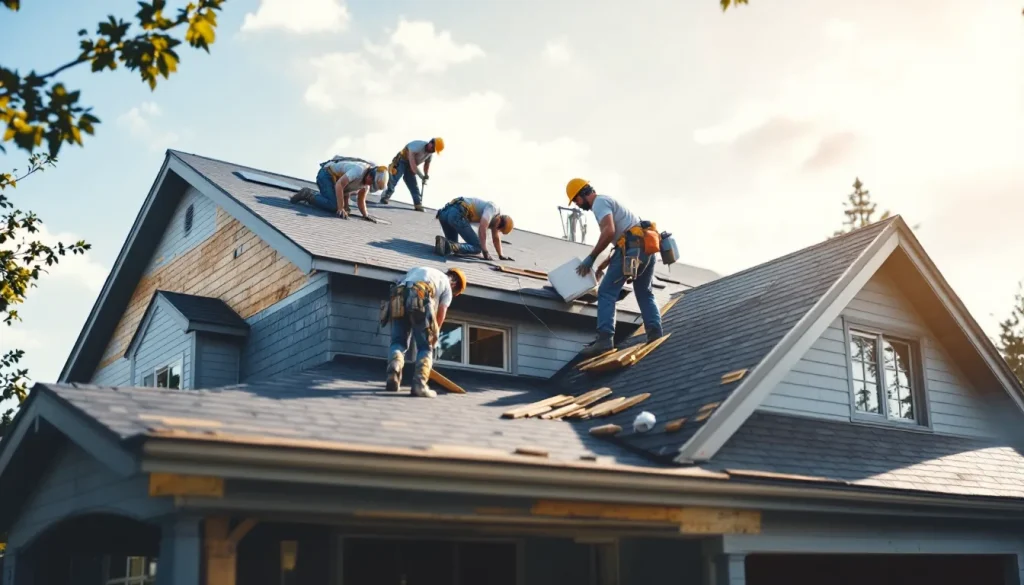
The average cost (for the full data set, see our the full 2026 Roofing Cost Report) to replace roof in 2026 on a typical 2,000 square foot one-story U.S. home with architectural asphalt shingles is $16,500, and that number is more useful than it looks because it sits inside a tight band. About 70% of standard reroofs in this size range land between $13,500 and $19,500. The other 30% are pulled either lower (small, simple, low-pitch roofs in low-cost-of-labor markets) or higher (large, complex, steep-pitch roofs in high-cost markets, or premium materials beyond asphalt). This guide breaks out the national average by region, by home size, and by material, so the homeowner reading three quotes can see whether they are inside the band or outside it.
Last reviewed: August 2026.
The 2026 national average, by the numbers
The benchmark figure: 2,000 square feet of conditioned floor area, single story, 6/12 pitch, standard rectangular footprint, architectural (for the full data set, see our the 2026 Shingle Brand Comparison Report) asphalt shingles (GAF Timberline HDZ, Owens Corning Duration, or CertainTeed Landmark grade), full tear-off, synthetic underlayment, ice and water shield at eaves and valleys, new drip edge, new flashing where required, ridge vent, four vent boots replaced, full magnetic sweep cleanup, and permit pulled. Installed by a licensed and insured contractor.
That job, nationally averaged in 2026, costs $16,500. About 22 squares of roof area (because a 2,000 sq ft footprint at 6/12 pitch is 22.4 squares of roof surface), at a blended labor and material cost of around $735 per square. The per-square framework is covered in our cost per square reference and the cost per square foot companion.
Regional cost variation
Northeast (Boston, NYC, Philadelphia, NJ, CT): +25% to +30%
A 2,000 sq ft asphalt reroof (see our tear-off and reroof pricing) in the Northeast typically runs $20,500 to $22,000. Labor rates are 30% to 40% higher than national average, ice and water shield requirements extend further up the slope (2 feet past the interior wall plane is the IRC minimum, but local codes often require 3 feet or full eave-to-ridge in heavy snow load zones), and snow guards or snow rails on certain roof sections add line items. Underlayment specifications often call for full synthetic across the entire deck rather than felt-and-ice-and-water hybrid.
Midwest (Chicago, Detroit, Indianapolis, Cleveland, St. Louis, Minneapolis, Kansas City): baseline
A 2,000 sq ft asphalt reroof in the Midwest runs $14,500 to $17,500. This is the closest region to the national average. Labor markets are stable, permit costs are predictable ($150 to $350), and material distribution through ABC Supply, Beacon, and SRS is dense, keeping wholesale shingle prices near national average. Cold-climate detail work (ice and water shield, ice dam membrane in valleys) adds 5% to 8% versus the warm-climate equivalent.
Southeast inland (Atlanta, Charlotte, Nashville, Birmingham): baseline to -10%
Inland Southeast runs $13,500 to $16,500. Year-round installation seasons mean stable labor utilization, and competition is high in most metros. Algae-resistance becomes a higher priority spec (StainGuard Plus AR on GAF, StreakGuard on OC, StreakFighter AR on CertainTeed), which is included in the standard architectural lines, so it is a spec decision not a price decision.
Florida and Gulf Coast: +15% to +25%
A 2,000 sq ft asphalt reroof in Florida runs $18,500 to $21,000. The Florida Building Code requires specific product approval (FPA) numbers for every shingle, underlayment, ridge cap, and fastener used. High Velocity Hurricane Zone (HVHZ) counties (Miami-Dade, Broward, Monroe) require additional sealed product approval packages and a higher fastening pattern (6 nails per shingle, not 4). Permit fees are higher ($400 to $1,200) because of the wind mitigation review. Insurance (for the full data set, see our the 2026 State of Roofing Insurance report) reform under AOB regulation has driven contractor compliance costs up. See our Florida AOB reform guide for the regulatory context and the Florida roofing contractor license primer for the contractor side.
West Coast (Seattle, Portland, San Francisco, Los Angeles, San Diego): +15% to +25%
$19,000 to $21,500 for the same job. Labor rates are high, permit and plan check fees are stacked (especially in coastal California with Title 24 cool-roof verification), and disposal fees are notably higher than other regions. The Pacific Northwest adds detail for moss-prone north slopes (zinc strips, chemical treatment). The California C-39 license guide covers the contractor side.
Mountain West and Plains (Denver, Salt Lake City, Phoenix, Las Vegas, Albuquerque, Oklahoma City, Dallas): -5% to +5%
$15,000 to $17,500. Hail markets (Denver, Dallas, Oklahoma City) often quote Class 4 impact-resistant shingles as the default rather than upgrade, which adds $1,500 to $3,000 to the base price but is offset by an insurance discount of 10% to 30% on annual homeowner premiums. See our Class 4 impact-resistant shingles guide.
Cost by home size
Roof surface scales roughly with footprint, with a small premium for the fixed costs of mobilization, dump trailer, permit, and crew setup. The pitch multiplier amplifies large homes because total roof surface grows faster than footprint when pitch is steep. See our roof square footage calculator method for the pitch math.
- 1,200 sq ft footprint (typical starter home or small ranch): $8,500 to $11,500
- 1,500 sq ft footprint (smaller two-story or mid-size ranch): $11,500 to $14,500
- 2,000 sq ft footprint (national average benchmark): $13,500 to $19,500
- 2,500 sq ft footprint (larger ranch or smaller two-story): $17,000 to $22,000
- 3,000 sq ft footprint (typical larger two-story or sprawling ranch): $20,000 to $26,000
- 3,500 sq ft footprint (large two-story with garage): $24,500 to $32,500
- 4,000+ sq ft (large custom homes, often with complex roof geometry): $30,000 to $50,000+
Complexity drives the upper end of each band: roof with 3 or more dormers, multiple intersecting hips, mansard sections, cricket framing at chimneys, or skylight count above 4. A simple gable on a rectangular footprint is the lower end. The roof replacement cost calculator walks through the math for the homeowner working a specific quote.
Cost by material
Material choice is the single biggest lever on reroof price. On the same 2,000 square foot job, architectural asphalt sets the $16,500 baseline, standing seam metal runs 60% to 90% higher, clay or concrete tile 90% to 150% higher, cedar shake 80% to 120% higher, and natural slate 150% to 300% higher. The table below compares typical installed cost against that asphalt baseline.
| Roofing material | Typical installed cost (2,000 sq ft roof) | Change vs architectural asphalt |
|---|---|---|
| Architectural asphalt (baseline) | $16,500 | Baseline |
| Three-tab asphalt | About 80% of architectural | About -20% |
| Standing seam metal | $26,500 to $32,000 | +60% to +90% |
| Clay or concrete tile | $30,500 to $42,000 | +90% to +150% |
| Cedar shake | $28,000 to $35,000 | +80% to +120% |
| Synthetic slate | $25,000 to $35,000 | Value alternative to natural slate |
| Natural slate | $40,000 to $65,000+ | +150% to +300% |
Architectural asphalt: baseline
The $16,500 national average is built on architectural asphalt at 22 squares of roof area. Three-tab asphalt (the lower grade) runs about 80% of architectural cost but only delivers 15 to 20 years of life versus 25 to 30 for architectural, and is increasingly out of code in wind-exposed regions.
Metal: +60% to +90%
Standing seam metal on the same 2,000 sq ft footprint typically runs $26,500 to $32,000 with a 24-gauge Galvalume standing seam panel (Drexel Metals, McElroy, Englert). Stamped metal shingle (interlocking aluminum or steel) is closer to +40% to +60% over asphalt. Metal life is 40 to 70 years depending on coating.
Tile (clay or concrete): +90% to +150%
Clay tile or concrete tile in the Sun Belt runs $30,500 to $42,000 on the 2,000 sq ft job. Structural considerations matter: tile weighs 800 to 1,100 pounds per square versus 240 to 300 for asphalt, so older homes may need framing reinforcement. Tile lasts 50 to 100 years.
Slate: +150% to +300%
Natural slate runs $40,000 to $65,000+ on the same job. Salvage slate from quarries in Vermont, New York, and Virginia is the U.S. supply. Synthetic slate (DaVinci, CertainTeed Symphony) runs $25,000 to $35,000 and is the value alternative.
Cedar shake: +80% to +120%
Cedar shake or shingle runs $28,000 to $35,000 on the 2,000 sq ft job. Climate sensitivity is real (wet northeast climates accelerate replacement at 25 to 30 years; dry Mountain West climates can stretch to 40+ years). Some HOAs and fire-restriction jurisdictions ban cedar entirely.
What drives the high end of the band on the same job
Two identical-looking homes on the same street can get bids $5,000 apart on a reroof. The reasons are almost always one of these six factors.
Pitch. A 4/12 roof is walkable with no fall protection beyond standard. A 9/12 or 10/12 roof needs harnesses, anchors, and slower work. Add 15% to 25% for steep pitch. A 12/12 or steeper is a specialty job that adds 30% to 50% in labor.
Story count and access. A two-story home with limited yard access (no driveway dump trailer placement, hand-carry shingles up ladders) adds 10% to 15% over the equivalent ranch. A three-story or homes on tight urban lots can add 20% to 25%.
Tear-off (see our reshingle vs replace cost) layer count. Most reroofs are removing one shingle layer. If the inspection shows two layers (a layover was done previously), tear-off labor and dump fees roughly double, adding $1,200 to $2,400.
Decking condition. Quotes include a decking allowance for damaged sheets (typically 1 to 3 sheets at $75 to $120 each). Roofs with widespread rot, undersized decking (3/8 inch in older homes), or a non-conforming substrate (plank decking with gaps too wide for modern fasteners) can require partial or full deck replacement at $1.50 to $3.50 per square foot.
Chimney and skylight count. Every chimney is $400 to $1,200 in flashing work. Every skylight is $300 to $800 to reflash or replace the curb. Three chimneys and four skylights add $3,000 to $6,000 over a roof with no penetrations.
Roof complexity (dormers, hips, valleys). A simple gable is the baseline. Every dormer adds material waste and labor for tie-in detail (typically $200 to $500). Cross-hip roofs and roofs with multiple intersecting valleys add 10% to 20% in material waste and labor.
What is and is not included in a typical quote
A complete reroof quote should include: full tear-off down to deck, decking allowance per sheet replacement (typically $75 to $120 per sheet for OSB or plywood), synthetic underlayment, ice and water shield to local code, new drip edge, replacement of all step and counter flashing, ridge vent or other ventilation system, pipe and vent boot replacements (3 to 6 typical), new shingles per spec, magnetic sweep cleanup, permit, and disposal.
What is usually not included: skylight replacement, chimney crown or cap rebuilds, gutter replacement (separate scope), solar panel removal and reinstallation, structural framing repairs beyond decking, and HVAC penetration relocation. These are scope adders that should be priced separately. See our cost to redo roof guide for the line item detail.
How to read three quotes
Quotes within 15% of each other on the same scope are typically all legitimate, and the choice comes down to contractor certification, workmanship warranty length, and reference quality. A quote 25% below the others is almost certainly missing scope (smaller underlayment package, layover instead of tear-off, no decking allowance, no permit) or running uninsured. A quote 25% above the others is either upgrading material (higher-end shingle line, longer workmanship warranty) or pricing in complexity the lower bids missed (steep pitch surcharge, dormer count, chimney work).
The pricing band is real and predictable. Three quotes that span $15,000 to $19,000 in the Midwest on a standard 2,000 sq ft asphalt reroof are all in bounds, and the decision is made on workmanship warranty and contractor credentials, not price. See our roof installation contractor hiring guide for the credential checklist that goes alongside the cost comparison.
Financing the reroof, briefly
The 2026 reroof market offers four common payment paths. Cash from savings is the cleanest and avoids interest charges. Home equity line of credit (HELOC) at 8% to 9.5% APR is the most common financing source for projects in the $15,000 to $30,000 range. Manufacturer-backed financing through GAF, OC, or CertainTeed contractor programs (often 0% promotional for 12 to 24 months, then converting to standard rate) works for shorter-tenure homeowners. Contractor-offered third-party financing through companies like GreenSky or Service Finance Company is fast but typically carries higher APR (12% to 18%) and should be compared carefully against HELOC alternatives.
The financing decision often gets mixed in with the contractor choice when the contractor offers a promotional rate. Separate the two decisions. Pick the contractor on credentials and warranty, then evaluate the financing on actual APR over the actual term. A 0% for 12 months promo that converts to 18% APR after the promo period is a worse deal than a HELOC at 9% for the homeowner who cannot pay off the balance in the first year.
The role of the deductible on insurance claim replacements
For homeowners whose reroof is being paid for in part by an insurance claim (hail or wind damage), the financial math changes. The carrier pays the actual cash value or replacement cost minus the deductible. Standard wind/hail deductibles range from $1,000 to 2% of the dwelling coverage in hail-prone states. The homeowner pays the deductible, and the carrier pays the rest of the approved scope.
What this means in practice: a $20,000 reroof with a $2,500 deductible costs the homeowner $2,500 out of pocket. A $20,000 reroof with a 2% deductible on $400,000 coverage costs the homeowner $8,000 out of pocket. The latter scenario is increasingly common in Texas, Oklahoma, Kansas, Colorado, and Florida. Some carriers offer a higher voluntary deductible in exchange for lower annual premiums, which can be the right tradeoff for homeowners with Class 4 impact-resistant shingles already installed.
The average cost in 2026 is not a wish or a marketing number. It is the price of a code-compliant reroof from a licensed, insured, certified contractor using mid-grade architectural shingles. Quotes below the band are usually borrowing from compliance or quality. Quotes above the band are usually pricing in premium spec or premium warranty. The right answer for most homeowners is squarely inside the band, with the deciding factor being the workmanship warranty and the contractor’s certification tier.
For homeowners getting ready to shop the project, the right starting point is the geometry math. Use the pitch multiplier method to confirm the roof area, then size the quote against the per-square pricing in this article. Three quotes within 15% of that target are all working from honest numbers. The choice among them is about warranty, communication, and reference quality, in that order. Price is the tiebreaker, not the headline.
Roof replacement cost: frequently asked questions
How much does it cost to replace a roof in 2026?
The 2026 national average to replace a roof on a typical 2,000 square foot single story home with architectural asphalt shingles is $16,500. About 70% of standard reroofs in this size range land between $13,500 and $19,500. Small, simple, low-pitch roofs in low-labor markets fall below that; large, complex, or premium roofs in high-cost markets run above it.
How much more does a metal roof cost than asphalt?
Standing seam metal on the same 2,000 square foot footprint typically runs $26,500 to $32,000, roughly 60% to 90% above architectural asphalt, and lasts 40 to 70 years. Stamped metal shingle sits closer to 40% to 60% above asphalt. For a smaller home, see our breakdown of the average metal roof cost on a 1,600 square foot home.
Why do two similar homes get roof quotes thousands of dollars apart?
Six factors drive the spread: roof pitch, story count and site access, the number of shingle layers to tear off and replace, decking condition, chimney and skylight count, and complexity such as dormers, hips, and valleys. A steep 12/12 pitch alone can add 30% to 50% in labor, and a hidden second layer adds $1,200 to $2,400.
What should a complete roof replacement quote include?
A complete reroof quote covers full tear-off to the deck, a decking allowance, synthetic underlayment, ice and water shield to local code, drip edge, step and counter flashing, ridge vent, three to six new vent boots, new shingles, magnetic cleanup, permit, and disposal. Skylight replacement, chimney rebuilds, and gutter replacement are separate scopes priced on their own.
How much does insurance pay toward a hail or wind reroof?
When a reroof follows approved hail or wind damage, the carrier pays actual cash value or replacement cost minus your deductible. Standard wind and hail deductibles range from $1,000 to 2% of dwelling coverage. On a $20,000 reroof, a $2,500 flat deductible leaves you paying $2,500, while a 2% deductible on $400,000 of coverage leaves you paying $8,000 out of pocket.
Does home size change the price much?
Yes. Roof cost scales with footprint plus a small fixed premium for setup and disposal. A 1,200 square foot footprint runs $8,500 to $11,500, the 2,000 square foot benchmark $13,500 to $19,500, a 3,000 square foot home $20,000 to $26,000, and 4,000 square feet or more $30,000 to $50,000 or higher, especially with complex roof geometry.