
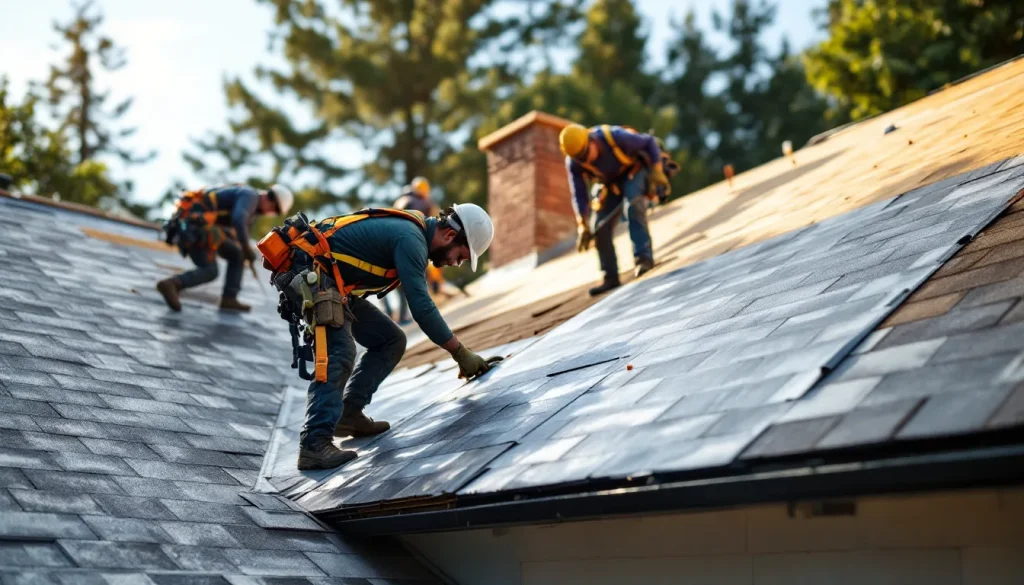
How long does a roof replacement take? A typical asphalt shingle roof replacement in 2026 takes 2 to 4 days for a single-family residential home (2,000 to 2,500 sq ft) under normal weather conditions. Metal roofs take 4 to 7 days, tile takes 5 to 10 days, and slate takes 7 to 14 days. The timeline depends on material complexity, weather, crew size, tear-off versus overlay, and whether the underlying deck needs repair. The honest range from the contractor’s first foot on the property to final inspection is wider than most homeowners expect because of permits, material delivery, and the inevitable weather day or two. Here is the realistic timeline by material, the day-by-day breakdown, and the variables that can push a 3-day asphalt job into a 6-day job.
The short version
- Asphalt shingle: 2 to 4 days for a 2,000 to 2,500 sq ft home with a 6-person crew.
- Metal (standing seam): 4 to 7 days because seam panels require precise measurement and ridge detailing.
- Tile (concrete or clay): 5 to 10 days due to weight, fragility, and individual unit placement.
- Slate: 7 to 14 days because each slate is hand-fitted by a specialist crew.
- Permits add 1 to 4 weeks before any work starts; material delivery adds 1 to 2 weeks for specialty products.
- Weather (rain, high winds, freezing temperatures) typically adds 1 to 3 days to any project.
Short answer plus timeline by material
| Roofing material | Active install days (2,500 sqft) | Total project window (incl prep) | Typical crew size |
|---|---|---|---|
| Asphalt 3-tab shingle | 1 to 2 days | 3 to 5 days | 5 to 7 |
| Asphalt architectural shingle | 2 to 4 days | 4 to 7 days | 5 to 7 |
| Standing seam metal | 4 to 7 days | 6 to 12 days | 3 to 5 |
| Stone-coated steel | 3 to 5 days | 5 to 8 days | 4 to 6 |
| Concrete tile | 5 to 8 days | 8 to 14 days | 4 to 6 |
| Clay tile | 6 to 10 days | 10 to 16 days | 4 to 6 |
| Natural slate | 7 to 14 days | 14 to 28 days | 3 to 4 specialists |
| Wood shake / shingle | 4 to 7 days | 7 to 12 days | 4 to 6 |
Asphalt shingle timeline: 2 to 4 days
Asphalt is the fastest material because the install process is highly repeatable, the units (shingles) are large and easy to handle, and the crews that install them in volume have refined the workflow to near-industrial efficiency. A 6-person crew on a straightforward gable roof of 2,000 to 2,500 sq ft typically finishes in 2 to 3 working days.
Day 1 covers tear-off of the old roofing, deck inspection, replacement of any rotten sheathing, and installation of underlayment and drip edge. Tear-off alone runs 4 to 8 hours depending on layer count (single layer goes fast, two or three layers takes the full day). Day 2 covers shingle installation on the main field, including starter course, valleys, and step flashing at walls. Day 3 covers ridge cap installation, final flashing, cleanup with rolling magnet sweeps for nails, and final inspection prep.
Complex roofs (hip-and-valley designs, multiple dormers, steep pitches above 10:12, multiple chimneys or skylights) can stretch a 3-day job to 4 or 5 days because flashing details are time-intensive. For simple single-story ranch homes, 1.5 to 2 days is achievable with experienced crews.
Metal roof timeline: 4 to 7 days
Standing seam metal is the most common modern metal install and runs 4 to 7 days for a residential reroof. The slower pace reflects the precision required: panels are custom-cut to the rake length, each seam is mechanically locked or snapped, and flashing details at ridges, valleys, and penetrations are fabricated on site.
Day 1 is tear-off and deck prep, identical to asphalt. Day 2 is underlayment (typically a high-temp synthetic rated to 240 to 260 degrees Fahrenheit) and starter clips along the eave. Days 3 and 4 are panel layout and installation across the field, working bottom-up and locking each seam to the previous one with a hand or power seamer. Days 5 and 6 are ridge cap, valley fabrication, and penetration flashing. Day 7 is final cleanup and walk-through.
Metal install crews are typically smaller (3 to 5 people) than asphalt crews because the work is more specialized. A larger crew does not speed metal install proportionally because the bottleneck is the seamer and the layout planning, not raw labor count.
For more on metal install specifics, see metal roof installation. For the cost framework, see metal roof cost and standing seam metal roof cost.
Tile roof timeline: 5 to 10 days
Concrete and clay tile take 5 to 10 days because of three factors: weight (3 to 4 tons per 1,000 sq ft requires careful staging on the deck), fragility (each tile can crack from foot pressure during install), and individual placement (tiles are mortared or mechanically fastened one at a time with no shortcut analog to a shingle nail gun).
Concrete tile installs run 5 to 8 days for 2,500 sq ft. Clay tile (heavier and more fragile) runs 6 to 10 days. The day-by-day pattern is tear-off (1 to 2 days because old tile is heavy to handle), deck repair and reinforcement (1 day if existing rafters need sistering for tile weight), underlayment with double-layer 30-lb felt or self-adhering membrane (1 day), tile install (3 to 6 days), and ridge, valley, and rake details (1 to 2 days).
If the existing structure was not engineered for tile and you are switching from asphalt, add 1 to 3 days for structural reinforcement. A licensed structural engineer should sign off before tile installs on a previously asphalt-rated framing system.
Slate roof timeline: 7 to 14 days
Natural slate is the slowest and most specialized roofing material. A 2,500 sq ft slate install runs 7 to 14 days, sometimes longer, because each slate is hand-cut to fit, individually nailed with copper or stainless nails (never galvanized, which corrodes the slate), and graded for color and thickness during placement.
Slate crews are typically 3 to 4 specialists with traditional training. The Slate Roofing Contractors Association of North America (SRCA) certifies specialty contractors. A reroof project will include 1 to 2 days of tear-off (carefully, because old slate is often reusable for accent work), 1 day of deck inspection and copper or stainless flashing fabrication, 5 to 11 days of slate install, and 1 to 2 days of ridge and finishing details.
Synthetic slate (CertainTeed Symphony, DaVinci, Brava) installs faster than natural slate because the units are lighter and dimensionally consistent. Synthetic slate runs 5 to 8 days for a 2,500 sq ft project.
What happens each day on a typical asphalt reroof
| Day | Activities | Crew on site | Hours |
|---|---|---|---|
| Day 0 (eve before) | Material delivery to driveway, dumpster placement, yard prep | 2 (delivery) | 1 to 2 |
| Day 1 morning | Tear-off of existing roof to deck, debris into dumpster | 5 to 7 | 4 to 6 |
| Day 1 afternoon | Deck inspection, replace rotted sheathing, drip edge install | 5 to 7 | 3 to 4 |
| Day 2 morning | Underlayment install, ice and water shield at valleys and eaves | 5 to 7 | 2 to 3 |
| Day 2 afternoon | Starter course, shingle field installation begins | 5 to 7 | 4 to 5 |
| Day 3 morning | Field shingle install continues, valley and penetration flashing | 5 to 7 | 4 to 5 |
| Day 3 afternoon | Ridge cap install, final flashing details | 4 to 6 | 3 to 4 |
| Day 4 (if needed) | Cleanup, magnet sweep, final walk-through | 2 to 4 | 2 to 4 |
Day 0 (the evening before) is when most homeowners notice the project starting: a 30-yard dumpster lands in the driveway and the material delivery truck drops shingle bundles, underlayment rolls, and flashing materials on the lawn. Smart contractors stage materials on the roof itself the morning of Day 1 to avoid weighting the lawn, but the driveway dumpster typically stays through Day 4 or 5.
Weather delays
Weather is the single biggest source of timeline slippage. Three conditions stop work: active precipitation (rain, snow, ice), wind speeds above 25 to 30 mph (shingles cannot be set in high wind), and temperatures below 40 or above 95 degrees Fahrenheit (asphalt sealant strips activate poorly at extremes).
Tear-off can sometimes continue in light rain if the crew can dry-in the deck with synthetic underlayment before water reaches it, but most crews will pause tear-off if rain is imminent because an exposed deck overnight is a recoverable mess. Once the deck is exposed, the contractor’s insurance puts pressure on getting underlayment down before sunset.
Typical weather delay budgets: spring and fall projects in the Midwest and Northeast, 1 to 3 weather days expected; summer projects in hurricane and tornado zones, 2 to 5 weather days expected; winter projects below 45 degrees, 3 to 7 weather days expected if the contractor will install in that range at all (many will not below 40 degrees).
Crew size impact on timeline
| Crew size | 2,500 sqft asphalt timeline | Quality risk |
|---|---|---|
| 3 to 4 people | 4 to 6 days | Low (slow pace, careful work) |
| 5 to 7 people | 2 to 4 days | Low (standard size for quality work) |
| 8 to 10 people | 1 to 2 days | Medium (less supervision per worker) |
| 11+ people | 1 day | Higher (rush pace, potential cosmetic issues) |
Larger crews can finish faster, but speed comes at the cost of supervision density and craftsmanship attention. A 5 to 7 person crew with a working foreman is the sweet spot for quality on residential asphalt work. Larger crews are common on insurance restoration jobs where the contractor has multiple roofs to complete in a short claim deadline window. Smaller crews (3 to 4 people) are common on premium installs where the contractor charges more per square but works more carefully.
For vetting contractors before they get on your roof, see how to choose a roofing contractor.
Tear-off versus overlay timeline difference
Tear-off (removing the old roof down to the deck) adds 0.5 to 1.5 days to the project compared to overlay (installing new shingles directly over the existing single layer). Overlay is permitted by the International Residential Code (IRC R908) when the existing roof is a single layer and structurally sound, but most municipalities limit overlay to one event in the roof’s life.
The timeline savings from overlay are real (you skip tear-off and dumpster work) but the long-term cost is meaningful. An overlay roof typically has 80 to 85 percent of the lifespan of a tear-off install because the double-layer traps heat and accelerates granule loss on the bottom layer. Most professional roofers and the NRCA recommend tear-off for any reroof beyond the first one.
Tear-off also lets the contractor inspect the deck for hidden damage, which is the single most common discovery on a reroof project. Wet OSB, missing sheathing nails, and concentrated rot at penetrations all surface during tear-off and would have been hidden by an overlay.
Permit delays before work starts
Permit timelines vary by jurisdiction. Most permit-or-die municipalities (which includes essentially every incorporated city in California, Florida, Texas, and most Northeast states) require a roofing permit before any work begins. Permit fees run $150 to $750 depending on city, and approval times range from same-day over-the-counter (in roofer-friendly jurisdictions) to 2 to 4 weeks in slower jurisdictions or for complex re-roofs.
The contractor typically pulls the permit on the homeowner’s behalf, but the homeowner is named on the permit and is ultimately responsible if a code issue surfaces years later. Permit-required roofs that were installed without permits are a common discovery during home sales and can force a retroactive permit fee plus inspection or in some cases a partial reroof.
HOA approval is a separate process from permit and can add 2 to 6 weeks if your community requires architectural review for color or material changes. Match-the-existing reroofs typically skip HOA review; any material change triggers it.
Material delivery timeline
Standard asphalt shingles in current production colors are stocked at distributor warehouses (ABC Supply, Beacon Building Products, SRS Distribution, Allied Building Products) and ship to the job site within 1 to 5 business days of order. Same-day or next-day pickup is common in major metros.
Specialty materials add real time. Custom-color standing seam panels take 2 to 6 weeks from order to delivery because the panels are roll-formed to the project’s specific lengths. Clay and concrete tile in non-stock colors take 3 to 10 weeks. Natural slate can take 4 to 16 weeks depending on quarry source. Synthetic slate runs 2 to 6 weeks.
Plan ahead: order specialty materials before the tear-off date is set, because nothing wastes contractor time and money like a torn-off roof waiting for back-ordered tile.
How home size scales the timeline
| Home size | Roof area | Asphalt timeline | Metal timeline | Tile timeline |
|---|---|---|---|---|
| Small ranch | 1,200 to 1,600 sq ft | 1 to 2 days | 3 to 5 days | 4 to 6 days |
| Typical 3-bedroom | 1,800 to 2,400 sq ft | 2 to 3 days | 4 to 6 days | 5 to 8 days |
| 4-bedroom 2-story | 2,500 to 3,200 sq ft | 3 to 4 days | 5 to 7 days | 6 to 10 days |
| Large suburban | 3,300 to 4,500 sq ft | 4 to 6 days | 7 to 10 days | 8 to 14 days |
| Estate | 4,500+ sq ft | 6 to 10 days | 10 to 18 days | 14 to 28 days |
Timeline does not scale linearly with size. The mobilization cost (delivery, setup, dumpster placement, tear-off rhythm establishment) is roughly constant across small and medium homes, which makes the per-square-foot timeline shorter on bigger homes once the crew gets going. A 4,000 sq ft asphalt reroof is typically 1.6 to 2 times the work of a 2,000 sq ft reroof, not 2 times exactly.
Pitch and complexity factors
Roof pitch and geometric complexity stretch timelines beyond what raw square footage suggests. A 12:12 pitched roof requires roof jacks, harnesses, and slower, more careful work, which adds 30 to 60 percent to install time. A roof with 3 or more hips and valleys, multiple dormers, or skylights at the eaves adds 20 to 40 percent because flashing details are time-intensive and slow the field install rhythm.
The complexity multiplier compounds across materials. A complex metal roof can stretch a 6-day baseline to 9 or 10 days because every valley flashing is custom-fabricated on site. A complex slate roof can stretch a 14-day baseline to 20 or 24 days because each valley requires hand-fitted slate and copper flashing details.
Pre-existing damage and the timeline domino
The most common timeline disruption mid-project is the discovery of unexpected damage during tear-off. Wet OSB sheathing under the original roof, rotted rafter tails, deteriorated soffit framing, or chimney flashing that has been failing for years all surface once the original roofing is removed.
Most reroof contracts include a per-sheet allowance for sheathing replacement (typically $90 to $160 per 4×8 sheet of OSB installed, including framing for fastening and disposal of old material). The contractor identifies sheathing replacement needs after tear-off and either swaps materials within the existing budget envelope or invoices the homeowner for additional sheets above the contract allowance.
Each repaired sheet adds roughly 30 to 60 minutes to the day’s schedule. Larger structural surprises (rotted rafter ends requiring sister framing, soffit framing replacement) can add a full day to the project.
Permit, inspection, and sign-off after install
The work is not really done when the last shingle is set. Most jurisdictions require a post-install inspection by a municipal building inspector, typically scheduled 1 to 5 business days after the contractor calls for inspection. The inspector confirms that fasteners, underlayment, flashing, and venting meet local code amendments to IRC R905.
Final inspection pass triggers the certificate of completion (sometimes called a final building permit signoff), which the homeowner needs for insurance, warranty, and resale. Contractors typically include the inspection coordination in the contract but the homeowner should verify the final inspection actually closed out before final payment.
Frequently asked questions
How long does a roof replacement take on a one-story house?
One-story 1,500 to 2,000 sq ft asphalt reroofs typically finish in 1.5 to 3 days because access is easier and the slope is usually moderate. Metal on the same size finishes in 3 to 5 days; tile in 4 to 7 days.
Can a roof be replaced in one day?
Yes for small asphalt roofs (under 1,500 sq ft) with a crew of 8+ people and simple geometry. The trade-off is supervision density per worker drops as crew size grows, so single-day rushes have slightly higher cosmetic issue rates. Many production-volume roofers complete simple ranch homes in one long day.
Do I need to be home during the roof replacement?
No, but staying home is helpful for two reasons. First, you can answer questions about hidden details (where the attic access is, whether a particular ceiling stain is from this roof or an older issue). Second, you can verify the dumpster, materials, and tools are on your property and not damaging landscaping.
How long does the roof inspection take before replacement?
30 to 90 minutes for a thorough pre-bid inspection covering the field, valleys, flashing, ventilation, and attic. The contractor will photograph damage and measure the roof for the bid. For more on inspection process, see how to get a roof inspection and roof inspection cost.
How long after the roof is replaced can I move back into the attic spaces?
Immediately. The work is on top of the deck and does not impact the attic interior. Some installs do generate sawdust or shingle granule dust through soffit vents, so vacuum any exposed attic surfaces after the project ends if you store items in the attic.
What is the longest a roof replacement should take?
For a simple 2,500 sq ft asphalt reroof, a project taking longer than 7 to 10 days has process problems (under-staffing, weather windows poorly chosen, or a contractor splitting crews across too many concurrent jobs). For slate or specialty installs, longer timelines are normal.
What delays the roof replacement timeline most often?
Weather is the biggest factor. After weather, the most common delays are unexpected deck damage (rotted sheathing that adds repair time), permit office backlogs, material back-orders, and crew availability conflicts when the contractor is juggling multiple insurance restoration jobs at once. Asking the contractor about their current job queue at bid time helps set realistic expectations.