
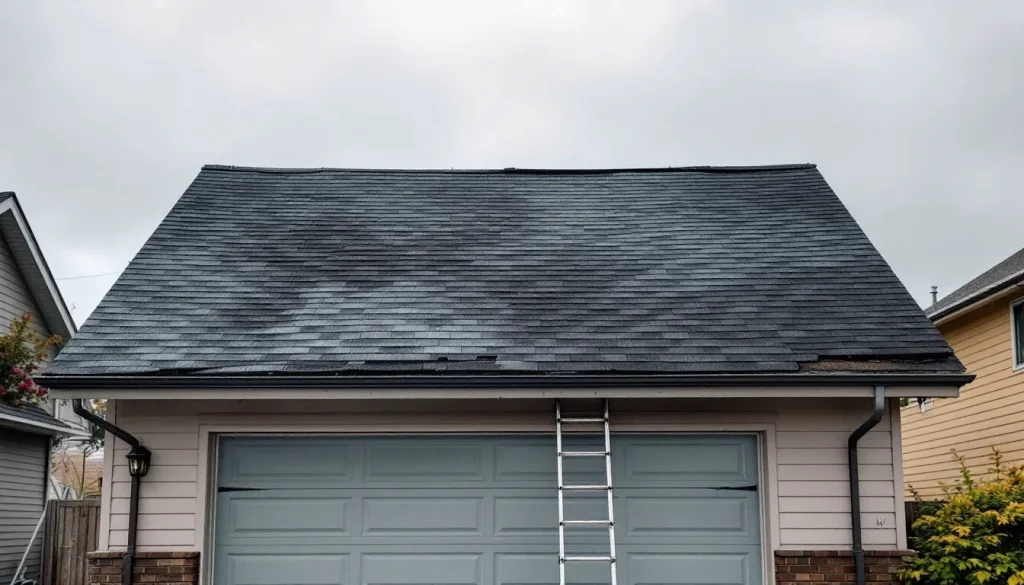
The first thing to know about how to fix a sagging garage roof is that the visible sag is a symptom, not the problem. The actual problem is one of five things: rafter rot from a long-term roof leak (see our water stains on a ceiling guide), undersized framing that finally caught up to the load, snow load that exceeded design capacity, ridge beam failure from poor original construction, or a failed wall connection at the top plate. Each failure mode has a different repair path. A 12 ft sag from rafter rot can be fixed with sister rafters and a temporary shoring jack for $800 to $2,000 DIY. A ridge beam failure on a detached garage is structural engineer territory and runs $4,000 to $15,000 to fix permanently. Before you put a single bottle jack under a sagging roof, you need to identify which of the five failure modes you have. Below is the diagnostic sequence pros use, the repair cost ranges by failure mode, and the clear line where DIY ends and a structural engineer starts.
The short version
- Sag is a symptom. The five real causes: rafter rot, undersized framing, snow overload, ridge beam failure, top plate connection failure.
- Don’t jack a sagging roof without diagnosing the cause first. You can make rotten framing worse or shift load onto a failing wall.
- Sister rafters (DIY): $800 to $2,000 for typical 2-car detached garage with localized rot.
- Ridge beam replacement or reinforcement (contractor): $4,000 to $15,000 depending on access and span.
- Top plate failure on attached garages often means the garage is pulling away from the house. Engineer-only.
- Any sag visible from the driveway (1 inch or more) is past the point where waiting is reasonable.
- Call a structural engineer if: sag exceeds 2 inches, ridge has dropped, cracks at wall-to-roof junctions, or any sign of foundation movement.
The short answer: identify the failure mode first
A sagging garage roof gets fixed by treating the underlying structural cause, not by jacking up the sag and replacing shingles. The five common failure modes and how to identify each:
| Failure mode | Visible signs | DIY fix possible? | Typical cost |
|---|---|---|---|
| Rafter rot (local) | Sag in 1 to 3 rafter bays, water staining on sheathing, soft spots | Yes | $800 to $2,000 |
| Undersized rafters (whole roof) | Even sag across whole span, no visible rot, sheathing intact | Sometimes | $1,500 to $5,000 |
| Snow overload (recent) | Sag appeared after heavy snow, no rot, possible rafter splits | Sometimes | $1,200 to $4,500 |
| Ridge beam failure | Ridge has dropped, both slopes pulled in toward center, walls bowing out | No | $4,000 to $15,000 |
| Top plate failure | Wall pulling away from roof, gap visible at fascia, more common on attached garages | No | $5,000 to $25,000 |
If you can see daylight between the top of the wall and the bottom of the fascia, or if the sag extends across the whole roof evenly with the ridge dropping, stop and call a structural engineer. The DIY path applies only to localized rot or limited snow damage on a roof whose original framing was correctly sized.
For broader context on garage roof problems, see our garage roof overview.
Step 1: Diagnose from inside the garage
Get inside the garage (if attached, the side facing the house; if detached, anywhere with attic access). Bring a flashlight, a 4 ft level, and a chalk or pencil. Don’t go on the roof yet.
Look for water damage
- Sheathing should be uniformly gray-brown. Black staining, white mineral deposits, or dark blotches indicate prior leaks.
- Soft spots on sheathing (push with a screwdriver handle, not the tip) mean the OSB or plywood has rotted.
- Rafters with dark stains running down their faces have wet history. Use a Phillips screwdriver to test for rot: if the tip pushes in more than 1/4 inch with hand pressure, the rafter is compromised.
Check rafter dimensions
- Measure rafter depth (the vertical dimension). Detached garages built before 1990 often have 2×6 rafters at 24-inch on-center, which is undersized for any 24 ft+ span under modern snow loads.
- Check spacing (16-inch or 24-inch on-center).
- Count rafters in each bay between bracing or walls.
Look for splits and cracks
Hold the flashlight along the rafter and look for splits running parallel to the grain, especially near the ridge or where the rafter meets the top plate. Splits indicate the rafter has exceeded its bending capacity, usually from snow overload.
Check the ridge
Sight along the ridge from one gable end to the other. A flat ridge with both slopes uniformly sagging suggests rafter or sheathing problems. A ridge that has dropped in the center (more sag at the middle than at the ends) suggests ridge beam failure.
Check the walls
Use the 4 ft level on the inside of each wall. Walls that bow outward (top tilted out) mean the rafters are no longer holding the walls together. This is a load-path failure. Walls that bow inward mean the original framing didn’t have rafter ties and is being squeezed by the roof load.
Step 2: Diagnose from outside (if safe)
If the sag is visible from outside, document the geometry:
- Stretch a string from one gable end to the other along the ridge. Measure the maximum sag in inches.
- Same for the eave line on each side.
- Photograph each elevation. Sag patterns help diagnose cause.
Do not go on the roof if the sag exceeds 2 inches or if you see cracked or missing shingles in the sag zone. Use a tall ladder or rent a lift to inspect (see our 30-point inspection checklist guide) from the eave.
For roof safety basics see our roof safety guide.
Common failure mode 1: rafter rot from long-term leak
Rafter rot is the most common DIY-fixable cause. Pattern: a roof leak (often at a vent, flashing, or valley) drips down a specific rafter for years. The rafter softens, loses bending strength, and the section above sags.
Fix: sister rafters
Sister rafters are new rafters added next to existing rotted ones, fastened together so the new rafter carries the load. This is the standard repair for localized rot.
- Fix the leak first. A new sister won’t help if the leak keeps soaking it too. See our how to fix a roof leak guide.
- Support the sagging area with a temporary 2×4 or 2×6 post jacked up from the garage floor with a screw jack or hydraulic bottle jack. Lift slowly, 1/8 inch every few hours over 24 to 48 hours. Never try to lift a sag back to flat in one motion; you risk cracking sheathing or shingles.
- Cut the new sister rafter from the same dimension lumber as the original (or one size larger). Match the angle cuts at the top (against ridge board) and bottom (birdsmouth on top plate).
- Slide the sister in next to the rotted rafter. It should sit on the top plate and against the ridge.
- Fasten the sister to the original with structural screws (Simpson SDWS22512 or equivalent) or 16d nails at 8-inch on-center, staggered top and bottom.
- Remove the temporary support slowly after fastening is complete.
Cost
- 2×8 lumber: $20 to $35 per 12 ft rafter
- Structural screws (50 pack): $25 to $40
- Jack rental (if needed): $30 to $50 per day
- Total for sistering 3 to 5 rotted rafters in a 2-car detached garage: $250 to $500 in materials
- Contractor cost: $800 to $2,000 for same work
Common failure mode 2: undersized rafters across whole roof
A garage built in 1965 with 2×4 rafters at 24-inch on-center spanning 18 ft will eventually sag. Not because anything is rotten, but because the original framing was undersized for the actual load over decades of seasonal cycling.
Fix options
Three options, ranked by cost:
Option A: Add rafter ties (collar ties or ceiling joists). If the original framing has no ties between opposing rafters, adding them transfers load to the walls more efficiently and can stop further sag. Cost: $400 to $1,000 DIY.
Option B: Sister every rafter with a deeper rafter. Adds bending capacity across the whole roof. Cost: $1,500 to $3,500 DIY, $3,500 to $7,500 contractor (see our questions to ask guide).
Option C: Add a structural ridge beam. Transforms the framing from rafters-meeting-at-ridge-board (which requires the walls to resist outward thrust) to rafters-bearing-on-ridge-beam (which transfers load vertically to posts at the gable ends). This is the highest-quality fix but requires engineer design. Cost: $3,000 to $10,000 contractor.
For a sagging undersized-framing garage that you plan to keep for 20+ years, Option C is the durable answer. For older garages slated for replacement, Option A may buy enough time.
Common failure mode 3: snow overload
If the sag appeared after a heavy snow season and there’s no rot, you likely had snow load above design capacity. The rafters may have permanent set (slight bending that doesn’t fully recover) and may have splits.
Diagnostic
- Look for splits along the bottom edge of each rafter (tension face).
- Look at the metal connectors at the top plate. Hurricane ties stretched or pulled away from the plate indicate uplift or overload.
- Measure deflection. Anything over 1/2 inch deflection per 10 ft of span is structural.
Fix
For mild snow overload with no splits, sistering the affected rafters works. For splits or repeated overload events, the framing should be re-engineered. Some homeowners in heavy snow zones (Buffalo, Denver, Minneapolis, Boston) preemptively install a structural ridge beam to handle modern snow loads on garages built before snow-load tables tightened in the 2000s IRC editions.
Common failure mode 4: ridge beam failure
A ridge beam (the structural beam at the peak that rafters bear onto) can fail by bending, splitting, or pulling out of its end supports. The visible signs are dramatic: the ridge drops in the middle, both slopes pull in toward the center, and the walls may bow outward as a result.
This is not DIY territory. The failure usually indicates the original ridge beam was undersized, the supporting posts at the gable ends are inadequate, or both. Repair requires structural engineering and typically involves either replacing the beam with a deeper LVL or steel beam, or adding a second beam parallel to the existing one.
Cost: $4,000 to $15,000 depending on access (can the beam come in through a gable end opening, or does the roof need to come off?), beam span, and material chosen.
Common failure mode 5: top plate connection failure (attached garages)
This is the worst diagnosis. Attached garages can pull away from the house at the connection between the garage roof and the main house wall. The failure mode is the top plate of the garage’s connecting wall losing its grip on the house’s framing or the garage roof rafters losing their connection to the top plate.
Visible signs
- Gap visible between the garage roof and the house wall
- Cracked stucco or split siding at the connection
- Garage door is no longer square in its opening
- Daylight visible at the soffit corner where the garage meets the house
Call a structural engineer immediately. The cost to fix is $5,000 to $25,000 depending on the extent and the underlying cause (sometimes it’s a foundation movement problem masquerading as a roof problem).
When to call a structural engineer
Call before doing any repair work if any of the following apply:
- Sag exceeds 2 inches over any 10 ft span
- The ridge has dropped (not just the field sagging, the actual peak is lower)
- Walls are bowing outward or inward
- Cracks at corners where roof meets wall
- Any sign of foundation movement (cracked slab, settling, gaps at base of walls)
- Garage is attached and pulling away from the house
- Original framing was undersized and you want a permanent fix
- You’re considering converting the garage to living space (this triggers different code requirements)
Engineer’s fee is typically $400 to $1,200 for a site visit and stamped repair drawing. The cost is small compared to a re-do or an insurance claim denial.
DIY repair: sister rafter walkthrough (most common case)
Assuming you’ve diagnosed localized rafter rot in 3 to 5 rafters, the leak is fixed, and the sag is under 2 inches.
Materials needed
- 2×8 or 2×10 PT lumber, 12 ft lengths (1 per rotted rafter)
- Structural screws (Simpson SDWS22512 or equivalent), 25 to 30 per rafter
- Hurricane ties (Simpson H2.5A), 1 per sister to attach to top plate
- Construction adhesive (Liquid Nails Heavy Duty or PL Premium)
- Temporary shoring: 2×6 posts, screw jacks or hydraulic bottle jacks, 2×6 pads at top and bottom
Sequence
- Identify each rotted rafter. Mark with chalk inside the garage.
- Set up temporary shoring under the sag zone. Use 2×6 posts with 2×6 pads top and bottom, sitting on the slab. Tighten screw jacks until they take light pressure (not lift).
- Over 24 to 48 hours, slowly tighten the jacks to reduce sag. 1/8 inch every 4 to 6 hours. Stop if you hear cracking from above.
- Once the sag is minimized (full flat may not be achievable; close to flat is the goal), cut the first sister rafter to match the existing rafter angles.
- Apply a 3/8-inch bead of construction adhesive to the face of the existing rafter that will mate to the sister.
- Slide the sister in next to the original. Press it flush.
- Drive structural screws at 8-inch on-center, alternating top and bottom edge of the rafter.
- Add a hurricane tie connecting the sister to the top plate.
- Repeat for each rotted rafter.
- Leave shoring in place for 48 hours after the last fastener is driven.
- Remove shoring slowly.
What to do about the sheathing above
If the sheathing in the sag area is also rotted, it needs replacement, which means lifting shingles and cutting out and replacing the bad section. This usually means scheduling the structural repair to coincide with shingle replacement, or accepting that you’ll need to redo some shingles after the structural work.
Insurance coverage for sagging garage roofs
Homeowner’s insurance covers sudden damage from named perils (wind, hail, falling tree). It does not cover gradual sag from wear, rot, undersized framing, or improper original construction. The carrier’s stance on snow overload depends on the carrier and whether the storm exceeded historical norms.
If you have damage from a specific storm event:
- Document with photos before any temporary shoring
- File the claim within the carrier’s notice window (typically 60 days)
- Get a roofer or engineer to write the storm-cause finding
- Carrier sends adjuster; you can have a public adjuster represent you for a percentage
If the sag is gradual and from age, it’s on you. Plan the repair as a maintenance expense, not an insurance claim.
Don’t do these things
- Don’t jack a sagging roof in one motion. Slow, incremental, over 24 to 48 hours.
- Don’t put new shingles over a sagging roof. The sag stays under the new shingles, and you’ve wasted the cost of the shingles.
- Don’t add a heavier roof material to a sagging roof. Tile or slate over a sagging asphalt shingle roof guarantees collapse.
- Don’t ignore a sag that’s slowly getting worse. Sags accelerate as load shifts to fewer load paths.
- Don’t try to DIY a ridge beam fix. Engineer required.
- Don’t shore up a sag and call it fixed. Shoring is temporary support during repair, not a fix.
FAQ
How serious is a 1 inch sag in my garage roof?
Worth investigating but not necessarily urgent. A 1 inch sag over a 20 ft span could be original construction tolerance, mild wood creep, or early-stage failure. Get into the attic, inspect the rafters for rot, splits, and connections. If you find rot or splits, schedule repair. If everything looks sound and the sag has been stable for years, monitor it.
Can I fix a sagging garage roof myself?
Yes for localized rafter rot or mild snow overload with no other failure signs. The sister rafter repair is well within DIY range for someone with framing experience. No for ridge beam failure, top plate failure, undersized framing across the whole roof, or any sag over 2 inches. Those need engineer-designed repairs.
What does it cost to fix a sagging garage roof?
$250 to $500 DIY for sistering 3 to 5 rafters with localized rot. $800 to $2,000 contractor for the same. $1,500 to $5,000 for whole-roof sistering. $4,000 to $15,000 for ridge beam repair or replacement. $5,000 to $25,000 for top plate connection failure on attached garages.
Will my insurance pay for a sagging garage roof repair?
Only if the sag is from a specific, recent, covered peril (wind, hail, tree fall, sometimes excess snow). Gradual sag from age, rot, or undersized framing is not covered. Document storm-caused damage immediately with photos before doing any temporary shoring.
How long can I safely leave a sagging garage roof before fixing it?
Stable mild sag (under 1 inch, not progressing): months to a year, with monitoring. Any progressing sag, sag over 2 inches, ridge dropping, walls bowing, or signs of foundation movement: don’t park your car in there until it’s diagnosed by an engineer. Garages do collapse, especially under snow load.
Bottom line
A sagging garage roof is fixed by identifying the structural cause first, then matching the repair to the failure mode. Localized rafter rot from a long-term leak is the most common DIY-fixable case: sister the rotted rafters after fixing the leak, $250 to $500 in materials, weekend project. Undersized framing across the whole roof, ridge beam failure, and top plate connection failure all require structural engineering. The diagnostic sequence (inside-the-garage rafter inspection, rot check, ridge sight, wall plumb check) takes 30 minutes and saves you from doing the wrong repair. Call a structural engineer if sag exceeds 2 inches, the ridge has dropped, walls are bowing, or you see any sign of foundation movement. The $500 to $1,200 engineer’s fee is small insurance against a $15,000 wrong-repair mistake or, worse, a structural collapse.