
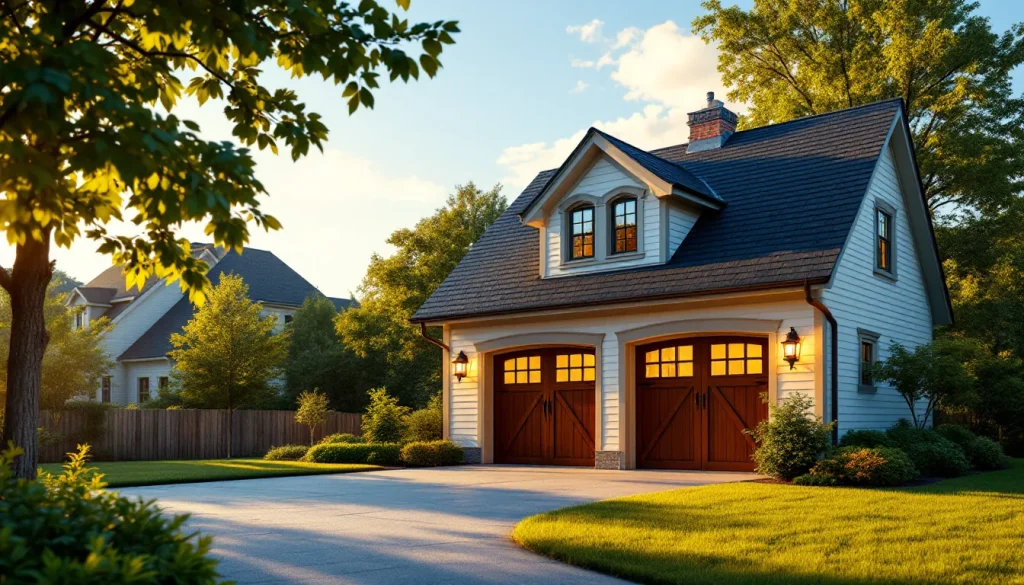
A garage roof in 2026 costs $2,500 to $6,500 to replace depending on whether the garage is detached (simpler permit, standalone reroof, smaller crew load) or attached (must integrate with the house roof, more flashing, sometimes a single permit covering both). The typical 2-car garage at 600 to 800 sq ft of roof area falls in the middle of the residential cost curve at $4.50 to $9 per sq ft installed for asphalt shingles. Common issues include sagging from undersized rafters, leak damage at the house wall connection on attached garages, decking rot from venting failures, and accelerated wear from concentrated runoff hitting concrete driveways and slabs. Here is what to expect: cost by garage size, the detached vs. attached decision tree, code rules from IRC R905 and R807, material match recommendations, and the DIY threshold.
The short version
- 2-car detached garage roof replacement: $3,000 to $5,500 in mid-grade asphalt shingles. 2-car attached: $3,500 to $6,500 because of the integration with the house roof.
- Match the new garage roof material to the main house. A garage with shingles 5 years younger than the house roof reads as “patched” to buyers and hurts resale.
- Attached garage roofs share a flashing interface with the house: step flashing along the sidewall, kickout flashing at the bottom. Skipping the kickout is the most common failure point.
- Sagging garage roofs are usually undersized rafters, snow load excess, or rotted decking. Diagnosis is sequence: visual inspection, attic check, sheathing probe.
- IRC R807 requires attic access for any roof area over 30 sq ft with vertical clearance over 30 inches. Most garage attics qualify.
- Permit is required for any full reroof in most jurisdictions. Partial repair (under 25 percent of roof area) is sometimes exempt.
Short answer: garage roof cost and the first decisions
A garage roof replacement is structurally simpler than a house roof (one open volume, no occupied space below, fewer penetrations) but the cost per square foot is similar because mobilization, dump fees, and labor rates do not scale down. The decision matrix:
| Garage type | Roof area | Asphalt shingle cost | Metal cost (standing seam) | Notes |
|---|---|---|---|---|
| 1-car detached | 240 to 320 sq ft | $1,800 to $3,200 | $3,800 to $6,400 | Smallest scale. Mobilization is a big chunk. |
| 1-car attached | 240 to 320 sq ft | $2,200 to $3,800 | $4,400 to $7,200 | Bump for sidewall flashing integration. |
| 2-car detached | 500 to 750 sq ft | $3,000 to $5,500 | $6,500 to $11,000 | Most common project size. |
| 2-car attached | 500 to 750 sq ft | $3,500 to $6,500 | $7,500 to $12,500 | Premium for house integration. |
| 3-car detached | 800 to 1,100 sq ft | $4,500 to $8,000 | $9,500 to $15,500 | Often pulls a separate permit from house. |
| 3-car attached | 800 to 1,100 sq ft | $5,200 to $9,000 | $10,500 to $17,000 | Larger flashing interface, more material match risk. |
| Detached oversized / RV garage | 1,200 to 1,800 sq ft | $6,500 to $13,500 | $13,000 to $26,000 | Approaching small commercial scale. |
The math above assumes a single-layer tear-off, mid-grade architectural asphalt shingles (GAF Timberline HDZ, CertainTeed Landmark, Owens Corning Duration), standard 15 lb felt or synthetic underlayment, drip edge, and code-minimum ventilation. For high-end material upgrades (designer asphalt, stone-coated steel, cedar shake) add 25 to 80 percent.
Detached vs. attached garage roof
The single biggest factor in garage roof project complexity is whether the garage is detached (its own structure) or attached (shares at least one wall with the house). The detached path is almost always simpler, cheaper per sq ft, and faster to complete.
Detached garage roof characteristics:
- Standalone structure with all four walls independent of the house
- Permit is a standalone accessory structure permit (often simpler than dwelling permit)
- No flashing interface with the house
- Material choice can deviate from house if HOA allows (sometimes a stylistic choice)
- Reroof can happen entirely independent of any house roof work
- Crew can work without disturbing the house occupants
Attached garage roof characteristics:
- At least one wall (usually a long wall) shares structure with the house
- Garage roof often slopes off the house wall or meets the house roof at a sidewall or valley
- Flashing interface required: step flashing along the sidewall, kickout flashing at the bottom of the sidewall, valley flashing where roof planes meet
- Permit usually pulled as a partial dwelling work permit
- Material choice should match the house to avoid a “patched” visual
- Reroof often paired with house reroof to integrate the flashing properly
The cost premium on attached garage roof work runs 15 to 25 percent over the detached equivalent because of the flashing complexity and the slower crew pace working alongside the house roof. The premium is unavoidable: skipping the flashing integration creates leaks that cost more than the savings.
Cost by garage size: the detailed breakdown
| Component | 1-car (300 sq ft roof) | 2-car (650 sq ft roof) | 3-car (950 sq ft roof) |
|---|---|---|---|
| Tear-off labor | $300 to $500 | $550 to $900 | $750 to $1,300 |
| Dump fees | $80 to $180 | $150 to $300 | $220 to $450 |
| Sheathing repair (if needed) | $60 to $300 | $100 to $500 | $200 to $800 |
| Drip edge and flashing | $120 to $250 | $200 to $400 | $280 to $600 |
| Underlayment | $60 to $130 | $120 to $250 | $180 to $380 |
| Architectural shingles (material) | $300 to $500 | $650 to $1,100 | $950 to $1,650 |
| Shingle install labor | $450 to $750 | $1,000 to $1,650 | $1,500 to $2,400 |
| Ridge vent, ridge cap, accessories | $80 to $180 | $150 to $300 | $200 to $450 |
| Permit | $150 to $350 | $200 to $450 | $250 to $550 |
| Mobilization, overhead, contractor margin | $200 to $500 | $380 to $850 | $550 to $1,200 |
| Total range | $1,800 to $3,840 | $3,500 to $6,700 | $5,080 to $9,780 |
The numbers above represent a detached single-wide garage roof reroof with no major surprises. Add the attached premium (15 to 25 percent) for attached garages. Add 20 to 50 percent for material upgrades beyond mid-grade architectural asphalt.
Material choice: matching the house
The single most important garage roof material decision is whether to match the house roof material or deliberately differ. Three scenarios:
Scenario 1: house was reroofed within the last 5 years. Match the material and brand. Try to source the same product line; if the line was discontinued, pick the nearest replacement in the same manufacturer’s lineup. Mismatched garage and house roofs read as patched and damage resale. Even if your eye does not catch the difference, buyer agents and inspectors do.
Scenario 2: house and garage are both due for reroof. Do them together. Single mobilization, single material order, single dump cycle. The combined bid usually comes in 8 to 15 percent below the sum of separate bids. Material consistency is automatic.
Scenario 3: house roof has 8+ years remaining, garage is failing now. The hard case. Three options: reroof the garage in a material that matches the house’s current product (knowing the line may be discontinued by the time the house needs reroofing), pick a higher-grade material on the garage that will be the standard when the house is reroofed in 8 years (designer asphalt or standing seam metal), or accept a temporary visual mismatch and plan to redo both in 8 to 12 years.
For most homeowners in scenario 3, matching the current house material is the right call. The visual consistency outweighs the risk of product discontinuation.
Material options for garages:
- 3-tab asphalt: $3.50 to $5.50 per sq ft installed. Cheapest. Rarely the right choice on attached garages (visual mismatch with most house roofs).
- Architectural asphalt: $5.50 to $9.00 per sq ft installed. Default for most garages. Wide product variety.
- Standing seam metal: $14 to $22 per sq ft installed. Long life, modern look. See standing seam metal roof cost.
- Corrugated metal: $7 to $12 per sq ft installed. Rustic, farmhouse aesthetic. Often used on rural detached garages and pole barns. See corrugated metal roofing.
- Cedar shake: $14 to $22 per sq ft installed. Historic or Craftsman style. Maintenance-heavy.
- Stone-coated steel: $12 to $18 per sq ft installed. Mimics shingle or tile look with metal durability.
For comparison context see metal vs asphalt shingle roof.
Sagging garage roof: causes and assessment
A sagging garage roof is one of the most common reasons homeowners search for a reroof. The visible sag is the symptom; the cause is usually one of four things.
Cause 1: undersized rafters for the snow load. Common in garages built before modern span tables were widely enforced, or in homeowner-built garages with framing sized by eye. The rafters slowly deflect under repeated winter snow loads, take a permanent set, and eventually sag visibly. Verification: measure rafter dimension, spacing, and span. Compare to IRC Table R802.5.1 for your snow load.
Cause 2: rotted decking from a leak. Long-standing roof leak rots sheathing in a localized area, creating a low spot. Verification: walk the roof and probe with a screwdriver. Soft sheathing indicates rot. Inspect from the attic for water staining and visible damage.
Cause 3: missing or undersized rafter ties / collar ties. A gable garage roof needs ties to handle the outward thrust of the rafters at the wall plate. Without them, the rafters push the walls out and the ridge drops. Verification: inspect attic for the presence and condition of ties. IRC R802.3.1 requires rafter ties in the lower third of the rafter span.
Cause 4: foundation settling. Garage foundation has shifted and one wall is no longer plumb. The roof above sags as the geometry distorts. Verification: check wall plumb with a 4-foot level. Inspect foundation for cracks.
The right fix depends on the cause:
- Undersized rafters: sister with new dimensional lumber alongside the existing rafters, or add intermediate purlins to shorten the effective span.
- Rotted decking: tear off, replace sheathing, re-roof. See roof sheathing.
- Missing ties: install rafter ties (2×4 minimum) at the right elevation.
- Foundation: structural fix required, beyond roofing scope.
See sagging roof repair for full diagnostic and repair process.
Tear-off considerations
Tearing off the existing roof is the default approach to a garage reroof. Almost all jurisdictions prohibit a third layer of shingles, and most roofers refuse to install a second layer even where code allows it. Two-layer roofs carry doubled dead load, double tear-off cost when finally reroofed, and void manufacturer warranty on the new shingles.
Tear-off has cost components:
- Labor: 1 to 3 worker-hours per square (100 sq ft). For a 6.5-square garage, 6 to 18 hours of tear-off labor.
- Disposal: dumpster rental or dump truck loads. Shingle waste runs 250 to 400 lb per square. A 6.5-square garage produces 1,600 to 2,600 lb of waste, fitting easily in a 10-yard dumpster.
- Sheathing inspection and repair: tear-off exposes the decking. Soft spots, rot, and fastener pull-through become visible. Budget $50 to $200 in surprise sheathing repair on most jobs.
- Cleanup: magnet sweep, ground tarp, satellite nail pickup around the work zone.
If you have a finished interior in the garage attic or any storage in the rafters, expect dust and debris infiltration during tear-off regardless of tarping. Clear the space before the crew arrives.
Decking inspection: what to check and replace
Once the existing shingles are off, the sheathing condition becomes visible. The crew should walk the entire roof and probe at any suspect locations. What to look for:
- Soft spots that flex underfoot or take a screwdriver tip without resistance
- Black or brown staining indicating water intrusion
- Delamination of OSB layers
- Fastener pull-through from previous shingles
- Gaps between sheets larger than 1/4 inch (poor original installation)
- Knot holes or splits in plywood
Damaged sheets get replaced before underlayment goes down. The replacement panel must match the existing thickness (1/2 inch plywood, 7/16 OSB, 5/8 inch plywood) so the shingle plane stays smooth. Replacement costs $40 to $70 per 4×8 sheet of OSB, $70 to $110 per sheet of 1/2 inch plywood, plus 0.5 to 1 worker-hour per sheet.
For the garage reroof estimate to be reliable, the contractor should specify sheathing replacement as a line item with a unit price (“if sheathing replacement is required, $X per sheet”) rather than a blanket “no sheathing repair included” or a fixed allowance that may not cover actual conditions.
Detached garage permit (vs. attached)
The permit path differs for detached vs. attached garage roofs.
Detached garage:
- Standalone accessory structure permit, typically over-the-counter
- Permit fee $150 to $400
- One inspection (usually after shingle install, sometimes mid-job for ice and water shield in cold climates)
- No HOA design review required in most cases (the garage is presumed to match the house already)
Attached garage:
- Treated as partial dwelling work. May share a permit with house reroof if done together.
- Permit fee $200 to $500
- Inspection focuses on flashing integration with the house
- May trigger HOA review if visible from the street
Skipping the permit is more risky on attached garage work because the flashing interface affects house insurance coverage. If the garage flashing fails and water damages the house structure, an unpermitted reroof gives the insurance carrier a denial path. The $300 permit cost is cheap insurance.
Insulation considerations
Garage attic insulation comes up during reroof for two reasons: existing insulation may need to be removed and replaced (if rotted or moldy from leaks), and a reroof is the cleanest time to upgrade ventilation that affects insulation performance.
The categories:
- Unfinished garage attic, unconditioned garage: minimal insulation typically. R-19 to R-30 in the ceiling joists if any. Reroof rarely affects insulation here.
- Unfinished garage attic, conditioned garage (heated workshop): insulation in the ceiling matters. Verify intact insulation after the reroof and add if depleted.
- Finished garage attic (storage loft or bonus room): insulation in the rafter bays. Reroof is the time to verify and upgrade.
The ventilation question affects all three cases. Garage attics need 1 sq ft of net free ventilation area per 150 sq ft of attic floor (IRC R806.2). Most garages get this through a combination of soffit vents and a ridge vent. If your existing garage has neither, the reroof is the time to add a ridge vent ($150 to $300 in material plus 1 to 2 hours labor). See attic ventilation.
Climate-matched garage roof picks
Detached garages often live without the same maintenance cycle as the main house, so material durability matters more on the garage than the house in some cases. Climate match drives the long-term cost of ownership.
| Climate | Best garage roof material | Slope target | Avoid |
|---|---|---|---|
| Heavy snow (Upper Midwest, Mountain West) | Standing seam metal (sheds snow), architectural asphalt with ice and water shield | 6/12 or steeper | Low slope below 4/12 (ice dam risk) |
| Hurricane (Gulf, SE Atlantic) | Class H or G impact-rated asphalt, hurricane-rated standing seam | 5/12 or steeper | 3-tab asphalt (uplift failure) |
| Hail belt (Plains, Front Range) | Impact-rated Class 4 architectural asphalt or stone-coated steel | 5/12 or steeper | Standard 3-tab (denting and granule loss) |
| Hot, sunny (Southwest) | Cool-coated asphalt, cool-coated standing seam, clay tile | 4/12 to 7/12 | Dark asphalt (heats garage interior, accelerates wear) |
| Coastal (salt air) | Aluminum standing seam with stainless fasteners | 4/12 to 7/12 | Galvanized steel without coastal coating |
| Pacific Northwest | Architectural asphalt with algae-resistant granules | 5/12 or steeper | Cedar shake (moss buildup without treatment) |
| Temperate (Midwest, Mid-Atlantic) | Architectural asphalt matching the house | 5/12 or steeper | None specific |
Detached garage roof lifespan vs. house roof
Detached garages typically outlive house roofs installed the same year. Two reasons: less foot traffic for routine maintenance, and fewer penetrations (no plumbing vents, no HVAC, fewer chimneys). The lifespan delta runs 10 to 25 percent in favor of the detached garage roof.
| Material | House roof life | Detached garage life | Attached garage life |
|---|---|---|---|
| 3-tab asphalt | 15 to 18 years | 17 to 22 years | 15 to 18 years |
| Architectural asphalt | 22 to 28 years | 25 to 32 years | 22 to 28 years |
| Impact-rated Class 4 asphalt | 25 to 32 years | 28 to 35 years | 25 to 32 years |
| Standing seam metal | 50 to 70 years | 55 to 75 years | 50 to 70 years |
| Corrugated metal | 40 to 55 years | 45 to 60 years | 40 to 55 years |
| Cedar shake | 25 to 35 years | 28 to 40 years | 25 to 35 years |
| Clay tile | 50+ years | 50+ years (underlayment limits) | 50+ years |
Common garage roof mistakes
- Mismatched material on an attached garage. Cheaper shingles on the garage than the house. Reads as patched. Costs you on resale.
- Skipping kickout flashing on attached garage sidewalls. The single most common attached-garage leak pattern. Water runs behind the siding and rots the wall.
- No ridge vent or soffit vent. Attic moisture buildup, accelerated shingle wear, decking rot.
- Two-layer roof. Doubles dead load, voids warranty, doubles eventual tear-off cost.
- Wrong nail penetration on shingles. Nails set too high above the nailing strip, leading to shingles that blow off in moderate wind.
- Cheap underlayment on a low-slope garage. Standard 15 lb felt fails fast below 4/12 slope. Use double underlayment or pivot to synthetic.
- Skipping ice and water shield in cold climates. IRC R905.1.2 requires ice and water shield from the eave to 24 inches inside the warm wall line in areas with historical ice dam problems.
- Skipping flashing at the garage door header. The header above the garage door (where the wall meets the roof above) needs flashing too. Often overlooked.
- Concentrated downspout discharge onto driveway concrete. Garage gutters often dump onto driveways that slope toward the foundation. Standing water plus freeze-thaw cracks the concrete and threatens the foundation.
DIY vs. pro for garage reroof
A garage reroof is one of the better DIY-territory residential roofing projects because the geometry is usually simple (gable roof, modest slope), the area is manageable, and the height is lower than a house. Where DIY makes sense:
- Detached gable garage with simple geometry
- Single layer to tear off (no surprises)
- Slope 4/12 to 8/12 (steep enough for shingles, not so steep DIY becomes dangerous)
- Comfortable working at 12 to 18 foot eave height
- Have help (2 to 3 people minimum for tear-off and lifting bundles)
- Weekend window with weather cooperation
Where DIY does not make sense:
- Attached garage where flashing interface with house is required
- Complex hip or hip-and-valley geometry
- Slopes above 9/12 (safety risk)
- Steel decking (specialty install, not standard residential)
- Significant sagging or structural issues that need pre-reroof repair
- Permit jurisdiction that requires licensed contractor for roof work
DIY material cost for a 2-car detached garage in architectural asphalt: $1,200 to $2,000. Pro install of the same: $3,500 to $6,500. The DIY savings of $2,000 to $4,500 are real but represent 30 to 60 hours of work for a 2-person team. At equivalent labor rates that math is roughly $40 to $60 per hour of DIY time, which is competitive with skilled hourly trade work in most markets.
For pro selection see how to choose a roofing contractor.
When to repair vs. replace the garage roof
Garage roofs in the middle of their life can sometimes be repaired rather than replaced. The decision points:
- Damage under 25 percent of roof area: repair candidate. Patch shingles, replace damaged sheathing, address flashing failures.
- Damage 25 to 50 percent of roof area: judgment call. If the undamaged areas are over halfway through their life, replace. If they have plenty of life left and the damage is concentrated, repair.
- Damage over 50 percent of roof area: replace.
- Single-event damage (storm, fallen tree): insurance claim. Often a full replacement under coverage even if repair would technically work.
- Age over 80 percent of expected life: replace. Repair money on a roof at year 20 of 25 is money you will spend again in 3 to 5 years.
For more context see signs you need a new roof and how long does a roof last.
Driveway runoff and gutter sizing
A common garage roof issue that goes beyond the roof itself is concentrated runoff hitting the driveway and the garage door threshold. Garage roofs often have no gutter on the side facing the driveway because the assumption is that water can drip off the eave onto the driveway and run away. In practice, this concentrates runoff at the door threshold and causes:
- Standing water at the door threshold (entry and freeze damage)
- Driveway concrete cracking from repeated freeze-thaw
- Foundation water intrusion if the driveway slopes back toward the garage
- Ice buildup in winter
Adding a gutter and downspout on the driveway side eaves runs $200 to $500 installed and resolves all four issues. The downspout should discharge at least 6 feet away from the foundation, ideally onto a graded surface that slopes away from the structure.
Garage roof slope: what is typical
Garage roof slopes typically follow the main house slope, which in modern American residential construction is 5/12 to 9/12 for asphalt shingle roofs. Detached garages sometimes go lower (3/12 to 5/12 for shed-style or low-profile gable roofs) to keep the overall structure visually subordinate to the house.
Slope determines material options per IRC R905. Standard asphalt shingles need 4/12 minimum (or 2/12 with double underlayment). Below 4/12 you trade off material flexibility for visual subordination. Most garage roofs are at or above 4/12 because of this. See roof pitch chart.
Reroof timing: when to schedule
Garage reroof is weather-dependent. In most climates the install window runs April through October. Cold-weather reroof is possible with cold-weather shingles and proper handling but adds cost and lead time. Summer is peak season; expect 2 to 6 weeks of lead time from contract to install during peak. Winter and shoulder season often have 1 to 2 week lead time.
Schedule considerations:
- Spring (April to May): demand starts climbing, prices climb with it
- Summer (June to August): peak season, highest prices, longest lead times
- Fall (September to October): excellent weather, demand still high, marginal price relief
- Late fall (November): off-season prices, weather risk
- Winter (December to February): cold-weather work, niche specialty
If the garage roof is functional and the budget allows, scheduling for shoulder season saves 8 to 15 percent on most quotes.
Related: Flat Garage Roof Replacement: Cost, Materials, and DIY (2026)
Frequently asked questions
How much does it cost to replace a 2-car garage roof?
$3,000 to $5,500 for a detached 2-car garage in architectural asphalt shingles. $3,500 to $6,500 for an attached 2-car garage with the sidewall flashing premium. Add 50 to 130 percent for standing seam metal. Add 80 to 150 percent for cedar shake.
Should my garage roof match my house roof?
Yes, especially on attached garages and on detached garages visible from the same vantage as the house. Mismatched material reads as patched and hurts resale. The exception is intentional contrast (metal garage roof on an asphalt house) when it reads as a design choice, not a budget shortfall.
Do I need a permit to reroof my garage?
In most jurisdictions, yes, for full reroof. Partial repair (under 25 percent of roof area) is sometimes exempt as maintenance. Attached garage reroof is more likely to require permit and inspection than detached.
Why is my garage roof sagging?
Four common causes: undersized rafters for the snow load, rotted sheathing from a long-standing leak, missing or undersized rafter ties, or foundation settling under one wall. Diagnose before repair; the fix depends entirely on the cause. See sagging roof repair for the full diagnostic sequence.
Can I install a metal roof on my garage?
Yes. Standing seam metal works at virtually any slope. Corrugated metal panels need 3/12 minimum. Metal roofs last 40 to 60 years vs. 22 to 28 years for architectural asphalt, but the upfront cost is 2 to 3x. See our metal roof installation guide.
How long does a garage roof last?
Same as the house roof for the same material: 22 to 28 years for architectural asphalt in good ventilation, 40 to 60 years for standing seam metal, 15 to 18 years for 3-tab asphalt. Detached garages often outlast house roofs because they have less foot traffic and fewer penetrations.
What is the cheapest way to replace a garage roof?
DIY install of mid-grade architectural asphalt shingles on a detached gable garage. Material cost runs $1,200 to $2,000 for a 2-car footprint. Pro install of the same is $3,000 to $5,500. Skip 3-tab in favor of architectural at this price point; the cost difference is small and the lifespan is 30 to 50 percent longer.