
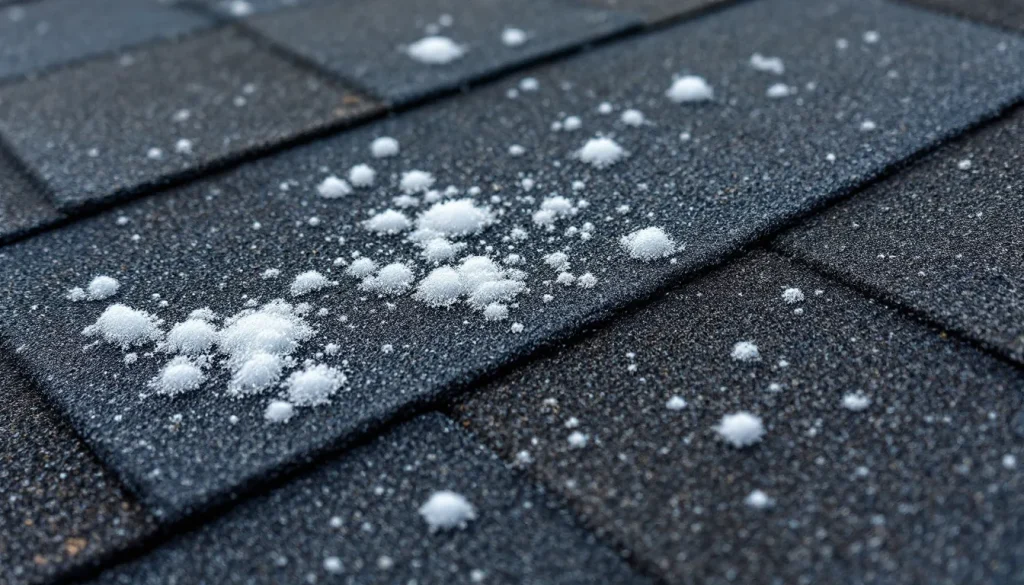
How much hail damage to replace roof comes down to a specific adjuster benchmark: 8 to 10 functional hail hits per 100 square feet (a 10-by-10 foot test square) is the industry standard threshold that triggers a full roof replacement on most homeowner insurance (see our partial roof replacement) claims. Below that, you typically get repair only. Above it, the carrier almost always approves a full tear-off and replace. Hail size matters too: stones under 1 inch rarely produce functional damage on architectural asphalt shingles, while 1.25-inch to 2-inch hail produces mat-fracture bruising that fails the test. The threshold also depends on the impact-resistance rating of your shingle (UL 2218 Class 1 through Class 4) and your carrier’s specific guidelines.
The short version
- The industry standard is 8 to 10 functional hail hits per 100 square feet to trigger replacement.
- Hail under 1 inch rarely damages architectural shingles. Hail at 1.25 inches and up usually does.
- “Functional damage” means mat fracture, granule loss exposing the mat, or loss of weatherproofing. “Cosmetic” means dimples without mat fracture.
- You generally have 1 year from the storm date to file a claim, but some carriers and states allow up to 2.
- If an adjuster calls damage cosmetic only, request a re-inspection, get a written report from a licensed roofer, and consider a public adjuster.
The Short Answer: 8 to 10 Hail Hits per 100 sq ft Threshold
Insurance adjusters across the major carriers use a square-foot test to measure hail (for the full data set, see the 2026 Roofing Hail and Storm Loss Database) damage density. They mark off a 10-by-10 foot square on each roof slope, count the number of functional hail strikes inside it, and compare to their carrier’s threshold.
| Functional Hail Hits per 100 sq ft | Typical Carrier Decision | Approved Scope |
|---|---|---|
| 0 to 4 | Denied or repair-only | Cosmetic, no payout |
| 5 to 7 | Repair scope | Replace damaged shingles only |
| 8 to 10 | Slope replacement | Replace the entire affected slope |
| 10+ | Full roof replacement | Tear-off + new roof |
The number 8 to 10 is not a federal standard. It is a convergent industry practice across State Farm, Allstate, USAA, Farmers, Liberty Mutual, Travelers, and most regional carriers. Some carriers use a slightly different cutoff (6 hits on one slope, for example), but 8 to 10 is the most common operating standard reported by independent appraisers and public adjusters.
The Adjuster Test: How Damage Is Measured
The adjuster’s playbook is consistent across carriers. Here is what happens when they show up:
- Walk-around inspection from the ground to find obvious damage and downed limbs.
- Ladder up to the roof. Check 4 test squares (one per major slope) by measuring with a chalk line or measuring tape.
- Use a soft chalk or lumber crayon to mark each functional hit found inside the test square.
- Photograph every marked hit with measurement reference.
- Check the soft metals: gutters, downspouts, AC condenser fins, soft-metal vent caps, window screens. Soft-metal damage corroborates hail event and size.
- Check for collateral: damaged screens, broken shingles, missing tabs, valley damage, flashing dents.
- Estimate hail size based on impact diameter on soft metals.
- Write the scope.
If you are present (and you should be), watch the test squares get drawn and counted. Take your own photos. Disagree on the spot if their hit count looks low.
Hail Size Matters: Marble, Golf Ball, Tennis Ball
Hail size correlates strongly with damage potential. The NOAA Severe Storms Reference Guide defines hail in standard size brackets, and the roofing industry uses those benchmarks too.
| Hail Diameter | Comparison | Damage to Architectural Asphalt |
|---|---|---|
| 0.5 inch | Marble | Cosmetic only, no mat fracture |
| 0.75 inch | Penny / dime | Borderline. Granule loss possible. |
| 1.0 inch | Quarter | NWS severe threshold. Functional damage possible. |
| 1.25 inch | Half dollar | Functional damage likely on standard shingles. |
| 1.5 inch | Walnut / ping pong ball | Functional damage on most shingles. |
| 1.75 inch | Golf ball | Severe damage. Often full replacement. |
| 2.0 inch | Egg / hen egg | Severe damage including deck. |
| 2.5 inch | Tennis ball | Catastrophic. Replacement guaranteed. |
| 2.75 inch | Baseball | Catastrophic. Often deck damage. |
| 4.0 inch+ | Softball | Total loss potential. |
The National Weather Service defines “severe” hail as 1 inch (quarter-sized) or larger. That is also roughly the threshold where standard 3-tab and architectural shingles begin showing functional damage. Class 4 impact-rated shingles can shrug off 1.5 to 2 inch hail with no functional damage at all.
UL 2218 Impact Resistance Ratings
The Underwriters Laboratories 2218 standard is the industry test for impact resistance. A steel ball is dropped from a measured height onto a shingle, and the shingle is graded based on whether it fractures.
| UL 2218 Class | Steel Ball Size | Equivalent Hail | Insurance Discount |
|---|---|---|---|
| Class 1 | 1.25 inch | 1 inch hail | None |
| Class 2 | 1.5 inch | 1.25 inch hail | Sometimes |
| Class 3 | 1.75 inch | 1.5 inch hail | 5 to 15 percent |
| Class 4 | 2 inch | 1.75 to 2 inch hail | 10 to 35 percent |
Class 4 shingles cost about 10 to 25 percent more than standard architectural and typically qualify for 10 to 35 percent off your homeowners insurance premium in hail belt states. In Texas, Colorado, Oklahoma, Kansas, and Nebraska, the math usually pencils out within 5 years. Major Class 4 products: GAF Timberline AS II, CertainTeed Landmark IR, Owens Corning Duration Storm, Atlas StormMaster Shake.
What Counts as “Functional Damage” vs “Cosmetic”
This is the single most contested point in any hail claim. The carriers, the contractors, and the public adjusters all use slightly different definitions, but here is the working consensus.
Functional damage (qualifies for replacement)
- Hail bruising: a soft spot in the shingle where the asphalt mat has fractured (felt as a soft, mushy dimple when pressed)
- Granule loss exposing the mat (black spots visible on the shingle)
- Cracks in the shingle mat radiating from a hit point
- Missing tabs caused by the impact
- Damage to seal strips that compromises wind resistance
Cosmetic damage (typically denied)
- Surface dimples with no mat fracture
- Granule loss without exposing the mat
- Minor scuffing
- Faded color from existing wear
- Algae streaks or moss
Some carriers in some states sell a “cosmetic damage exclusion” endorsement that reduces premiums by 5 to 10 percent in exchange for waiving cosmetic-only claims. Read your declarations page. If you have this endorsement, even slight-but-cosmetic damage is denied.
The 4-Square Test Adjusters Use
The adjuster typically tests four 10-by-10 squares, one per slope (north, south, east, west). Why four?
- It accounts for variation across the roof.
- It identifies whether damage is consistent (real hail) or sporadic (might be other causes).
- It surfaces wind-driven hail patterns, where one slope takes most of the impact.
If only one slope shows the threshold (8 to 10 functional hits per 100 sq ft) but the others do not, you may get a single-slope replacement approval rather than full roof. Matching shingle availability often forces the carrier to approve full replacement anyway, because a 10-year-old shingle color cannot be matched to current production.
Granule Loss Patterns from Hail
Hail granule loss has a distinctive look that differs from age-related shedding.
- Hail granule loss is concentrated in distinct circular spots roughly the size of the hail stone, with sharp edges. The exposed mat in the center is bright black.
- Age-related granule loss is diffuse, irregular, and concentrated along edges, ridges, and high-traffic foot paths.
- Mechanical granule loss (from tree branches, foot traffic, dropped tools) is in lines or smears.
Adjusters know these patterns. So do experienced roofing contractors. Photograph every distinct circular spot on the roof. They are your strongest documentary evidence.
Bruising vs Fracturing: The Invisible Damage
The single most overlooked form of hail damage is mat bruising that you cannot easily see from above. The granules look intact. The shingle looks OK. But the asphalt mat underneath has fractured, and the shingle has lost its weatherproof seal.
The test: a roofer presses firmly with a thumb on a suspected hit. A healthy shingle resists. A bruised shingle feels soft, mushy, almost like pressing into a marshmallow. Once you feel a bruise, you know what to look for, and you will find more across the roof.
Bruised shingles fail the same way fractured ones do, just on a delayed timeline. They leak within 6 to 24 months after the storm. This is why a documented hail event with bruising-but-no-cracking still typically qualifies for replacement.
Hail Map: Where Damage Is Most Common
The NOAA Storm Prediction Center publishes annual hail event maps. The hail belt runs through the central plains and Front Range states.
| State | Avg. Annual Hail Events (1 inch+) | Roofing Claim Implications |
|---|---|---|
| Texas | 700+ | #1 state for hail claims. Class 4 standard. |
| Kansas | 400+ | Multi-event years common. |
| Nebraska | 350+ | Tornado/hail overlap. |
| Oklahoma | 300+ | Carrier scrutiny is high. |
| Colorado | 300+ | Front Range corridor extreme. |
| Missouri | 250+ | Spring storm season. |
| South Dakota | 200+ | Rural claim density. |
| Iowa | 200+ | Derecho exposure. |
| Minnesota | 150+ | Twin Cities metro hits. |
| Wyoming | 150+ | Cheyenne corridor. |
If you live in a top-10 hail state, the math on Class 4 impact-rated shingles is nearly always positive. The Insurance Information Institute (III) reports that hail accounts for about $13 billion in insured losses per year nationally.
Storm Date Matching: You Must Claim Within the Window
Most policies require you to file a claim within 1 year of the storm date that caused the damage. Some states extend this to 2 years (Texas is one), and some carriers shorten it to 6 months. Two things to lock down immediately after a hail event:
- Identify the storm date. Use the NOAA Storm Events Database or Hail Strike at hailstrike.com. You need the exact date and county for the carrier to match.
- Photograph everything within 72 hours. Damaged screens, dented gutters, bent flashing, vent caps, AC fins. Time-stamped photos prevent later disputes about when the damage occurred.
If you wait 18 months and then claim a hailstorm from 2 years prior, the adjuster will scrutinize whether the damage actually came from that event or from a later one not covered by your policy.
What If the Adjuster Says “Cosmetic Only”
This happens regularly. The adjuster walks the roof, draws their squares, counts 4 to 6 hits where you and your contractor counted 12 to 15, and writes “cosmetic damage, no payable claim.” Here is the playbook to challenge it.
- Request the adjuster’s report in writing, including their photos and notes.
- Get your roofing contractor‘s written report with photo evidence and a count of functional hits.
- Submit a formal request for re-inspection through your claims line. Most carriers will send a second adjuster, often a more senior one.
- Show up for the re-inspection with your contractor present. Two technical pros on the roof together produce better outcomes than a homeowner alone.
- If still denied, file with your state’s Department of Insurance. A regulator complaint often triggers another internal review.
- If still denied, hire a public adjuster (more on this below) or pursue appraisal under your policy’s appraisal clause.
Getting a Second Opinion: Public Adjusters
A public adjuster works for you, not the insurance company. They cost 10 to 20 percent of the final settlement. They earn their fee on claims that were initially denied or underpaid.
When a public adjuster makes sense:
- Your claim was denied outright but you have documented functional damage
- The settlement is less than half of your independent contractor’s estimate
- The adjuster missed a slope or excluded specific elements
- The carrier is dragging the process past 30 days with no clear reason
Public adjusters are licensed by state. Verify the license before signing. Avoid any “PA” who shows up uninvited after a storm. The reputable ones come from referrals, not door-knocks.
Insurance Carrier Differences: Hail Claim Criteria
The 8-to-10-hits standard is industry-wide, but each carrier has internal tweaks. Here is the field-reported behavior of the major carriers (based on aggregated 2024-2026 reports from contractors and public adjusters).
| Carrier | Hail Claim Disposition | Notes |
|---|---|---|
| State Farm | Moderate | Frequently uses staff adjusters. 8-hit threshold typical. Roof-age scrutiny strict in some states. |
| USAA | Generous | Higher claim approval rates reported. Strong member loyalty. Tends to pay full RCV without dispute. |
| Allstate | Strict | Heavy use of contracted IA firms. ACV-first policies more common. Re-inspection frequently needed. |
| Farmers | Moderate | Cosmetic exclusions common in TX, CO. Read your declarations page. |
| Liberty Mutual | Moderate | RCV with hold-back common. |
| Travelers | Moderate | Aggressive depreciation schedules. Class 4 discounts available. |
| Nationwide | Moderate | Standard playbook. |
| Progressive | Strict | Newer to homeowners. Limited claims discretion in some states. |
None of this is policy language. It is what contractors and public adjusters report from years of fielding hail claims. Your own claim outcome depends on your specific policy, the assigned adjuster, and the storm record.
How Soon After Hail to File
The right cadence:
- Within 24 hours: Document with photos and video. Tarp any active leaks.
- Within 1 week: Get an inspection from a local, licensed roofing contractor. Get their report in writing.
- Within 30 days: File the claim with your carrier. Earlier filings get more attentive adjusters before claim volume swamps the carrier.
- Within 6 months: Complete the work and submit final invoices to release recoverable depreciation (if RCV policy).
Filing immediately is almost always better than waiting. Storm-chasing contractors who tell you to “wait six months and I will file for you” are doing it for their own pipeline, not your benefit. Carriers do not punish prompt filers, and prompt filers get less scrutinized inspections.
Cost Math: What You Actually Pay
If your claim is approved at full replacement, here is what your numbers look like for a typical 2,000 sq ft architectural shingle roof in 2026.
| Item | Amount |
|---|---|
| Replacement Cost Value (RCV) estimate | $14,500 |
| Recoverable depreciation | ($3,500) |
| Actual Cash Value (ACV) initial payment | $11,000 |
| Less hail/wind deductible (1 to 5 percent of dwelling) | ($2,500 to $7,500) |
| Net first check | $3,500 to $8,500 |
| Second check after work completed (recoverable dep.) | $3,500 |
| Total carrier payout | $11,000 to $14,500 |
| Homeowner out of pocket (deductible) | $2,500 to $7,500 |
Hail and wind deductibles in storm-belt states are often separate from your standard deductible and run 1 to 5 percent of the dwelling coverage amount. On a $300,000 home, that is $3,000 to $15,000. Read your declarations page before storm season. For total project context, see how much does a new roof cost or run our roof replacement cost calculator.
Choosing a Hail Claim Contractor
The right contractor is local, licensed, insured, and has been in business in your area for at least 3 to 5 years. Avoid door-knocking storm chasers from out of state. Verify the contractor’s standing with the state contractor licensing board and with the BBB. Ask for at least 3 local references on past insurance work. See how to choose a roofing contractor for a full vetting checklist.
FAQs
How much hail damage to replace roof under State Farm?
State Farm uses the standard 8-to-10 functional hits per 100 square feet threshold in most states, with internal scoping variations by region. Roof age is also factored. Contractors report State Farm staff adjusters apply this benchmark consistently across the central plains.
Will insurance cover hail damage on an old roof?
Yes, if your policy is Replacement Cost Value (RCV) and the damage is from a covered storm. Roof age affects how depreciation is calculated but does not by itself void coverage. An Actual Cash Value (ACV) policy on a 22-year-old roof will pay much less than the same RCV policy, because depreciation eats the payout. Check your declarations page for “RCV” versus “ACV” on roof coverage.
How long do I have to file a hail damage claim?
One year from the storm date is the most common policy limit, with Texas and a few other states extending to 2 years. Some carriers have shortened this to 6 months. File immediately. Waiting reduces the carrier’s confidence that the damage came from the claimed storm.
What size hail damages a roof?
1 inch (quarter-sized) is the National Weather Service severe threshold and the practical floor for functional damage to standard architectural asphalt shingles. 1.25-inch hail will damage most non-impact-rated shingles. 2-inch hail damages every common residential roofing material to varying degrees.
Can hail damage a metal roof?
Yes, cosmetically. Metal roofs (especially aluminum and softer-gauge steel) can show dents from 1.5-inch and larger hail. Most dents are cosmetic only. Stone-coated steel and standing seam roofs perform best. Most metal roof carriers in hail belt states sell cosmetic damage exclusions specifically for metal roofs.
What happens if my deductible is more than the damage?
You pay out of pocket, and the claim closes with no carrier payout. In hail-belt states with high percentage deductibles ($5,000 to $10,000), small to moderate hail events often produce damage just below the deductible. Document the damage anyway. If multiple events happen in a year, the cumulative damage can sometimes be claimed together.
Will my insurance go up after a hail claim?
In most states, a single hail claim is treated as “act of God” and does not directly raise your individual premium. However, your carrier may raise rates broadly across the region after a major storm year. Some carriers also non-renew policies after multiple claims in a 3-year window. Filing one legitimate claim is rarely a rate-driver. Filing three is.
Should I get a Class 4 impact-rated shingle if I live in a hail belt state?
Yes, almost always. The 10 to 25 percent extra material cost is usually offset within 3 to 5 years by the 10 to 35 percent premium discount most hail-belt carriers offer for Class 4 shingles. You also reduce the odds of needing to file a claim in the first place, which protects your renewal status.