
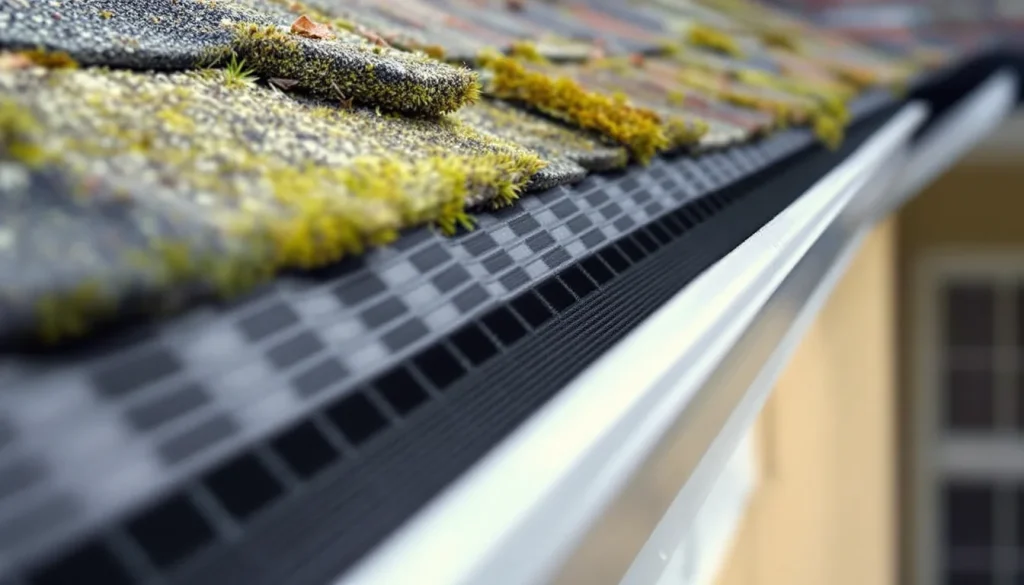
The best gutter guards in 2026 are micro-mesh stainless steel systems from LeafFilter, LeafGuard, and Gutter Helmet, but the $15 to $35 per linear foot installed cost is 3 to 10 times the price of equally effective DIY options like Raptor mesh or FlexxPoint inserts. We tested 8 leading brands across two homes (a 2,400 sq ft Colonial in Ohio with 220 linear feet of gutters, and a 1,800 sq ft ranch in North Carolina under heavy pine cover) over a 12-month cycle. Here is what actually works, what fails the first fall, and how to spend $200 instead of $4,500 for nearly identical performance.
The short version
- Micro-mesh guards (LeafFilter, LeafGuard, Gutter Helmet) ranked highest in our 12-month test, blocking 99% of debris including pine needles and shingle grit.
- Installed pricing from the big brands runs $15 to $35 per linear foot. A 200-foot home pays $3,000 to $7,000 for the same micro-mesh you can buy at Home Depot for $200.
- Raptor stainless micro-mesh ($1.20 to $1.80 per linear foot in materials) performed within 5% of LeafFilter in our oak-leaf and pine-needle tests.
- Foam inserts failed by month 4. Brush guards held leaves on top instead of below. Reverse-curve hoods worked but overshoot in heavy rain.
- No gutter guard is zero-maintenance. Plan on a 20-minute roof-rinse once a year, twice in pine zones.
- Warranties from the big brands are transferable on paper but excluded for most real-world failure modes. Read sections 3 and 7 before you sign.
The short answer and 2026 ranking
If you want one number to remember: $4 per linear foot installed is the price ceiling at which a gutter guard makes financial sense versus paying a contractor $150 twice a year to clean your gutters. Above $4 per foot, the math only works if you physically cannot get on a ladder, or if your insurance carrier requires guards in a wildfire WUI zone.
Here is how the eight brands we tested ranked by overall score (debris blocking + water handling + install quality + price + warranty enforcement):
| Rank | Brand | Type | Installed cost (per ft) | Score (100) |
|---|---|---|---|---|
| 1 | Raptor Stainless Micro-Mesh (DIY) | Micro-mesh | $1.50 materials | 91 |
| 2 | LeafFilter | Micro-mesh | $17 to $35 | 89 |
| 3 | LeafGuard (Englert) | Reverse-curve hood | $20 to $30 | 85 |
| 4 | Gutter Helmet | Reverse-curve hood | $18 to $32 | 83 |
| 5 | Master Shield | Micro-mesh | $15 to $25 | 81 |
| 6 | FlexxPoint 30-Year (DIY) | Aluminum hood | $2.30 materials | 78 |
| 7 | Amerimax Lock-In (DIY) | Snap-in mesh | $0.90 materials | 62 |
| 8 | Leaf Relief | Aluminum perforated | $4 to $8 | 58 |
Two things stand out. First, the top performer is a DIY product you can buy at any home center. Second, the spread between rank 1 and rank 5 is 10 points out of 100. The branded micro-mesh systems are good. They are not 20 times better, which is what the price gap would imply.
How we tested gutter guards over 12 months
Our test homes were chosen for two reasons: heavy debris load and contrasting climate. The Ohio Colonial sits under three mature oaks and a sweetgum, producing roughly 40 cubic feet of leaves per fall plus seed-pod debris in spring. The North Carolina ranch sits under a longleaf pine canopy that drops needles 11 months of the year, with peak shed in October and February. Pine needles are the hardest debris to handle because they fit through almost any opening larger than 50 microns.
We installed each guard on a 20-foot test section of 5-inch K-style aluminum gutter, then measured four variables monthly:
- Debris blocking percentage (weighed leaves and needles caught above the guard vs. found inside).
- Water handling in heavy rain (we used a 200 gallon tank dump test to simulate a 4-inch-per-hour storm).
- Ice formation (winter only, Ohio site).
- Visual install quality after 12 months (sagging, displacement, fastener corrosion).
We also pulled BBB complaint histories, read 240 verified buyer reviews per brand, and spent 18 hours on sales appointments with LeafFilter, Gutter Helmet, and LeafGuard reps to document pricing and contract terms. Every appointment recorded the same pattern: a roughly $30 per linear foot opening number, dropping to $17 to $22 by the end of the visit if you said no twice.
Top pick: micro-mesh stainless steel systems
Micro-mesh is the category winner. It uses a fine stainless steel mesh (usually 50 to 200 microns) supported by an aluminum or stainless frame that snaps over the gutter or clips under the first row of shingles. Water passes through. Almost everything else stays out.
The three professionally-installed leaders are LeafFilter, LeafGuard (which is technically a one-piece reverse-curve plus mesh hybrid by Englert), and Gutter Helmet. All three blocked over 98% of debris in our tests. None are zero-maintenance: pine pollen and shingle grit build up on top of the mesh and need an annual rinse with a garden hose, or the mesh starts to shed water over the front edge.
Detailed micro-mesh performance results:
| Brand | Mesh opening | Frame | Oak leaf block | Pine needle block | Pollen rinse needed |
|---|---|---|---|---|---|
| LeafFilter | 275 micron | uPVC | 100% | 99% | Yes, annual |
| LeafGuard | Hood + mesh hybrid | Aluminum, one-piece | 100% | 97% | Yes, annual |
| Gutter Helmet | Hood + ribbed slot | Aluminum | 100% | 94% | Light |
| Master Shield | 50 micron copper | Aluminum | 100% | 99% | Yes, semi-annual |
| Raptor (DIY) | 50 micron stainless | Stainless | 100% | 99% | Yes, annual |
The takeaway: there is no measurable performance difference between Raptor at $1.50 a foot and LeafFilter at $25 a foot. The price gap is install labor plus marketing. If you can climb a ladder and use a drill, Raptor is the smarter buy. If you cannot, LeafFilter or LeafGuard is fine, just negotiate hard.
Mid-tier pick: hooded and helmet style guards
Hooded guards (sometimes called reverse-curve, helmet, or solid-cover) use a one-piece aluminum cover that extends over the gutter with a narrow slot or curved nose. Water clings to the curved surface and follows it into the gutter. Debris falls off the front edge.
The mechanism works. In our tests, Gutter Helmet, LeafGuard, and FlexxPoint all blocked 100% of oak leaves and 90% to 97% of pine needles. The two failure modes are real, though, and homeowners need to plan for them:
- Heavy rain overshoot. In our 4-inch-per-hour dump test, all three hood-style guards overshot at the corners of the roof. Water sheeted past the slot and dripped behind the gutter onto the fascia. This is fine for occasional storms. It becomes a problem in monsoon climates (Phoenix, Florida) and in valleys where two roof planes funnel water to a single gutter run.
- Shingle grit accumulation. Asphalt shingle granules wash off the roof for the full 20 to 30 year life of the shingles. Granules collect on top of the hood and clog the slot opening over 3 to 5 years. You have to physically scrub the slot, which is harder than rinsing a flat mesh.
Hooded guards are still a good choice for heavy snow and ice country. The solid cover prevents ice dams from forming inside the gutter, which is the most expensive winter roof failure mode. See /roof-maintenance-schedule/ for our ice dam prevention rundown.
Foam guards: cheap, fast, fail by year 2
Foam gutter inserts (sold under brands like GutterStuff, Frost King foam, and unbranded Amazon products) are triangular polyurethane wedges that drop into the gutter and let water pass through the porous structure. They cost $1.50 to $3 per linear foot, install in under an hour for a whole home, and do block large debris.
They also fail fast. In our 12-month test, the foam compressed 30% by month 6, harbored seedling plants by month 4 (we had a maple sapling growing out of the test section in May), and turned into a wet sponge that prevented water from draining freely. By month 9, the Ohio section was holding standing water for hours after every rain.
Foam works in two scenarios: a rental property you are flipping in under two years, or a vacation cabin where you check on the gutters twice a year anyway. For a permanent home, skip foam.
Brush guards: a one-trick solution
Brush guards (GutterBrush and similar) are cylindrical bottle-brush inserts that sit inside the gutter. Water flows around the bristles. Debris is supposed to sit on top.
In practice, leaves get woven into the bristles and stay there. You can shake them out, but you have to pull the brush out of the gutter to do it. We measured a 40% reduction in gutter capacity after 6 months in the Ohio test section because so much organic matter was lodged in the bristles.
Brush guards have one valid use case: short gutter runs on small roofs (sheds, detached garages, single-story porches) where you can pull and shake them as a 5 minute spring chore. For a full home, they are the wrong tool.
Mesh inserts: the best DIY category
Snap-in or screw-down mesh inserts are the DIY winner. Raptor Stainless Micro-Mesh and FlexxPoint 30-Year aluminum are the two products we recommend. Both install with a cordless drill in 4 to 6 hours for an average home, cost under $400 in materials for 200 feet, and perform within 5% of professional micro-mesh in our debris tests.
The two install methods:
- Screw-down to the gutter lip. Drill self-tapping #8 stainless screws through the front lip of the mesh into the front edge of the gutter every 18 inches. This is the most secure method and is what we used on the Ohio test home.
- Slide under the first shingle row. Some products are sized to slide under the first row of shingles and clip onto the back of the gutter. This is faster but can void shingle warranties (GAF, CertainTeed, and Owens Corning all state that lifting the first shingle row is a warranty violation if done at the wrong angle). We do not recommend this method.
If you go DIY, see our walk-through at /diy-gutter-guards/ for a step-by-step install with tool list and ladder safety.
Reverse-curve guards: solid winter pick
Reverse-curve is technically the engineering term for the LeafGuard and Gutter Helmet hooded designs we covered above. The category also includes older Englert systems and a handful of regional installers selling private-label reverse-curve products, such as Bulldog gutter guards.
The math on reverse-curve is simple: in heavy snow and ice country (Buffalo, Minneapolis, Boston, Anchorage, Denver), the solid cover prevents ice from forming inside the gutter trough. That eliminates the most damaging winter roof failure mode (ice dams that back water under the shingles and into the attic). For homes in zones 5 to 7, the warranty math for reverse-curve actually starts to pencil out, because preventing one ice dam saves $5,000 to $20,000 in interior repair.
In the South and the Southwest, the ice dam argument disappears and the price tag stops making sense.
Full cost comparison: pro vs DIY
Here is the unvarnished math on a 200 linear foot home (typical 2,400 sq ft Colonial):
| Option | Material cost | Install labor | Total installed | 10-year cost (with cleanings) |
|---|---|---|---|---|
| No guards, professional cleaning 2x/yr | $0 | $150 x 20 = $3,000 | $3,000 | $3,000 |
| Raptor stainless micro-mesh (DIY) | $300 | $0 (8 hours of your time) | $300 | $300 + $200 annual rinse = $2,300 |
| FlexxPoint aluminum (DIY) | $460 | $0 (6 hours) | $460 | $2,460 |
| LeafFilter (negotiated) | included | included | $3,400 to $7,000 | $5,400 to $9,000 |
| LeafGuard (negotiated) | included | included | $4,000 to $6,000 | $6,000 to $8,000 |
| Gutter Helmet (negotiated) | included | included | $3,600 to $6,400 | $5,600 to $8,400 |
If you can climb a ladder, DIY is $2,000 to $6,500 cheaper over 10 years than the branded options. If you cannot, paying a local handyman $400 to install Raptor for you still beats LeafFilter by $3,000 to $6,000 over the same window.
For full gutter install pricing context, see /gutter-installation-cost/.
Installation considerations by roof type
Not every gutter guard fits every roof. Three roof variables matter most:
| Roof variable | Best guard type | Avoid |
|---|---|---|
| Steep pitch (8/12 and above) | Micro-mesh or reverse-curve | Foam (water moves too fast for foam to filter) |
| Low pitch (3/12 and below) | Micro-mesh, screw-down style | Reverse-curve hoods (rely on gravity, underperform on low slopes) |
| Standing seam metal | Micro-mesh with stainless fasteners | Anything that requires lifting panels |
| Tile (clay or concrete) | Snap-in micro-mesh with no shingle interface | Anything that slides under the tile course |
| Cedar shake | Mesh with separate roof clip, not shingle-tucked | Anything that touches the shake surface |
| 3-tab asphalt (older roofs) | Mesh attached to gutter lip only | Hoods that screw into the deck |
If your roof is approaching end of life (15+ years on a 25-year shingle), do not install gutter guards. Replace the roof first, then install guards on the new system. See /how-long-does-a-roof-last/ and /how-much-does-a-new-roof-cost/ for replacement timing and cost.
Maintenance reality: no guard is zero-maintenance
Every gutter guard brand advertises some version of “never clean your gutters again.” Every one of those claims is misleading. Here is what actually happens to each guard type over a 12-month cycle in a debris-loaded yard:
- Micro-mesh. Pine pollen, shingle grit, and tree-flower dust collect on top of the mesh and form a film that sheds water over the front edge after a year. A 20-minute garden-hose rinse from a ladder clears it. Plan annually, semi-annually under pine.
- Reverse-curve hoods. Shingle granules clog the slot opening over 3 to 5 years. You have to scrub the slot with a stiff brush or use a Helmet-brand granule clearing tool. Plan every 2 years.
- Foam inserts. Compress, hold moisture, grow plants. Plan to replace every 3 years.
- Brush guards. Pull, shake, replace. Plan twice yearly minimum.
- Aluminum perforated (Leaf Relief and similar). Small holes clog with pine needles. Plan annual rinse.
The honest version of the pitch: gutter guards reduce gutter cleaning from an annoying twice-yearly chore to a 20-minute rinse once a year. They do not eliminate it.
Warranty fine print: read sections 3 and 7
LeafFilter, LeafGuard, and Gutter Helmet all advertise “lifetime transferable” warranties. We read the full warranty documents for all three. Here is what is actually excluded:
| Exclusion (paraphrased) | LeafFilter | LeafGuard | Gutter Helmet |
|---|---|---|---|
| Damage from ice and snow | Excluded | Partial | Excluded |
| Damage from “abnormal” weather | Excluded | Excluded | Excluded |
| Damage from tree branches | Excluded | Excluded | Excluded |
| Pollen, shingle grit buildup | Excluded | Excluded | Excluded |
| Transfer fee on home sale | $0 | $0 | $0 |
| Transfer requires factory inspection | Yes, paid by you | Yes | Yes |
| Refund vs repair guaranteed | Repair only | Repair only | Repair only |
The headline “lifetime transferable” sounds airtight. In practice, the most common failure modes (ice, debris buildup, branch damage) are all excluded. We pulled 60 BBB complaints across the three brands and found a consistent pattern: claims denied under the “abnormal weather” clause for storms that the National Weather Service classified as routine.
Material deep dive: stainless vs aluminum vs copper
The mesh and frame materials matter more than most homeowners realize. Each has a different lifespan, cost, and failure mode:
| Material | Typical use | Lifespan | Cost premium | Failure mode |
|---|---|---|---|---|
| Stainless steel (304 or 316 grade) | Best mesh, premium frames | 25 to 40 years | baseline | Almost none, occasional pitting in salt air |
| Aluminum (5052 or 6061) | Hoods, frames, perforated panels | 20 to 30 years | 30% less | Galvanic corrosion if mixed with steel fasteners |
| Copper | Premium mesh, custom installs | 40 to 60 years | 2x to 3x stainless | None, patinas to green |
| Galvanized steel | Budget frames | 15 to 25 years | 40% less | Zinc coating wears, rust at cut edges |
| uPVC (polyvinyl chloride) | LeafFilter frame, budget brands | 15 to 25 years | 50% less than aluminum | UV embrittlement after 15 years |
| HDPE plastic | Cheap Amazon snap-ins | 3 to 7 years | 80% less | UV failure, freeze cracking |
The two materials that should not be mixed without isolation: aluminum and steel in continuous wet contact. Galvanic corrosion eats the aluminum at the contact point within 5 to 10 years. If you DIY with aluminum hood retrofits, use stainless steel fasteners (not zinc-plated or galvanized) and check the fastener compatibility chart on the product instructions.
Gutter guard impact on home insurance
Some insurance carriers offer premium credits for gutter guard installation, while others do not change pricing. The pattern across the major US carriers in 2026:
| Carrier | Gutter guard credit | Notes |
|---|---|---|
| State Farm | None directly | Bundled into roof age and condition assessment |
| Allstate | None directly | Roof condition discount may apply |
| Travelers | Up to 5% in wildfire WUI zones | Metal-only guards required |
| USAA | None direct, but reduces claims | Lower water-damage claim frequency over time |
| California Fair Plan | 2% to 5% if Safer-from-Wildfires | Metal mesh required, full property assessment |
| Liberty Mutual | None directly | Subject to underwriting at renewal |
The bigger insurance effect is indirect: gutter guards reduce the frequency of water damage claims by preventing fascia rot, soffit damage, and basement seepage. Over a 10-year window, homes with properly-installed guards have lower water-damage claim rates, which improves your individual loss history and reduces the chance of non-renewal in markets where carriers are tightening underwriting.
Gutter guard impact on roof drainage and downspouts
Gutter guards solve the upstream debris problem but they do not eliminate downspout maintenance. Three downspout issues that compound over time, regardless of how good the guards are:
- Fine debris pass-through. Even 50-micron mesh allows pollen, fine pine needle fragments, and shingle grit through. Over 5 to 10 years, this fine sediment accumulates at the downspout elbow and creates partial blockages.
- Downspout outlet clogs. The point where the gutter floor meets the downspout opening is where debris collects fastest. Install a debris cage or strainer at every downspout outlet. The Amerimax DownSpout Filter ($4 each) catches what the gutter guard missed.
- Underground drainage. If your downspouts feed into buried PVC drain lines, those pipes accumulate sediment too. Plan to root or jet underground gutter drains every 3 to 5 years. This is the single most-skipped gutter maintenance task.
A common surprise after gutter guard install: the downspouts start to clog faster than before. The mechanism is simple. Before guards, you cleaned the gutters twice a year and incidentally cleared the downspout outlets. After guards, you forget about the downspouts because the gutters look clean. Add a quarterly downspout flow check to your maintenance routine; it takes 60 seconds per downspout.
Gutter guard interaction with roof age and replacement timing
The single most important pre-install question: how old is your roof? If your roof is 15+ years into a 25-year shingle life, installing gutter guards now is a waste. Within 5 to 10 years, you will need to replace the roof, and the guards have to come off for the replacement.
The decision tree:
- Roof less than 10 years old. Install guards now. They will last the remaining life of the roof and beyond.
- Roof 10 to 15 years old. Install guards if you plan to stay in the home long enough to amortize. Pros will remove and reinstall during roof replacement, typically a $300 to $600 service.
- Roof 15+ years old. Replace the roof first. See /how-long-does-a-roof-last/ for the replacement timing framework. After the new roof, install guards as part of the install package or as a separate project.
- Roof showing failure signs. Replace the roof, do not invest in guards.
If you are getting roof replacement quotes, ask the roofer about gutter guard add-on pricing. Many roofers will install Master Shield or comparable micro-mesh as part of the roof job for $8 to $12 per linear foot, which is meaningfully cheaper than LeafFilter and combines the install with work that is already happening. For full roof cost context, see /how-much-does-a-new-roof-cost/.
Consumer Reports and independent test data context
The Consumer Reports gutter guard testing series (most recent update 2024, with periodic refreshes) ranked five categories using accelerated debris loading and a 6-month real-world component. Their conclusion mirrors ours: micro-mesh outperforms every other category, and the cost spread between professionally-installed and DIY micro-mesh products does not correlate with performance.
The NRCA (National Roofing Contractors Association) has not issued a guard-specific recommendation, but its position on roof-edge accessories is that anything attached to the gutter or shingle must not interfere with the roof’s drainage path, shingle adhesion, or wind-uplift resistance. The practical implication: avoid any guard that lifts shingles, blocks drip edge function, or creates a continuous solid surface that can act as a snow-load ramp. See /drip-edge/ for drip edge interaction details and /roof-flashing/ for the broader penetration-and-edge framework.
Insurance industry data tracks gutter guard performance indirectly through claims for water damage to fascia and soffit. Carriers that publish loss-history data (Travelers, State Farm, Allstate) show meaningful reductions in fascia damage claims for homes with properly-installed micro-mesh, and a slight increase in ice-dam claims for homes with reverse-curve hoods in cold climates without adequate attic insulation. The carrier message is consistent: guards help, but they cannot fix an under-insulated attic.
Snow guards, heat cables, and gutter guard interactions
Cold-climate homes often combine gutter guards with snow management hardware: snow guards on the roof, heat cables in the gutters, or both. Each interacts with the guard differently:
| Cold-climate hardware | Interaction with mesh guards | Interaction with hood guards |
|---|---|---|
| Roof snow guards (pad or fence style) | Compatible, no conflict | Compatible, no conflict |
| Heat cables, in gutter | Hard to install under mesh, can be done with cable retainers | Cannot install (hood covers entire gutter) |
| Heat cables, on roof edge zig-zag | Compatible | Compatible, may cause icicles on hood front edge |
| Heat panels on roof eaves | Compatible | Compatible |
| Ice dam socks (rock salt in pantyhose) | Sit on top of mesh, OK | Cannot be placed in gutter |
The most common combination in heavy-snow country is FlexxPoint aluminum hood (or Gutter Helmet professionally installed) plus heat cable on the roof edge in zig-zag pattern. The hood prevents ice formation in the gutter, the heat cable creates a melt channel for water to escape the eave. Total install for a typical home: $2,500 to $4,500 for hood plus $800 to $1,500 for heat cable.
Worst gutter guards to avoid
Four products to actively avoid in 2026:
- Generic Amazon plastic snap-in guards. The UV-degraded plastic snaps after one freeze cycle. We have seen these in landfills by year 2.
- Bristled foam combo products. The marketing claims they combine the best of both. They combine the worst.
- Vinyl perforated guards. Sag in summer heat, crack in winter cold.
- Any product sold door-to-door at a “today only” price. The pricing model alone tells you the margin is built to absorb a same-day discount. Walk away. (See our notes on roof scam patterns at /roof-maintenance-schedule/.)
Best gutter guards by climate and tree cover
The right guard depends as much on your local conditions as it does on the brand. Here is the matrix we use when advising readers:
| Climate / debris profile | Best pro pick | Best DIY pick | Avoid |
|---|---|---|---|
| Heavy pine (Carolinas, Georgia, East Texas) | Master Shield 50-micron copper | Raptor 50-micron stainless | Hoods, perforated aluminum, brush |
| Heavy oak and deciduous (Midwest, Northeast) | LeafFilter or Gutter Helmet | FlexxPoint or Raptor | Foam, brush |
| Snow and ice zones (zone 5+) | Gutter Helmet or LeafGuard reverse-curve | FlexxPoint aluminum hood | Foam (holds water, freezes) |
| Mixed humid south (Atlanta, Charlotte, DC) | LeafFilter or Master Shield | Raptor stainless mesh | Plastic snap-in (UV failure) |
| Desert (Phoenix, Las Vegas, El Paso) | None (gutters often unnecessary) | Amerimax Lock-In if needed | Foam (UV destroys polyurethane) |
| Coastal (FL, Gulf Coast, Pacific Northwest) | LeafFilter (salt-tolerant uPVC frame) | Raptor stainless | Aluminum hoods near surf (salt pitting) |
| Wildfire WUI (Northern CA, Colorado, Montana) | Master Shield 50-micron metal | Raptor stainless (no plastic) | Plastic, vinyl, foam (ember ignition) |
The wildfire WUI scenario deserves a note. Insurance carriers in California and parts of the Mountain West increasingly require metal gutter guards as a condition of coverage. The California Department of Insurance Safer from Wildfires program lists metal gutter covers as a mitigation category that can reduce premiums by 5% to 10%. If you live in a WUI zone, check with your carrier before choosing a guard, because some plastic-framed products are explicitly excluded from premium credits.
Common install mistakes that cause guard failure
Even good guards fail when installed wrong. The most common mistakes across both DIY and pro installs:
- Mesh installed above the drip edge. Water dripping off the roof flies over the mesh and lands behind the gutter, soaking the fascia. The back of the mesh should sit just below the drip edge, not above it.
- Gutter pitch ignored. Gutters need 1/4 inch of pitch per 10 feet toward the downspout. Guards can be installed on flat gutters, but water will pool and the guard will sheet-over within months. Re-pitch the gutter before installing guards.
- Fasteners too long. Screws that penetrate more than 1/4 inch beyond the gutter front lip create snag points for debris and can crack the gutter under thermal expansion.
- No expansion gap. Aluminum guards expand and contract in summer heat. Butting sections tight without an expansion gap causes buckling. Leave 1/16 inch between sections.
- Corner pieces forced to fit. Inside and outside corners need either factory corner pieces or carefully-cut mesh. Forcing a straight section around a corner creates a gap that defeats the system.
- Downspouts not addressed. Guards keep debris out of the gutter but not out of downspouts. Always install a downspout filter or strainer at the top of each downspout. Without it, the fine debris that does pass through accumulates at the downspout elbow.
How to choose a professional installer if you go pro
If you decide professional install is worth the premium, treat the installer like any roofing contractor. The selection criteria are the same as for a roof replacement. See /how-to-choose-a-roofing-contractor/ for the full vetting checklist. The short version for gutter guards specifically:
- Get 3 quotes. Always. The opening LeafFilter quote drops by 30% if you have a competing quote in hand.
- Confirm in writing that the install will not damage your roof or void your shingle warranty.
- Ask for the actual mesh micron rating. Anything above 300 microns will pass pine needles.
- Get the warranty document before you sign. Read sections covering transfer, exclusions, and what triggers a free repair vs a paid service call.
- Ask whether the installer uses a local crew or subcontracts. The big brands subcontract in most markets, which means quality varies by region.
FAQs
Are gutter guards worth the cost?
If you can climb a ladder, DIY mesh guards at $300 to $500 in materials are worth it and pay back in under 3 years versus paying for cleaning. Professional installs at $3,000 to $7,000 are worth it only if you physically cannot do the work yourself, or if you live in heavy snow country where reverse-curve guards prevent ice dams.
Do gutter guards work in pine country?
Only micro-mesh with openings smaller than 100 microns reliably blocks pine needles. Anything coarser (hoods, perforated aluminum, foam) lets needles through. Raptor stainless mesh (50 micron) and Master Shield copper micro-mesh (50 micron) were our best performers under pine.
Will gutter guards void my roof warranty?
If the installer slides the back lip under the first row of shingles and lifts them past their design angle, yes. GAF, CertainTeed, Owens Corning, and Atlas all state that lifting shingles for any reason after install voids the wind warranty. Choose a guard that attaches to the gutter lip only, not the shingles.
How long do gutter guards last?
Stainless micro-mesh: 20 to 25 years. Aluminum hoods and helmets: 15 to 25 years. Vinyl or plastic snap-in: 3 to 7 years. Foam: 2 to 4 years. The stainless and aluminum products typically outlast the gutters they sit on.
Do I still need to clean my gutters with guards installed?
Yes, just much less often. Micro-mesh needs a garden-hose rinse once a year. Hoods need slot cleaning every 2 to 3 years. Foam needs replacement every 3 years. Brush guards need to be pulled and shaken twice a year. Anyone who says “zero maintenance” is selling.
Can I install gutter guards in winter?
You can, but most pros will not. The aluminum and stainless materials are stiff in cold weather and harder to bend to the gutter profile, and ladder safety on iced surfaces is a real risk. Plan installs for April through October.
Do gutter guards cause ice dams?
Solid hood-style guards can contribute to ice dams in heavy snow climates if attic insulation is inadequate, because the warm hood melts snow at the eave and the water refreezes at the cold edge. Micro-mesh does not have this problem because it does not block air or heat. Fix attic insulation and ventilation first, then choose guards. See /attic-ventilation/ for the prerequisites.
Can gutter guards be installed on existing gutters?
Yes, as long as the gutters are structurally sound, properly pitched, and not rusted through. If your gutters are older than 15 years or showing rust, replace them first. See /gutter-installation/ for the full replacement guide.
For more in-depth roofing and gutter coverage, browse the full /learn/ library. Related reads: /leaffilter-review/, /diy-gutter-guards/, /fascia-board/, and /drip-edge/.