
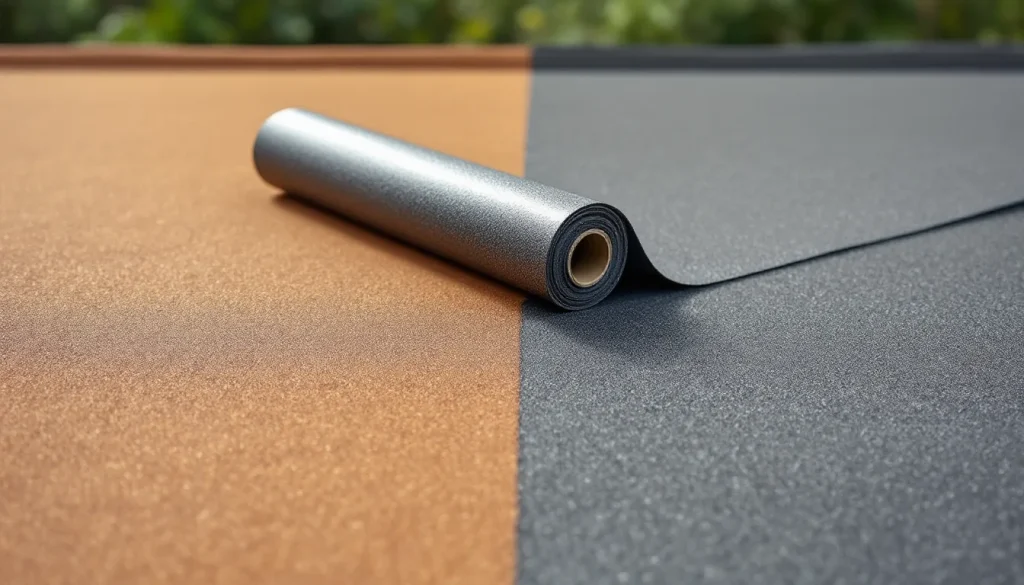
The best synthetic underlayment in 2026 depends on whether you are optimizing for tear strength, UV window, weight, install-day weather, or price. The seven major contenders (DuPont Tyvek Protec 120, GAF Deck-Armor, Owens Corning ProArmor, CertainTeed DiamondDeck, IKO Stormtite, Atlas Summit 60, Sharkskin Ultra) all sit within a fairly narrow performance band but differ enough on specific attributes that the right pick depends on the install. Tyvek Protec 120 leads on tear strength and overall premium (for the full data set, see our the 2026 State of Roofing Insurance report) reputation. GAF Deck-Armor pairs with GAF system warranties. Sharkskin Ultra and Atlas Summit lead on price-per-square. CertainTeed DiamondDeck and IKO Stormtite occupy the middle. ProArmor offers the longest UV exposure window. The price spread between the cheapest and most expensive is roughly $45 per square installed, which translates to $1,350 on a 30-square roof, often the difference between an underlayment upgrade and a hold-the-line bid.
The short version
- Tyvek Protec 120: premium leader. ~$190/sq, 65+ lbf tear, 120-day UV. DuPont engineering pedigree.
- GAF Deck-Armor: ~$175/sq, 50 lbf tear, 6-month UV. Required for some GAF system warranty tiers.
- OC ProArmor: ~$180/sq, 45 lbf tear, 12-month UV. Best UV window in the segment.
- CertainTeed DiamondDeck: ~$165/sq, 40 lbf tear, 6-month UV. Mainstream architectural-spec pick.
- Sharkskin Ultra: ~$155/sq, 55 lbf tear, 6-month UV. Heavy contractor following in PNW and TX.
- IKO Stormtite: ~$145/sq, 30 lbf tear, 90-day UV. Price-led mainstream pick.
- Atlas Summit 60: ~$160/sq, 35 lbf tear, 6-month UV. Newer market entrant, contractor favorable.
Why synthetic at all (the felt comparison in two paragraphs)
Asphalt (for the full data set, see our the 2026 Shingle Brand Comparison Report)-saturated felt (15-lb and 30-lb) has been the default roof underlayment since the early 1900s. It works. It is also heavy, tears at the slightest provocation, absorbs water (becoming heavier and weaker), buckles in heat, and gives off the smell that defines reroof day. Synthetic underlayments are polypropylene or polyethylene woven scrims with non-woven coatings, engineered to outperform felt on every measurable axis except cost-per-square at the cheapest tier.
The trade-off used to be price. In 2010, synthetic ran 2 to 3x the cost of 30-lb felt. By 2026, the price gap has shrunk to 20% to 40%, and synthetic is the default on most new shingle installs. Felt persists mainly in low-bid markets, on inspection-driven cheap reroofs, and in cases where the homeowner specifically requested it. For the full felt vs synthetic decision, see felt vs synthetic underlayment.
The metrics that actually matter
Marketing material on synthetic underlayment runs heavy on claims like “10x stronger than felt” or “industry-leading durability (for the full data set, see our the 2026 Roofing Material Lifespan Report).” The metrics that matter on the roof:
- Tear strength (lbf, per ASTM D1117 or equivalent): determines how well it resists puncture from foot traffic, nail miss-strikes, and wind.
- Nail sealability: how well the membrane self-seals around fasteners. Improves long-term water resistance.
- UV exposure window (days): how long the underlayment can sit exposed without UV degradation if the shingles get delayed.
- Weight (lb per square): affects shipping cost, handler fatigue, and installation speed.
- Wrinkle and lay-flat behavior: how well the membrane lays without bubbles or wrinkles that telegraph through shingles.
- Slip resistance: walking surface for installers, especially in damp or sloped conditions.
- Cold-weather flexibility: cracks at low temperature?
- Warranty terms and system integration (GAF, OC, CertainTeed require their own underlayment for some warranty tiers).
The 7-brand comparison table
| Product | Tear strength (lbf) | Nail seal | UV exposure window | Weight (lb/sq) | Cost per square installed (2026) |
|---|---|---|---|---|---|
| Tyvek Protec 120 (DuPont) | 65+ | Strong | 120 days | 3.5 | $185-200 |
| GAF Deck-Armor | 50 | Moderate | 180 days | 4.0 | $170-185 |
| Owens Corning ProArmor | 45 | Moderate | 365 days | 4.2 | $175-190 |
| CertainTeed DiamondDeck | 40 | Moderate | 180 days | 3.8 | $160-175 |
| Sharkskin Ultra | 55 | Strong | 180 days | 4.5 | $150-165 |
| IKO Stormtite | 30 | Moderate | 90 days | 3.2 | $140-150 |
| Atlas Summit 60 | 35 | Moderate | 180 days | 3.5 | $155-170 |
The “cost per square installed” figure includes the material plus an apportioned share of install labor; standalone material pricing is roughly 35% to 50% of the installed figure.
Tyvek Protec 120 (DuPont)
DuPont enters the roofing underlayment category with the same engineering credibility they built in housewrap. Tyvek Protec 120 is the high-end pick: 65+ lbf tear strength leads the category by a wide margin. The polypropylene scrim is co-extruded with a textured slip-resistant coating that delivers the best walkability rating in the segment.
The 120-day UV window is shorter than OC ProArmor but longer than most. The nail seal performance is strong, particularly around miss-strikes. The catch is price: at $185 to $200 per square installed, Tyvek is the priciest mainstream synthetic.
Where it shines: high-end residential, complex multi-slope roofs where install labor exceeds material cost, hurricane-zone installs where tear strength matters at edges. Where it is overkill: simple gable roofs in mainstream price points.
GAF Deck-Armor
GAF’s house-brand synthetic. Performance is solid but not category-leading. The system-warranty integration is the real value proposition: GAF’s Golden Pledge and Silver Pledge enhanced warranty tiers require the use of Deck-Armor (or the equivalent FeltBuster on lower tiers) in combination with GAF shingles. Skip Deck-Armor on a Golden Pledge install and the contractor cannot register the warranty.
For homeowners installing GAF Timberline HDZ or higher on a warranty tier that demands it, Deck-Armor is the correct pick by default. For homeowners installing GAF shingles on a standard warranty, the underlayment choice opens up.
FeltBuster vs Deck-Armor
GAF makes a budget option called FeltBuster that sits below Deck-Armor on tear strength (30 lbf vs 50 lbf) and warranty integration. FeltBuster is fine for standard installs but does not qualify for the top GAF warranty tiers.
Owens Corning ProArmor
OC’s premium synthetic, integrated into the Owens Corning Total Protection Roofing System. ProArmor’s standout is the 365-day UV exposure window, longer than any competitor. For phased installs (especially in regions where contractor backlogs run weeks during peak season), the 12-month UV window means a finished underlayment can sit through a full winter without degradation if shingles are delayed.
Tear strength is moderate at 45 lbf. Lay-flat behavior is good. Nail sealing is moderate. For OC system warranty tiers (Preferred and Platinum Contractor levels with OC shingles), ProArmor is the natural underlayment pick.
OC RhinoRoof
OC also offers RhinoRoof as a step down from ProArmor. RhinoRoof has 30 lbf tear and 60-day UV. It is the budget OC option, not the system-warranty default.
CertainTeed DiamondDeck
The category mainstream. CertainTeed’s DiamondDeck performs reliably across all metrics without leading on any. 40 lbf tear, 180-day UV, decent nail seal, fair price at $160 to $175 per square installed. For CertainTeed Landmark and Landmark PRO installs registered for SureStart Plus enhanced warranty, DiamondDeck is the system-integrated underlayment.
For homeowners not committed to a brand-system warranty, DiamondDeck is a defensible middle pick. It is not the best at anything but it does not embarrass itself anywhere either.
Sharkskin Ultra (Kirsch Building Products)
Sharkskin has a strong contractor following, particularly in the Pacific Northwest, Texas, and the Mountain West. The walkability and slip resistance are best-in-class, which matters when contractors are walking the underlayment on steep slopes during install. Tear strength at 55 lbf is second only to Tyvek. Price at $150 to $165 per square installed is among the best in the category for the performance tier.
The marketing reach is smaller than GAF or OC, so homeowner brand recognition is low. Contractors in markets where Sharkskin distributes will recommend it preferentially. The product is privately held and not tied to a shingle manufacturer, which means no system-warranty conflict in either direction.
Other Sharkskin variants: Sharkskin Comp (lighter weight, for low-slope), Sharkskin Solo (single-ply use), Sharkskin Hi-Temp (metal roof and tile applications).
IKO Stormtite
IKO’s mainstream synthetic. Lower tear strength (30 lbf) and shorter UV window (90 days) than most competitors, but the price is among the lowest at $140 to $150 per square installed. For value-driven installs paired with IKO shingles (Nordic Class 4, Cambridge, Crowne Slate), Stormtite is the system-integrated pick.
The performance trade-off is real. Stormtite tears more easily under nail-gun overshoots and foot traffic than premium picks. On uncomplicated gable roofs with experienced crews, it works fine. On complex roofs or with less-experienced crews, the tear failures eat into the cost savings.
IKO RoofGard-Cool Gray
IKO’s cool-gray variant, designed for visibility during install and slightly lower install-day heat. Same core tear and UV performance as Stormtite.
Atlas Summit 60
Newer market entrant relative to the established brands. Atlas builds Summit 60 with a polymeric scrim and slip-resistant coating, performance-tier similar to CertainTeed DiamondDeck. Price is contractor-friendly at $155 to $170 per square installed. For Atlas StormMaster Slate and Pinnacle Pristine installs, Summit 60 integrates into Atlas’s enhanced warranty programs.
Atlas’s distribution is regional. Strong presence in the Southeast and Midwest, lighter coverage on the coasts. For contractors with Atlas as a primary supplier, Summit 60 is the natural underlayment pick. For homeowners not committed to Atlas, alternatives offer similar performance at similar prices with broader distribution.
What the install spec should require
Regardless of brand, the underlayment spec on your roof contract should specify:
- Brand and product line (not just “synthetic”)
- Coverage area (typically full deck, except where ice and water shield substitutes at eaves, valleys, and penetrations)
- Overlap (typically 4 inches horizontal, 6 inches vertical)
- Fastener type and spacing (cap nails or plastic-cap fasteners, 12 inches on center field, 6 inches on edges)
- Compatibility with the shingle manufacturer’s warranty program
The contractor’s bid should list the underlayment by name. If it says “synthetic underlayment” without brand specification, ask for the brand before signing. Cheap unbranded synthetics from import sources are sold under generic SKU names and have failed nail-seal tests in independent reviews.
Where ice and water shield interacts with synthetic underlayment
Synthetic underlayment is the field membrane covering most of the roof. Ice and water shield is the sticky-back self-sealing membrane covering specific high-risk areas: eaves (typically 3 to 6 feet up from the eave, beyond the projection of the interior wall plane in cold climates), valleys, around skylights and chimneys, and around penetrations.
Most modern codes require ice and water shield at eaves in any climate zone with a January mean temperature below 25 degrees F. Even in warmer climates it is advisable at valleys and around penetrations.
For full ice-and-water-shield spec, see ice and water shield. For the related peel-and-stick category that bridges synthetic underlayment and ice-and-water, see peel and stick underlayment.
UV exposure window: when it actually matters
Most reroof projects shingle the same day or within 48 hours of underlayment install. The UV window does not really matter for those projects; any of the 7 brands here will tolerate 2 days of sun without measurable degradation.
UV window matters when:
- The contractor strips the roof, installs underlayment, then weather delays shingle install for days or weeks.
- Phased reroofs where one slope is done at a time over a season.
- New construction where the roof deck is underlayment-only during framing-to-finish, sometimes for months.
- Long-distance contractor backlogs during peak hail or storm-claim season.
For new construction (see our new construction roofing detail guide) projects with long timelines, ProArmor’s 12-month UV is genuinely useful. For mainstream residential reroofs, a 90-day or 180-day window is sufficient and the UV-driven brand differentiation is mostly marketing.
The walkability factor
Contractor experience walking the underlayment matters more than homeowner research suggests. A slippery underlayment in damp conditions creates real fall risk. Most modern synthetics have non-slip coatings or textures, but quality varies.
The contractor consensus ranking on walkability:
- Sharkskin Ultra (best)
- Tyvek Protec 120
- GAF Deck-Armor
- OC ProArmor
- CertainTeed DiamondDeck
- Atlas Summit 60
- IKO Stormtite
Contractors who walk slick underlayment for a living tend to push back on switching to lower-walkability products even if the homeowner picks a different brand for other reasons.
Where to spend extra, where to save
For most homeowners, the underlayment line on the contract is a $400 to $800 difference between mid-tier and premium. The cost-benefit framework:
- Spend on premium (Tyvek, GAF Deck-Armor system, OC ProArmor) if: high-wind region, complex roof with valleys, long install timeline expected, system warranty tier requires it, or contractor has strong preference.
- Save with mid-tier (CertainTeed DiamondDeck, Atlas Summit 60, Sharkskin Ultra) if: simple gable roof, mainstream shingle, experienced contractor, standard timeline.
- Save with budget (IKO Stormtite) only if: bid pressure is real, contractor is experienced with the product, simple roof geometry, mild climate.
For homeowners doing a full new-roof analysis, our how much does a new roof cost guide breaks down where underlayment fits in the total project budget. For the Class 4 IR upgrade that often pairs with a synthetic underlayment system spec, see class 4 impact resistant shingles.
FAQ
Can I install synthetic underlayment over old shingles for a lay-over?
Most manufacturer specs do not approve synthetic over existing shingles. The lay-over creates uneven substrate, traps moisture, and voids most manufacturer warranties on both the underlayment and the new shingles. Tear off the old roof first.
Does synthetic underlayment work under metal roofing?
It depends on the metal panel system and the synthetic. Most general-use synthetics are rated for asphalt shingle applications only. For metal roofing under hot conditions (standing seam in southern climates), use a high-temperature rated underlayment like Sharkskin Hi-Temp, GAF FeltBuster HT, or Polyglass Polystick MTS. Standard synthetics can degrade at the elevated panel temperatures of metal roofs in summer. For metal-specific install details, see metal roof installation.
What about cap nails vs staples for synthetic underlayment install?
Plastic cap nails or plastic cap staples are required by most manufacturer specs (and most modern codes). Bare staples or roofing nails without caps tear through synthetic underlayment in wind and rain. The cap distributes load and prevents tear-out.
Does synthetic underlayment need to be replaced when shingles are replaced?
Yes. Tear off both shingles and underlayment together. Synthetic underlayments are designed for a one-time install life paired with the shingles above; they are not rated for reuse under new shingles.
Is the cheapest synthetic underlayment worse than 30-lb felt?
For tear strength and water resistance, even the cheapest synthetic (IKO Stormtite, RoofGard) outperforms 30-lb felt. For long-term aging, all major-brand synthetics outperform felt. The only categories where felt might match or beat synthetic are slipperiness (felt is grittier in dry conditions) and cost (felt remains the cheapest option in many markets).
Bottom line
All seven major synthetic underlayments here will outperform 15-lb or 30-lb felt across every meaningful metric except raw material cost. Within the synthetic segment, Tyvek Protec 120 leads on tear strength, OC ProArmor leads on UV window, Sharkskin Ultra leads on walkability and price-performance. GAF Deck-Armor and CertainTeed DiamondDeck deliver mainstream reliability tied to their parent brand system warranties. IKO Stormtite is the budget pick that works on simple roofs with experienced contractors. The $45 per square spread between cheapest and most expensive is real money on a 30-square roof, but on a complex roof or a hurricane-zone install, the premium pays back fast in install integrity and warranty coverage. For the related material decisions on the same roof, see felt vs synthetic underlayment, ice and water shield, and peel and stick underlayment. For the cost rollup that puts underlayment in context with the whole project, see how much does a new roof cost.