
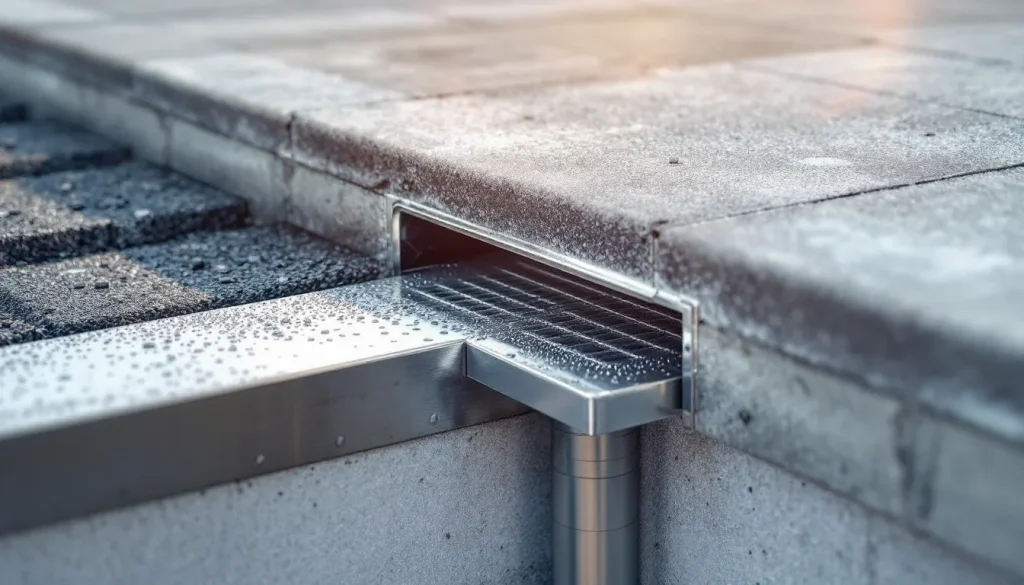
The scuppers vs gutters question on a flat roof is settled by three factors: whether the roof has a parapet wall, how big the contributing area is, and what the local code official will sign off on. Scuppers are through-wall drains cut directly through a parapet, sized by International Plumbing Code (IPC) Section 1106 and required to be paired with an overflow scupper at least 2 inches above the primary. Gutters are external collection troughs hung at the eave of a non-parapeted low-slope roof, sized by IPC Appendix C tables and commonly used on residential flat additions and porch roofs. On a true commercial flat roof with a parapet, scuppers (or internal drains) are the default and gutters are rare. On a residential flat roof or addition without a parapet, gutters are usually the right call.
The short version
- Scuppers go through a parapet wall. Gutters hang at the eave of a non-parapeted roof. The wall geometry decides which one is even possible.
- IPC 1106 sizes scuppers off rainfall rate and contributing area. A 4×6 inch primary scupper drains about 600 square feet at a 4-inch-per-hour rainfall rate.
- Overflow scuppers are required by code on every parapeted roof. They sit at least 2 inches above the primary scupper or roof drain and exist for the moment the primary clogs.
- Conductor heads and downspouts collect scupper discharge and route it to grade. Skipping the conductor head splashes water down a building face and stains masonry.
- Most commercial flat roofs use scuppers as the secondary/overflow and internal drains as the primary. Pure scupper drainage is common only on small flat roofs without a structural drain path.
- Residential flat additions over a garage, porch, or shed dormer almost always use a gutter at the eave because no parapet exists.
Short answer: it is a geometry question first
Before any sizing math, the building tells you the answer. If the roof has a continuous parapet around the perimeter, water cannot run off an eave because there is no eave. Drainage has to go through the wall (scupper), down through the deck (internal drain), or both. If the roof has no parapet and ends at a fascia like a sloped roof would, a gutter at the edge catches the runoff the same way it would on a steep roof.
This sounds obvious but the number of contractors who try to add a gutter to a parapeted commercial roof, or skip scuppers on a parapeted addition because the homeowner did not want them, is non-trivial. Both are install errors with predictable failure modes. A gutter on a parapet does nothing because water cannot reach it. Skipping scuppers on a parapeted roof forces water to find a way out, which it does, usually through the wall flashing.
How scuppers actually work
A scupper is a rectangular or round opening cut through a parapet wall, lined with a sheet metal sleeve, sealed to the roof membrane on the field side, and discharging into a conductor head and downspout on the wall face. The sleeve is typically 24-gauge galvanized, stainless, or copper, formed with a flange that laps under the membrane base flashing and turns down on the exterior face to shed water clear of the wall.
Pre-formed scupper boxes are available from Marathon Roof Drains, Mitchel Metal Products, Olympic Manufacturing, and any sheet metal shop will fabricate them on demand. Pre-formed pricing runs $80 to $250 per scupper depending on size and material. Custom copper or stainless fabrication runs $200 to $600. The cost difference is rarely worth the savings on a job where the install labor itself is $400 to $900 per scupper.
The membrane integration is where scuppers fail. The base flashing has to wrap up the parapet, over the scupper flange, and down the inside of the sleeve. On TPO this is heat-welded. On EPDM it is bonded with seam tape and lap sealant. On PVC it is hot-air welded the same as TPO. Skipping the wrap or shortcutting the welded seam at the scupper sleeve is the most common failure point we see on flat roof leak callbacks, and it ties directly into the broader parapet wall flashing detail.
IPC sizing math for scuppers
IPC Section 1106 sets the sizing rules. The contributing roof area, the design rainfall rate, and the scupper geometry all feed in. The table the code references gives discharge capacity for rectangular scuppers at different heads of water above the scupper invert.
A 4-inch-wide by 6-inch-tall primary scupper, at a 2-inch head of water (water 2 inches deep above the scupper invert), discharges roughly 78 gallons per minute. At a 4-inch-per-hour rainfall rate, this handles about 600 square feet of contributing roof area. A 6-inch-wide scupper at the same head handles roughly 1,200 square feet. An 8-inch-wide scupper handles roughly 1,800 square feet.
For most commercial roofs, you size for the local 100-year, 1-hour rainfall intensity (NOAA Atlas 14 data), not a national average. Phoenix designs to about 2.5 inches per hour. Atlanta to 4.5. Miami and the Gulf Coast to 5 to 6. Multiply your contributing area by the local rate and check the discharge tables. The scupper has to handle the rate without water rising above the design head, because the head depth is what drives the membrane into the parapet base flashing.
Overflow scuppers: the code requirement everyone forgets
IPC 1106.4 requires a secondary (overflow) drainage path on every roof drainage system. On a scuppered roof, this means a second scupper at least 2 inches above the primary, discharging to a separate downspout or to grade (not into the same conductor head as the primary). On an internal-drained roof, this means a secondary overflow drain or a scupper through the parapet at least 2 inches above the primary drain inlet.
The reason the overflow has to be 2 inches above the primary is that ponding water that high indicates a clogged primary. The overflow exists for the moment the primary fails, to keep the standing water depth from reaching structural live load limits and collapsing the deck. Two collapses per year in the U.S. commercial building stock are attributable to clogged primary drains with no functioning overflow.
The overflow does not need to be as big as the primary because it only carries flow when the primary is fully clogged, which is not the design storm condition. But it has to be there. Code officials check for it on every flat roof permit and the absence of an overflow is the most common cause of a flat roof permit getting kicked back.
How gutters work on a flat roof
On a non-parapeted flat roof (a residential flat addition, a porch roof, a shed dormer), a gutter functions identically to a gutter on a sloped roof. The roof ends at a fascia, the membrane wraps over a drip edge, and water sheets off into a K-style or half-round gutter hung from hidden hangers below.
The catch is the sheet flow rate. A flat roof drains slower than a sloped roof of the same area, so peak flow at the gutter edge is more sustained. A 5-inch K-style gutter handles up to about 1,200 square feet of flat roof area at a 4-inch-per-hour rainfall rate, but the gutter has to be pitched and hangered properly. A 6-inch K-style or 7-inch half-round handles 1,400 to 2,000 square feet. See gutter materials compared for the material trade-offs.
Downspout sizing matters more on a flat roof than on a steep roof because of the same sustained flow. The IPC suggests one downspout per 1,200 to 1,400 square feet of contributing area, spaced no more than 35 to 40 feet apart along the gutter run. Two-inch by three-inch rectangular downspouts handle up to 1,200 square feet. Three-by-four handles 1,800.
Conductor heads and downspout connections
Whether the source is a scupper or a gutter, the discharge has to go somewhere. A conductor head (sometimes called a leader head) is a decorative metal box that sits below a scupper outlet, catches the discharge, and transitions to a round or rectangular downspout. It is sized to handle the design storm flow without overflowing.
Skipping the conductor head is the most common scupper detail shortcut. The scupper outlet just dumps onto the wall face or directly into a downspout with no transition. This splashes water across masonry, stains stone and brick, and on a freezing climate causes ice damming at the wall. A $150 conductor head from Petersen PAC-CLAD, Berridge, Englert AmeriClad, or Drexel Metals (or a fabricated one from any sheet metal shop) solves all three problems.
The downspout itself is sized off IPC Appendix C tables for the contributing area. Two-inch round (or 2×3 rectangular) handles up to about 1,200 square feet. Three-inch round (or 3×4 rectangular) handles up to about 1,800. Four-inch round handles up to about 4,000. Run downspouts to a splash block, a buried drain line, or a stormwater connection per local code.
When to use scuppers vs gutters: the decision matrix
The decision usually flows from the building geometry, but a few specific cases are worth calling out:
| Building condition | Default drainage choice | Why |
|---|---|---|
| Commercial flat roof with continuous parapet | Internal drains primary, scuppers overflow | No eave to gutter. Internal drains avoid wall penetration. Scuppers as code-required overflow. |
| Small commercial flat roof with parapet (under 3,000 sq ft) | Scuppers primary and overflow | Internal drains add cost without need at this size. |
| Residential flat addition over garage, no parapet | Gutter at eave | Standard residential drainage. No parapet to scupper through. |
| Residential flat roof with low parapet (decorative) | Scuppers through parapet | Parapet blocks eave drainage. Scuppers are the only option short of cutting an internal drain. |
| Modern flat-roof house with full parapet | Internal drains or scuppers | Same as commercial logic. Internal drains hide the discharge inside the wall, scuppers expose it. |
| Porch or shed dormer with low slope | Gutter at eave | Standard low-slope residential drainage. |
| Flat roof bordering taller building wall | Cricket plus scupper or drain | Water collects against the taller wall. Scupper or drain at the cricket low point. |
Material choices for scuppers and conductor heads
Scuppers and conductor heads are sheet metal items and the material matters for life. The defaults:
Galvanized steel. Cheapest. 15 to 25 year life in dry climates, shorter in coastal or freeze-thaw climates. Acceptable for low-budget commercial work but not the right answer for a building you plan to keep.
Pre-painted galvanized (Kynar 500 / PVDF coating). 30 to 40 year life with the paint warranty. The default for commercial scupper boxes from Petersen PAC-CLAD, Berridge, and Englert AmeriClad. Cost premium over plain galvanized is about 25 to 40 percent.
Aluminum. Corrosion-resistant and lighter to work with. 30 to 50 year life. Common on residential flat roofs. Cost roughly 1.5 to 2x galvanized.
Stainless steel. 50-plus year life. Used on premium commercial work, coastal buildings, and food/pharma facilities. Cost roughly 3 to 5x galvanized.
Copper. 75-plus year life with patina protection. Used on historic and high-end residential. Forms a distinctive green patina but stains masonry as it weathers. Cost roughly 4 to 7x galvanized.
Where scupper installs go wrong
Three failure modes show up over and over:
Undersized for the contributing area. A contractor installs a 4×4 scupper on a 1,500 square foot roof in a 5-inch-per-hour rainfall climate. Water backs up, depth exceeds the parapet base flashing height, and leaks into the wall. The fix is to enlarge the scupper or add a second.
Missing or undersized overflow. Primary scupper exists, but no overflow scupper or the overflow is at the same elevation as the primary. The first time the primary clogs with leaves, water depth climbs without limit. This is the failure mode that collapses decks.
Membrane-to-scupper transition incomplete. The base flashing is run to the scupper but not wrapped fully into the sleeve, or the sleeve flange is not lapped properly with the membrane. Water that should discharge through the scupper instead runs behind the membrane and into the wall. The fix is to re-flash the scupper with the membrane manufacturer’s standard detail, which on Carlisle, GAF EverGuard, Versico, and Sika Sarnafil systems all involve a heat-welded or seam-taped wrap into the sleeve.
For the broader install detail on the parapet and how scupper integration fits in, see parapet wall flashing and counter flashing.
Code citations that matter
A quick reference for the code paragraphs you will see cited on plan reviews and permit comments:
| Code section | What it covers |
|---|---|
| IPC 1106.1 | Roof drains required, sized per contributing area and rainfall rate |
| IPC 1106.4 | Secondary (overflow) drainage required, at least 2 inches above primary |
| IPC 1106.5 | Scupper sizing per Table 1106.6 based on discharge head |
| IPC Appendix C | Gutter and downspout sizing tables for residential and small commercial |
| IBC 1503.4 | Drainage system required for roofs that may collect water |
| IBC 1611 | Structural live load for ponding water |
| ASCE 7-22 Section 8 | Rain load calculation for blocked primary drain scenario |
Cost comparison: scupper system vs gutter system on a typical flat roof
| System | Roof size | Materials | Installed cost |
|---|---|---|---|
| Two galvanized scuppers + conductor heads + downspouts | 1,500 sq ft with parapet | Pre-formed boxes | $1,800 to $3,200 |
| Two Kynar-painted aluminum scuppers + conductor heads | 1,500 sq ft with parapet | PAC-CLAD or Englert | $2,400 to $4,000 |
| Custom copper scuppers + conductor heads | 1,500 sq ft with parapet | Sheet metal shop fab | $4,500 to $7,500 |
| 5-inch K-style aluminum gutter, two downspouts | 1,500 sq ft, no parapet | Continuous run | $900 to $1,600 |
| 6-inch K-style aluminum gutter, three downspouts | 2,500 sq ft, no parapet | Continuous run | $1,400 to $2,400 |
| Internal roof drain + overflow scupper | 4,000 sq ft with parapet | Cast iron drain, sleeve scupper | $2,800 to $5,500 per drain |
For a deeper breakdown on per-foot gutter pricing across materials, see gutter cost per linear foot.
How scuppers integrate with drainage design
Scuppers are one element of the larger drainage system. On a typical commercial flat roof, the system includes tapered insulation that directs water toward drain locations, internal roof drains as the primary path, and scuppers through the parapet as the code-required overflow. On smaller buildings, scuppers can serve as both primary and overflow, with two scuppers (one low, one 2 inches higher) replacing internal drains entirely.
The slope is the prerequisite. A scupper does nothing if the membrane around it does not actually drain to it. Minimum 1/4 inch per foot positive slope is the design standard. If your existing roof does not have that and you are adding scuppers as a retrofit fix, you are usually mitigating a leak rather than solving it. See flat roof drainage design for the full slope-and-drain-layout playbook.
If you are seeing ponding water around an existing scupper location, the problem is almost always slope (or a clogged scupper), not scupper size. The fix is tapered insulation to re-establish positive flow toward the scupper, sometimes combined with adding a second scupper. See ponding water flat roof for the diagnostic path.
Commercial vs residential scupper expectations
Commercial flat roofs default to internal drains for primary drainage and scuppers for overflow. The reason is that internal drains route water inside the building footprint and connect to a roof drain leader pipe that ties into the building storm drainage. This keeps the wall face clean and avoids the icicle and stain problems that come with exterior discharge.
Residential flat roofs with parapets (modern flat-roof houses, additions over a garage with a wall return) typically use scuppers because cutting an internal drain through a residential framed deck is more invasive and more expensive than cutting through a parapet. The scupper-with-conductor-head approach is also a more visible design element on residential, which architects often prefer.
If you have a leaking flat roof and the leak is showing up at the wall return or near a scupper, see roof leak repair and roof flashing repair for the diagnostic and fix path. Most scupper-area leaks are membrane-to-flashing wrap failures rather than scupper failures.
Maintenance: keep both clear
Both scuppers and gutters need cleaning. Scuppers clog with leaves, debris, and bird nests. A clogged scupper backs water up onto the roof exactly the way a clogged drain does, and the overflow scupper has to take over until cleaning happens. Inspect scuppers twice per year, after fall leaf drop and before spring rain.
Gutters need the same schedule plus more cleaning frequency if the roof has tree cover. See best gutter guards if your gutters are clogging chronically.
FAQs
Can a flat roof use gutters instead of scuppers?
Only if the roof has no parapet. Water has to be able to reach an eave to enter a gutter. A parapeted roof requires through-wall scuppers or internal drains.
How big does a scupper need to be?
IPC Table 1106.6 sizes it. A 4×6 inch scupper at 2-inch head handles roughly 600 square feet at 4-inch-per-hour rainfall. A 6×6 handles roughly 1,200 square feet. Always size for local 100-year storm intensity.
Is an overflow scupper actually required by code?
Yes. IPC 1106.4 requires a secondary drainage path on every roof drainage system, at least 2 inches above the primary. Code officials check for it on permit review.
Do I need a conductor head below a scupper?
Not strictly required by code, but skipping it splashes water across the wall face, stains masonry, and on freezing climates creates wall-face ice damming. The $150 conductor head is worth it.
Can scuppers and gutters be used together?
Rarely. The geometry usually drives one or the other. The exception is a flat roof with a parapet on three sides and an open eave on the fourth (a recessed deck, for example), where scuppers handle the parapeted sides and a gutter handles the open eave.
What size downspout do I need below a scupper?
Match the scupper discharge. A 4×6 inch scupper feeds a 2×3 inch downspout. A 6×6 feeds a 3×4. A larger scupper feeds 4-inch round or 4×5 rectangular. See IPC Appendix C for the table.
Bottom line
Scuppers vs gutters is decided by the building geometry first, then by the contributing area math. If the roof has a parapet, scuppers (or internal drains) are the answer. If the roof ends at a fascia, gutters are the answer. The code-required overflow path is non-negotiable on any parapeted roof: a second scupper at least 2 inches above the primary, or a secondary drain. Skipping the overflow is the failure mode that collapses decks. Size the primary off IPC tables for the local rainfall rate, and detail the membrane-to-scupper wrap exactly the way the manufacturer specifies. For the broader system context, see flat roof drainage design, flat roof materials compared, and commercial flat roof overview.
Related reading: all roofing guides | flat roof types 2026 | flat roof drainage design | parapet wall flashing | ponding water flat roof | gutter cost per linear foot | gutter materials compared | counter flashing | roof flashing