
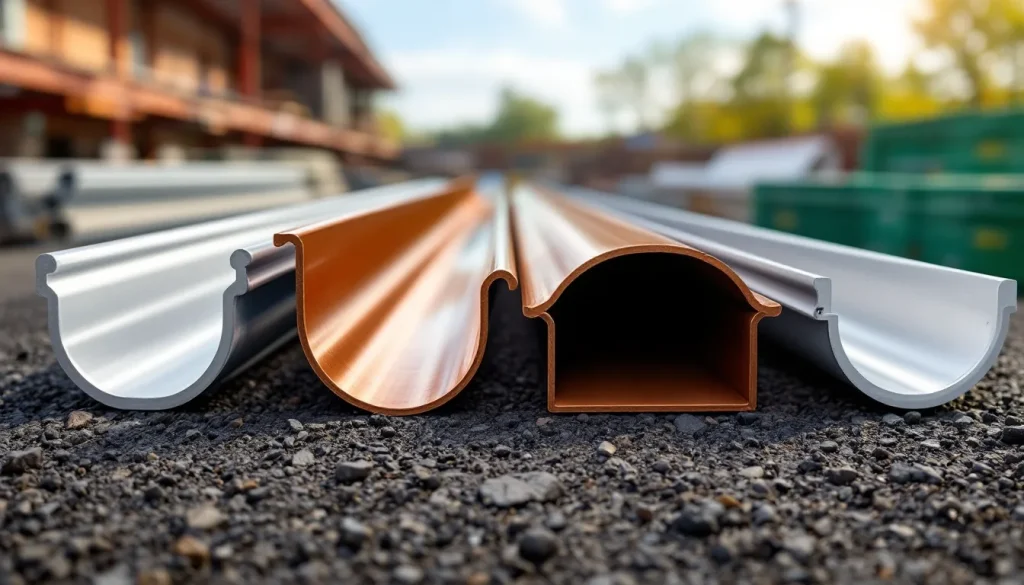
The honest answer on gutter cost (see our 2026 gutter prices by material guide) per linear foot installed in 2026 lives between $4 and $45 depending on what metal you pick and who hangs it. Aluminum K-style, the workhorse of the residential market, lands $7 to $13 per linear foot installed. Copper half-round, the high end, runs $25 to $45. Galvalume steel sits in the middle at $9 to $16. Vinyl, the price-led option that nobody on the trade side actually recommends, comes in at $4 to $8. Zinc is rare in North America but real, $25 to $40, and it has a 50-year service life that beats everything else on the board except copper.
The short version
- Aluminum 5-inch K-style: $7 to $13 per linear foot installed. The default residential spec.
- Aluminum 6-inch K-style: $9 to $15 per linear foot installed. Spec this up if your roof is over 1,200 square feet drainage area.
- Copper 5-inch half-round: $25 to $45 per linear foot installed. 50-plus year life, develops patina over 7 to 10 years.
- Galvalume steel: $9 to $16 per linear foot installed. 15 to 20 year life, real corrosion risk in coastal salt air.
- Zinc: $25 to $40 per linear foot installed. 50-plus year life, self-healing patina, niche product in the US.
- Vinyl: $4 to $8 per linear foot installed. 10 to 15 year life if you are lucky and never get a hard freeze.
- Continuous premium: roughly 30 to 50 percent over the same gauge sectional. Almost always worth it on aluminum and copper.
- Downspouts add $7 to $12 per linear foot for aluminum, $40 to $60 for copper.
Why per-linear-foot pricing varies so much
A linear foot of installed gutter is not one number. It is the sum of material (see our gutter material comparison), fabrication, hangers, sealant, fasteners, downspout share, and labor, all stacked into one quoted figure. When two contractors give you wildly different per-foot numbers on what looks like the same job, the difference is almost always in those line items, not in profit margin or “ripoff” markups.
Material itself is the smallest piece on aluminum. A 10-foot stick of 5-inch K-style aluminum gutter from a supply house runs roughly $9 to $12 in 2026, or about $1 per linear foot raw. Add coil cost (for the full data set, see our the full 2026 Roofing Cost Report) for continuous fabrication ($1.20 to $1.60 per foot in 0.027 gauge aluminum, more for 0.032), hidden hangers at $2 to $4 each spaced every 24 to 30 inches, end caps, outlets, miters, downspout transitions, sealant, and zip screws, and the all-in material cost reaches $3.50 to $5 per linear foot before any labor hits the sheet.
Labor is where the spread happens. A two-person crew running a New Tech Machinery MACH II or Mark IV continuous gutter machine on a one-story straight-fascia ranch can put up 200 to 300 linear feet in a working day. The same crew on a two-story Victorian with bay windows, ladder reaches over landscaping, and miter-heavy corner geometry might manage 80 to 120 feet. Both jobs price out at $7 to $13 per linear foot, but the contractor’s margin and the customer’s value are very different.
Aluminum K-style: the $7 to $13 default
Aluminum K-style is the spec on roughly 75 percent of new residential gutter jobs in the US in 2026. The reason is straightforward: it is light enough to handle on a ladder, it does not corrode, it accepts paint reliably, and continuous aluminum is fabricated on site from coil stock by a gutter machine, so the only joints are at corners and downspout outlets. A well-installed continuous aluminum K-style gutter system (see our full roof rain gutter system design guide) holds water for 25 to 30 years with cleaning twice a year.
The standard gauge is 0.027 inches. Some contractors upcharge for 0.032 inch heavy-gauge, which is more rigid and holds up better in snow and ice loading. The premium runs roughly $1 to $2 per linear foot. On steep-pitch roofs in northern climates where ice dams form and snow slides hit the gutter, 0.032 is the right call. On a single-story ranch in Atlanta, 0.027 is fine.
Coil colors are wide. Spectra Metal Sales (one of the dominant coil suppliers to gutter contractors in North America) and Englert each offer 30-plus standard colors with a 35-year finish warranty. Custom colors are available with a small upcharge. Color choice does not affect performance, just match to fascia, soffit, and trim.
For installation specs and hanger spacing detail, see our rain gutter install guide. For the size decision, see gutter sizes and capacity.
Copper: the $25 to $45 long-haul play
Copper gutters cost three to five times what aluminum costs, and they outlast aluminum by 25 to 30 years. The math works out in favor of copper only if you intend to own the house for more than 15 years and the architecture justifies the look. On a 1920s Tudor, a craftsman bungalow, or a historic colonial, copper is the period-correct choice. On a 2008 vinyl-sided builder home, it is not.
The 2026 supply chain for copper gutters runs through a small group of fabricators. Berridge in Texas does custom copper half-round and K-style runs. Senox out of Pennsylvania is a major copper coil supplier and pre-fab section seller. Englert offers copper alongside their aluminum line. Most copper jobs are sectional because continuous copper machines are rare, but copper sections solder together cleanly and the joints become invisible once patina forms.
Pricing breakdown: copper coil at 16 ounce thickness runs $12 to $18 per linear foot raw in 2026. Soldered joints, copper-compatible hidden hangers ($5 to $8 each), and skilled labor (copper installers charge a premium because the soldering work is real metalwork, not zip-screw assembly) push the all-in installed cost to $25 to $45 per foot. Downspouts are even more expensive because copper round downspouts run $40 to $60 per linear foot installed.
Copper develops a brown patina at year 1 to 2, a darker chocolate brown by year 3 to 5, and the classic green verdigris between years 7 and 15 depending on local humidity and air chemistry. If you want green faster, no product will accelerate it predictably. If you want to delay the patina, clear lacquer coatings exist but fail within 3 to 5 years and require recoating.
Galvalume steel: $9 to $16, the inland workhorse
Galvalume is a steel coil coated with an aluminum-zinc-silicon alloy that gives it better corrosion resistance than plain galvanized steel. It is the standard metal roofing substrate sold by major mills like AkzoNobel-coated and Sherwin-Williams-coated coil and it shows up in gutter form as well. Steel gutters are heavier and more rigid than aluminum, which means they hold their shape better under snow load, but they are not corrosion-proof. Salt air, acid rain (see our rain gutter cost options), and dissimilar metal contact (copper flashings draining into a steel gutter, for example) all accelerate failure.
Installed cost lands $9 to $16 per linear foot in 2026. Steel gutters are usually sectional because the gauge is too heavy for most portable continuous machines, but the sections come in 10-foot lengths and the joints are sealed with butyl tape and pop-rivets. Life expectancy in a Midwest or interior West climate runs 15 to 20 years. In coastal Florida, the Carolinas, or the Pacific Northwest coast, expect 10 to 15 years before perforation appears at the seams.
Where steel makes sense: matched to a Galvalume or painted steel standing-seam roof, the look is unified and the metal chemistry stays consistent. For matching gutters to a metal roof, see our gutter installation base guide for the broader system.
Zinc: the $25 to $40 European import
Zinc gutters are a niche product in the US market, common in Europe (especially Germany, Austria, and Switzerland) and gaining traction on high-end architecture stateside. Drexel Metals offers a zinc product line in North America, and a handful of importers bring in VMZINC and Rheinzink coil.
Zinc has two real advantages over aluminum and copper. First, it self-heals: small scratches and dents oxidize over and seal themselves within months. Second, it carries a 50-plus year service life with zero coating maintenance. The patina is gray to dark gray, not green like copper, and it forms within the first 12 to 24 months.
The disadvantages are price ($25 to $40 per foot installed) and installer scarcity. Most aluminum gutter crews have never touched zinc. The metal cuts and forms similar to copper and the fabrication uses soldered joints, but the learning curve is real and you need to vet the installer for actual zinc experience.
Vinyl: $4 to $8, and why every reputable roofer steers you away
Vinyl gutters are the cheapest option in 2026 and the most common cause of gutter-related callbacks within 5 years. The material is PVC extrusion, which is brittle in cold weather, expands and contracts dramatically with temperature, and turns chalky and brittle from UV exposure within 7 to 10 years. The sections are short (10 feet maximum, often 8 feet) and they connect with snap fittings and gasketed joints that leak within 3 to 5 years.
Vinyl makes sense in one scenario: a rental property where the owner intends to replace the gutters every 10 years and never wants to spend more than $1,500 on the system. For owner-occupied housing where you plan to be in the place for more than 7 years, the math on vinyl never works because you will be replacing it inside the period that aluminum would still be running fine.
The single hard freeze problem with vinyl is real. Below 20 degrees Fahrenheit, PVC gets brittle enough that a bump from a ladder, a falling branch, or even normal expansion contraction at a joint will crack the gutter. The fix is replacement of the cracked section, which is fast and cheap but happens often enough that vinyl ends up costing more than aluminum over a 20-year horizon.
continuous vs sectional: the 30 to 50 percent premium
Continuous gutter is fabricated on site from a coil of metal that runs through a portable gutter machine (New Tech Machinery MACH II is the dominant tool, with the Mark IV running both 5-inch and 6-inch profiles from the same head). The machine extrudes a continuous gutter section that matches the exact length of your fascia run, with no joints except at corners and downspout outlets.
Sectional gutter is sold in 10-foot pre-formed lengths at home centers and supply houses. It connects with slip-joint sleeves sealed with butyl tape or sealant. Every joint is a potential leak point. On a 200-foot gutter run, sectional gives you 18 to 20 joints. Continuous gives you 4 to 8 (just the corners and downspouts).
The cost premium for continuous runs 30 to 50 percent over the same gauge sectional. On a 200-foot job, that is roughly $400 to $800 extra. The trade-off is real: continuous reduces leak points by 75 percent and lasts 25 to 30 years instead of 15 to 20. For the comparison in more depth, see continuous vs sectional gutters.
What is in the labor line
A gutter installation invoice almost never breaks out labor as a separate line because the contractor is selling you a finished product per linear foot. The labor inside that number covers a fairly specific list of tasks:
- Tear-off and disposal of existing gutters and downspouts if you have them
- Fascia inspection for rot and damage (see fascia rot from gutters for what the crew is looking for)
- Snap chalk lines for pitch (1/4 inch drop per 10 feet toward the downspout)
- Run the gutter machine and cut to length
- Install hidden hangers every 24 to 30 inches (closer in snow regions)
- Cut and seal end caps, miters, and downspout outlets
- Hang downspouts with elbows and straps
- Set splash blocks or extensions away from the foundation
- Cleanup and haul-away
A typical 200-foot residential job takes a two-person crew 6 to 9 hours. At fully loaded labor rates of $90 to $130 per hour per crew member, that is $1,080 to $2,340 in labor alone, before any material.
Downspout pricing: the line item that surprises homeowners
Downspouts are quoted separately on most contracts and they add real money. A 2-inch by 3-inch aluminum downspout runs $7 to $12 per linear foot installed. A 3-inch by 4-inch (the right size for any roof over 1,000 square feet of drainage area) runs $9 to $14 per linear foot installed. Copper round downspouts hit $40 to $60 per linear foot installed.
The 2-inch by 3-inch handles roughly 600 square feet of roof drainage area. The 3-inch by 4-inch handles roughly 1,200 square feet. On larger roofs, you need either bigger downspouts or more of them. Standard spacing is one downspout per 35 to 40 feet of gutter run, but high-rainfall regions and steep roofs need closer spacing. For the full sizing decision on downspouts, see downspout placement and sizing.
At the bottom of every downspout, you need either a splash block (a precast concrete pad that throws water 2 to 4 feet away from the foundation) or a flexible extension. Splash blocks run $15 to $30 each at supply houses. Extensions are $20 to $40 each. For the decision between them, see splash blocks vs extensions. For homes where downspouts tie into a buried drainage system, see french drain gutter integration.
2026 pricing by region
Per-foot pricing varies by region because labor rates and supply chain costs differ. Rough national bands for aluminum 5-inch K-style continuous installed:
| Region | Low end ($/lf) | High end ($/lf) | Notes |
|---|---|---|---|
| Southeast (GA, FL, NC, SC, AL) | $7 | $11 | Lower labor costs, high install volume |
| Midwest (OH, IN, IL, MI) | $8 | $12 | 0.032 gauge premium common for snow load |
| Northeast (NY, NJ, PA, MA) | $9 | $15 | Higher labor rates, older housing stock complexity |
| Pacific Northwest (WA, OR) | $8 | $13 | Heavy rainfall drives 6-inch upsell |
| Mountain West (CO, UT, ID) | $8 | $12 | Snow load region, 0.032 gauge common |
| Southwest (AZ, NM, TX inland) | $7 | $11 | Low rainfall, smaller systems common |
| California coast | $10 | $16 | High labor costs across the board |
What drives a quote up or down
If you are getting bids and trying to read them, here is what moves the per-foot number:
- Story height. Two-story work prices 15 to 25 percent over single-story.
- Fascia condition. If the fascia needs replacement before gutter install, that is a separate trade (carpentry) at $8 to $15 per linear foot of fascia in addition to gutter cost.
- Gauge upgrade. 0.032 inch aluminum over 0.027 adds $1 to $2 per foot.
- Color match. Standard colors are included. Custom color match runs $0.50 to $1 per foot premium.
- Tear-off. Removing existing gutters adds $1 to $2 per foot.
- Hanger upgrade. Spectra E-Z Lock and Raytec hidden hangers are standard. Heavy-duty hangers for ice and snow regions add $0.50 to $1 per foot.
- Gutter guards. Quality covers like the ones we cover in our best gutter guards review add $6 to $20 per linear foot.
How to read a quote
A good gutter quote has the following line items broken out:
- Linear feet of 5-inch (or 6-inch) gutter at $X per foot
- Linear feet of downspout at $Y per foot
- Number of miters (inside, outside) at $Z each
- Number of end caps at $W each
- Number of downspout outlets and elbows
- Tear-off and disposal of existing system if applicable
- Splash blocks or extensions
- Color and material specification
- Gauge specification (0.027 or 0.032 for aluminum)
- Warranty terms (material and workmanship)
A quote that just says “200 linear feet of gutters, $1,800” is not enough information. Push back and ask for the breakdown. Contractors who do quality work will give it to you because they want to differentiate from the lowball bid that skipped 0.032 gauge and included no downspout outlets.
Lifecycle cost, not sticker price
The right framing for the gutter decision is lifecycle cost, not sticker price. A vinyl system at $4 per foot will run roughly $800 on a 200-foot job and will need replacement at year 10. An aluminum continuous system at $10 per foot will run $2,000 and last 27 years. Copper at $35 per foot will run $7,000 and last 50-plus years.
Over a 30-year ownership horizon:
- Vinyl: $800 initial + $800 at year 10 + $800 at year 20 = $2,400, with three install events and the disruption that comes with them.
- Aluminum: $2,000 initial + nothing for 27 years. Maintenance is twice-yearly cleaning (see gutter cleaning cost and schedule).
- Copper: $7,000 initial, nothing for 50 years.
Aluminum wins on pure dollar math. Copper wins on architecture, resale, and zero-maintenance peace of mind. Vinyl never wins for owner-occupied housing.
One more thing: gutter cost is part of a bigger system
Gutters do not work in isolation. They need drip edge to deliver water from the roof edge into the trough (see drip edge and drip edge installation detail). They terminate at fascia board that has to be solid (see fascia board). They route water past soffit vents without interfering with intake airflow. On flat roofs, gutters are often replaced by scuppers and internal drains entirely (see scuppers vs gutters flat roof and flat roof drainage design). For the broader roofing pricing picture that gutters fit into, see roofing cost per square and how much does a new roof cost. For more, browse the learn library.
When you call for quotes, ask the contractor to price the gutters as part of the full edge-of-roof system, not as an afterthought. A good roofer will quote drip edge, gutters, downspouts, and termination as one integrated package because that is how the water actually moves.