
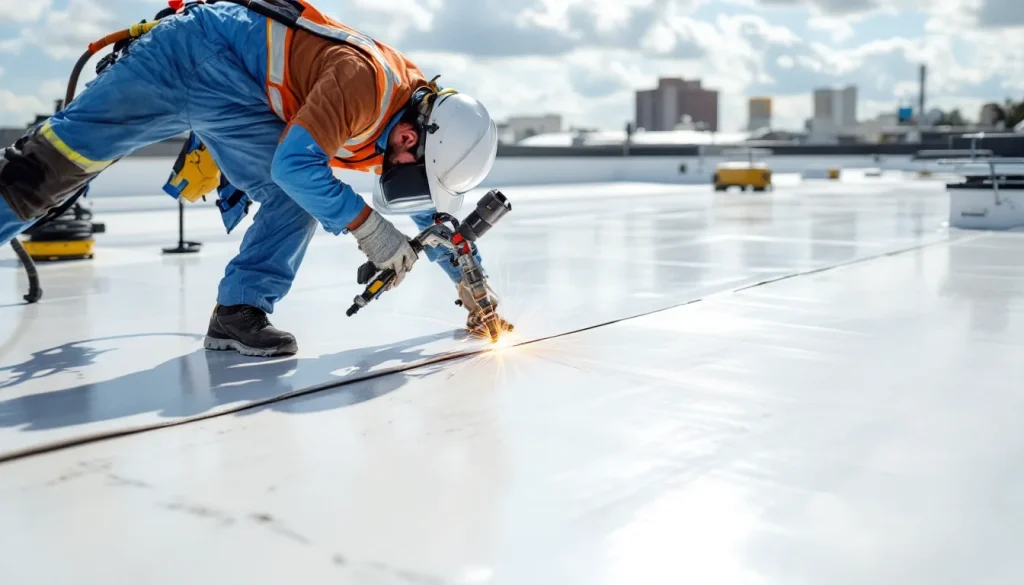
TPO roof installation cost in 2026 lands between $7 and $14 per square foot for most U.S. commercial projects, with the spread driven by membrane thickness (60-mil vs. 80-mil), attachment method (mechanically attached vs. fully adhered vs. ballasted), insulation R-value (R-25 vs. R-30 vs. higher), cover board choice, and warranty term. A 20,000 sq ft warehouse (see our industrial roof repair guide) with 60-mil mechanically attached TPO over R-25 ISO and a basic 15 year material warranty might land at $7.50 per square foot installed. The same building with 80-mil fully adhered TPO over R-30 ISO, Securock cover board, and a 30 year No Dollar Limit total system warranty might land at $13.50.
Both are real prices. Both are correct. The difference is what the warranty covers, how the roof performs in a hailstorm, and what the building will look like at year 22. This guide breaks the costs by component so you can read a TPO (see our commercial roof repair costs by type) bid and know what you’re buying.
Membrane thickness and attachment method: the two biggest price drivers
TPO membrane comes in 45, 60, 80, and 90 mil thicknesses, with 60-mil and 80-mil dominating commercial (see our commercial roof types guide) new construction and reroofs in 2026. The mil number is the actual membrane thickness in thousandths of an inch. Thicker membrane resists puncture better, holds welds tighter under thermal cycling, and qualifies for longer manufacturer warranties.
60-mil mechanically attached: $7 to $9 per square foot installed. This is the cost-leader spec for warehouse, manufacturing, and big-box retail. The membrane is rolled out, fasteners and plates secure it through the cover board into the deck on a defined pattern, and seams are hot-air welded. Wind uplift performance is good (typically rated for 90+ mph), and installation (see our commercial roof installation step-by-step guide) is fast (a 30,000 sq ft roof can go down in 5 to 7 days with a competent crew). Warranty: 15 to 20 years material-only standard, NDL available on certified installs.
60-mil fully adhered: $9 to $12 per square foot installed. The membrane (see our TPO vs. PVC membrane comparison guide) is bonded to the cover board with bonding adhesive, eliminating the fastener pattern and dramatically improving wind uplift performance (rated for 120+ mph, important in coastal Florida, Texas, and Gulf states). Slower install, more material cost, longer warranty terms available. This is the spec for office buildings, schools, and any high-wind-zone application.
80-mil mechanically attached: $8 to $11 per square foot installed. The 80-mil thickness is the puncture-resistance upgrade for roofs with heavy foot traffic, frequent rooftop equipment service, or hail exposure. The extra cost (for the full data set, see our the full 2026 Roofing Cost Report) over 60-mil is modest, and the warranty term typically jumps from 15-20 years to 20-25 years.
80-mil (see our TPO membrane pricing by mil thickness) fully adhered: $10 to $14 per square foot installed. Top-tier spec, highest manufacturer warranty terms (30 year NDL available from Carlisle, Versico, GAF, Sika, and Firestone on certified installs), best wind and puncture performance. Most common on Class A office, healthcare, and any owner who plans a 25 year hold.
Ballasted TPO: $5 to $8 per square foot installed. The membrane is loose-laid and held in place by river rock or pavers. Cheap, fast, but heavy (deck has to support 10 to 15 lbs per square foot of ballast load), and difficult to inspect or repair without moving rock. Mostly used now for retrofit of older ballasted roofs where the building’s structural design assumes the load. Rarely specified for new construction in 2026.
The choice between attachment methods isn’t just a wind question. It’s also a warranty question (NDL terms differ by attachment method), a leak-diagnosis question (mechanically attached roofs leak differently than fully adhered), and a future-recoverability question (overlay or recover work down the road is easier on adhered systems). See our TPO vs EPDM roofing comparison for how this stacks against the alternative single-ply chemistry.
Insulation: ISO R-value drives 15% to 25% of total cost
Polyisocyanurate (ISO) insulation is what sits between the deck and the cover board on virtually every modern commercial TPO install. The R-value spec determines both energy performance and cost. 2026 ASHRAE 90.1 commercial energy code requires roughly R-30 minimum in most climate zones (Zones 4 through 8), with some zones higher. The IECC commercial path runs in parallel ranges depending on local adoption.
R-25 ISO (approximately 4 inches): about $1.50 per square foot installed. The cost-floor spec, increasingly out of code in most U.S. climate zones for new construction but still common on reroofs in code-grandfathered jurisdictions.
R-30 ISO (approximately 5 inches): about $1.80 per square foot installed. The new-construction baseline in most of the country in 2026.
R-38 ISO (approximately 6.5 inches): about $2.30 per square foot installed. Spec for high-performance buildings, LEED-certified projects, and northern climate zones (6, 7, 8).
Tapered ISO system: add 10% to 25% to insulation cost depending on slope complexity. Tapered insulation establishes positive drainage on otherwise flat decks. Required by code in many jurisdictions for any new low-slope roof. The complexity (crickets, saddles around drains, valleys) drives the upper end of the cost band.
One detail that matters: cheap ISO board (no facer, or facer that delaminates) is a false economy. The cover board fastens to the ISO facer. Facer failure compromises wind uplift performance and voids manufacturer warranties. Spec name-brand ISO (Atlas, Carlisle, Firestone/Holcim, GAF, Johns Manville) and verify the facer type with the contractor.
Cover board: the $0.50 to $0.80 upgrade that prevents the most common failures
Cover board sits between the ISO insulation and the TPO membrane. It provides hail-impact resistance, foot-traffic protection, and a stable substrate for membrane adhesion. The most common options in 2026:
Gypsum cover board (Securock from USG, DensDeck from Georgia-Pacific): add $0.50 to $0.80 per square foot. The market-standard for cover board in commercial TPO. Hail-rated, fire-rated (UL Class A assemblies), and dimensionally stable. Securock and DensDeck dominate the spec sheets you’ll see in 2026.
High-density ISO cover board (HD ISO): add $0.40 to $0.65 per square foot. Cheaper than gypsum and works in most applications, but doesn’t match gypsum on hail or fire performance.
Perlite board: add $0.30 to $0.50 per square foot. Older spec, increasingly rare in new commercial work, but still occasionally specified for moisture absorption applications.
The omission of cover board entirely is a cost-cutting move that some bids will hide. A TPO membrane installed directly on ISO is allowed by some manufacturers but typically with reduced warranty terms and degraded hail performance. If you’re comparing bids and one is $0.60 per square foot cheaper than the others, check whether they omitted cover board. The savings on the bid will likely be paid back as hail damage repairs and reduced warranty in year 7.
Fasteners, plates, adhesives, and accessories
The mechanical attachment hardware (steel fasteners and stress-plates) for mechanically attached systems runs about $0.40 to $0.70 per square foot. Fastener pattern density varies by wind zone: a 6-inch fastener pattern at 12 inches on center along seams is standard for moderate wind zones, with denser patterns in higher exposures. The fastener spec should match the engineered uplift calculation for your building.
Bonding adhesives for fully adhered systems add about $0.70 to $1.20 per square foot to material cost depending on the adhesive type. Low-VOC water-based adhesives are increasingly required in California and several other states.
Accessory components (walk pads, pipe boots, T-joint covers, edge metal, drain flashings) typically add $0.30 to $0.70 per square foot of total accessory budget. These are not optional and should not be value-engineered out of a bid.
Total cost breakdown: a typical 2026 commercial TPO install
Here’s how a real 2026 bid for a 30,000 sq ft warehouse reroof with 60-mil mechanically attached TPO, R-30 ISO, Securock cover board, and a 20 year NDL warranty looks on the unit-price side:
Tear-off of existing roof: $1.20 per sq ft (varies widely by old system; gravel BUR tear-off runs $2.00+, single-ply tear-off can be $0.80).
R-30 ISO insulation: $1.80 per sq ft.
Securock cover board: $0.65 per sq ft.
60-mil TPO membrane: $1.40 per sq ft (material).
Fasteners and plates: $0.55 per sq ft.
Labor for membrane install: $2.20 per sq ft.
Accessory components (drains, flashings, edge metal, walk pads): $0.50 per sq ft.
Mobilization, dumpster, crane, overhead, profit: $0.70 per sq ft.
Total: about $9.00 per sq ft.
The same building with 80-mil fully adhered TPO and a 30 year NDL warranty might add: $0.80 per sq ft for thicker membrane, $1.00 per sq ft for adhesive vs. fasteners and the additional labor, and roughly $0.20 per sq ft for the warranty premium and additional inspection requirements, putting total at about $11.00 per sq ft. The premium is real but the building has 10 more years of warranty coverage and substantially better wind performance.
The warranty value calculation for the premium spec is one we cover in our companion piece on commercial roof warranty (NDL vs. material-only). For most commercial owners planning a 20+ year hold, the upgrade math works.
What contractor selection costs you (or saves you)
TPO is a manufacturer-warranted system, and the warranty only issues when the install is done by a contractor on the manufacturer’s authorized installer list. The certification process requires the contractor’s crew to complete manufacturer training, the project to be inspected by a manufacturer technical rep before, during, and after install, and the contractor to maintain authorized status through documented continuing education and clean project history.
Bids from non-authorized contractors can be $0.40 to $1.20 per sq ft cheaper than authorized installer bids. They get there by skipping the manufacturer’s spec details that the authorization process verifies. The result: a roof that looks like a TPO roof but has a contractor warranty rather than a manufacturer warranty. When the contractor is out of business in year 6 (and the failure rate on small commercial roofers is high enough that this is a real risk), you have no warranty recourse.
The questions in our questions to ask a roofing contractor piece translate directly. The most useful for commercial: ask for the manufacturer authorization number, then call the manufacturer to verify it’s current. Ask for two recent NDL warranty projects with the manufacturer’s pre-inspection report. The contractors who pass these checks are the ones whose installs are still on the building in year 25.
Roof access, building height, and site factors
Cost adders that don’t show up until the walkthrough: crane requirements on buildings without roof access add $1,500 to $5,000 per day for crane rental, and a typical 30,000 sq ft job needs 2 to 4 crane days. Buildings over 4 stories require additional safety rigging, longer material hoist times, and OSHA-compliant tie-off systems that add about $0.30 to $0.60 per sq ft. Occupied building work (no production shutdown allowed, work during off-hours only) typically adds 20% to 40% to total labor cost.
The economic case for TPO over alternative systems (EPDM, modified bitumen, BUR, metal) holds on most low-slope commercial buildings, but the specific install spec matters more than the membrane type. A poorly specified TPO install at $7 per sq ft is a worse buy than a properly specified modified bitumen roof at $9 per sq ft. The right answer is the spec that matches your wind zone, climate zone, hold period, and warranty preference, installed by an authorized contractor with documented quality control.
If you’re comparing residential metal options that occasionally come up on small mixed-use buildings, our metal roof installation piece covers the alternative path for those projects. For owners weighing whether to overlay or replace based on existing roof condition, the conversations in our flat roof coating restoration and flat roof repair cost guides offer the smaller-scale economic frame. The commercial principles scale similarly with bigger numbers.
Tear-off vs. recover: how the existing roof affects price
The single largest cost variable that’s not on most bid sheets up front is what happens to the existing roof. A full tear-off (remove existing membrane, insulation, and any rotted decking down to deck level) adds $0.80 to $2.50 per sq ft depending on what’s being removed and disposal cost in your jurisdiction. A recover (see our TPO commercial roof restoration) (install over existing roof, allowed by code if the building has fewer than two existing roof layers and the deck is sound) saves the tear-off cost but constrains the new system spec.
Recover work also requires a moisture survey of the existing roof. If more than 25% of the underlying insulation is wet, most jurisdictions and most manufacturers require tear-off. Owners hoping to save $40,000 on recover sometimes find out at the survey stage that the savings aren’t available. Build the moisture-survey conditional into your budget so you’re not caught flat-footed if the recover path closes.
The companion conversations on commercial repair (what gets fixed before the new TPO goes down) and warranty (which manufacturer terms drop with recover vs. fresh tear-off) both affect the cost-benefit math. Recover installs typically come with shorter NDL terms than full tear-off installs because the manufacturer can’t verify what’s underneath. The cost savings on tear-off can be partly offset by the shorter warranty term, which matters most for long-hold owners.
TPO is a mature commercial roofing technology with a deep installer base and well-understood economics. The cost spread you’ll see in bids reflects real differences in what you’re buying, not negotiation noise. Read the spec sheets carefully, verify the contractor’s manufacturer authorization, and don’t optimize for the lowest per-square-foot price when the membrane has to perform for 25 years.