
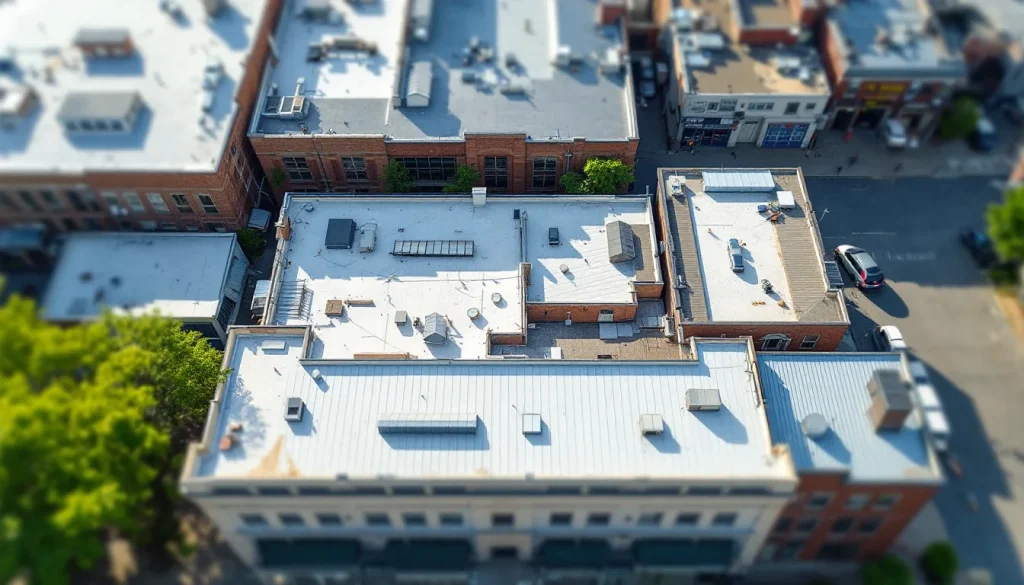
Choosing a system for commercial roofs in 2026 is a different calculus than it was even five years ago. The membrane landscape has stabilized around three single-ply systems (TPO, EPDM, PVC) that hold roughly 85% of new commercial flat-roof installations. Mod-bit and built-up roofing still serve specific use cases. Standing seam metal owns the longest-lifespan segment. Insulated metal panel is the only honest answer on cold storage. This overview is for building owners, facility managers, and asset managers who need to understand what they actually own on top of their building, what it costs to replace, how long it lasts, and what decisions they need to make when the roof reaches end of service life.
The six commercial roof systems building owners actually see
Almost every commercial building in the US is using one of six roof system families: TPO single-ply membrane, EPDM single-ply membrane, PVC single-ply membrane, modified bitumen, built-up roofing (BUR), or standing seam metal. Cold storage adds a seventh category, insulated metal panel (IMP). Each system has a different cost structure, lifespan, repair pattern, and tenant fit. Understanding which system is on the building is step one of any capital planning exercise. The detailed system-by-system technical breakdown is in our commercial building roof types guide.
TPO: $6-10 per sq ft installed, 18-25 year lifespan
Thermoplastic polyolefin (TPO) is the dominant commercial single-ply membrane in 2026, holding roughly 50% of new commercial flat-roof installations. The leading TPO products are Carlisle Sure-Weld TPO, GAF EverGuard TPO, Versico VersiWeld, and Holcim/Firestone UltraPly TPO. All four are heat-welded at the seams, available in 45-mil, 60-mil, and 80-mil thicknesses, and reflective white (or tan or gray) for energy performance.
Installed cost in 2026. Mechanically attached 60-mil TPO runs $6.50 to $9.50 per square foot installed including ISO insulation. Fully adhered 60-mil runs $7.50 to $11.00. 80-mil systems run $1.00 to $2.00 per square foot more than 60-mil.
Lifespan. 18 to 25 years on a 60-mil install with proper detailing, less on 45-mil systems exposed to harsh UV, more on 80-mil systems with regular maintenance.
Where TPO fits. Distribution warehouses, retail, office buildings, schools, light manufacturing. Anywhere the roof needs reflective performance, reasonable lifespan, and competitive install cost. The per-square pricing breakdown by thickness is in our TPO membrane pricing by mil guide.
Where TPO does not fit. Roofs with grease, oil, or chemical exposure (PVC is correct). Roofs in regions with extreme thermal cycling where EPDM has the long-term track record. Roofs with extensive ponding water (EPDM or silicone-coated restoration performs better).
EPDM: $5-9 per sq ft installed, 25-35 year lifespan
Ethylene propylene diene monomer (EPDM, often called rubber roofing) holds roughly 25% of the commercial single-ply market in 2026. The leading EPDM products are Carlisle Sure-Seal EPDM, Firestone RubberGard EPDM, and Versico VersiGard EPDM. EPDM is not heat-welded; seams are joined with seam tape, splice adhesive, or peel-and-stick.
Installed cost in 2026. Mechanically attached 45-mil EPDM runs $5.00 to $7.00 per square foot installed. 60-mil runs $6.00 to $8.00. 90-mil runs $7.00 to $10.00. Ballasted EPDM (loose membrane held down by stone) runs slightly less but adds significant dead load to the deck.
Lifespan. 25 to 35 years on a properly detailed 60-mil install. EPDM has the longest field-proven service life of any commercial single-ply membrane in the US market.
Where EPDM fits. Schools, government buildings, warehouses, anywhere long lifespan and low maintenance matter more than reflective performance. EPDM is black (or sometimes white with reflective top sheet at a cost premium) so it does not deliver the cool-roof energy savings of TPO or PVC.
The TPO vs EPDM head-to-head decision is covered in detail in our TPO vs EPDM roofing comparison.
PVC: $9-15 per sq ft installed, 25-30 year lifespan
Polyvinyl chloride (PVC) is the premium thermoplastic single-ply, holding roughly 10% of the commercial market in 2026. The leading PVC products are Sika Sarnafil, Carlisle Sure-Flex PVC, IB Roof Systems PVC, and Duro-Last PVC. Sika Sarnafil S327 in particular is the spec choice on hospitals, schools, and high-value institutional buildings.
Installed cost in 2026. PVC runs $9.00 to $15.00 per square foot installed in standard 60-mil, with Sika Sarnafil S327 at the high end of the range ($12.00 to $18.00 installed). The cost premium over TPO buys chemical resistance, longer-term welding integrity, and pre-fabricated detail accessories that perform better at penetrations.
Lifespan. 25 to 30 years, with documented installations performing well past 35 years on properly maintained roofs.
Where PVC fits. Restaurants and food service (kitchen exhaust grease), hospitals and labs (chemical exposure), schools (long lifespan with low maintenance), any roof with rooftop equipment that discharges contaminants onto the membrane. The TPO vs PVC head-to-head is covered in our TPO vs PVC membrane comparison.
Modified bitumen: $5-9 per sq ft installed, 15-25 year lifespan
Modified bitumen (mod-bit) is a multi-ply asphaltic system, either SBS (styrene-butadiene-styrene, more flexible, cold-climate) or APP (atactic polypropylene, stiffer, warm-climate). The leading mod-bit products are from Soprema, IKO, Henry, and Polyglass. Mod-bit is applied with a torch, hot asphalt, cold adhesive, or self-adhered.
Installed cost in 2026. Two-ply mod-bit runs $5.00 to $7.50 per square foot installed. Three-ply runs $7.00 to $9.50.
Lifespan. 15 to 25 years depending on number of plies, surfacing (granulated cap sheet vs smooth), and application method.
Where mod-bit fits. High-traffic roofs needing puncture resistance, retrofit applications over existing BUR, smaller commercial buildings where single-ply economics do not work as well. Mod-bit also remains a serious system for any roof that needs walkway pad performance or extensive plaza or amenity surfacing.
The modified bitumen system deep-dive is in our modified bitumen roof guide.
Built-up roofing (BUR): $5-8 per sq ft installed, 20-30 year lifespan
Built-up roofing is the legacy multi-ply asphalt-and-felt system that dominated commercial roofing from the 1950s through the 1990s. BUR remains in service on millions of commercial buildings, but new BUR installations are rare in 2026. The labor pool that knows how to install BUR correctly is aging out, and the systems are increasingly being replaced with single-ply or modified bitumen during reroof. For newer systems, the installation process and phase sequence looks very different from a legacy BUR crew.
Building owners with existing BUR should plan for replacement with TPO, EPDM, PVC, or mod-bit when the BUR reaches end of life. Patching aged BUR with mismatched materials creates more problems than it solves.
Standing seam metal: $10-18 per sq ft installed, 40-50+ year lifespan
Standing seam metal is the longest-lifespan commercial roofing system in the US market. Properly installed Galvalume or aluminum standing seam roofs routinely deliver 40 to 50 years of service. Painted Kynar-finish (PVDF) standing seam can perform 50 to 60 years with the coating still intact.
Installed cost in 2026. $10.00 to $18.00 per square foot installed depending on panel gauge, finish, and roof complexity.
Where standing seam fits. Commercial buildings where the owner plans a long hold horizon (institutional, government, corporate campus), buildings with architectural visibility, steep-slope commercial roofs where membrane is not an option. Standing seam is not typically the right choice on low-slope warehouse or distribution where membrane economics dominate. Our commercial metal roof guide covers the commercial metal market in depth.
Insulated metal panel (IMP): $15-26 per sq ft installed, 30-40 year lifespan
Insulated metal panel is the spec choice on cold storage, refrigerated distribution, and freezer warehouses. IMP combines a foamed-in-place polyisocyanurate or polyurethane core (4 to 6 inches thick, R-32 to R-48) with two coated steel skins into a single integrated weather and thermal barrier.
Installed cost in 2026. $15.00 to $26.00 per square foot installed depending on panel thickness, finish, and freezer-down logistics.
Where IMP fits. Cold storage, freezer, food manufacturing with controlled-temperature requirements, pharmaceutical and biotech facilities with humidity control. IMP is the only system that delivers the thermal performance these tenants need without compromising weather barrier integrity.
Restoration coating: $2.50-5 per sq ft, 10-15 year extension
For buildings with roof systems still in serviceable condition but approaching the back end of service life, restoration coating extends life 10 to 15 years at $2.50 to $5.00 per square foot. The four chemistry families are silicone, acrylic, polyurethane, and asphalt emulsion. Silicone (GACO GacoFlex S2000, Henry 887 Tropi-Cool, Conklin Rapid Roof III, APOC Tropi-Cool 247) dominates the warranty-backed restoration market. The full restoration cost breakdown is in our commercial roof restoration cost guide.
The decision matrix building owners should use
The right commercial roof system depends on four building-owner inputs: (1) expected hold period (5 years vs 25 years), (2) tenant continuity tolerance (24/7 manufacturing vs 9-to-5 office), (3) energy code and energy cost (reflective cool roof for high cooling load vs darker membrane in heating-dominated climates), and (4) chemical or environmental exposure (grease, oil, chemicals, salt air).
Short hold (5-10 years), no chemical exposure, cost-sensitive. 60-mil TPO mechanically attached, $7-9/sq ft installed. Get the warranty in writing and inspected annually.
Long hold (20-30 years), institutional building, low maintenance preference. 60-mil or 90-mil EPDM fully adhered, $7-10/sq ft installed. Or standing seam metal if the building geometry supports it.
Chemical exposure, food service, or hospital. Sika Sarnafil PVC or Carlisle Sure-Flex PVC, $11-18/sq ft installed. The cost premium pays back in chemical resistance and reduced repair frequency.
Cold storage or freezer. IMP, $16-26/sq ft installed. Nothing else maintains the thermal envelope without compromise.
Existing roof in last quarter of life but structurally sound. Restoration coating, $2.50-5/sq ft. Extend 10-15 years and defer replacement capital.
Aged BUR or mod-bit needing replacement. Single-ply (TPO or EPDM) over insulation board, $6-10/sq ft installed.
Lifespan and per-year cost reality check
Building owners often fixate on installed cost per square foot and miss the more important number: cost per square foot per year of service life. A $7/sq ft TPO at 22 years = $0.32/sq ft/year. A $9/sq ft EPDM at 32 years = $0.28/sq ft/year. A $14/sq ft PVC at 28 years = $0.50/sq ft/year. A $16/sq ft standing seam at 45 years = $0.36/sq ft/year. The cheapest installed cost is rarely the cheapest annualized cost. Our 2026 roofing material lifespan report covers the annualized cost math by system and by climate.
Inspection and maintenance: the cost most owners ignore
Every commercial roof should be inspected twice yearly (spring and fall) by a manufacturer-certified inspector, with documented findings and photo records. The cost runs $400 to $1,800 per inspection depending on roof size and complexity. Manufacturer warranties almost always require this. Skipping inspections voids the warranty and turns a 25-year roof into a 15-year roof. The inspection and maintenance program details are in our commercial roof inspection schedule guide. For repair pricing once issues are found, our commercial roof repair guide walks through cost by membrane type and failure mode.
Energy code and cool roof requirements in 2026
Most US jurisdictions in 2026 mandate cool roof on commercial new construction and major reroof. The energy code typically requires a minimum solar reflectance index (SRI) on low-slope commercial roofs, which white TPO and PVC meet by default but black EPDM, mod-bit, and dark metal do not meet without surface treatment.
California Title 24 is the most stringent in this area, requiring SRI 78 for low-slope commercial roofs. Most other jurisdictions (IECC adopters) require SRI 75 to SRI 82 depending on climate zone. Building owners considering EPDM in any energy-code-strict jurisdiction need to either pay the premium for white-reflective EPDM or accept that the project may not satisfy code without supplemental cool roof certification documentation.
The cool roof premium typically runs $0.40 to $0.85 per square foot on white-reflective EPDM compared to standard black EPDM, which narrows the cost gap with TPO meaningfully. For owners in California, Arizona, Nevada, and other hot-climate energy-code-strict regions, white TPO or PVC is often the default spec because the EPDM cool-roof premium eliminates the EPDM cost advantage.
Hail rating and impact resistance considerations
Buildings in hail-prone regions (Texas, Oklahoma, Kansas, Colorado, Nebraska, parts of the upper Midwest) need to consider hail rating when selecting the membrane system. Standard 60-mil TPO and EPDM perform reasonably well against small hail (under 1-inch diameter) but suffer puncture damage from larger hail. 80-mil TPO and 90-mil EPDM with cover board substantially improve hail performance. When a severe event does hit, how you handle the commercial roof storm damage claim matters as much as the membrane rating.
For commercial buildings in regions with regular severe hail events, the additional cost of 80-mil membrane and cover board ($0.75 to $1.75 per square foot) typically pays back in reduced claim risk and lower insurance premiums. Some commercial insurers in hail regions now require Class 4 impact-rated systems for new commercial construction and offer meaningful premium discounts for buildings that meet the higher rating.
What building owners should actually do in 2026
The owner of any commercial building should know five things about their roof: (1) what system is installed and when, (2) what the manufacturer warranty terms are and who holds them, (3) what the documented current condition is from the most recent professional inspection, (4) what the projected remaining service life is, and (5) what the replacement or restoration plan is when service life ends. Most commercial building owners can answer one or two of these. The ones who can answer all five spend less on roof capital across the building’s life because they make decisions on planned horizons rather than emergency replacement after a failure. For how the trade itself operates, see our commercial roofing business overview.
For owners who do not have this baseline, the right first step is a roof asset survey from a manufacturer-independent commercial roofing consultant, and the same due diligence applies when you compare the best commercial roofing companies for the work. Expect to pay $0.05 to $0.15 per square foot for a full survey including infrared moisture scan, deck condition assessment, drainage analysis, detail flashing inventory, and a 10-year capital plan. The survey cost pays back inside the first capital cycle by preventing the wrong system choice or the wrong replacement timing.