
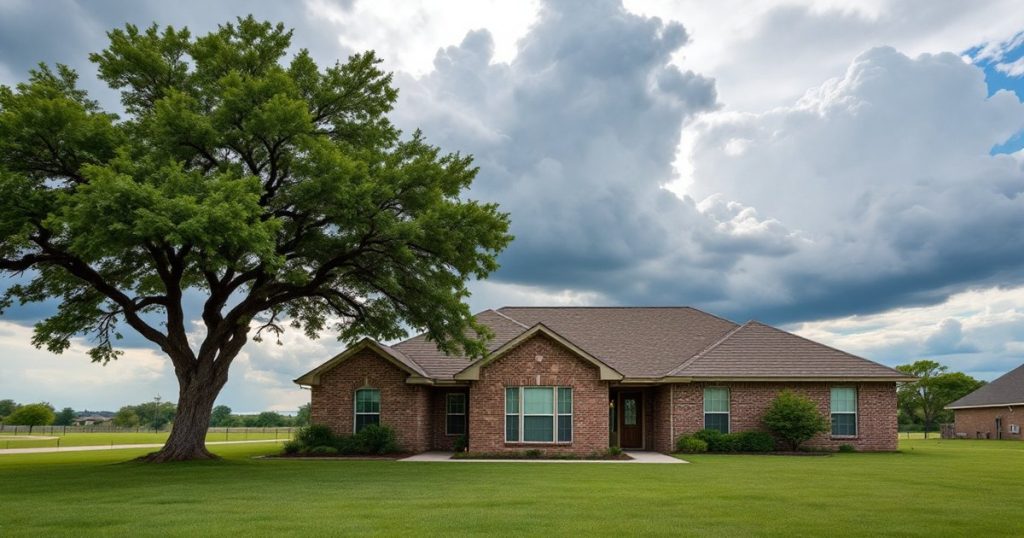
Roof replacement cost in Texas usually lands around $9,000 to $18,000 for a standard architectural shingle job on a typical home in the big metros, and $22,966 to $28,211 for the larger, fully specified 30-square shingle roof priced in the 2025 Cost vs. Value Report. Both figures come in under the national numbers. The main reason is labor: Texas roofers earn a mean $22.69 an hour, about 81 percent of the U.S. mean of $27.95, per BLS May 2025 wage data.
By The Roofing Brief Team. Last reviewed: October 2026.
Every figure below is tied to a named source: Bureau of Labor Statistics wage tables, the Cost vs. Value city reports for Dallas, Houston, Austin and San Antonio, Texas statutes, Texas Department of Insurance (TDI) guidance, the Texas Comptroller, and our own tally of ten years of NOAA storm records. Ranges are conditional. Your bid will depend on roof size, pitch, material, and what the crew finds under the old shingles.
Key numbers at a glance
These are the figures most Texas homeowners are looking for: the typical total for a shingle roof, what a larger or metal roof runs, how far below the national average Texas sits, and how often hail forces the job. Each row names its source and the project it describes. Compare a bid against the row that matches your roof size, because the totals describe different jobs.
| Figure | Texas value | U.S. comparison | Source |
|---|---|---|---|
| Standard architectural shingle replacement (about 1,700 to 2,200 sq ft of roof) | Dallas $10,000 to $18,000; Houston $10,000 to $18,000; San Antonio $9,000 to $14,000 | About $10,000 national average for a smaller standard job | The Roofing Brief metro cost data (aggregated 2026 price guides); Fixr |
| 30-square asphalt shingle replacement, full spec | Dallas $28,211; Houston $27,519; Austin and San Antonio $22,966 | $31,871 | Cost vs. Value Report 2025 (JLC) |
| 30-square standing-seam metal replacement | Dallas $46,790; Houston $44,883; Austin and San Antonio $37,265 | $51,865 | Cost vs. Value Report 2025 (JLC) |
| Roofer mean hourly wage | $22.69 (Texas, 81% of U.S.) | $27.95 | BLS OEWS, May 2025, SOC 47-2181 |
| Hail reports of 1 inch or larger, 2016 to 2025 | 11,063 (15.6% of the U.S. total, most of any state) | 70,905 | NOAA Storm Events Database, Roofing Brief tally |
| Sales tax on residential reroofing labor | Not taxable; contractor pays tax on materials under a lump-sum contract | Varies by state | Texas Comptroller publication 94-116 |
How much does a roof replacement cost in Texas by material?
In Texas, 3-tab asphalt is the cheapest full replacement at about $2.50 to $4.00 per square foot installed, architectural shingles run $4.50 to $7.50, and metal spans $6.50 to $18.00 depending on panel type, per Fixr’s Texas cost guide. Tile and slate sit at the top. On a 2,000 square foot roof, that is roughly $5,000 for basic shingles up to $60,000 for slate.
The table pairs Fixr’s Texas per-square-foot ranges with This Old House’s Texas figures, which are built on RSMeans data from Gordian. The totals column is our multiplication of Fixr’s range by 2,000 square feet of roof surface (20 roofing squares), which is close to a mid-size single-story Texas home once pitch and overhangs are counted. Roof area, not floor area, is what you are billed for; our roof cost for a 1,500 square foot house walks through that conversion.
| Material | Installed cost per sq ft (Fixr, Texas) | Per sq ft (This Old House, Texas) | Total on a 2,000 sq ft roof | Source |
|---|---|---|---|---|
| 3-tab asphalt shingles | $2.50 to $4.00 | $4.92 (asphalt overall) | $5,000 to $8,000 | Fixr (updated Jan. 31, 2025); This Old House (updated June 18, 2026) |
| Architectural asphalt shingles | $4.50 to $7.50 | Not split out | $9,000 to $15,000 | Fixr |
| Wood shakes | $5.00 to $10.00 | $11.12 | $10,000 to $20,000 | Fixr; This Old House |
| Metal (exposed fastener to standing seam) | $6.50 to $18.00 | $9.55 | $13,000 to $36,000 | Fixr; This Old House |
| Concrete tile | $7.00 to $10.00 | Not listed | $14,000 to $20,000 | Fixr |
| Clay tile | $10.00 to $26.00 | $14.79 | $20,000 to $52,000 | Fixr; This Old House |
| Slate | $15.00 to $30.00 | $14.89 | $30,000 to $60,000 | Fixr; This Old House |
Two Texas-specific upgrades change these numbers. A Class 4 impact-resistant shingle (UL 2218) typically adds about 15 to 25 percent to the shingle line, per our impact-resistant vs standard shingles comparison. In the coastal windstorm counties, shingles rated ASTM D3161 Class F or ASTM D7158 Class H are what TDI tells homeowners to select, which rules out some economy products. For metal-specific math, see our metal roof cost for a 1,500 sq ft house.
Texas roof replacement cost by city: Dallas, Houston, Austin and San Antonio
For the same fully specified 30-square shingle roof, the 2025 Cost vs. Value Report prices Dallas highest of the four big Texas metros at $28,211, Houston at $27,519, and Austin and San Antonio both at $22,966. Every Texas city in the report comes in under the $31,871 national figure. Metal costs about 1.6 times as much as shingles in each city.
The table adds the two drivers that explain most of the city spread: roofer wages and the permit fee. Wages are BLS May 2025 metro figures for roofers. Permit fees are for a standardized $12,000 reroof from PermitCalculator’s 2026 data, as compiled in our roof permit cost by metro report.
| Metro | 30-square asphalt job (CvV 2025) | 30-square metal job (CvV 2025) | Asphalt cost recouped at resale | Roofer mean wage (BLS May 2025) | Reroof permit, $12,000 job |
|---|---|---|---|---|---|
| Dallas-Fort Worth | $28,211 | $46,790 | 56.9% | $23.84 (85% of U.S.) | $167 (Dallas) |
| Houston | $27,519 | $44,883 | 68.9% | $22.18 (79% of U.S.) | $147 |
| Austin | $22,966 | $37,265 | 76.4% | $24.08 (86% of U.S.) | $370 |
| San Antonio | $22,966 | $37,265 | 77.8% | $21.68 (78% of U.S.) | $27 |
| U.S. national | $31,871 | $51,865 | 67.5% | $27.95 | About $224 average (26 cities) |
Sources: Cost vs. Value Report 2025 (JLC) city reports; BLS Occupational Employment and Wage Statistics, May 2025, SOC 47-2181, metro areas Dallas-Fort Worth-Arlington, Houston-Pasadena-The Woodlands, Austin-Round Rock-San Marcos and San Antonio-New Braunfels; PermitCalculator 2026 via The Roofing Brief. The Cost vs. Value project assumes a tear-off to bare sheathing, 30 squares of shingles with a 25-year minimum warranty, 30-lb felt or synthetic underlayment, a hip roof and two skylights, so it describes a large, complete job rather than an average house.
The city figures line up with our roof replacement cost by metro ranking, where Houston, Dallas and San Antonio anchor the low end of 13 major U.S. metros for a standard job. Smaller Texas markets such as Lubbock, Amarillo, El Paso and the Rio Grande Valley are not priced in the Cost vs. Value report, so treat the four-metro range as a guide rather than a statewide rule.
Why published Texas averages range from $6,777 to $28,211
Published “average roof cost in Texas” figures disagree because each source prices a different roof. This Old House’s $6,777 asphalt total implies about 1,377 square feet of roof, Fixr’s $12,000 assumes 2,000 square feet, and the Cost vs. Value $28,211 Dallas figure is a 3,000 square foot roof with skylights. Match the source’s roof size to yours before you judge a quote.
| Source | Texas figure | Roof it describes | Best used for |
|---|---|---|---|
| This Old House (June 2026, RSMeans data) | $6,777 asphalt total; $8,634 stated average; $6,777 to $20,531 range | About 1,377 sq ft of roof at $4.92 per sq ft (implied by its own figures) | Small, simple roofs |
| Fixr Texas guide (Jan. 2025) | $12,000 average; $6,000 to $20,000 range | 2,000 sq ft shingle roof | Mid-size single-story homes |
| The Roofing Brief metro data (2026) | $9,000 to $18,000 by metro | 1,700 to 2,200 sq ft architectural shingle roof with tear-off | Typical metro homes |
| Cost vs. Value 2025 (JLC) | $22,966 to $28,211 (asphalt); $37,265 to $46,790 (metal) | 3,000 sq ft hip roof, two skylights, full tear-off | Large or complex homes, and resale planning |
A quote that looks high against the $8,634 headline may be normal for a 2,800 square foot two-story roof. A quote that matches the Cost vs. Value number for a 1,500 square foot ranch is worth questioning. Our roof replacement cost calculator shows how to convert floor area to roof squares and build your own baseline.
Why a new roof costs less in Texas than the national average
Texas roofs cost less mainly because Texas roofers are paid less. The BLS May 2025 mean for roofers is $22.69 an hour in Texas against $27.95 nationally, an 18.8 percent gap, and the median gap is 17.0 percent ($22.13 vs $26.65). Because labor is 40 to 60 percent of an installed roof, per Fixr, wages alone predict a Texas price about 8 to 11 percent below the national figure.
Roofing Brief calculation: 40 percent labor share times the 18.8 percent wage gap equals 7.5 percent; 60 percent times 18.8 percent equals 11.3 percent. The Cost vs. Value numbers land close to that prediction for the two biggest metros. Dallas comes in 11.5 percent below the national asphalt job and Houston 13.7 percent below. Austin and San Antonio come in 27.9 percent below, a deeper discount than wages alone explain, which points to local contractor competition and material pricing as additional factors. Limitation: OEWS covers payroll employees only and excludes self-employed roofers.
Materials do not carry the same discount. Shingles, underlayment and metal panels are priced on national supply chains, so on a Texas job the material line is a larger share of the total than it is in a high-wage state. That is also why a material upgrade, such as Class 4 shingles or standing-seam metal, moves a Texas bid by a bigger percentage than the same upgrade does in Seattle or New York. Our roofer salary by state report ranks the wage side for all 50 states.
What changes the price of a new roof in Texas
Beyond size and material, the biggest Texas-specific price movers are hail exposure, coastal windstorm certification, insurance deductibles, and the timing of the job after a storm. Some Texas rules lower your cost, such as no sales tax on residential reroofing labor. Others add to it, such as a WPI-8 inspection on the coast or a percentage wind and hail deductible.
| Driver | Effect on your cost | Source |
|---|---|---|
| Hail exposure (Texas leads the U.S. in 1 inch or larger hail reports) | More insurance-driven replacements; spring demand spikes; Class 4 shingles often chosen for insurance credits | NOAA Storm Events Database (Roofing Brief tally); TDI |
| Coastal windstorm area (14 counties plus parts of Harris County) | Roof replacement needs a TDI certificate of compliance (WPI-8) for a TWIA policy; inspection and code-compliant products add cost | TDI windstorm inspection guidance |
| Sales tax | Labor on residential reroofing is not taxable; under a lump-sum contract the roofer pays tax on materials and does not charge you tax | Texas Comptroller publication 94-116 |
| Permit fee | About $27 (San Antonio) to $370 (Austin) on a $12,000 reroof | PermitCalculator 2026, via The Roofing Brief |
| Existing layers | A third layer is not allowed; two or more existing layers mean full tear-off and more disposal cost | International Residential Code R908.3.1.1 (2021); Texas adopts the IRC as its municipal residential code (Local Government Code 214.212), and cities may adopt later editions |
| Wind and hail deductible | A percentage deductible (for example 2 percent of a $350,000 dwelling limit equals $7,000) can exceed the cost difference between two bids; Texas law requires you to pay it | TDI; Texas Insurance Code ch. 707 |
| Roof age and coverage type | Some insurers switch older roofs to actual cash value, which cuts the claim payout by depreciation | TDI consumer guidance |
| Post-storm demand | Crews booked out after spring hail; winter is the demand trough nationally | BLS CES via The Roofing Brief seasonality index |
How Texas hail drives roof replacement demand and timing
Texas logged 11,063 hail reports of 1 inch or larger from 2016 to 2025, about 15.6 percent of the U.S. total and nearly twice second-place Kansas (6,054), in our tally of the NOAA Storm Events Database. Almost 90 percent of those Texas reports fell between March and June, so roof demand, and contractor pricing power, peaks in late spring and summer.
The tally counts unique NOAA Storm Events records (deduplicated by event ID) with hail of at least 1 inch, the size the National Weather Service treats as severe. Hail of 2 inches or larger accounted for 1,986 of the Texas reports, or 18 percent. The NWS Storm Prediction Center’s separate preliminary count, cited by the Insurance Information Institute, also ranks Texas first in 2025 with 902 major hail events; the two databases count reports differently, so their totals do not match.
| Year | Texas hail reports, 1 inch or larger | Of which 2 inches or larger | U.S. total, 1 inch or larger | Texas share |
|---|---|---|---|---|
| 2016 | 1,172 | 194 | 7,291 | 16.1% |
| 2017 | 1,087 | 173 | 7,954 | 13.7% |
| 2018 | 699 | 99 | 6,028 | 11.6% |
| 2019 | 1,178 | 200 | 7,176 | 16.4% |
| 2020 | 841 | 113 | 6,195 | 13.6% |
| 2021 | 1,027 | 216 | 5,029 | 20.4% |
| 2022 | 641 | 94 | 5,884 | 10.9% |
| 2023 | 1,731 | 355 | 10,062 | 17.2% |
| 2024 | 1,385 | 294 | 7,421 | 18.7% |
| 2025 | 1,302 | 248 | 7,865 | 16.6% |
| 2016 to 2025 | 11,063 | 1,986 | 70,905 | 15.6% |
Source: NOAA NCEI Storm Events Database, annual detail files 2016 to 2025, Roofing Brief tally. May alone produced 4,100 of the Texas reports and April 2,915, so 63 percent of a decade of Texas hail fell in those two months. The four North Texas counties of Tarrant (380), Denton (298), Collin (265) and Dallas (157) together logged 1,100 reports, about 10 percent of the state total, with Bexar County (San Antonio) at 242.
The practical effect on price: after a large spring hailstorm, local crews fill their schedules with insurance work and out-of-area contractors arrive. If your roof is aging but undamaged, booking a replacement outside the March to June window often gets you more crew availability and more room to negotiate. Our cheapest month to replace a roof index shows national roofing employment bottoming out in January and February. For state-level claim data, see our hail damage roof insurance claims by state report.
Coastal Texas: windstorm certificates and what they add
If you live in one of Texas’s 14 first-tier coastal counties, or in La Porte, Morgan’s Point, Pasadena, Seabrook or Shore Acres east of Highway 146 in Harris County, a roof replacement generally needs a TDI windstorm inspection and certificate of compliance (Form WPI-8) to keep or buy a Texas Windstorm Insurance Association (TWIA) policy. Budget for the inspection and for code-rated products.
The 14 counties are Aransas, Brazoria, Calhoun, Cameron, Chambers, Galveston, Jefferson, Kenedy, Kleberg, Matagorda, Nueces, Refugio, San Patricio and Willacy, per TWIA. TDI says most new construction, roof replacements and major repairs in this designated catastrophe area require an inspection. Roof repairs under 100 square feet that do not involve decking are an example TDI gives of work that does not.
- Before signing, confirm with your insurance agent whether your policy, including any TWIA wind coverage, requires the work to meet the IRC or IBC and carry a WPI-8.
- Ask the roofer how the inspection will be handled. A WPI-8 is issued for work inspected during construction, by a TDI-appointed engineer or a TDI inspector.
- Check the product labels. TDI’s reroofing guidance tells coastal homeowners to choose asphalt shingles rated ASTM D3161 Class F or ASTM D7158 Class H, and to use products installed to the manufacturer’s high-wind instructions.
- Schedule inspections before the roof is covered. If the work is already finished, only a Texas licensed professional engineer can inspect it for a WPI-8-E, which TDI notes may cost more.
- Keep the certificate. You can look it up later in TDI’s WPI-8 search, and you will need it for TWIA eligibility and when you sell.
Houston proper (west of Highway 146) and inland metros are outside the catastrophe area, but Gulf Coast wind still shapes roof choices there. Our FORTIFIED roof cost guide covers the IBHS wind standard that goes beyond code.
Insurance, deductibles and roof age: the Texas rules
Texas law requires you to pay your full insurance deductible on a roof claim, and it is a Class B misdemeanor for a roofer to waive, absorb or rebate it without the insurer’s consent (Business and Commerce Code 27.02). Separately, TDI said on September 29, 2026 that insurers cannot decline or nonrenew a home policy based only on roof age, though roof condition can still count.
Several Texas rules shape how much of a new roof insurance will cover and how much you pay:
- Deductible proof: Under Insurance Code 707.004, an insurer with replacement cost coverage may hold back recoverable depreciation until you show reasonable proof that you paid the deductible, such as a canceled check or a financing contract.
- Required contract notice: A contract of $1,000 or more expected to be paid from a property insurance claim must carry a boldface notice that Texas law requires the insured to pay the deductible (Business and Commerce Code 27.02(b)). The rule took its current form through H.B. 2102 in 2019.
- Actual cash value on older roofs: TDI’s consumer guidance says some companies switch roofs to actual cash value coverage as they age, and that insurance will not pay for a new roof just because it is old or worn out.
- Roof age alone: TDI’s September 2026 announcement clarifies that companies may base decisions on the physical condition of the roof but cannot deny or nonrenew a policy simply because the house or roof is older. Check TDI for the final rule text.
- Disaster upfront payments: After a declared natural disaster, a remediation contractor without a local business address for at least a year cannot require payment before work begins, and partial payments must be proportionate to work done (Business and Commerce Code chapter 58).
Texas also does not license roofing contractors at the state level, so local registration, insurance certificates and references carry more weight. Our Texas roofing license guide covers what to check. For carrier rules on aging roofs nationwide, see insurance non-renewal by roof age.
Which roof should you pick in Texas?
For most Texas homeowners, architectural asphalt is the value choice, a Class 4 impact-resistant shingle is the better buy in the North Texas and Panhandle hail corridor, and metal or tile makes sense mainly for long ownership horizons. On the coast, the wind rating and WPI-8 eligibility of the product matter more than the brand.
| Your situation | Usually the better pick | Why | Source |
|---|---|---|---|
| DFW, Panhandle or West Texas, frequent hail | Class 4 (UL 2218) asphalt or metal | Class 4 earns the highest impact-resistant credit an insurer offers; the discount amount is set company by company | TDI impact-resistant roofing credits; NOAA tally |
| Coastal county with TWIA wind coverage | Shingles rated ASTM D3161 Class F or D7158 Class H, or tested metal panels, installed for a WPI-8 | Certificate of compliance generally required for TWIA eligibility | TDI windstorm guidance |
| Selling within about five years | Architectural asphalt | Asphalt recoups 56.9% (Dallas) to 77.8% (San Antonio) of cost at resale vs 48.6% to 65.0% for metal | Cost vs. Value Report 2025 |
| Staying 20 years or more | Standing-seam metal or concrete tile | Higher upfront cost (about 1.6 times asphalt in Texas CvV data) spread over a longer service life | Cost vs. Value Report 2025 |
| Tight budget, small simple roof | 3-tab or entry architectural asphalt | $2.50 to $7.50 per sq ft installed in Texas | Fixr Texas guide |
TDI notes that discounts for impact-resistant roofing are set by each insurance company, which also decides what testing and paperwork it accepts. TWIA’s credit requires UL 2218-labeled products and TDI Form PC068, completed by the contractor. Get the premium credit in writing from your carrier before you pay for the upgrade. Our impact-resistant shingle insurance discount by state report compares carrier programs.
How to get an accurate roof replacement quote in Texas
An accurate Texas roof quote starts with the roof’s actual square footage, a named shingle or panel product, a tear-off and decking allowance, and the permit and any windstorm inspection spelled out as line items. Get at least three written bids, which TDI also recommends, and compare them line by line rather than by total.
- Measure or estimate roof area in squares (100 sq ft each), not the home’s floor area.
- Ask each roofer to name the product line, impact class (UL 2218) and wind class (ASTM D3161 or D7158) on the bid.
- Confirm the bid includes tear-off of every existing layer, disposal, underlayment, flashing and drip edge, plus a per-sheet price for replacement decking.
- Have the permit fee listed, and in a coastal county the WPI-8 inspection plan.
- If insurance is involved, check that the contract includes the deductible notice Texas law requires, and never accept an offer to cover your deductible.
- Verify the contractor’s local registration, insurance certificate and physical address, since Texas has no state roofing license to look up.
- Pay as work progresses. TDI warns against contractors who want money before materials are on site.
Are there Texas programs or tax credits for a new roof?
As of October 2026, Texas has no statewide grant for roof replacement or fortification. A 2025 bill to create one, H.B. 1576 (a hurricane and windstorm mitigation grant program), passed the Texas House but stalled in the Senate Business and Commerce Committee. The governor has said he will seek a roof fortification program, which would need legislation.
Federal credits do not help a 2026 Texas roof either. Asphalt and metal roofs stopped qualifying for the 25C home improvement credit after 2022, and Public Law 119-21 ended 25C for property placed in service after December 31, 2025. The 25D residential clean energy credit, which covered the power-generating part of solar roofing, ended for systems installed after December 31, 2025. Check current IRS guidance and a tax professional. Texas does save you money on taxes in one way: residential reroofing labor is not subject to state sales tax, per the Texas Comptroller.
Find vetted roofers in Texas metros
We research and score roofing contractors metro by metro using certifications, licensing or registration checks, and review data. Each page below lists the firms that passed our checks in that Texas market, and explains when a market has too few qualifying firms to rank.
- North Texas: best roofers in Dallas, Waco, Killeen, Tyler, Longview
- Gulf Coast: best roofers in Houston, Beaumont, Corpus Christi, College Station
- Central and South Texas: best roofers in Austin, San Antonio, Laredo, McAllen, Brownsville
- West Texas and Panhandle: El Paso, Lubbock, Amarillo, Midland, Odessa, Abilene
For the national picture behind these Texas numbers, start with our roof replacement cost guide.
Frequently asked questions
How much does it cost to replace a roof in Texas?
Most Texas homeowners pay about $9,000 to $18,000 to replace a typical architectural shingle roof of 1,700 to 2,200 square feet in the major metros, based on The Roofing Brief’s 2026 metro data. Fixr puts the Texas average at $12,000 for a 2,000 square foot shingle roof. A large 30-square roof costs $22,966 to $28,211 in the 2025 Cost vs. Value Report.
Will insurance cover a 20 year old roof in Texas?
It can, if a covered peril such as hail or wind damaged it, but the payout may be reduced. TDI says some insurers switch aging roofs to actual cash value coverage, which subtracts depreciation, and no policy pays for a roof just because it is old. TDI said in September 2026 that insurers cannot deny or nonrenew a policy based only on roof age; condition still counts.
What is the 25% rule for roofing?
The 25 percent rule is a Florida Building Code provision: if more than 25 percent of a roof section is repaired or replaced within 12 months, the whole section must be brought up to current code, though Florida’s 2022 law (SB 4-D) exempts roofs built to the 2007 code or later. Texas has no statewide 25 percent rule. Texas cities enforce the International Residential Code, which has no such trigger.
Is $30,000 too much for a roof?
For a typical Texas asphalt shingle roof, $30,000 is high. The 2025 Cost vs. Value Report prices a large 3,000 square foot shingle roof with two skylights at $22,966 to $28,211 in Austin, San Antonio, Houston and Dallas. A $30,000 bid can be reasonable for a very large, steep or complex roof, or for metal, which runs $37,265 to $46,790 for that roof in Texas.
What time of year is the cheapest to replace a roof?
Late fall and winter are usually the cheapest times to replace a roof in Texas. Nationally, roofing employment bottoms out in January and February, per BLS data compiled in our seasonality index. In Texas, about 90 percent of severe hail reports fall between March and June, so spring and early summer bring storm-driven demand, booked crews and less room to negotiate.
How much does it cost to repair a roof in Texas?
Most small roof repairs cost about $150 to $900, while valley rebuilds or decking repairs can reach $2,000 to $3,000, per our roof repair cost guide, and Texas labor rates sit below the national average. A roof inspection runs about $100 to $600 in Texas, per Fixr. On the coast, repairs under 100 square feet without decking work generally need no windstorm inspection, per TDI.
What is the most expensive part of replacing a roof?
Labor is usually the largest single part of a roof replacement, at 40 to 60 percent of the total, per Fixr. In Texas, where roofers earn about 81 percent of the U.S. mean wage (BLS, May 2025), materials make up a relatively larger share. Hidden decking replacement, extra tear-off layers and premium products such as standing-seam metal can each add thousands.
Do you pay sales tax on a roof replacement in Texas?
Not on the labor. The Texas Comptroller states that labor to repair, remodel or restore residential real property is not taxable, and that repair or remodeling includes reroofing. Under a lump-sum contract, the roofer pays tax on the materials when buying them and does not charge you tax. Under a separated contract, the materials charge is taxable.
Sources
- U.S. Bureau of Labor Statistics, Occupational Employment and Wage Statistics, May 2025, Roofers (SOC 47-2181): U.S., Texas, and the Dallas-Fort Worth-Arlington, Houston-Pasadena-The Woodlands, Austin-Round Rock-San Marcos and San Antonio-New Braunfels metro areas.
- Cost vs. Value Report 2025, Journal of Light Construction: Dallas, Houston, Austin and San Antonio city reports; Roofing Replacement (asphalt shingles) and (metal) project descriptions.
- Fixr, Roof Replacement Cost in Texas (updated January 31, 2025).
- This Old House, Roof Replacement Cost in Texas (updated June 18, 2026), RSMeans data from Gordian.
- NOAA National Centers for Environmental Information, Storm Events Database, annual detail files 2016 to 2025 (Roofing Brief tally, deduplicated by event ID).
- Insurance Information Institute, Facts and Statistics: Hail (NWS Storm Prediction Center counts).
- Texas Department of Insurance: What you need to know about windstorm inspections; Repairing My Roof after a Storm; Products qualifying for impact-resistant roofing credits; Insurance and your roof; news release of September 29, 2026 on roof age.
- Texas Windstorm Insurance Association, coverage area (designated catastrophe area).
- Texas Business and Commerce Code sections 27.02 and chapter 58; Texas Insurance Code chapter 707; Texas Local Government Code section 214.212.
- Texas Comptroller of Public Accounts, publication 94-116, Real Property Repair and Remodeling.
- International Code Council, 2021 International Residential Code, sections R905.2.4.1 and R908.
- Texas Legislature Online, 89(R) H.B. 1576 bill history.
- PermitCalculator 2026 fee data, via The Roofing Brief roof permit cost by metro report.