
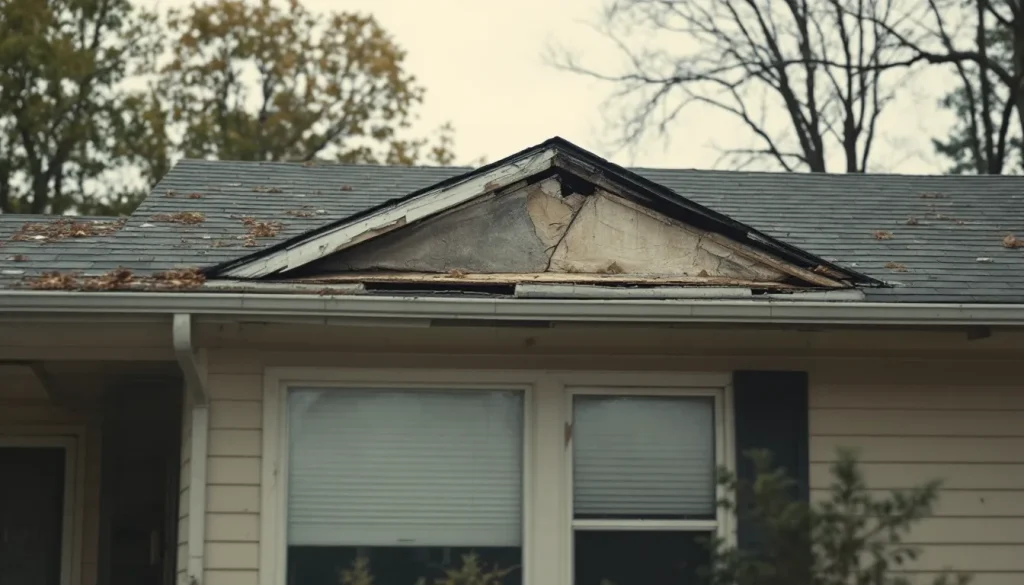
A sagging roof in 2026 is rarely cosmetic. The cause matters enormously: a 1-inch sag at the ridge from undersized rafters is structurally different from a 4-inch sag caused by years of leak damage and rotted decking. Repair costs range from $1,500 for sister-rafter reinforcement on a single bay to $15,000 or more for a full structural rebuild on a roof with widespread decking failure. Here is how to assess severity, identify the cause, and price the repair before the sag becomes a collapse. Detached structures follow the same logic, covered in our sagging garage roof fix guide.
The short version
- A sagging roof signals structural compromise. Repair cost ranges from $1,500 (sister rafters on one bay) to $15,000+ (full deck and rafter replacement).
- Severity matters: under 1 inch is usually cosmetic or settling, 1 to 3 inches is repairable, over 3 inches often signals decking rot or rafter failure.
- Six common causes: undersized rafters, excessive snow load, water-rotted decking, foundation movement, truss damage, and termite or other insect activity.
- A structural engineer’s inspection ($300 to $800) is the right starting point before any repair quote. Roofers should not diagnose structural sag.
- Insurance covers sudden structural damage from a covered peril (heavy snow, falling tree). Gradual sag from age, neglect, or undersized framing is excluded.
- The compounding-damage math is brutal: a $1,500 sister-rafter repair today often becomes a $12,000 deck-and-rafter rebuild within five years if ignored.
The Short Answer: 3 Severity Levels and Action by Level
Roof sag severity divides cleanly into three categories. The action required is very different for each.
| Severity | Visual Indicator | Likely Cause | Action | Typical Cost |
|---|---|---|---|---|
| Mild (under 1 inch) | Subtle dip visible only from certain angles | Settling, minor rafter creep | Inspect and monitor | $300 to $800 (inspection) |
| Moderate (1 to 3 inches) | Visible dip from ground, often a single bay | Undersized or single damaged rafter, localized decking rot | Sister rafters, partial decking | $1,500 to $6,000 |
| Severe (over 3 inches) | Obvious wave or hammock effect, sometimes multiple bays | Widespread decking rot, multiple rafter failure, truss damage | Full structural repair | $8,000 to $25,000+ |
One severity bracket above the visible sag is often a hidden issue: a roof showing 2 inches of sag at the surface may have 4 inches of cumulative deflection in the framing when measured from underneath. A structural engineer’s inspection is the only way to confirm.
Visual Severity Assessment
The from-the-ground assessment that every homeowner can do:
- Stand 30 to 50 feet back from the house. Look at the ridge line. It should be straight from gable to gable.
- Photograph the ridge with a level reference. Hold a level horizontally in the foreground, photograph the ridge behind it. The deviation shows up clearly.
- Look at the field of the roof. Sags often show up as a smooth dip or a “wave” pattern, not a sharp angle.
- Walk around the house. Check all four faces. A sag visible from one angle may not show from another.
- Check the soffit and fascia lines. If the ridge sags, the soffit usually sags with it.
From inside the attic, the more reliable measurement:
- Run a chalk line or taut string from gable wall to gable wall at the ridge.
- Measure the gap between the string and the actual ridge board at three to five points along the length.
- Record measurements. Any deviation greater than 1 inch warrants engineering evaluation.
Cause 1: Undersized or Damaged Rafters
The most common structural cause of mild to moderate sag. Many homes built before the 1970s used 2×6 rafters on 24-inch centers for spans they could not actually support long-term. By the 2000 IRC, rafter sizing tables were tightened, but legacy framing persists.
Signs of rafter undersizing:
- Even sag along the entire ridge line, not localized.
- House built before 1980 with 2×6 or 2×8 rafters on 24-inch centers spanning 14+ feet.
- No collar ties or rafter ties present in the attic (these can be required by IRC R802.5).
- Sag develops slowly over decades and is visible on every face equally.
Repair approach: sister rafters. A new full-length rafter is installed alongside each existing rafter, nailed and glued to share the load. The original rafter does not need to be removed. This is the cleanest structural fix for undersizing.
Sister rafter cost: $200 to $400 per rafter installed, depending on access and lumber size. A typical 1,500 sq ft home with 30 rafters runs $6,000 to $12,000 for a complete sister-rafter retrofit. Partial retrofits on the most-stressed rafters (under a heavy load like a chimney or solar array) can be done for $1,500 to $4,000.
Cause 2: Excessive Snow or Ice Load
Snow load is a region-specific design factor. IBC and IRC require roofs to be designed for ground snow load (Pg) by location, with conversion factors for roof pitch and exposure. Houses in IRC climate zones 5+ are typically designed for 30 to 60 psf ground snow load. Houses in climate zone 7+ (parts of Maine, Minnesota, mountain states) may require 70 to 100+ psf design.
When sag follows a heavy snow year:
- Localized sag pattern, often worst over rooms with less heat (garages, additions, unheated porches).
- Asymmetric loading from wind-drifted snow on the leeward roof slope.
- Visible deflection that did not exist the previous summer.
- Cracking sounds during heavy snow events.
If a snow load event caused sag, the structure may have damaged rafters or stressed connections that need engineering evaluation before next winter. Repair options range from collar tie or rafter tie addition ($800 to $2,500) to partial rafter sistering or full replacement.
Snow load is also a covered peril under most HO-3 homeowners policies. If the cause is documentable (a known heavy snow event), file a claim. Our walkthrough on filing an insurance claim for roof damage covers the documentation process.
Cause 3: Water Damage and Rotted Decking
The most common cause of localized severe sag. Years of unaddressed leaks rot the OSB or plywood decking, the decking softens, and the roof surface dips between rafters.
Identifying decking rot:
- Sag is localized, often within a 4 to 8 foot area.
- The sag is between rafters (the rafters themselves are still straight), so the dip has a scalloped pattern.
- From the attic, the underside of the decking shows water staining, black mold, or visible delamination.
- Pressing on the decking from above (carefully) feels spongy or springy.
- History of leaks at a chimney, valley, or skylight in the area of sag.
Repair is decking replacement, which requires removing shingles above the rotted area, replacing the OSB or plywood (typically 1/2 inch or 5/8 inch), and reinstalling underlayment and shingles. Cost: $5 to $12 per square foot for decking replacement plus shingle work. A 100 sq ft section runs $500 to $1,200 in framing materials plus $400 to $1,000 in shingle and labor. See our roof deck repair cost guide for a full method-by-method breakdown.
The compounding-damage trap: if leaks continue, decking rot spreads outward 2 to 4 feet per year. The same $1,800 repair today becomes a $6,000 to $9,000 repair in three years.
For the cost framework on full deck-and-roof replacement, see our new roof cost guide. Decking replacement adds $1.50 to $3.50 per square foot to a re-roof.
Cause 4: Foundation Settlement Pulling Walls Apart
A less common but more serious cause. When a foundation settles unevenly, the walls move with it. If two gable walls move apart by half an inch, the ridge drops by an amount that depends on rafter span and pitch.
Signs of foundation-driven roof sag:
- The sag corresponds to visible foundation cracks, especially stair-step cracks in masonry.
- Doors and windows on the affected wall stick or fail to close properly.
- Interior drywall cracks at the corners of door and window openings.
- The roof sags but rafters appear straight when sighted along their length. The whole roof has dropped, not deflected.
This requires foundation investigation before any roof work. A structural engineer’s evaluation ($300 to $800) determines whether the foundation needs underpinning, piers, or other stabilization. Foundation repair costs typically run $5,000 to $25,000 depending on severity. Roof work after foundation stabilization may be limited to cosmetic adjustment or none at all if the structure was simply pulled out of alignment without rafter damage.
Cause 5: Truss Damage (Engineered Truss Systems)
Homes built since the 1980s frequently use engineered (see our roof truss cost and types) roof trusses instead of stick-framed rafters. Trusses are engineered systems with specific load paths. Cut a single truss member to install an HVAC unit or pull a connector plate to add a bathroom fan, and the truss can lose 30 to 60 percent of its load capacity.
Signs of truss damage:
- Sag in a localized area corresponding to a previous HVAC, plumbing, or electrical project in the attic.
- Visible cut or notched truss members.
- Missing or pulled-off connector plates (the metal gusset plates at truss joints).
- Trusses installed in homes built 1970 to 1995 are at risk because earlier truss designs used smaller plates and less redundancy.
Truss repair is engineering-mandatory work. A truss repair engineer (typically the original truss manufacturer or a third-party PE) designs a repair, which usually involves sister-truss installation, replacement of damaged members, or addition of structural plates. Cost: $500 to $2,000 per damaged truss, plus engineering fees of $500 to $2,000.
Never attempt truss repair without engineered drawings. A botched truss repair can collapse the roof.
Cause 6: Termite or Other Insect Damage
Termite, carpenter ant, and powder post beetle damage hollows out structural framing without obvious surface signs until severe.
Indicators:
- Sag in localized area, often near eaves or in attic corners that retain moisture.
- Mud tubes on framing (termites) or sawdust piles (carpenter ants, powder post beetles).
- Wood that crumbles when probed with a screwdriver.
- History of termite activity in the region or property.
Repair requires pest treatment first ($1,500 to $4,000 typical for termite treatment), then structural repair of damaged framing. Damaged rafters typically need full replacement, not sistering. Cost: $4,000 to $15,000 depending on extent.
Homeowners in Southern states (Florida, Texas, Louisiana, Georgia, and the Carolinas) should pull a termite inspection ($100 to $300) as part of any sagging roof investigation.
The Inspection: What a Structural Engineer Looks For
Before any sagging roof repair work, a licensed structural engineer’s inspection is the right first step. Roofers can install sister rafters, but they should not diagnose the underlying structural cause. That is engineering work.
What the engineer evaluates:
- Rafter sizing and span. Are existing rafters adequate for current code and current loading?
- Collar tie and rafter tie presence. Are these horizontal members present and adequately fastened (IRC R802.5)?
- Decking condition. Is the decking sound or rotted? How widespread?
- Bearing wall integrity. Are the walls supporting the roof sound and plumb?
- Truss integrity (if applicable). Are all members and connector plates intact?
- Foundation indicators. Are there signs of differential settlement affecting the roof?
- Snow and wind load adequacy. Does the current structure meet design load requirements for the region?
Cost: $300 to $800 for a single-family residential inspection with a written report. The report becomes the basis for any contractor quote and is often required by permit authorities for structural repair work.
Repair: Sister Rafters ($1,500 to $6,000)
The most common repair for moderate sag from undersized or single-failed rafters. The process:
- A new rafter, sized appropriately (often 2×10 or 2×12 even when the original was a 2×8), is cut to span from the top plate to the ridge board.
- The new rafter is installed alongside the existing rafter, in full contact.
- The two are nailed and glued together with construction adhesive and 10d or 16d common nails on a staggered pattern (typically 12 to 16 inch spacing).
- The new rafter is fastened to the top plate and ridge board with appropriate framing connectors (often Simpson H2.5 or LSTA strap).
Cost variables:
- Number of rafters being sistered (typically 4 to 30 in a residential job).
- Access to the attic (full standup vs crawl).
- Insulation in the way (blown-in insulation needs to be relocated).
- HVAC, plumbing, and electrical in the bay (work around).
Sister-rafter repair on a single bay typically runs $1,500 to $3,000. A complete attic-wide sister retrofit on a 1,500 sq ft home runs $6,000 to $12,000.
Repair: Full Rafter Replacement ($4,000 to $10,000)
When a rafter is damaged beyond sistering (large rot section, termite hollowing, fire damage), full replacement is required. This is a more invasive repair because the existing rafter must be removed without compromising the roof during the work.
The process typically involves:
- Temporary shoring under the ridge to support the roof load.
- Removing shingles, underlayment, and decking above the damaged rafter.
- Removing the damaged rafter.
- Installing the new rafter, fastened to the top plate and ridge.
- Installing new decking, underlayment, and shingles.
- Removing shoring.
Cost: $1,500 to $3,000 per rafter replaced including roofing restoration. A typical job involves 2 to 5 rafters and runs $4,000 to $10,000.
Repair: New Decking ($5 to $12 per Square Foot Installed)
When decking rot is the primary sag cause, decking replacement is the repair. Scope ranges from partial (a single 4×8 sheet) to full deck (the entire roof).
The process:
- Strip shingles and underlayment in the affected area, with at least 12 inches of overlap onto sound surrounding material.
- Remove the rotted decking down to the rafters.
- Inspect the rafters for damage. If sound, proceed. If damaged, repair or replace before decking goes back.
- Install new decking (1/2 inch CDX plywood or 5/8 inch OSB are the typical choices, depending on rafter spacing). 7/16 inch OSB is the minimum allowed by IRC R803 on 16-inch-on-center framing.
- Install new underlayment and ice and water shield where applicable.
- Install new shingles, color-matched to surrounding field.
Cost breakdown for a 100 sq ft decking repair:
| Item | Approximate Cost |
|---|---|
| Plywood/OSB decking (100 sq ft) | $80 to $180 |
| Underlayment and ice and water | $60 to $150 |
| Shingles (color-matched) | $120 to $250 |
| Labor (strip, replace, install) | $500 to $1,200 |
| Disposal | $50 to $100 |
| Total | $810 to $1,880 |
Larger areas scale proportionally. Decking replacement during a full re-roof is typically $1.50 to $3.50 per sq ft added cost.
When to Evacuate (Clear Safety Indicators)
Some roof conditions are emergencies requiring immediate evacuation pending professional assessment:
- Visible crack or split in a rafter or truss member. The structural redundancy has failed.
- Audible cracking sounds from the attic. Active failure progression.
- Doors and windows that suddenly will not close in the affected wing of the house. Indicates major structural movement.
- Sag that has progressed visibly in days or weeks rather than years. Active failure.
- Significant snow load on a roof with known structural issues. Combination of pre-existing weakness and current loading.
- Sag of 4 inches or more developing rapidly after an event (snow, wind, falling object). Possible imminent collapse.
In any of these scenarios, evacuate the area below the affected roof section and call a structural engineer immediately. Roof collapses kill people every winter in northern climates.
Insurance Coverage for Structural Sagging
Standard HO-3 policies cover sudden structural damage from covered perils. They exclude gradual deterioration.
Typically covered:
- Snow and ice load collapse or sag (with documentation of the weather event).
- Wind damage causing structural failure.
- Falling tree causing structural damage.
- Sudden water damage from a covered cause (burst pipe in attic) leading to structural sag.
Typically not covered:
- Gradual sag from age, settling, or undersized framing.
- Decking rot from chronic, untreated roof leaks.
- Termite or other insect damage.
- Foundation settlement causing roof movement.
For covered claims, the carrier may pay for both the structural repair and the roof restoration. ACV vs replacement cost coverage matters here. On a roof past 50 percent of its service life, ACV depreciation can reduce the payout significantly. Our walkthrough of what an insurance adjuster looks for during a roof inspection covers the documentation and adjuster meeting process.
Cost of Doing Nothing (Compounding Damage Math)
The economic case for prompt sag repair is brutal. Three scenarios from working roofers:
| Scenario | Year 1 Cost | Year 3 Cost | Year 5 Cost |
|---|---|---|---|
| Sister 4 rafters today | $2,500 | Done | Done |
| Ignore. Decking begins rotting around stressed area | $0 | $4,500 (sister rafters + partial deck) | $9,000 (sister rafters + larger deck + shingle area) |
| Ignore. Decking rot spreads, framing damage progresses | $0 | $0 | $15,000 to $25,000 (full structural rebuild + new roof) |
Roof sag does not get better on its own. Loads do not decrease. Aging materials do not strengthen. Every year of delay shifts the repair scope outward.
The honest decision rule: any sag over 1 inch warrants engineering inspection within 90 days. Any sag over 3 inches warrants engineering inspection immediately. Any sag that is visibly progressing warrants immediate evacuation of the affected area and inspection.
For a broader picture of the repair vs replace tradeoff once structural repair is done, see our signs you need a new roof guide and the new roof cost guide. Sometimes the structural repair is the right move; sometimes a full tear-off and rebuild is more economical. The decision usually turns on three factors: how much of the deck and framing need replacement, how old the existing roof covering is, and whether the home will be sold within five years (in which case a documented full replacement often pays back at sale). Run the numbers both ways with quotes in hand before committing.
FAQs
Is a sagging roof dangerous?
Mild sag (under 1 inch) is rarely an immediate danger but warrants inspection. Moderate sag (1 to 3 inches) is structurally significant and needs repair within months. Severe sag (over 3 inches) is potentially dangerous, especially under load conditions like snow. Any sag that is visibly progressing is a safety issue.
How much does it cost to fix a sagging roof?
$1,500 for sister rafters on a single bay, up to $25,000+ for full structural rebuild with new decking. The median residential sagging roof repair runs $4,000 to $9,000 once decking and roofing restoration are included.
Can a sagging roof be fixed without replacing the whole roof?
Yes, in most cases. Sister rafters, partial decking replacement, and localized shingle replacement can address moderate sag without a full re-roof. Severe sag with widespread decking rot often makes full replacement the more economical choice.
What causes a roof to sag in the middle?
Middle-of-ridge sag typically signals undersized rafters, missing collar ties, or rafter creep over decades. Heavy snow loads accelerate the pattern. Six common causes are listed in this guide; an engineering inspection identifies which applies.
Will insurance pay for a sagging roof?
Only if the sag was caused by a covered peril (heavy snow event, wind damage, falling tree). Gradual sag from age, undersized framing, or chronic leak damage is excluded under standard HO-3 wear-and-tear language.
Do I need a structural engineer for a sagging roof?
For any sag over 1 inch, yes. An inspection costs $300 to $800 and produces a written report that becomes the basis for any contractor quote. Roofers can install sister rafters or replace decking, but they should not diagnose the underlying structural cause.
How long does sagging roof repair take?
Sister rafter work on 4 to 6 rafters: 1 to 3 days. Localized decking replacement: 1 to 2 days. Full deck and rafter rebuild: 5 to 14 days depending on scope and weather. Add engineering inspection lead time of 1 to 3 weeks.
Can a sagging roof collapse?
Yes. Sagging roofs collapse under load conditions (heavy snow, ice, water accumulation) every winter in northern climates. The risk increases with sag depth and with deferred repair. Sag of 4+ inches developing rapidly is a clear collapse-risk indicator. Evacuate and call an engineer immediately.