
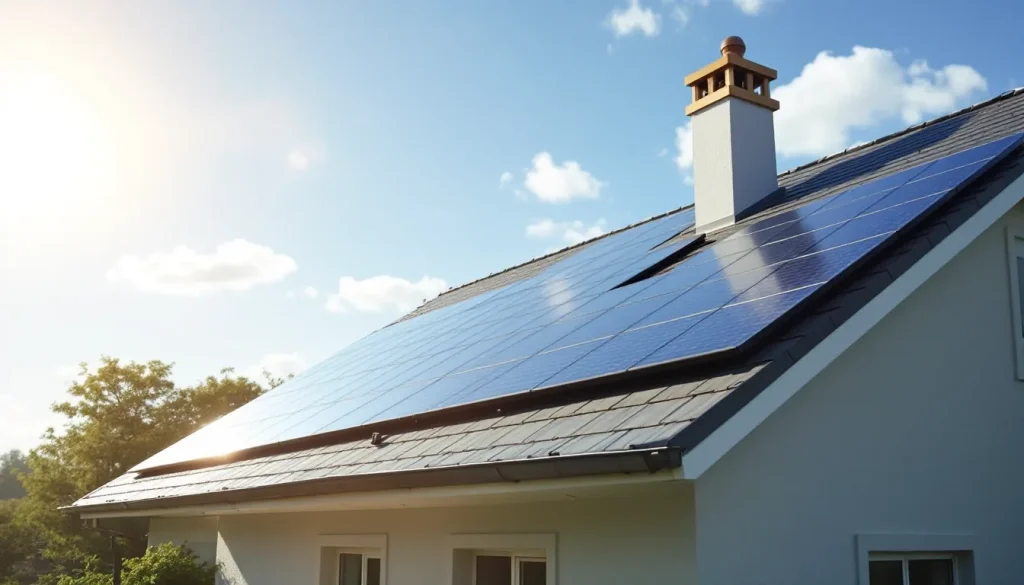
Solar shingles cost $21 to $25 per square foot installed in 2026, putting a typical 25-square (2,500 sq ft) installation between $52,500 and $62,500 before the 30 percent federal solar tax credit. The market leaders are GAF Timberline Solar, Tesla Solar Roof, and CertainTeed Apollo II, each with different aesthetic and electrical tradeoffs. After the Section 25D Investment Tax Credit, net cost drops to $36,750 to $43,750. That is roughly 2.5 to 3.5 times the cost of a conventional asphalt reroof with rack-mounted solar panels, with payback periods running 14 to 22 years in most US markets versus 7 to 12 years for the conventional approach. Here is the real cost breakdown and payback math, brand by brand.
The short version
- Solar shingles cost $21 to $25 per square foot installed in 2026, or $52,500 to $62,500 for a 2,500 sq ft roof.
- Three brands dominate: GAF Timberline Solar ($21 to $24/sqft), Tesla Solar Roof ($23 to $30/sqft), CertainTeed Apollo II ($22 to $26/sqft).
- The 30 percent federal Section 25D tax credit applies to the entire integrated roof, not just the active solar tiles.
- Net cost after credit: $36,750 to $43,750 for a typical home.
- Payback period runs 14 to 22 years versus 7 to 12 for conventional panels, because the price premium is real.
- The aesthetic premium and integrated warranty are the selling points, not the financial return.
The short answer plus three-brand comparison
| Brand | Installed cost per sqft | Active power per shingle | Active area coverage | Warranty |
|---|---|---|---|---|
| GAF Timberline Solar (ES) | $21 to $24 | 45W per shingle | 40 to 60% of roof | 25 yr product, 25 yr power |
| Tesla Solar Roof V3 | $23 to $30 | 71.67W per glass tile | 30 to 60% of roof | 25 yr product, 25 yr power |
| CertainTeed Apollo II | $22 to $26 | 63W per module | 30 to 50% of roof | 25 yr product, 25 yr power |
The price spread reflects three things: brand premium (Tesla charges for the Tesla name), installation complexity (Tesla and Apollo II have proprietary mounting), and active-area ratio (the fraction of roof that actually generates power). GAF wins on simplicity because the Timberline Solar shingles nail down like conventional architectural shingles. Tesla wins on appearance because the inactive glass tiles are visually identical to the active ones. CertainTeed sits in the middle on both.
GAF Timberline Solar
GAF’s Timberline Solar Energy Shingle (ES) launched in 2022 and is the only nailable solar shingle on the US market. Each active shingle measures 64 by 17 inches and outputs 45 watts at the module level. The big innovation is that installers nail them with a standard roofing nail gun rather than using proprietary mounting hardware, which collapses install labor to roughly $4 to $6 per square foot versus $8 to $12 for Tesla or Apollo II.
System sizing typically lands at 6 to 11 kW for a residential roof depending on active-area coverage. The active shingles are flanked by standard Timberline HDZ shingles (matched in color and shadowline) to fill the inactive areas. From the curb, the difference between an active Timberline Solar shingle and a conventional HDZ shingle is visible but subtle: the active shingles have a darker, smoother finish without the granular texture.
2026 installed pricing runs $21 to $24 per square foot for a 6 to 9 kW system, including the inactive Timberline HDZ shingles, underlayment, drip edge, ridge cap, and inverter. The system uses string inverters from SolarEdge or Enphase microinverters depending on the installer.
Tesla Solar Roof
Tesla Solar Roof launched in 2017 (the original V1) and has gone through three major redesigns to V3.5 (the current product as of 2026). The system uses tempered glass tiles, half of which contain crystalline silicon cells and half of which are visually identical inactive blanks. Active tiles output 71.67 watts each.
The big aesthetic win is that the active and inactive tiles are visually indistinguishable from the ground because both use the same glass face. From the air or close inspection, the active tiles have a slight blue tint from the underlying silicon. The big install penalty is that Tesla’s mounting system is proprietary and Tesla controls the installer pipeline (most installs are Tesla Energy crews, with some certified third-party installers in major metros).
2026 installed pricing runs $23 to $30 per square foot for an 8 to 12 kW system. Tesla’s quote (see our solar system quote comparison) includes the Powerwall 3 battery in most configurations, which adds $9,000 to $11,000 of cost but qualifies for the Section 25D credit as part of the integrated system. Pure roof-only Tesla Solar Roof installs (no battery) sit at the lower end of the price range.
CertainTeed Apollo II
CertainTeed’s Apollo II solar shingle is the third major player, with the Apollo Tile II variant offering a flat-tile aesthetic that competes more directly with Tesla. Each Apollo II module outputs 63 watts at 17.5 percent efficiency, with a 25-year power warranty.
The Apollo II mounts to a proprietary rail system that fastens to the deck before the inactive shingles are installed around the active modules. This makes install labor higher than GAF Timberline Solar but lower than Tesla because CertainTeed’s installer network is broader than Tesla’s. Apollo II pairs with Enphase microinverters, which gives per-shingle production monitoring.
2026 installed pricing runs $22 to $26 per square foot for a 6 to 10 kW system. Apollo II’s selling point is the integration with CertainTeed’s broader roofing warranty (Apollo II is covered under the SureStart Plus warranty when installed with the Landmark shingle line), which appeals to buyers who want a single warranty contact for the entire roof.
Solar shingles vs solar panels: the real cost difference
| Comparison | Solar shingles (2,500 sqft) | Conventional panels + asphalt (2,500 sqft) |
|---|---|---|
| Roof + solar combined cost | $52,500 to $62,500 | $10,000 (roof) + $21,000 (8 kW solar) = $31,000 |
| System wattage | 7 to 10 kW | 8 kW |
| Section 25D ITC base | Full $52,500 to $62,500 | $21,000 (solar only, not roof) |
| 30% federal credit | $15,750 to $18,750 | $6,300 |
| Net cost | $36,750 to $43,750 | $24,700 |
| Premium over conventional | $12,050 to $19,050 | baseline |
The full integrated solar shingle install qualifies the entire roof cost for the Section 25D credit, which is the one place where shingles claw back some of the premium. The credit on a Tesla Solar Roof at $62,500 is $18,750, which is $12,450 more than the credit on a conventional roof-plus-panels install. But even with the full credit advantage, you are still paying a $12,000 to $19,000 premium for the aesthetic and warranty integration.
For straight-up panel install context, see our coverage of solar panels on metal roof, where the cost-per-watt math runs $2.80 to $3.50 versus the $6.00 to $8.50 effective per-watt cost of solar shingles.
Per-square-foot install math, line by line
| Line item | GAF Timberline Solar | Tesla Solar Roof V3 | CertainTeed Apollo II |
|---|---|---|---|
| Active solar shingles / tiles | $9.50 to $11.00 | $12.00 to $15.50 | $10.00 to $12.00 |
| Inactive matched shingles / tiles | $2.50 to $3.50 | $3.50 to $4.50 | $3.00 to $3.75 |
| Underlayment + drip edge + ridge | $1.20 to $1.60 | $1.40 to $1.80 | $1.30 to $1.70 |
| Inverter (string or microinverters) | $1.50 to $2.00 | $1.80 to $2.40 | $1.60 to $2.10 |
| Labor (tear-off + install) | $4.00 to $5.00 | $3.00 to $4.50 | $3.80 to $4.80 |
| Permit + electrical + interconnect | $1.30 to $1.60 | $1.30 to $1.80 | $1.30 to $1.65 |
| Installer margin (15 to 20%) | $1.50 to $2.30 | $2.00 to $3.00 | $1.60 to $2.50 |
| Total per sqft | $21.50 to $24.00 | $25.00 to $30.00 | $22.60 to $26.50 |
The federal 30 percent Section 25D ITC
The Section 25D Investment Tax Credit covers 30 percent of qualifying solar installation costs through tax year 2032 under the Inflation Reduction Act. For integrated solar shingle systems, the IRS treats the entire roof as a single qualifying property because the active and inactive shingles together form one functional solar generation surface. This is materially different from rack-mounted panels, where only the solar equipment qualifies and the underlying roof does not.
For a $58,000 Tesla Solar Roof, the credit is $17,400. For a $54,000 GAF Timberline Solar install, the credit is $16,200. For a $56,000 CertainTeed Apollo II, the credit is $16,800. The credit is claimed on IRS Form 5695, line 6a, and carries forward indefinitely if it exceeds your annual tax liability.
SEIA (Solar Energy Industries Association) maintains updated guidance on integrated solar product credit eligibility at seia.org. Always confirm with a tax professional that your specific install qualifies for the full-roof credit before signing.
State and utility incentives
State-level solar incentives layer on top of the federal credit. California’s NEM 3.0 net billing structure changed the value of exported solar in 2023 to a much lower compensation rate, which extended California payback periods by 3 to 6 years. New York’s NY-Sun program offers $0.20 to $0.40 per watt rebates depending on utility territory. Massachusetts SMART program provides production-based incentives of $0.06 to $0.30 per kWh for 10 years.
Texas has no statewide rebate but Austin Energy and CPS Energy in San Antonio offer $2,500 rebates. Florida has no state incentive but property tax exemption applies. The DSIRE database (dsireusa.org, maintained by NC State) is the canonical source for state-by-state incentives.
Payback period math by region
| Region | Net cost (~$40K) | Annual generation (8 kW) | Avg utility rate | Annual savings | Payback years |
|---|---|---|---|---|---|
| Phoenix, AZ | $40,000 | 14,200 kWh | $0.143/kWh | $2,031 | 19.7 yrs |
| San Diego, CA | $40,000 | 13,100 kWh | $0.382/kWh | $5,004 | 8.0 yrs |
| Austin, TX | $40,000 | 12,800 kWh | $0.146/kWh | $1,869 | 21.4 yrs |
| Denver, CO | $40,000 | 12,400 kWh | $0.142/kWh | $1,761 | 22.7 yrs |
| Boston, MA | $40,000 | 10,600 kWh | $0.298/kWh | $3,159 | 12.7 yrs |
| Atlanta, GA | $40,000 | 11,800 kWh | $0.139/kWh | $1,640 | 24.4 yrs |
| Long Island, NY | $40,000 | 11,200 kWh | $0.247/kWh | $2,766 | 14.5 yrs |
| Newark, NJ | $40,000 | 10,800 kWh | $0.187/kWh | $2,020 | 19.8 yrs |
The honest takeaway: solar shingles pay back fastest in high-rate markets (California, Northeast) and slowest in low-rate markets (Atlanta, Houston). In most US markets, payback runs 15 to 22 years for solar shingles versus 7 to 12 for conventional panels. The financial case for solar shingles is rarely a winner on raw IRR. The case is aesthetic preservation, HOA compliance in design-restricted communities, and warranty integration.
Roof age and reroof timing
Solar shingles only make financial sense if you need a new roof anyway. If your existing asphalt roof has 10+ years of remaining life, conventional panels rack-mounted to the existing roof are 60 to 70 percent cheaper than tearing off a usable roof to install solar shingles. The decision tree is straightforward: roof needs replacing in 0 to 3 years, consider solar shingles; roof has 4+ years of life, install conventional panels and revisit at next reroof.
For lifespan benchmarks to assess your existing roof, see asphalt shingle roof lifespan and signs you need a new roof. For cost comparisons against a standard reroof, see how much does a new roof cost.
Where solar shingles do not work
Solar shingles fail the financial test on heavily shaded roofs because the lower-output active area cannot overcome the price premium. If your roof has 25+ percent shading from trees, chimneys, or neighboring structures, the annual generation drops by 25 to 50 percent and payback stretches past 30 years. Conventional panels with microinverters or DC optimizers handle partial shading much better because you can selectively place panels in unshaded zones.
Solar shingles also struggle on complex roof geometries with many hips, valleys, dormers, and skylights, because each obstruction requires custom flashing integration with the active shingle layout. Simple gable and hip roofs are the ideal canvas; complex Victorian or French country roofs add 15 to 30 percent to install labor.
Steep pitches (above 9:12) add labor cost across all three products. Low pitches below 3:12 generally cannot use solar shingles because most products require a minimum 2:12 or 3:12 pitch for water shedding.
How solar shingles handle hail and wind
Solar shingles must clear the same weather durability standards as conventional roofing materials, plus additional standards for the active solar components. Tesla Solar Roof glass tiles carry a Class 3 hail impact rating under UL 2218, which means they survive 1.75 inch diameter steel ball impacts in lab testing. GAF Timberline Solar shingles carry Class 4 hail rating (the highest available), matching the asphalt shingles they replace. CertainTeed Apollo II modules carry Class 4 hail rating.
Wind performance is rated under ASTM D3161 and ASTM D7158. All three solar shingle products carry 130 mph wind ratings when installed per manufacturer specifications. GAF Timberline Solar uses the same StrikeZone nailing area and LayerLock technology that powers the Timberline HDZ wind warranty.
Field performance from major weather events validates the lab ratings. Tesla Solar Roof installations in the September 2024 Hurricane Helene path showed essentially zero structural damage; the failure mode in that storm was attic flooding from rain, not roof loss. GAF Timberline Solar installations in the May 2024 Texas hailstorms saw less than 1 percent of installed roofs require any shingle replacement.
Insurance carrier acceptance and premium impact
| Carrier acceptance category | Tesla Solar Roof | GAF Timberline Solar | CertainTeed Apollo II |
|---|---|---|---|
| Major national carriers (State Farm, Allstate, Farmers) | Accepted | Accepted | Accepted |
| FAIR Plan / coastal insurer of last resort | Accepted with rating premium | Accepted standard | Accepted standard |
| Wildfire WUI carriers (California) | Class A integrated rating accepted | Class A asphalt rating accepted | Class A asphalt rating accepted |
| Hail/wind-belt carriers (TX, OK, KS) | Some premium increase | Same as standard asphalt | Same as standard asphalt |
Most US homeowner policies cover solar shingles under the dwelling coverage at the same rate as conventional roofing materials. Some carriers charge a 5 to 15 percent premium for Tesla Solar Roof because the higher replacement cost increases the carrier’s loss exposure. GAF Timberline Solar and CertainTeed Apollo II generally insure at standard asphalt rates.
Battery storage integration costs
| Battery option | Capacity | Adds to install cost | Federal credit eligibility |
|---|---|---|---|
| Tesla Powerwall 3 | 13.5 kWh | $10,500 to $13,500 | Full 30% Section 25D |
| Enphase IQ Battery 10C | 10.08 kWh | $11,000 to $14,000 | Full 30% Section 25D |
| FranklinWH aPower 2 | 15 kWh | $13,500 to $16,500 | Full 30% Section 25D |
| SolarEdge Home Battery | 9.7 kWh | $9,500 to $12,500 | Full 30% Section 25D |
Tesla Solar Roof installations almost always include a Powerwall 3 because the Tesla quote bundles the products. GAF Timberline Solar and CertainTeed Apollo II installations are battery-agnostic, so installers spec whichever brand their service network supports best. Enphase microinverter-paired systems pair naturally with Enphase IQ Batteries because the energy management software ties together.
Inverter replacement at year 12 to 15
String inverters (used in some GAF Timberline Solar configurations) typically need replacement at year 12 to 18 of service. Microinverters (Enphase IQ8 series, used by Apollo II and some GAF installs) carry 25-year warranties but field experience suggests 18 to 25 years of service life. Tesla’s solar inverter is integrated into the Powerwall 3 system and follows the Powerwall service cycle.
The 2026 replacement cost for a residential string inverter runs $2,200 to $3,800 installed. For microinverter systems, individual unit replacement runs $250 to $400 each as failures appear, typically 1 to 3 units per year past year 15. Plan for $3,000 to $6,000 of inverter or microinverter replacement cost over the system’s 25 to 35 year life.
HOA approval and aesthetic factors
The aesthetic case for solar shingles is real in deed-restricted communities that prohibit conventional rack-mounted panels. Many HOAs explicitly approve solar shingles because they preserve the roofline silhouette. Tesla Solar Roof, in particular, is often approved in communities that reject conventional panels because the glass tiles read as architectural rather than industrial.
State solar access laws (in California, Florida, Texas, Arizona, and others) limit HOA authority to reject solar entirely, but HOAs can still impose design standards. Solar shingles sidestep almost all of these design fights because the integration with the roof itself is the entire product proposition.
Documentation matters in HOA negotiations. The manufacturer’s product spec sheet, the installer’s wiring diagram, and a rendering of the finished roof typically satisfy architectural review boards. Tesla and GAF both provide HOA approval kits to installers; CertainTeed provides the same on request through the Apollo II dealer network.
Solar shingle installer certification
Each manufacturer maintains a certified installer network. Tesla Solar Roof can only be installed by Tesla Energy crews or Tesla Certified Installers (a small network of independent contractors who have completed Tesla’s training and meet capacity and quality benchmarks). GAF Timberline Solar installers must be Master Elite roofers who have completed GAF’s solar training (about 250 contractors nationwide as of 2026). CertainTeed Apollo II installers must be SureStart Plus certified roofers with Apollo II-specific solar training.
NABCEP PV Installation Professional certification is not required by the manufacturers but is the gold standard for the electrical side of the install. Most certified installers carry both the manufacturer credential and NABCEP PVIP credential. SEIA member directories filter installers by manufacturer credential and state. For broader contractor vetting, see how to choose a roofing contractor.
Financing solar shingle installations
Solar shingles are typically too expensive for cash payment for most homeowners, so financing is the practical reality. Three financing paths dominate. Cash-out home equity refinance or HELOC: cheapest interest rates (7 to 9 percent in 2026), interest is tax-deductible if used for home improvement, but requires equity in the property. Solar loans (Mosaic, GoodLeap, Sungage): higher rates (8 to 12 percent) but no equity required and fast approval; the loan secures against the solar equipment itself. Manufacturer financing (Tesla Energy financing, GAF EasyApply): convenient but typically the highest rate of the three options.
The decision hinges on rate and tax treatment. A 9 percent home equity loan with tax-deductible interest costs roughly the same effectively as a 7 to 8 percent solar loan after the tax savings. Run the math both ways before signing. A 25-year solar loan at 10 percent on $40,000 means roughly $363 per month for 25 years, totaling $108,900 in payments versus $40,000 principal. The payment schedule should be compared against the annual utility savings to confirm the cash flow works.
Performance monitoring and reporting
All three solar shingle systems include a monitoring app that reports system production, panel-level (or module-level) output, consumption, and grid export. Tesla uses the Tesla app (the same one that handles vehicle and Powerwall); GAF Timberline Solar uses the SolarEdge mySolarEdge or Enphase Enlighten apps depending on inverter selection; CertainTeed Apollo II uses Enphase Enlighten.
Monitoring matters for two reasons. First, performance warranties require the manufacturer (and you) to detect underperformance and submit warranty claims promptly. Second, federal and state production-based incentive programs (Massachusetts SMART, New Jersey TRECs) require monthly production reporting from a metered monitoring system. The included monitoring satisfies both needs.
Frequently asked questions
How much does Tesla Solar Roof cost in 2026?
Tesla Solar Roof costs $23 to $30 per square foot installed in 2026, or $57,500 to $75,000 for a typical 2,500 sq ft home. After the 30 percent federal Section 25D tax credit, net cost is $40,250 to $52,500. Tesla quotes typically include a Powerwall 3 battery.
Are solar shingles worth it financially?
In most US markets, no. Payback runs 15 to 22 years for solar shingles versus 7 to 12 for conventional panels. The exceptions are high-rate markets like California and the Northeast where payback drops to 8 to 13 years, and homes that need a new roof anyway where the reroof cost would have been spent regardless.
Does the 30 percent federal tax credit apply to the whole solar shingle roof?
Yes for integrated solar shingle systems. The IRS treats the active and inactive shingles together as one solar generation surface, so the entire installation qualifies. This is different from conventional panels where only the solar equipment qualifies, not the roof beneath them.
Which solar shingle has the best aesthetics?
Tesla Solar Roof has the cleanest aesthetic because active and inactive glass tiles are visually identical. GAF Timberline Solar is more visible up close but blends well at curb distance. CertainTeed Apollo II sits in the middle, with a flat-tile look that competes with Tesla.
How long does a solar shingle roof last?
All three major brands warranty product and power for 25 years. Real-world service life expectations are 25 to 35 years for the active components and 30 to 40 for the inactive shingles. The active electronic components (inverters, microinverters) typically need replacement at year 12 to 18, which adds $2,000 to $4,000 over the system’s life.
Can solar shingles power my whole house?
A typical 7 to 10 kW solar shingle install generates 9,000 to 14,000 kWh per year depending on location, which covers 70 to 110 percent of average US household consumption (10,500 kWh/year). Pair with a Powerwall or equivalent battery for overnight and grid-outage coverage.
Are GAF Timberline Solar shingles the same as regular Timberline shingles?
The active solar shingles are visually similar to but functionally different from standard Timberline HDZ. The inactive shingles in the same install are standard Timberline HDZ in a matched color. GAF designed the active shingles to blend with HDZ at curb distance while accepting closer inspection will show a difference.
Do solar shingles increase home resale value?
Zillow’s 2024 research found solar-equipped homes sell for 4.1 percent more on average. For a $500K home, that is roughly $20,500 of premium. The premium tends to be higher for integrated solar shingles than rack-mounted panels because buyers perceive the integrated systems as more permanent and less likely to require replacement at sale time.