
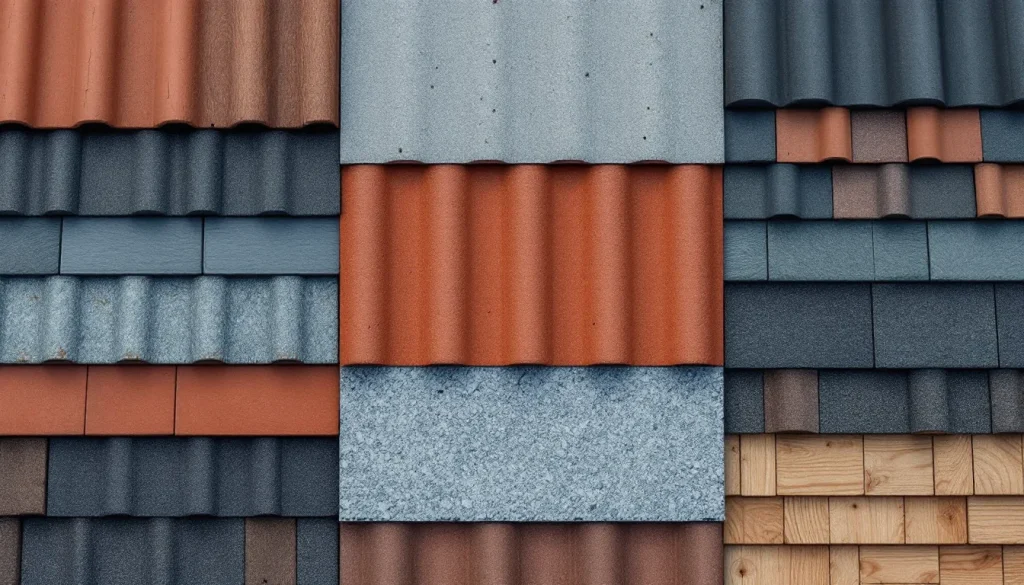
A complete roofing materials list for 2026 covers 18 distinct materials that show up on residential and light commercial quotes: 3-tab asphalt shingles, architectural shingles, designer/luxury shingles, standing-seam metal, corrugated metal, metal shingles, clay tile, concrete tile, natural slate, synthetic slate, cedar shakes, cedar shingles, EPDM rubber, TPO membrane, modified bitumen, built-up roof (BUR), green/living roof, and solar shingles. Each one has a specific price range ($1.50 to $25.00 per square foot (see our roof cost per square foot guide) installed), a typical lifespan (8 to 100+ years), a weight load (190 to 1,200 pounds per square), and a warranty structure. This guide is the reference sheet: what each material actually is, what it costs, how long it lasts, who makes it, and what climate or roof type it’s best for. Use it to vet a contractor’s quote, plan a reroof, or short-list options before a deeper material-specific deep dive.
The short version
- 18 materials cover essentially everything you’ll see on residential and light commercial roof quotes in 2026.
- Asphalt shingles (3-tab, architectural, designer) dominate residential at ~75% of US installs.
- Metal (standing-seam, corrugated, metal shingle) is the fastest-growing residential category, now ~14% of new installs.
- Tile (clay, concrete) leads in Sun Belt and Mediterranean markets; slate (natural and synthetic) is regional/luxury.
- Wood (cedar shakes, cedar shingles) is niche due to fire code restrictions in most western states.
- Flat-roof materials (EPDM, TPO, modified bitumen, BUR) split among rubber, thermoplastic, and asphalt families.
- Specialty materials (green roofs, solar shingles) are growing but still under 1% of the residential market.
Quick reference: all 18 materials at a glance
The table below summarizes every material (see our roof material calculator) covered in this guide. Use it as the comparison sheet; the deeper sections that follow expand each one.
| Material | Installed cost ($/sf) | Lifespan | Weight (lb/square) | Major brands |
|---|---|---|---|---|
| 3-tab asphalt shingle | $3.50 to $5.50 | 15-20 yr | 190-240 | GAF, Owens Corning, CertainTeed |
| Architectural shingle | $5.00 to $8.00 | 25-30 yr | 240-350 | GAF Timberline, OC Duration, CT Landmark |
| Designer/luxury shingle | $8.50 to $14.00 | 30-50 yr | 400-480 | GAF Camelot II, OC Berkshire, CT Grand Manor |
| Standing-seam metal | $10.00 to $18.00 | 40-60 yr | 50-150 | McElroy Metal, MBCI, Englert |
| Corrugated metal | $4.00 to $7.00 | 25-40 yr | 50-100 | McElroy, Union Corrugating, Fabral |
| Metal shingle | $9.00 to $14.00 | 40-60 yr | 120-180 | Decra, Boral Steel, Matterhorn |
| Clay tile | $10.00 to $20.00 | 50-100 yr | 600-1,200 | Ludowici, Boral, MCA |
| Concrete tile | $8.00 to $14.00 | 30-50 yr | 800-1,200 | Eagle Roofing, Boral, US Tile |
| Natural slate | $15.00 to $30.00 | 75-150 yr | 700-1,000 | Vermont Structural Slate, Greenstone |
| Synthetic slate | $9.00 to $16.00 | 40-50 yr | 200-300 | DaVinci, Brava, EcoStar |
| Cedar shakes | $8.00 to $14.00 | 20-40 yr | 240-400 | Cedar Shake & Shingle Bureau certified |
| Cedar shingles | $7.00 to $12.00 | 20-30 yr | 200-300 | CertiGrade red and white cedar |
| EPDM rubber | $4.50 to $7.50 | 20-30 yr | 40-100 | Carlisle Sure-Weld, GAF EverGuard |
| TPO membrane | $5.50 to $9.00 | 20-30 yr | 30-50 | GAF EverGuard TPO, Carlisle Sure-Weld TPO |
| Modified bitumen | $5.00 to $8.50 | 15-25 yr | 100-180 | GAF Liberty, Polyglass, Siplast |
| Built-up roof (BUR) | $4.50 to $7.00 | 15-30 yr | 500-700 | GAF, Johns Manville, Tremco |
| Green/living roof | $15.00 to $40.00 | 40-50 yr | 800-2,000+ | LiveRoof, Roofmeadow, GreenGrid |
| Solar shingles | $20.00 to $25.00 | 25-30 yr | 250-400 | GAF Energy, Tesla Solar Roof, Timberline Solar |
Asphalt shingles (the dominant material family)
Asphalt shingles account for around 75% of US residential (see our residential roof material guide) roof installs in 2026. The product family splits into three tiers: 3-tab (entry), architectural/dimensional (mainstream), and designer/luxury (premium). All three share the same basic construction: an asphalt-impregnated mat (fiberglass or organic) with mineral granules embedded in the surface for UV protection and color.
3-tab asphalt shingles
The entry-level product. Single-layer construction, three evenly-spaced tabs cut at the bottom edge. 15 to 20 year realistic lifespan, 60 mph wind rating, $3.50 to $5.50 per square foot installed. Best for rental properties, outbuildings, and tight-budget (for the full data set, see our the full 2026 Roofing Cost Report) reroofs. Largely displaced by architectural in owner-occupied homes because the price gap is small but the lifespan gap is significant.
Architectural (dimensional) shingles
The mainstream choice in 2026, representing over 70% of new residential installs. Two or three asphalt layers laminated together with the bottom layer cut in a staggered pattern to create dimensional shadow lines. 25 to 30 year realistic lifespan (for the full data set, see our the 2026 Roofing Material Lifespan Report), 110 to 130 mph wind ratings with proper nailing, $5.00 to $8.00 per square foot installed. Major products: GAF Timberline HDZ, Owens Corning Duration, CertainTeed Landmark, IKO Cambridge, Atlas Pinnacle Pristine, Tamko Heritage, Malarkey Vista.
Designer/luxury shingles
Heavyweight multi-piece shingles that mimic slate, cedar shake, or tile aesthetics. 30 to 50 year realistic lifespan, wind ratings to 150 mph, Class 4 impact-rated options available. $8.50 to $14.00 per square foot installed. Major products: GAF Camelot II, OC Berkshire, CertainTeed Grand Manor and Presidential, IKO Royal Estate. See our asphalt shingle roof lifespan guide for the full tier breakdown.
Metal roofing (the fastest-growing category)
Metal roofing is now around 14% of US residential roof installs and growing roughly 8% per year. The category splits into three product families: standing-seam (panels with concealed clips), corrugated (panels with exposed fasteners), and metal shingles (individual panels that mimic shingle, slate, or tile aesthetics).
Standing-seam metal panels
The premium metal option. Panels lock together at raised ribs with concealed clips that allow thermal movement. 40 to 60 year service life with PVDF (Kynar 500) coatings. $10.00 to $18.00 per square foot installed. Pitch minimum 1:12 for hydrostatic seams. Major manufacturers: McElroy Metal, MBCI, Englert, Drexel Metals, ATAS International. Best for high-end residential, modern architecture, and commercial buildings over 5,000 square feet.
Corrugated metal panels
The budget metal option. Exposed-fastener panels (R-panel, PBR-panel, classic corrugated) screwed directly to purlins or roof deck. 25 to 40 year service life, with the gasketed fasteners typically needing replacement at year 15 to 20. $4.00 to $7.00 per square foot installed. Pitch minimum 3:12 per most manufacturer warranties. Best for ag, outbuildings, garages, and rural residential. See our corrugated metal roofing guide for the full breakdown.
Metal shingles
Stamped steel or aluminum panels that mimic the aesthetic of shingles, slate, or tile. Individual panels interlock and hide the fasteners. 40 to 60 year lifespan, $9.00 to $14.00 per square foot installed. Major brands: Decra, Boral Steel (Inspire), Matterhorn, EDCO. Best for residential homeowners who want metal durability with a traditional aesthetic and HOAs that restrict standing-seam.
Clay and concrete tile (the Sun Belt standard)
Tile dominates residential roofing in Mediterranean and Sun Belt markets: California, Arizona, Florida, Nevada, and Texas. The two materials have similar appearance and installation methods but very different price points, weights, and lifespans.
Clay tile
Kiln-fired natural clay tiles. The Mediterranean and Spanish Colonial standard. 50 to 100+ year lifespan; many California clay roofs from the 1920s are still in service. $10.00 to $20.00 per square foot installed. Heavy at 600 to 1,200 pounds per square (often requires structural reinforcement on retrofits). Major brands: Ludowici (American-made, premium), MCA Clay Roof Tile, Boral USA, Santafé.
Concrete tile
Cement-and-sand tile that mimics clay or other aesthetics at lower cost. 30 to 50 year lifespan, $8.00 to $14.00 per square foot installed. Even heavier than clay (800 to 1,200 lb/square). Major brands: Eagle Roofing Products, Boral Concrete Tile, US Tile. Concrete tile dominates volume California and Arizona residential roofing because of its cost advantage over clay.
Slate (natural and synthetic)
Slate is the longest-lasting residential roofing material (for the full data set, see the 2026 Material Carbon Report). Natural slate roofs in the Northeast US are routinely 100+ years old and still functional. The catch is cost, weight, and contractor scarcity. Synthetic slate has emerged as the realistic alternative for most homeowners who want the aesthetic without the price tag.
Natural slate
Quarried natural stone tiles, typically 1/4 to 3/8 inch thick, hung from nails on roof battens. 75 to 150 year lifespan, $15.00 to $30.00 per square foot installed (often higher for premium colors or imported sources). Major US sources: Vermont Structural Slate, Greenstone Slate, Newmont Slate. Heavy (700 to 1,000 lb/square) and requires specialized installers. Best for historic restoration, very-high-end new construction, and any application where 100+ year durability is the goal.
Synthetic slate
Polymer composite tiles that mimic the appearance of natural slate. 40 to 50 year lifespan, $9.00 to $16.00 per square foot installed. Much lighter (200 to 300 lb/square) so retrofits don’t require structural reinforcement. Major brands: DaVinci Roofscapes, Brava Roof Tile, EcoStar Majestic, Inspire by Boral. Best for homeowners who want slate aesthetics without the weight and cost.
Wood roofing (cedar shakes and shingles)
Wood roofing is the original residential roofing material in much of North America, predating asphalt by centuries. It’s now a niche product, restricted by fire code in most western states. Where allowed, it’s the premium “natural” aesthetic.
Cedar shakes
Hand-split or machine-split thick wood pieces with a rough textured surface. 20 to 40 year lifespan depending on grade and treatment. $8.00 to $14.00 per square foot installed. Western red cedar dominates; Alaskan yellow cedar is a premium option. Must be Class A or B fire-treated for most jurisdictions. Best for traditional and Craftsman-style homes in the Northeast, Mid-Atlantic, and Pacific Northwest where fire code allows.
Cedar shingles
Sawn (smooth-faced) wood shingles, thinner and more refined than shakes. 20 to 30 year lifespan, $7.00 to $12.00 per square foot installed. Best for historic restoration, traditional residential, and seaside architecture.
Both wood products require fire-retardant treatment for code compliance in California, much of the Mountain West, and an increasing number of wildfire-vulnerable jurisdictions. Costs above are for treated product; untreated is cheaper but increasingly restricted.
Single-ply membrane (flat-roof category)
Flat and low-slope roofs (under 2:12 pitch) don’t accept shingles or steep-slope tile. The dominant materials for these roofs are single-ply membranes: EPDM rubber, TPO thermoplastic, and PVC thermoplastic.
EPDM rubber membrane
Synthetic rubber sheet membrane (ethylene propylene diene monomer). Black is standard; white is available at premium. 20 to 30 year lifespan, $4.50 to $7.50 per square foot installed. Major brands: Carlisle Sure-Weld, GAF EverGuard, Firestone (now Holcim). Dominates small commercial and residential flat-roof applications because of low cost and reliable performance.
TPO membrane
Thermoplastic polyolefin single-ply membrane. White is standard, providing high reflectivity for energy code compliance. 20 to 30 year lifespan, $5.50 to $9.00 per square foot installed. Major brands: GAF EverGuard TPO, Carlisle Sure-Weld TPO, Johns Manville. Dominates commercial flat-roof new construction in 2026 because of the white reflective surface (Energy Star and IECC code compliance).
PVC membrane (specialty)
Polyvinyl chloride membrane. Chemical-resistant, fire-retardant. 25 to 35 year lifespan, $6.50 to $11.00 per square foot installed. Major brands: Sika Sarnafil, Johns Manville PVC. Best for restaurants, food processing, and applications with chemical or grease exposure.
Asphalt-based flat-roof materials
Modified bitumen and built-up roofing (BUR) are the asphalt-based flat-roof options. Both predate single-ply membranes and remain in use for specific applications.
Modified bitumen
SBS or APP modified asphalt sheet, applied in two layers (base sheet and cap sheet) by torch, mop, or self-adhesive. 15 to 25 year lifespan, $5.00 to $8.50 per square foot installed. Major brands: GAF Liberty, Polyglass, Siplast, Soprema. Best for residential flat roofs, porches, and small commercial. Granular cap sheet provides finish appearance.
Built-up roof (BUR)
Multiple layers of asphalt-saturated felt (see our best synthetic underlayment guide) with hot asphalt poured between each layer. 15 to 30 year lifespan, $4.50 to $7.00 per square foot installed. Heavy at 500 to 700 pounds per square. Largely displaced by single-ply membranes in new construction but still used for restoration of existing BUR systems.
Specialty roofing materials
Green/living roof
A waterproof membrane (typically EPDM or TPO) covered with a drainage layer, growing medium, and live plants. 40 to 50 year membrane lifespan, $15.00 to $40.00 per square foot installed. Very heavy (800 to 2,000+ lb/square) so requires structural design for new construction or major reinforcement for retrofits. Major systems: LiveRoof, Roofmeadow, GreenGrid. Best for commercial buildings pursuing LEED, urban heat island mitigation, or stormwater management requirements.
Solar shingles
Integrated photovoltaic shingles that replace conventional roofing material. The roof generates electricity. 25 to 30 year lifespan, $20.00 to $25.00 per square foot installed (often higher after inverter, battery, and integration). Major products: GAF Energy Timberline Solar (the dominant 2026 product), Tesla Solar Roof v4, CertainTeed Apollo II. Best for new construction or full reroof projects on south-facing roofs in solar-favorable utility markets.
Material selection by roof type
Steep-slope (4:12 and above)
Any material except dedicated flat-roof products. Most common: asphalt shingles (all tiers), standing-seam metal, metal shingles, clay tile, concrete tile, slate (natural or synthetic), cedar (shakes or shingles).
Low-slope (2:12 to 4:12)
Standing-seam metal (hydrostatic seam minimum), some asphalt shingles with double underlayment, modified bitumen, EPDM. Avoid 3-tab and architectural shingles at this pitch unless heavily detailed with ice and water shield.
Flat (under 2:12)
Single-ply membranes (EPDM, TPO, PVC), modified bitumen, built-up roof, green roof. No shingles, no tile.
Material selection by climate
Hot/dry (Phoenix, Las Vegas, Albuquerque)
Clay tile, concrete tile, standing-seam metal, cool-roof architectural shingles. UV-resistant coatings (PVDF/Kynar 500) matter on metal. Cedar is restricted in most western states.
Hot/humid (Houston, Miami, New Orleans)
Architectural or designer shingles (algae-resistant), clay tile, concrete tile, standing-seam metal, modified bitumen for flat areas. Wind ratings 130 mph or higher are required in coastal hurricane zones.
Mixed climate (Atlanta, Nashville, Dallas)
Architectural shingles dominate. Class 4 impact (see our Class 4 impact-resistant shingles guide)-rated shingles in hail zones. Metal and tile are growing as premium options.
Cold (Chicago, Denver, Boston, Minneapolis)
Architectural shingles, standing-seam metal (sheds snow well), metal shingles. Cedar performs well in low-fire-risk areas. Ice and water shield at eaves and valleys is required.
Marine (Seattle, Portland)
Architectural shingles with algae resistance, standing-seam metal, cedar. Moss treatment is part of normal maintenance.
What contractors actually quote
A typical residential reroof quote in 2026 prices the material, underlayment, accessories, labor, tear-off, and disposal as separate line items. The material itself is usually 30% to 40% of the total cost. Labor is 40% to 50%. Tear-off, disposal, deck repair, and code-required upgrades make up the rest.
For per-square pricing on the install side, see our roofing cost per square guide. For tear-off cost specifically, see tear-off roof cost. For the underlayment decision, see felt vs synthetic underlayment. For drip edge requirements, see drip edge.
Weight considerations
Roof weight matters for two reasons: structural capacity of the existing framing, and shipping/handling cost. Heavy materials (clay tile, concrete tile, slate) often require structural reinforcement on retrofit projects. The table at the top of this article shows pounds per “square” (100 square feet of roof area) for each material.
- Light (under 250 lb/sq): asphalt shingles (3-tab), metal panels, TPO, EPDM
- Medium (250 to 500 lb/sq): architectural and designer shingles, modified bitumen, synthetic slate, metal shingles, cedar shakes
- Heavy (500 to 1,000 lb/sq): BUR, natural slate, concrete tile (lighter end)
- Very heavy (1,000+ lb/sq): clay tile, concrete tile (heavy profiles), green roof
Before specifying a heavy material on an existing structure, a structural engineer should verify framing capacity. Switching from 250 lb/sq shingles to 1,200 lb/sq tile can require sister rafters, additional ridge beams, or new wall plates.
Warranty terms across materials
Manufacturer warranty (for the full data set, see the 2026 Warranty Comparison Database) terms vary significantly by material. The shorthand:
- Asphalt shingles: 20 to 50 year published warranties; 5 to 10 year non-prorated, rest prorated
- Metal (standing-seam): 30 to 50 year coating warranty; substrate often 25 year
- Metal (corrugated): 20 to 40 year coating warranty; substrate often 20 year
- Clay tile: 50 year to lifetime on the tile itself; fasteners and underlayment shorter
- Slate (natural): no formal warranty in most cases; lifespan is the warranty
- Synthetic slate: 40 to 50 year limited warranty
- Cedar: 20 to 25 year warranty on treated product
- EPDM/TPO: 20 to 30 year warranty; system warranties available with certified installers
- Solar shingles: 25 year power-output warranty; product warranty varies
Workmanship coverage (installation-defect protection) is usually available only through manufacturer-certified installer programs and adds 25 to 50 years of installation-related coverage on top of the product warranty.
FAQ
What is the most common roofing material in the US?
Architectural asphalt shingles. They account for over 70% of new US residential roof installs in 2026, with 3-tab and other asphalt products bringing the total asphalt share to around 75%. Metal is the next largest category at around 14%.
What is the longest-lasting roofing material?
Natural slate. Service lifespans of 100+ years are routine, and many Northeast US slate roofs from the 1800s are still in service. Clay tile is second at 50 to 100+ years.
What is the cheapest roofing material?
Roll roofing (not on this 18-material list but mentioned in our cheapest roofing material guide) at $1.50 to $2.50/sf installed. Of the mainstream residential materials, 3-tab asphalt shingles at $3.50 to $5.50/sf installed are the cheapest.
What is the best roofing material for high wind?
Standing-seam metal (rated to 180+ mph). Designer asphalt shingles with proper nailing (150 mph). Concrete tile (when installed with proper hurricane clips and underlayment). Avoid 3-tab shingles in any hurricane-exposed area.
What roofing material is best for hot climates?
Clay tile, concrete tile, standing-seam metal (with reflective Kynar coating), and cool-roof architectural shingles. All four reduce attic heat gain and last longer in high-UV environments than dark-colored shingles.
What roofing material is best for flat roofs?
For residential and small commercial: EPDM rubber (cheapest) or TPO membrane (for white reflective code compliance). For large commercial: TPO or PVC. For restoration of existing asphalt systems: modified bitumen.
Can I mix roofing materials on the same house?
Yes, common pairings include architectural shingles on steep slopes plus EPDM or modified bitumen on flat dormer or porch sections. Plan the transitions carefully (proper flashing) and make sure the materials are visually compatible from ground level.
Bottom line
The 18 materials above cover essentially every roof you’ll encounter on a US residential or light commercial property in 2026. The right pick depends on roof slope, climate, structural capacity, budget, and how long you plan to own the property. Architectural asphalt shingles win on volume because they balance all five factors well. Metal wins on lifespan-per-dollar. Tile wins on aesthetic and durability in Sun Belt markets. Slate wins on absolute longevity.
Use this list as the reference sheet when you’re vetting a contractor quote or planning a reroof. The deeper material-specific guides linked above (asphalt lifespan, corrugated metal, EPDM, etc.) carry the detail. For a starting orientation on the broader category landscape and what to ask, this list is the map. See also our learn hub for category navigation.