
Picking a roof material (see our complete roofing materials list) is not a price comparison. It is a total-cost-of-ownership decision over a 20 to 100 year horizon, and the cheapest material upfront is almost never the cheapest material over the life of the house. A real roof material calculator divides install cost by useful life, adds annual maintenance, factors in insurance discounts and financing cost, and lands on cost-per-year. By that math, asphalt at $16,000 to install over 20 years runs about $800 per year, while slate at $60,000 over 100 years runs about $600 per year. This piece walks the TCO math for asphalt, metal, tile, and slate so you can pick the material that matches your hold period, your climate, and your budget.
The Core TCO Formula
Total cost of ownership for a roof = (install cost + annual maintenance x years + cost of one or more replacements within the horizon – insurance discount x years – resale value bump) / years of horizon.
For a single-replacement horizon (you install once, the roof lasts the full hold period), the math simplifies to: (install + annual maintenance x years – insurance discount x years) / years.
The annual cost is the comparable number across materials with different lifespans. A 20-year asphalt roof and a 100-year slate roof are not comparable at install price. They are comparable at cost per year. That is the entire point of the TCO framing.
Asphalt Shingle: The Volume Default
Install cost on a 2,500 sq ft roof in 2026: $14,000 to $20,000 for standard architectural shingles, $20,000 to $28,000 for premium designer shingles (Owens Corning Duration Cool, GAF Timberline UHDZ, CertainTeed Landmark Premium). Use $16,000 as the working number for a basic architectural install on a standard-complexity house.
Useful life: 20 to 30 years for standard architectural, 25 to 35 years for premium. Use 20 years as the working assumption (because actual life depends on climate, attic ventilation, and install quality, and 20 is conservative).
Annual maintenance: $50 per year average for biannual inspections, occasional sealant touch-ups, and minor flashing repairs. Major storm repairs are typically insurance claims, not maintenance.
Insurance discount: most carriers do not give a discount for standard asphalt. Some give 5-10% for Class 4 impact-resistant shingles in hail-prone states (Texas, Oklahoma, Kansas, Colorado, Nebraska). Working assumption: $0 discount.
TCO math: $16,000 / 20 years + $50 maintenance = $800 + $50 = $850 per year all-in.
This is the baseline that every other material compares against. For lifespan context, see our asphalt shingle roof lifespan piece.
Standing Seam Metal: The Long-Hold Play
Install cost on a 2,500 sq ft roof in 2026: $25,000 to $35,000 for a 24-gauge Galvalume standing seam in basic colors, $30,000 to $45,000 for Kynar 500 PVDF premium colors. Use $28,000 as the working number for a basic standing seam install.
Useful life: 50 to 60 years on the panel, 40 to 50 years on the paint. Working assumption: 50 years.
Annual maintenance: $30 per year average for fastener checks, sealant touch-ups at penetrations, and occasional re-painting at year 30 to 35. Re-painting is the major maintenance event and costs $5,000 to $10,000 once in the life of the roof (amortize across all years: $150-200 per year).
Insurance discount: 5-25% discount in hail and wildfire states. On a $2,000 annual homeowner premium, a 10% discount is $200 per year. Working assumption: $150 per year discount averaged across regions.
TCO math: $28,000 / 50 years + $30 + $200 amortized re-paint – $150 discount = $560 + $30 + $200 – $150 = $640 per year all-in.
Metal beats asphalt on annual cost over a 50-year horizon by $210 per year. The catch is that you have to actually hold the house for the 50 years (or sell it with the long roof life as a selling point and capture the resale premium). For shorter holds, the math gets less favorable. For more, see our metal vs. asphalt shingle roof and standing seam metal roof cost pieces.
Concrete and Clay Tile: The 75-Year Material
Install cost on a 2,500 sq ft roof in 2026: $35,000 to $50,000 for concrete tile, $50,000 to $80,000 for clay tile. Use $40,000 as the working number for a concrete tile install on a structurally adequate roof. (Tile is heavy; some houses need engineered framing additions, which adds $5,000-15,000.)
Useful life: 50 to 75 years for concrete, 75 to 100 years for clay. Working assumption: 75 years.
Annual maintenance: $40 per year average for occasional cracked tile replacement, underlayment service (the underlayment under tile lasts 25-40 years and gets replaced once or twice during the tile’s life, costing $8,000-15,000 per re-underlayment event). Amortize: $150 per year for two underlayment events over 75 years.
Insurance discount: 5-15% in fire-prone states (California, Arizona, Nevada, parts of Texas) because tile is non-combustible. Working assumption: $150 per year discount averaged.
TCO math: $40,000 / 75 years + $40 + $150 amortized re-underlayment – $150 discount = $533 + $40 + $150 – $150 = $573 per year all-in.
Tile beats metal on annual cost by about $65 per year over a 75-year horizon. The catch is structural (the house has to hold the weight) and climate (tile makes sense in warm/dry climates; less so in heavy-snow states where the load is already constrained).
Natural Slate: The Century Roof
Install cost on a 2,500 sq ft roof in 2026: $50,000 to $90,000 for standard slate, $80,000 to $150,000 for premium hand-split slate. Use $60,000 as the working number for a standard slate install on a structurally adequate roof. (Slate is even heavier than tile; many houses need engineered framing, which adds $10,000-25,000.)
Useful life: 75 to 150 years for the slate itself, depending on the quarry. Vermont and New York slate (the premium domestic) runs 100-150 years. Imported slate from Spain or China runs 75-100 years. Working assumption: 100 years.
Annual maintenance: $40 per year for occasional slate replacement and fastener checks. Underlayment under slate lasts 50-75 years and gets replaced once during the slate’s life: $15,000-25,000 per event, amortize $200 per year.
Insurance discount: 5-20% in fire-prone states because slate is non-combustible. Working assumption: $200 per year discount averaged.
TCO math: $60,000 / 100 years + $40 + $200 amortized re-underlayment – $200 discount = $600 + $40 + $200 – $200 = $640 per year all-in.
Slate runs about $640 per year, roughly matching metal and undercutting asphalt by $200 per year over a 100-year horizon. The catch is the install cost (4x asphalt) and the structural requirement.
The Comparison Table
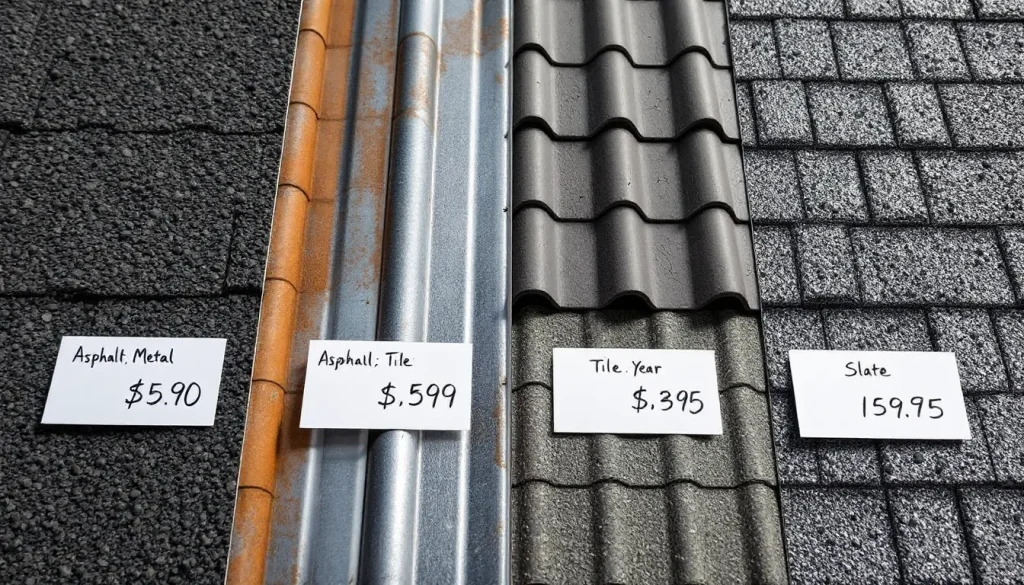
Asphalt: $16,000 install, 20-year life, $850 per year all-in. Wins on cash flow and short-hold scenarios.
Metal (standing seam): $28,000 install, 50-year life, $640 per year all-in. Wins on long-hold, wildfire/hail discount, and resale premium.
Tile (concrete): $40,000 install, 75-year life, $573 per year all-in. Wins in warm/dry climates with insurance discount.
Slate (Vermont): $60,000 install, 100-year life, $640 per year all-in. Wins on prestige, longest-lifespan, fire-resistance.
The cheapest roofing material upfront, three-tab asphalt at around $14,000 install, is the cheapest first year. Slate at $640 per year is the cheapest annualized over 100 years. The right pick depends on which horizon matters to you. For the broader cost picture, see our how much does a new roof cost piece.
Financing Cost: The Overlooked Variable
Most homeowners do not pay for a new roof in cash. They finance through a HELOC, a personal loan, contractor financing, or insurance proceeds (after a storm). The financing cost adds 10-25% to the effective install price over the loan term.
HELOC at 7.5% interest, 10-year term, $16,000 asphalt roof: total interest = $4,400. Effective cost = $20,400.
HELOC at 7.5%, 10 years, $28,000 metal: total interest = $7,750. Effective cost = $35,750.
HELOC at 7.5%, 10 years, $60,000 slate: total interest = $16,500. Effective cost = $76,500.
When you redo the TCO math with financing included, the cheaper-upfront materials get less attractive (because the absolute interest is smaller but the percentage hit is bigger relative to the lower base). The more expensive materials get less penalized in percentage terms over the long horizon. But the cash-flow burden in the early years is real on the expensive systems. For financing options, our roof financing options piece walks the menu.
Insurance Discount: How Much It Actually Matters
Insurance discounts for upgraded roof materials are real but inconsistent across carriers and states. The biggest discounts are for Class 4 impact-resistant materials in hail states (15-30% on the wind/hail portion of the premium, which is typically 30-50% of the total premium, so 5-15% of total premium).
Specific examples: Texas (hail-prone) gives Class 4 discounts on premiums averaging $200-500 per year. California (wildfire-prone) gives discounts for fire-resistant materials averaging $100-300 per year. Florida (hurricane-prone) gives discounts for wind-rated materials averaging $150-400 per year. The discount applies as long as the upgraded material is in place, so over a 50-year roof life, that $200 per year is $10,000 of cumulative discount.
The discount is not automatic. The homeowner has to provide the certificate of installation, the manufacturer specs, and sometimes a contractor attestation. The discount is also adjusted at carrier-renewal time, so it can change. Class 4 impact-resistant shingles are the most reliable category for discount; check our class 4 impact resistant shingles guide for the specifics.
Resale Value: What the Roof Adds at Sale
A new roof adds resale value, but less than it costs. The 2026 Cost vs. Value report from Remodeling Magazine shows asphalt roof replacement recovering about 60% of cost at resale on average. Metal recovers 55-65% in regions where metal is common (Florida, Texas, Colorado) and 35-45% where it is unusual. Tile recovers 50-60% in warm climates. Slate recovers a wide range, 30-70%, depending on neighborhood and architectural fit.
The right way to use this number in TCO math is to treat the resale recovery as a one-time adjustment at the sale year, not as an annual reduction. For long-hold owners who never sell, the resale value is zero. For owners who plan to sell at year 10, the resale bump is real and changes the effective net cost.
Climate-Specific Picks
Hail-prone (Texas, Oklahoma, Kansas, Colorado, Nebraska): Class 4 impact-resistant asphalt is the price-performance leader. Metal also works and earns the same discount. Tile and slate work but are over-engineered for the climate. Pick: Class 4 asphalt for budget, metal for long-hold.
Hurricane-prone (Florida, Gulf Coast, Carolina coast): metal or tile, both with proper attachment and uplift rating. Asphalt is acceptable with high-wind-rated shingles but underperforms in major events. Pick: metal or tile.
Wildfire-prone (California, Oregon, Washington, Arizona, parts of Colorado/Utah): tile or metal, both Class A fire-rated. Asphalt is acceptable Class A but tile/metal earn insurance discounts. Pick: tile in warm/dry, metal in mountain/forest.
Snow-prone (Northern New England, Upper Midwest, Mountain West): metal sheds snow well and ice-dams less than asphalt. Slate handles snow well but is heavy on structural load. Asphalt with good ice and water shield and proper ventilation also works. Pick: metal for long-hold, asphalt for budget.
Mild climate (most of California, Pacific Northwest, mid-Atlantic): any material works. Pick based on hold period and budget. For the snow-specific consideration, see our snow guards for metal roofs piece.
Hold Period: The Decision Driver
Hold period (years you plan to own the house) is the single biggest driver of which material wins on TCO.
Under 7 years: asphalt is correct. Premium materials never recoup in the hold. The first-year savings is real.
7 to 15 years: Class 4 asphalt with insurance discount, or metal if you are in a metal-friendly climate. Tile and slate do not recoup in 15 years.
15 to 30 years: metal becomes competitive on TCO. Tile becomes competitive in warm climates with insurance discount. Slate still does not recoup at 30 years.
30+ years: metal, tile, and slate all beat asphalt on TCO. The choice is climate and aesthetic.
Forever home (50+ years): slate or tile are the right answer. Metal is competitive but you may need a re-paint at year 35.
What the Calculator Misses
The TCO math is a useful framework but does not capture everything. Things it misses:
Aesthetic preference. If you have always wanted a slate roof, the math is not the only consideration.
Architectural fit. A standing seam metal on a colonial revival looks wrong. A slate on a craftsman bungalow looks right. The right material for the architecture sometimes overrides the cheaper option.
Energy savings. White TPO on commercial, cool-rated metal on residential, and light-colored tile can cut cooling load by 10-25% in hot climates. That is $200-500 per year on cooling bills, not captured in the basic TCO formula. For more on the color choice and energy implications, see our best roof color piece.
Solar compatibility. If you are putting solar on the roof, the roof material needs to support panel attachment. Metal is easiest for solar mounting. Asphalt is standard. Tile and slate require specialized mounting and add $1,000-3,000 to a solar install. For more, see our solar panels on metal roof piece.
Tax considerations. Some roof replacements qualify for energy-efficiency tax credits in 2026 (Cool Roof credits, Inflation Reduction Act provisions). Check our is new roof tax deductible piece for the current state of the rules.
Putting It Together: A Decision Workflow
Step 1: Determine hold period (forever, 30 years, 15 years, 7 years, under 7).
Step 2: Determine climate constraint (hail, wildfire, hurricane, snow, mild).
Step 3: Determine budget constraint (cash on hand, financing capacity).
Step 4: Determine structural constraint (can the house take the weight of tile or slate without re-engineering).
Step 5: Run TCO math for the 2-3 materials that survive steps 1-4.
Step 6: Pick the material with the lowest TCO that also fits aesthetic and architectural constraints.
For most homeowners, the answer at the end of this workflow is one of three materials: Class 4 asphalt for short-hold or budget-constrained, metal for long-hold in metal-friendly climates, or tile for long-hold in warm/dry climates with insurance discount available. Slate is the right answer for a small set of long-hold owners with prestige homes and the structural budget. For broader cost benchmarks, the roof cost per square foot piece has the per-system numbers.
The Bottom Line
The roof material calculator is not a price tag comparison. It is install cost divided by useful life, plus maintenance, minus insurance discount, equals cost per year. By that math, asphalt at $850 per year is the budget play, metal at $640 is the long-hold play, tile at $573 is the warm-climate play, and slate at $640 is the prestige play. Pick by hold period and climate, then run the math on the 2-3 finalists. The cheapest material upfront is almost never the cheapest material over the life of the house.