
Last reviewed: September 2026.
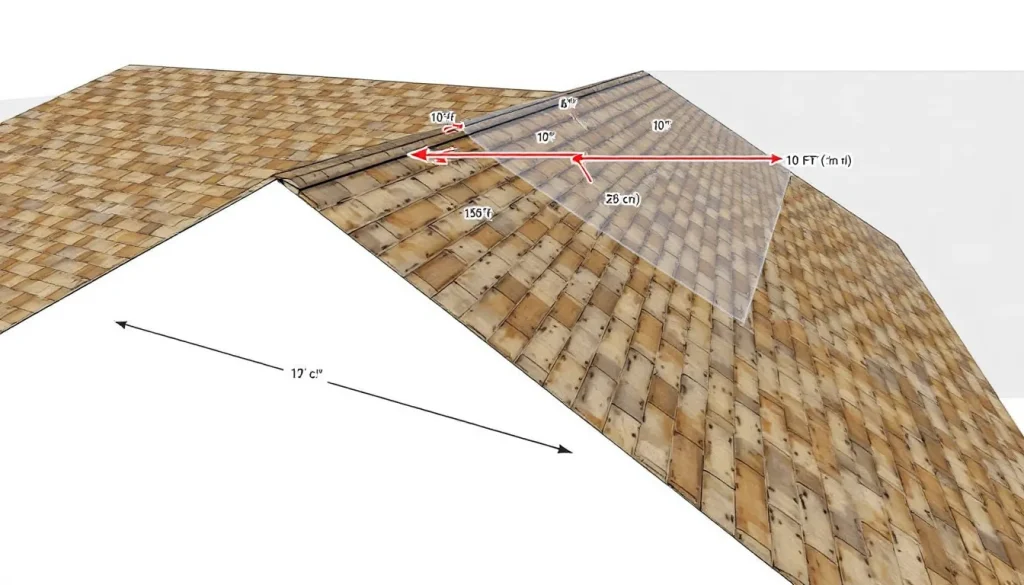
The how many square (see our how big is a square in roofing) feet in a roofing square question has one simple answer: a roofing square equals 100 square feet of roof surface area. It is a unit of measurement, not a measurement of any specific object. Pros use it because shingle math gets easier when you work in squares: architectural shingles ship 3 bundles per square, Class 4 impact-rated shingles ship 4 bundles per square, and shingle prices, labor rates, and tear-off charges in 2026 are almost always quoted “per square.” If a quote says “32 squares at $600 per square,” that means your roof has 3,200 sq ft of surface area and the contractor is charging $19,200 in shingles plus labor. The unit has nothing to do with shingle shape, color, or brand. It is purely a 10-foot by 10-foot square of finished roof.
The short version
- 1 roofing square = 100 sq ft of roof surface area (think 10 ft x 10 ft).
- Architectural asphalt: 3 bundles per square. Class 4 impact: 4 bundles per square.
- Contractors quote in squares because shingle, labor, and waste math all key off the unit.
- To convert sq ft to squares: divide by 100. A 2,683 sq ft roof = 26.83 squares (round up to 27).
- “Squares” is the actual roof surface, not the footprint. Footprint x pitch multiplier = roof surface.
- Waste factor (7% to 15%) is applied to the square count, not to the bundle count.
The math (formula)
The unit conversion is direct.
1 roofing square = 100 square feet of roof surface
Squares = Roof area in sq ft / 100
Roof area in sq ft = Squares x 100
The unit traces back to the way old roofers ordered slate and wood shake: a “square” was an area 10 feet on a side, the practical size a two-person crew could install in a day with one ladder setup. The unit stuck even as installation methods and materials changed. Today every shingle bundle, underlayment roll, drip edge piece, and labor rate in the residential roofing supply chain is priced and ordered with squares as the base unit.
Conversion table: squares to square feet to bundles
| Squares | Square feet | Architectural bundles (3 per sq) | Class 4 impact bundles (4 per sq) | Typical home |
|---|---|---|---|---|
| 15 | 1,500 sq ft | 45 | 60 | Small ranch or condo |
| 20 | 2,000 sq ft | 60 | 80 | Compact two-story |
| 25 | 2,500 sq ft | 75 | 100 | Average ranch or split-level |
| 27 | 2,700 sq ft | 81 | 108 | 2,400 sq ft ranch with 6/12 pitch |
| 30 | 3,000 sq ft | 90 | 120 | Larger two-story |
| 35 | 3,500 sq ft | 105 | 140 | Hip roof on average home |
| 40 | 4,000 sq ft | 120 | 160 | Large two-story with garage |
| 50 | 5,000 sq ft | 150 | 200 | Large complex roof |
| 60 | 6,000 sq ft | 180 | 240 | Estate home |
The “typical home” column assumes typical pitch and roof complexity. A steep roof or a complex hip can push a 2,400 sq ft footprint house up to 30 or more squares.
Worked example: 2,400 sq ft house with 6/12 pitch
Most homeowners want to know how their house translates to squares. Here is the full walk-through.
Step 1: get the footprint. A one-story 2,400 sq ft ranch has a 2,400 sq ft footprint.
Step 2: convert footprint to roof surface. Multiply by the pitch multiplier. For a 6/12 pitch the multiplier is 1.118.
2,400 sq ft x 1.118 = 2,683 sq ft of roof surface
Step 3: divide by 100 to get squares.
2,683 sq ft / 100 = 26.83 squares
Round up to 27 squares
Step 4: bundle math. 27 squares x 3 bundles per square = 81 bundles of architectural shingles.
Step 5: add waste. For a simple gable, add 7%: 27 x 1.07 = 28.89 squares. Order 29 squares (87 bundles total).
The same approach works in reverse: if a contractor’s quote says “29 squares,” that means 2,900 sq ft of roof surface, which back-calculates to roughly a 2,400 sq ft footprint at 6/12 pitch with some waste built in. Our how to calculate roof square footage guide covers the full footprint-to-area workflow.
Why pros use squares instead of square feet
Three reasons. First, shingle packaging. Every brand in the US (GAF, Owens Corning, CertainTeed, IKO, Atlas, Tamko, Malarkey) ships architectural shingles 3 bundles per square. Working in squares means bundle counts are clean multiples instead of weird decimals. 27 squares = 81 bundles. 27.4 sq ft = 0.822 bundles, which is meaningless.
Second, pricing. Material reps, distributors, and contractors all quote shingles, underlayment, starter strip, hip and ridge, and accessories per square. A quote that mixes squares and square feet is a quote that has not been double-checked. If you see “32 squares” on one line and “3,200 sq ft” on another, both numbers should agree.
Third, labor. Roofing labor in 2026 typically runs $200 to $350 per square for tear-off and reinstall, $150 to $250 per square for install only, and $50 to $80 per square for tear-off alone. Pricing in squares lets a contractor estimate labor in seconds. Pricing in square feet would multiply that number by 100 and obscure the unit cost.
Bundle math by shingle type
Not all shingles ship 3 bundles per square. The weight per bundle is what governs how many bundles fit into a square. Below is the current 2026 lineup.
| Shingle type | Example product | Bundles per square | Why |
|---|---|---|---|
| 3-tab basic | GAF Royal Sovereign | 3 bundles | Lighter weight, single layer. |
| Architectural mid-tier | GAF Timberline HDZ, OC Duration, CT Landmark | 3 bundles | Industry standard packaging. |
| Premium dimensional | GAF Timberline UHDZ, CT Landmark PRO | 3 bundles | Thicker but still 3 per sq. |
| Class 4 impact-rated | OC Duration FLEX, Malarkey Vista AR, CT Landmark Solaris | 4 bundles | Heavier polymer-modified asphalt. |
| Designer/luxury | GAF Camelot II, OC Berkshire, CT Grand Manor | 4 or 5 bundles | Multi-piece thick designer profile. |
| Slate-look composite | DaVinci Bellaforte, CertainTeed Centennial Slate | 4 bundles | Heavier composite. |
The shingle wrapper always states bundles per square. If a contractor’s bundle count looks light for the shingle you chose, ask. A Class 4 impact-rated shingle requires 33% more bundles for the same square count than a standard architectural. That difference is real money.
Waste factor: applied to the square count, not the bundle count
The waste factor is the percentage you add to cover shingles that get cut and discarded at valleys, hips, ridges, and around penetrations. Apply it to the square count, then convert to bundles.
| Roof complexity | Waste factor | For 27 squares |
|---|---|---|
| Simple gable | 5% to 7% | 29 squares (87 bundles) |
| Hip, no dormers | 10% to 12% | 30 squares (90 bundles) |
| Hip with dormers and valleys | 12% to 15% | 31 squares (93 bundles) |
| Cut-up with multiple intersecting planes | 15% to 20% | 32 to 33 squares (96 to 99 bundles) |
The shingle bundle calculator walks the same math from squares to final bundle order.
Pricing in squares: what to expect in 2026
Asphalt shingle replacement in 2026 prices out roughly like this on a per-square basis:
- 3-tab basic shingles: $350 to $550 per square installed
- Architectural mid-tier: $500 to $800 per square installed
- Premium dimensional: $650 to $1,050 per square installed
- Designer/luxury: $850 to $1,400 per square installed
- Class 4 impact-rated: $750 to $1,100 per square installed (insurance discount may apply)
For a 27-square house, the all-in number runs $13,500 (mid-tier low end) to $28,350 (designer mid-range). Add a few hundred to a few thousand for steep-slope premium (above 8/12), multiple stories, or complex flashing work. The full price model is in our roof replacement cost per square deep dive and roofing cost calculator method guide.
Reading a quote: squares vs square feet
A reputable contractor quote will state both the square count and the square footage. Compare them: 27 squares x 100 = 2,700 sq ft. If a quote says “27 squares, 3,200 sq ft,” something is inconsistent. Either the squares are wrong, the square footage is wrong, or there is a difference between “roof surface area” (which should match) and “house footprint” (which usually does not match, because of the pitch multiplier).
Some quotes will also separate “tear-off squares” from “install squares.” On a single-layer roof these match. On a roof being torn down to deck and rebuilt with a new layer plus new accessories, the install squares may include hip and ridge runs counted separately. Ask the contractor to walk you through the line items.
What a roofing square does not measure
A roofing square measures roof surface area only. It does not measure:
- House interior square footage
- House footprint (the horizontal projection)
- Ridge length, eave length, valley length, or hip length (these are linear feet)
- Underlayment area (close to the square count but the rolls are sized differently)
- Drip edge or fascia length (linear feet)
- Pipe boots, flashing, vents (count per unit)
A complete roof order includes squares of shingles, squares of underlayment, linear feet of drip edge, linear feet of starter strip, linear feet of hip and ridge cap, and a per-unit count of vents, boots, and step flashing. The square is just the shingle and the field underlayment.
Bundle weights and pallet logistics
A bundle of architectural shingles weighs 70 to 80 lbs in 2026. A pallet typically holds 42 bundles, or 14 squares, and weighs roughly 3,000 lbs. For our 27-square house, that is two pallets plus a few extra bundles, or one shingle truck delivery. Roof-loading services (cranes that lift bundles onto the roof) charge $100 to $200 in 2026 depending on roof height and access. Below 6 squares, contractors usually hand-load.
From squares to a real material order
Knowing how to convert squares is one step. Converting that into a complete material order is the next. A 27-square roof generates the following material list once you walk through the full bill:
- Field shingles: 27 squares + 7% waste = 29 squares = 87 bundles of architectural asphalt
- Starter strip: ~2 to 3 bundles covering the perimeter (roughly 200 to 250 linear feet on a typical 40 x 60 ranch)
- Hip and ridge cap: 1 to 3 bundles depending on roof shape. A simple gable needs just ridge coverage (~50 LF for our example). A hip roof adds 4 hip runs of 25 to 30 LF each.
- Synthetic underlayment: 27 to 29 squares of coverage. Each roll of GAF FeltBuster covers 10 squares, so 3 rolls.
- Ice and water shield: at least the eaves to 24 inches inside the warm wall line, plus all valleys. For our example, 2 rolls (each covering 200 sq ft).
- Drip edge: 200 to 250 LF, or 20 to 25 sticks of 10 ft drip edge.
- Roof nails: 4 nails per shingle for standard, 6 for high-wind. About 24,000 to 35,000 nails for our 27-square roof, or 4 to 6 boxes of 25 lb nails.
- Pipe boots, vent flashing, step flashing: per unit, varies by house. Typical: 2 to 4 pipe boots, 1 to 2 attic vents, 30 to 80 LF of step flashing.
The 27-square number drives the field shingle line, but every other line item is linear-feet or per-unit and has to be calculated separately. Our shingle bundle calculator covers field bundle math in depth, and the roof cost per square foot piece walks through how each line adds up.
Region and brand variations
The 100 sq ft definition of a square is universal in the US. The bundles-per-square count varies slightly by region and brand because some manufacturers ship slightly different bundle weights to balance pallet transport costs across regions. A bundle of Owens Corning Duration in the Southeast and a bundle in the Northwest cover the same area (1/3 of a square), but the packaging dimensions may differ by less than an inch. The square count never changes. A 27-square roof needs 27 squares of shingles regardless of brand or shipping region.
What does change is the local supplier’s pallet quantity. Most distributors pack 42 bundles per pallet, but some regional suppliers run 36 or 40. Always confirm pallet quantity when placing an order, because a 90-bundle order with a 36-bundle pallet ships on 3 pallets (108 bundle capacity), not 2.
FAQ
Why is a roofing square 100 sq ft and not just 1 sq ft?
Historical convention. A square was originally a 10 ft x 10 ft area of slate or shake, which was the practical install rate for a two-person crew with one ladder setup. The unit predates square-foot pricing in the construction industry.
Are roofing squares standardized across the US?
Yes. 1 roofing square = 100 sq ft of roof surface area is universal in the US. Canada and the UK use square meters instead. A roofing square is 9.29 square meters.
Does a roofing square include underlayment, drip edge, and other accessories?
No. The square only measures shingle field area. Underlayment, drip edge, starter, hip and ridge, and flashing are quoted separately, often per linear foot for the trim items.
How do I convert my contractor’s quote from squares to square feet?
Multiply by 100. A quote for 32 squares is a quote for 3,200 sq ft of roof. Then check that against a satellite measurement or footprint x pitch calc to make sure the contractor is not over-padding.
Why do Class 4 impact-rated shingles need 4 bundles per square?
They are heavier. The polymer-modified asphalt adds 30% to 40% to bundle weight, so the manufacturer ships fewer shingles per bundle to keep weight manageable for installers. Same square count, more bundles.
Bottom line
One roofing square equals 100 square feet of roof surface area. Pros use the unit because it makes shingle bundle math (3 bundles per square for standard architectural, 4 for Class 4) and labor pricing (per-square rates) clean. For a 2,400 sq ft footprint house with a 6/12 pitch, the roof is 2,683 sq ft, which is 26.83 squares, which rounds up to 27 squares, which equals 81 bundles before waste. After 7% waste on a simple gable, it is 29 squares and 87 bundles. The unit is just a convenience layer on top of square footage. Once you know it equals 100 sq ft, you can read any roofing quote.