
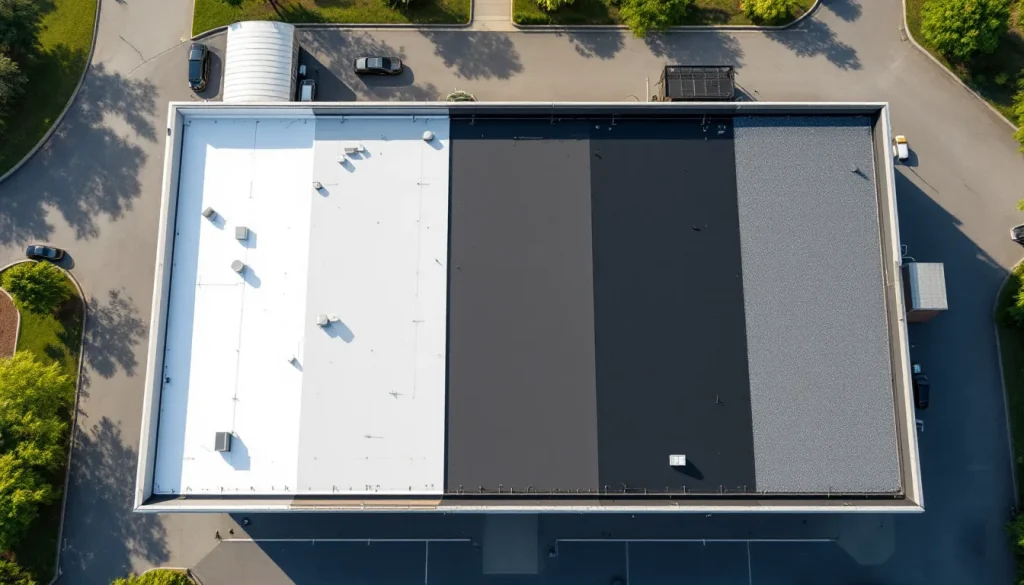
The five flat roof types dominating the 2026 market are TPO (see our low-slope roof systems overview) (thermoplastic polyolefin), EPDM (ethylene propylene diene monomer rubber), PVC (polyvinyl chloride), modified bitumen, and built-up roofing (BUR). Installed costs run TPO $7 to $12 per square foot, EPDM $5 to $9, PVC $9 to $15, modified bitumen $6 to $11, and BUR $5 to $10. TPO leads on volume because it is white, weldable, and ASTM tested for the long heat exposure that flat roofs absorb. EPDM is the value pick for shaded or northern roofs. PVC is the premium chemical resistant choice for restaurants and rooftop equipment. Modified bitumen and BUR are the legacy asphalt systems still installed where compatibility with existing decks or low budgets dictate the spec.
The short version
- TPO ($7 to $12 per sq ft installed) is the volume leader. Heat welded, reflective white, 20 to 30 year service life on 60 mil and 80 mil systems.
- EPDM ($5 to $9) is the price leader. Black rubber, adhered or ballasted, 25 to 30 year service life with proper detailing.
- PVC ($9 to $15) is the chemical resistant premium pick. Mandatory for restaurant grease exhaust roofs and rooftop kitchens.
- Modified bitumen ($6 to $11) is the legacy asphalt single ply. Torch down, cold adhered, or self adhered. 15 to 25 year service life.
- Built up roofing or BUR ($5 to $10) is the classic tar and gravel roof. Multi ply asphalt with gravel ballast. 20 to 30 year service life.
- None of them work without proper slope. Minimum 1/4 inch per foot to drains is IBC 1507 baseline.
Short answer: the five flat roof types and where each one wins
If you walk a hundred flat roofs in 2026, you will see five materials. TPO covers the bulk of new commercial (see our commercial flat roofing contractors) installs, roughly 60 percent of the single ply market according to membrane shipment data from NRCA member surveys. EPDM covers about 20 percent, mostly retrofits and budget projects. PVC covers another 10 percent, concentrated in restaurants, food processing, and any roof with rooftop chemical exposure. Modified bitumen and BUR split the remaining 10 percent, both leaning toward repair and recover work on existing asphalt roofs rather than new construction.
The choice between them comes down to climate, chemical exposure, slope, budget, and what the existing deck looks like. There is no universally best flat roof material. There is only the right pick for your specific roof. The TPO crowd will tell you TPO. The Carlisle Sure Seal EPDM dealers will tell you EPDM. The Sika Sarnafil rep will tell you PVC. Each one is correct for the conditions where their system wins. The job of this guide is to tell you which conditions favor which system. If you want a deeper teardown of installed cost per square foot for replacement, see flat roof replacement cost.
Comparison: the five flat roof types at a glance
| Type | Installed cost per sq ft | Lifespan | Install method | Best for |
|---|---|---|---|---|
| TPO | $7 to $12 | 20 to 30 years | Heat welded seams | New commercial, reflective roofs, warm climates |
| EPDM | $5 to $9 | 25 to 30 years | Adhered or ballasted, tape seams | Northern climates, shaded roofs, budget projects |
| PVC | $9 to $15 | 25 to 30 years | Heat welded seams | Restaurants, food processing, chemical exposure |
| Modified bitumen | $6 to $11 | 15 to 25 years | Torch down, cold adhered, or self adhered | Recover over BUR, smaller residential flat sections |
| Built up roofing (BUR) | $5 to $10 | 20 to 30 years | Multi ply hot asphalt with gravel | Historic buildings, heavy mechanical traffic, legacy specs |
TPO: the volume leader for a reason
Thermoplastic polyolefin (TPO) became the dominant single ply membrane in the early 2010s and has only widened its lead since. The reason is simple. TPO sheets weld to themselves with hot air at 1,100 degrees Fahrenheit, creating a monolithic seam that is stronger than the field membrane. No tapes, no adhesives, no glue lines that age separately from the sheet. The seam is the membrane.
TPO is also white. ASTM E1980 solar reflectance index ratings on standard white TPO run 78 to 86, which qualifies the membrane for ENERGY STAR and meets California Title 24 cool roof requirements. On a 50,000 square foot commercial roof in Phoenix or Houston, the cooling cost savings versus a black EPDM roof can hit 15 to 25 percent of annual HVAC load.
The major TPO brands in 2026 are Carlisle SynTec Sure Weld (the market leader by volume), GAF EverGuard TPO, Versico VersiWeld, Firestone (now Holcim) UltraPly TPO, Johns Manville TPO, and Mule Hide TPO. All of them are sold in 45 mil, 60 mil, and 80 mil thicknesses. The 45 mil is the minimum for warranty (for the full data set, see our the 2026 Roofing Material Lifespan Report) coverage. The 60 mil is the volume sweet spot. The 80 mil is the long warranty premium spec, typically tied to 25 or 30 year manufacturer warranties.
Where TPO loses. Cold weld dependency. If the welder runs too cold or the installer is sloppy, seams fail. Probe every seam at install. Also TPO does not love prolonged ponding. The reflective white surface accelerates UV breakdown of the membrane underneath when standing water is present. For that comparison, see TPO vs EPDM roofing.
EPDM: the rubber roof that quietly outlasts everything
Ethylene propylene diene monomer (EPDM) is the black synthetic rubber that has been on commercial roofs since the 1960s. It is the oldest single ply system in continuous use, and the field data on long term performance is overwhelmingly positive. NRCA studies have documented EPDM roofs functioning at 35 plus years with maintenance.
The major EPDM brands are Carlisle SynTec Sure Seal, Firestone (Holcim) RubberGard, Versico VersiGard, Johns Manville EPDM, and Mule Hide EPDM. All are sold in 45 mil, 60 mil, and 90 mil thicknesses. Reinforced EPDM with polyester scrim is available for high traffic or fastened applications.
EPDM installs three ways. Fully adhered with bonding adhesive over the substrate. Mechanically attached with fasteners and seam plates. Or ballasted with stone over a loose laid sheet. Adhered is the most common for new construction. Ballasted is rare today because the stone weight (10 to 12 pounds per square foot) limits which buildings can carry it.
Seams on EPDM are taped with factory cured seam tape rather than welded. The tape technology has improved dramatically since the 1990s, and a properly installed 2026 EPDM seam will outlast the field membrane. The trick is “properly installed.” EPDM tape requires a clean dry surface, proper primer activation, and roller pressure. Sloppy seams are the most common EPDM failure mode at 15 to 20 years.
Where EPDM wins. Cold climate flexibility (EPDM stays pliable to minus 40 degrees Fahrenheit), lower cost than TPO or PVC, and proven long term track record. Where it loses. Black color absorbs heat, so it does not qualify as a cool roof. Tape seams require skill. Not recommended for grease or solvent exposure.
PVC: the chemical resistant premium pick
Polyvinyl chloride (PVC) single ply has been on commercial roofs since the 1960s, with Sika Sarnafil leading the market since the company introduced the system in North America. PVC is heat welded like TPO, but the polymer chemistry differs in ways that matter. PVC is naturally resistant to grease, animal fats, plant oils, and many industrial (see our industrial roofing systems guide) chemicals. TPO is not.
This is why every fast food restaurant, commercial kitchen, hospital cafeteria roof, and food processing plant in 2026 specs PVC over the exhaust hood discharge zones at minimum. Some spec PVC for the entire roof. The grease and oils that vent from a kitchen exhaust degrade TPO and EPDM within a few years. PVC tolerates them for decades.
The major PVC brands are Sika Sarnafil (the historical leader), Carlisle Sure Flex, IB Roof Systems, and Duro Last. Duro Last is unique because it prefabricates the membrane to the exact roof dimensions in the factory, with seams welded in a controlled environment. The result is a roof that arrives with 80 percent of seams already welded, reducing field labor and seam failure risk.
Where PVC wins. Chemical resistance, fire performance (Class A fire rating on most assemblies), long weld seams. Where it loses. Cost. PVC is $9 to $15 per square foot installed, the most expensive single ply on the market. Also older PVC plasticizers migrate out over decades, which can leave membranes brittle. Modern PVC formulations have largely solved this.
Modified bitumen: the asphalt single ply
Modified bitumen is asphalt with elastomeric polymers (SBS or APP) added to improve flexibility and temperature performance. It comes in rolls (typically 39 inches wide) and is installed in two plies, base sheet plus cap sheet, with the cap sheet usually surfaced with mineral granules for UV protection.
Installation methods include torch down (open flame heating the back of the roll to melt the asphalt), cold adhered (asphalt based adhesive), self adhered (factory applied pressure sensitive adhesive on the back), and hot mopped (over a base layer of hot asphalt). Torch down is fastest but carries fire risk. Self adhered is safest for occupied buildings. For more on the system, see modified bitumen roof.
The major modified bitumen brands in 2026 are Soprema (the global leader, Sopralast brand), IKO Modified Bitumen, CertainTeed Flintastic, Henry HE925 series, Polyglass Polyflex, GAF Liberty, and Johns Manville Dynaweld. SBS modified products dominate the residential and smaller commercial market. APP modified products dominate the hot weather and steep slope markets.
Where modified bitumen wins. Compatibility with existing asphalt roofs (modified bitumen recovers a tired BUR roof cleanly), redundant ply construction that extends its service lifespan (two layers means one can fail without immediate leak), and good performance on small residential flat sections like dormers and porches. Where it loses. Shorter lifespan than single ply (15 to 25 years versus 25 to 30 for TPO and EPDM), labor intensive install, and torch fire risk on residential or wood deck applications.
Built up roofing: tar and gravel, still installed in 2026
Built up roofing (BUR) is the original flat roof system. Multiple plies of asphalt saturated felt mopped together with hot asphalt or coal tar pitch, then surfaced with gravel for UV protection. Three ply, four ply, and five ply systems are common, with thicker stacks rated for longer warranty terms.
BUR has been losing market share to single ply membranes for 30 years, but it is still installed in 2026 for specific use cases. Historic buildings where matching existing materials matters. Roofs with heavy mechanical equipment traffic where the gravel layer protects the membrane underneath. Cold storage and refrigerated facilities where the redundant plies and high R value insulation work well together. And government and institutional specs that have not been updated since 1995.
The remaining BUR producers in 2026 are GAF, Johns Manville, Soprema, and IKO. All offer felt and asphalt systems with current code compliance. Most also offer modified bitumen products as the natural successor to BUR, and the trend is for BUR replacements to go modified bitumen rather than another BUR.
Where BUR wins. Redundant ply construction (a single ply puncture does not leak immediately), gravel surface protects from foot traffic and UV, and code recognition under IRC R905.11. Where it loses. Heavy weight (4 to 5 pounds per square foot), hot kettle smoke and fire risk during install, and longer install schedule than single ply.
Membrane thickness: 45 mil vs 60 mil vs 80 mil
Single ply membranes (TPO, EPDM, PVC) come in three standard thicknesses. The choice drives warranty length, cost, and impact resistance.
| Thickness | Cost premium vs 45 mil | Typical warranty | Best for |
|---|---|---|---|
| 45 mil | Baseline | 10 to 15 years | Budget projects, low traffic roofs, short ownership horizon |
| 60 mil | +10 to 15% | 15 to 20 years | Most commercial new construction, volume sweet spot |
| 80 mil | +25 to 35% | 20 to 30 years | High traffic, hail prone regions, long ownership horizon |
| 90 mil EPDM | +30 to 40% | 20 to 30 years | Severe hail zones, fully adhered specs |
The math on thickness upgrade is usually favorable. The cost premium to go from 45 mil to 60 mil on a 20,000 square foot roof is typically $0.40 to $0.80 per square foot, or $8,000 to $16,000 total. The warranty extension is 5 to 10 years. If your replacement cost on the same roof is $200,000, deferring replacement by 5 to 10 years through thicker membrane saves $40,000 to $100,000 in present value terms. Almost always worth it.
Insulation: the layer under the membrane that does the work
Flat roof insulation is rigid foam board installed between the deck and the membrane. The dominant material in 2026 is polyisocyanurate (polyiso), which delivers R 5.5 to R 6 per inch and is the only insulation type with a Class A fire rating under most code paths. Extruded polystyrene (XPS) at R 5 per inch is the secondary option for cold storage. Expanded polystyrene (EPS) at R 3.7 to R 4 per inch is the budget option used over metal decks or in cold storage with thicker stacks.
IECC 2024 code requires R 25 to R 30 over commercial flat roofs in most climate zones. R 25 is roughly 4 inches of polyiso. R 30 is roughly 5 inches. The trick is that polyiso loses some R value at cold temperatures (the LTTR or long term thermal resistance value), so designers in cold climates increasingly spec thicker stacks or use a hybrid polyiso plus XPS approach.
Tapered insulation matters separately. Even a roof with adequate R value can pond water if the insulation is uniform thickness and the deck is flat. Tapered insulation is factory cut polyiso at a controlled slope (1/4 or 1/2 inch per foot) that directs water to drains. Tapered systems run $2.50 to $5.50 per square foot installed on top of the membrane cost. For roofs without inherent slope, this is non negotiable. See flat roof drainage design for the tapered math.
Warranty: what is actually covered
Flat roof warranties come in two flavors. Material only warranties (often 25 to 30 years) cover the membrane sheet against manufacturing defects. Total system warranties (often 15 to 25 years) cover materials plus labor and detail accessories. Both have exclusions, and the exclusions are where the real value lives.
Ponding water is excluded on essentially every major flat roof warranty (GAF, Carlisle, Firestone, Sika, Versico, Johns Manville, Mule Hide). Wind speed coverage is usually capped at 55 to 90 mph depending on attachment method. Foot traffic damage is excluded. Mechanical equipment damage from rooftop installers is excluded. Lightning strike and impact from objects (hail) are usually covered but with deductibles.
Read the actual warranty document before you sign the membrane spec. The marketing brochure says “30 year warranty.” The actual warranty document says “30 year material warranty subject to ponding exclusion, wind cap, traffic exclusion, and proper maintenance documentation.” Those caveats matter. If your spec includes a roof with chronic ponding, the 30 year warranty is functionally a 0 year warranty because the first claim will be denied.
Wind ratings: UL 580 and UL 1897
Flat roofs need wind uplift resistance, and the two standards that matter are UL 580 (overall wind uplift on the assembly) and UL 1897 (uplift on the attachment system). Together with FM Global 4470 (the FM Approvals standard) these define what wind speeds a roof assembly can handle.
For most commercial flat roofs in 2026, a Class 90 UL 580 rating (90 pounds per square foot uplift, equivalent to roughly 110 mph design wind) is the baseline. Coastal Florida, Texas Gulf Coast, and hurricane prone regions usually require Class 150 or Class 180. Mechanically attached TPO systems can reach Class 150 with the right fastening pattern. Fully adhered systems run lower but with better aesthetics and no fastener heads through the membrane.
The fastening density math is where wind ratings live or die. A Class 90 roof might use one fastener per 4 square feet. A Class 180 might use one per 1.5 square feet. The cost differential is real, but in coastal zones the alternative is the roof leaving the building during a Cat 3 storm. ASCE 7-22 wind load tables and the local building code dictate the minimum spec.
Climate zone matchups
| Climate | Recommended type | Why |
|---|---|---|
| Hot dry (Phoenix, Las Vegas, El Paso) | TPO 80 mil or PVC | White reflective, cool roof savings, UV resistance |
| Hot humid (Houston, Miami, New Orleans) | TPO 60 mil or PVC | Cool roof savings, chemical resistance for industrial |
| Mixed (Atlanta, Memphis, Kansas City) | TPO 60 mil or EPDM 60 mil | Either works; TPO if cooling dominant, EPDM if heating |
| Cold (Chicago, Minneapolis, Boston) | EPDM 60 mil or 90 mil | Cold flexibility, heating dominant climate favors black |
| Coastal Atlantic and Gulf | TPO 80 mil mechanically attached, high wind spec | Hurricane uplift coverage |
| Restaurant or commercial kitchen anywhere | PVC | Grease and animal fat resistance, mandatory near exhaust |
Residential flat roof considerations
Most US homes have sloped roofs, but flat sections show up on additions, garages, porches, modern architecture, and rowhouse construction. The material options are similar to commercial but the install methods often differ. EPDM and modified bitumen dominate residential flat roof work because they install cleanly over wood decks and tie into adjacent sloped roofs well. TPO is gaining residential share but requires welding equipment that smaller crews may not carry. PVC is rare on residential due to cost. For a deeper look at residential applications, see residential flat roof guide.
The other residential consideration is parapet detailing. Many residential flat roofs sit between walls or behind a low parapet, which means the flashing details where membrane meets wall are critical. See parapet wall roofing detail for the specifics on counter flashing, termination bars, and weep design at the wall transition.
Recover vs full tear off
If you have an existing flat roof at end of service life, you have two paths. Full tear off down to the deck, install new insulation and membrane, or recover with new membrane installed over the existing roof. Recover is faster and cheaper but limits future options.
IBC and IRC both limit roofs to two membrane layers. If you already have an original roof plus one recover, your only option at next replacement is full tear off. If you are on the original membrane, recover is legal. The savings on recover versus tear off run 30 to 50 percent of total project cost, so the decision is meaningful.
The catch with recover is that any moisture trapped in the existing insulation stays trapped, and any deck damage stays hidden. A moisture survey using infrared thermography or capacitance meters is the right pre work before deciding. If more than 5 percent of the existing insulation tests wet, recover is a bad idea because the wet insulation will continue degrading under the new roof.
FAQ
FAQs
Which flat roof type lasts longest?
EPDM and PVC both deliver 25 to 30 year service life in real world conditions. TPO is rated similarly but is newer in the field and the long term data is less complete. BUR can hit 30 plus years with maintenance. Modified bitumen is the shortest lived at 15 to 25 years.
Is TPO or EPDM better for a residential flat roof?
EPDM is the residential favorite because it installs without welding equipment and ties into adjacent sloped roofs with simple termination details. TPO is gaining residential share but most local crews are not equipped for it. For details, see residential flat roof guide.
What is the cheapest flat roof type?
EPDM at $5 to $9 per square foot installed is the price leader on single ply. BUR can match it at $5 to $10 if labor rates are favorable. Modified bitumen falls in the middle at $6 to $11.
Do I need a white roof for energy savings?
In hot climates (Phoenix, Houston, Miami) yes. ASTM E1980 SRI ratings above 78 qualify for cool roof credits and can cut HVAC load 15 to 25 percent. In cold climates the savings reverse because you lose passive solar heat in winter.
Can I install a flat roof over my existing roof?
Sometimes. IBC allows recover up to two total layers. If you already have an original roof plus one recover, your only option is tear off. A moisture survey before recover decision is mandatory.
Which flat roof type is best for a restaurant?
PVC, no exceptions. The grease and animal fats venting from commercial kitchen exhaust hoods will destroy TPO and EPDM within a few years. Sika Sarnafil, Carlisle Sure Flex, and IB Roof Systems are the dominant restaurant specs.
Bottom line
Pick the flat roof type that matches your climate, your chemical exposure, your slope, and your budget. TPO 60 mil is the volume sweet spot for most new commercial work. EPDM 60 mil is the budget pick in northern climates. PVC is mandatory for restaurants and food processing. Modified bitumen and BUR are the legacy asphalt options that still make sense on specific projects. Whatever you pick, the membrane is only as good as the slope underneath it, the seam welds at install, and the warranty document you actually read before signing. For pricing across all five types, see flat roof replacement cost. For the drainage that determines whether any of them last, see flat roof drainage design. For a deeper look at flat roof material economics and failure data, see flat roof materials compared.
Related reading: all roofing guides | TPO vs EPDM roofing | modified bitumen roof | ponding water flat roof | commercial flat roof overview | elastomeric roof coating | roofing cost per square