
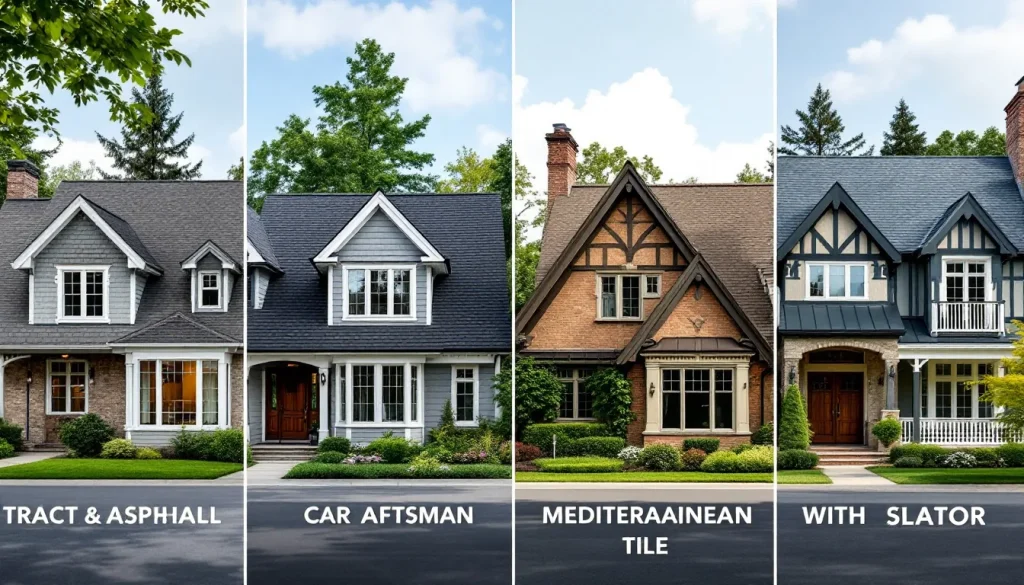
A residential roof decision is part architecture, part economics, and part climate. The material that makes sense on a 1955 ranch in Phoenix is not the material that makes sense on a 1923 Tudor in Connecticut, and the material that makes sense on a 1998 tract colonial in Atlanta is not the material that makes sense on a 2008 Mediterranean revival in coastal California. Architectural style sets the visual expectation. Climate sets the performance demand. Budget sets the realistic range. This guide walks through five common American home types, the roof material that fits each one, the lifespan (for the full data set, see our the 2026 Roofing Material Lifespan Report) you should expect, and the all-in installed cost for a typical 2,000 to 2,400 square foot home in 2026.
Tract home and builder-grade colonial: asphalt shingles
The majority of American homes built since 1980 are tract or builder-grade construction with simple gable or hip roof geometry, 4:12 to 8:12 pitch, modest overhangs, and a roof system designed for cost-effective installation and replacement. Asphalt (for the full data set, see our the 2026 Shingle Brand Comparison Report) shingles are the right material for this house type in nearly every case. They install fast, they replace fast, they accept any architectural roof line, they come in dozens of color options, and they carry meaningful warranties from established manufacturers.
Two product tiers matter. Three-tab asphalt (the simpler, flatter shingle with three rectangular tabs per piece) is the bottom of the market and runs roughly $3 to $4 per square foot installed for a $9,000 to $13,000 all-in on a typical 2,000 square foot home (see our complete residential roofing guide). Three-tab is functional but cheap-looking and the warranties are shorter (25 years typical, 60 mph wind rating). Architectural shingles (also called dimensional or laminated) layer two or three shingle slabs into one piece, present visual depth that mimics shake or slate from the street, carry 30 to 50 year warranties, and rate at 110 to 130 mph for wind. Architectural runs $4 to $7 per square foot installed for $13,000 to $20,000 all-in.
The expected lifespan of three-tab asphalt is 15 to 22 years in moderate climate, 12 to 18 years in harsh climate (high sun, repeated freeze-thaw). Architectural asphalt runs 22 to 30 years in moderate climate, 18 to 26 years in harsh climate. We unpacked the lifespan question and what shortens it in our asphalt shingle roof lifespan reference. The mainstream brand options in 2026 are GAF Timberline HDZ, Owens Corning Duration, CertainTeed Landmark, IKO Cambridge, Atlas Pinnacle Pristine, Tamko Heritage, and Malarkey Vista. Each has trade-offs in warranty depth, wind rating, hail tolerance, and color selection (see GAF Timberline HDZ review and Owens Corning Duration review).
Craftsman, farmhouse, and modern barn-style: standing seam metal
The clean horizontal seam lines of standing seam metal complement Craftsman, farmhouse, and the modern barn-style architecture that has dominated new custom builds since around 2015. Standing seam runs vertically up the slope with raised ribs that hide the fasteners under interlocking panels. The look is clean, contemporary, and authentic to the architectural style. The material (see our complete roofing materials list) is also one of the most durable residential roof options on the market.
Material choice matters. Galvalume-coated steel (24 gauge for residential, 22 gauge for higher-end) is the mainstream selection at $9 to $14 per square foot installed for $24,000 to $36,000 all-in on a 2,000 to 2,400 square foot home with moderate complexity. Aluminum standing seam (lighter, better for coastal salt-air exposure) runs $11 to $17 per square foot. Copper or zinc standing seam (premium, patinates beautifully over decades) runs $20 to $40 per square foot for a $50,000 to $90,000 all-in on the same home. Most homeowners land on steel.
The expected lifespan of a properly installed standing seam steel roof is 45 to 70 years. Paint finish (typically PVDF Kynar 500) carries 30 to 40 year fade warranties. The substrate lasts longer than the paint. We compared metal directly against asphalt economics in our metal vs. asphalt shingle roof deep dive. The upfront cost premium runs 2 to 3 times asphalt. The lifespan premium runs 2 to 3 times asphalt. The economics over a 50-year horizon usually favor metal slightly, with the visual and durability premium as the differentiator.
For Craftsman and farmhouse styles that want architectural asphalt as a budget alternative, premium-grade laminated shingles in earthy color blends (weathered wood, driftwood, hunter green) can pull off the look at half the cost of metal. CertainTeed Landmark Pro and GAF Timberline UHDZ are the strongest options in this category.
Mediterranean and Spanish revival: clay or concrete tile
Mediterranean, Spanish revival, mission, and southwest pueblo styles call for tile. The curved barrel profile of a clay S-tile or the flat-with-relief profile of a concrete tile reads as authentic to these architectural styles in a way that no other material does. Tile also performs in the climates where these styles are most common (California, the southwest, Florida, and the Gulf Coast). High sun, dry heat, and salt-air coastal exposure all favor tile.
Clay tile (genuine fired terra cotta) runs $15 to $25 per square foot installed for $40,000 to $60,000 all-in on a 2,000 to 2,400 square foot home, longer if structural reinforcement is needed because the existing framing was sized for asphalt. The main brand names are Boral (now Westlake Royal Roofing), MCA, Ludowici, and Eagle Roofing Products. Concrete tile is the value alternative at $10 to $16 per square foot installed for $26,000 to $40,000 all-in. Eagle, Boral, and US Tile are the mainstream concrete tile brands.
The expected lifespan of clay tile is 75 to 125 years. Concrete tile runs 50 to 80 years. Both are essentially permanent for the homeowner installing them. The catch: the tile lasts longer than the underlayment underneath. Most tile roofs need an underlayment replacement at year 25 to 40, which means lifting the tile, replacing the synthetic underlayment, and re-laying the tile. That mid-life service costs roughly 40 to 55 percent of a new tile install but the tile itself is reused. Plan for it as part of the long-term cost.
Tile weighs roughly 6 to 11 pounds per square foot for concrete and 9 to 12 pounds per square foot for clay. Most homes framed for asphalt (which weighs 2 to 3 pounds per square foot) need structural reinforcement to carry tile. A structural engineer reviews the framing and signs off, then a contractor sisters rafters or adds bracing as needed. Budget $3,000 to $9,000 for structural work if the home was not originally framed for tile.
Tudor, Colonial Revival, and historic homes: slate or composite slate
Slate is the heritage material for Tudor, Colonial Revival, Gothic Revival, and grand historic homes. Real natural slate is mined in Vermont, Pennsylvania, New York, Virginia, and a handful of other quarries plus imports from Spain, China, and Brazil. The look is distinctive, the durability is exceptional, and the price is significant.
Real slate runs $20 to $35 per square foot installed for $55,000 to $85,000 all-in on a 2,000 to 2,400 square foot home, with the higher end of the range for European or premium American slate (Vermont unfading green, Pennsylvania ribbon slate, Virginia Buckingham). Lifespan runs 75 to 175 years depending on slate origin. The underlayment, copper flashings, and snow guards have to be specified to match the slate’s longevity. Cheap underlayment under a 150-year slate is failure waiting to happen.
Composite slate (also called synthetic slate) is the price-reasonable alternative. Brands like DaVinci Roofscapes, Brava Roof Tile, and CertainTeed Symphony produce a polymer or rubber-modified product that mimics the look of slate at $11 to $18 per square foot installed for $28,000 to $42,000 all-in. Lifespan is 50 years (manufacturer warranty) and likely longer in practice. Composite is lighter (no structural reinforcement needed), installs faster (standard roofing tools, no special slate hammer or slate hook), and reads visually as slate from the street and even at moderate close range.
The decision between real slate and composite usually comes down to homeowner intent. If the home is a registered historic property or the homeowner intends to preserve original character with no compromise, real slate is the right call. If the home is a Tudor-style new build or the homeowner wants the look without the structural overhead, composite is excellent. We covered the visual choice in our best roof color guide, which applies to slate and composite as well.
Mid-century modern and contemporary: low-slope membrane or metal
Mid-century modern homes (typically built between 1945 and 1970) often feature flat or low-slope roof sections paired with overhanging eaves and broad fascia bands. The roof material choices change at low slope. Asphalt shingles are not allowed on slopes below 2:12 per nearly every manufacturer warranty. Tile is also off the table at low slope. The two real options are membrane roofing (TPO, EPDM, or PVC) and standing seam metal at low-slope-rated panel profiles.
TPO (thermoplastic polyolefin) is the mainstream choice at $7 to $11 per square foot installed for a $18,000 to $28,000 all-in on a 2,000 square foot home. The big brands are GAF EverGuard, Carlisle SynTec, Firestone (now Holcim), and Mule-Hide. Lifespan is 20 to 30 years. EPDM (ethylene propylene diene monomer, a black rubber membrane) runs slightly cheaper, performs in cold climates, and lasts 25 to 35 years. PVC runs slightly more expensive than TPO, handles chemical exposure better, and lasts 25 to 35 years.
Standing seam metal at low-slope-rated panel profiles (with mechanical seam crimping that handles the reduced slope) runs $13 to $19 per square foot installed for $34,000 to $46,000 all-in. The premium over TPO buys 30 to 40 years of additional lifespan. The architectural read of crisp metal seam lines on a mid-century home is often the right aesthetic choice as well.
Lifespan recap
Three-tab asphalt: 15 to 22 years. Architectural asphalt: 22 to 30 years. Standing seam steel: 45 to 70 years. Aluminum standing seam: 50 to 70 years. Copper or zinc: 100+ years. Concrete tile: 50 to 80 years. Clay tile: 75 to 125 years. Natural slate: 75 to 175 years. Composite slate: 50+ years. TPO membrane: 20 to 30 years. EPDM membrane: 25 to 35 years. PVC membrane: 25 to 35 years. The full lifespan reference is in our how long does a roof last guide.
Cost recap by home type
Tract home with architectural asphalt, $16,000 typical. Craftsman with standing seam steel, $28,000 typical. Mediterranean with concrete tile, $32,000 typical, or clay tile $48,000. Tudor with composite slate, $35,000 typical, or natural slate $65,000. Mid-century with TPO membrane, $22,000 typical, or standing seam metal $38,000. These are 2026 numbers for a 2,000 to 2,400 square foot home of moderate roof complexity in a typical US market. Coastal California, the urban northeast, and Hawaii run 20 to 40 percent higher. The detailed breakdown sits in our average cost to replace a roof reference and our roof cost per square foot guide.
How to think about the material decision
Three questions cut through the analysis paralysis. How long do you intend to own the home. If you are selling in 7 years, the residential roof decision is “what does the current market expect for this home type” and the answer is usually mainstream architectural asphalt in a neutral color. If you intend to age in the home for 25 years or more, the decision opens up to metal, tile, or slate where the long-term cost-per-year economics catch up with asphalt.
Second, what does your climate punish. Hail-prone regions (Texas, Oklahoma, Colorado, the upper Midwest) favor impact-resistant shingles (see our class 4 impact-resistant shingles reference) or metal. Hurricane-exposed coastal regions favor metal or concrete tile with elevated wind ratings. High-snow regions favor metal with snow guards or asphalt with proper ice and water shield. Hot dry climates favor tile or light-colored asphalt or reflective metal.
Third, what does your home’s architecture demand. The mismatch between a clay-tile Spanish revival and a re-roof in dark gray architectural asphalt is visible from the curb. So is the mismatch between a Craftsman with metal-look asphalt instead of real standing seam. Materials match style. Style matches material. When the match is right, the home looks intentional. When it is wrong, the home looks compromised.
Final read
A residential roof is not a generic decision. It is a match between your home’s architectural style, your climate’s performance demand, and your budget’s realistic range. Tract homes default to architectural asphalt and that is usually the right call. Craftsman and farmhouse styles open up to standing seam metal. Mediterranean and Spanish styles call for tile. Tudor and Colonial Revival styles call for slate or composite slate. Mid-century modern and contemporary low-slope homes call for membrane or low-slope-rated metal. Once you have matched the material to the home, the brand, color, and warranty selection becomes the next layer of decision. Match the material to the home first. The rest follows.