
Last reviewed: September 2026.
Hiring the right metal roofing contractor in 2026 is a different exercise from hiring an asphalt shingle contractor, because metal roofing fails in ways shingle roofing does not, and most of those failure modes trace to installation rather than material. A general roofing crew that installs ten asphalt jobs for every one metal job will tell you they handle metal. They probably do. The question is whether they install metal often enough to avoid the panel-end finishing errors, the thermal expansion miscalculations, and the substrate ventilation oversights that turn a 50-year roof into a 15-year leak problem. This guide walks through how to separate metal specialists from general roofers, which manufacturer authorizations actually matter, the seam profile decision that drives the entire job, and the contract language that distinguishes a real metal install from a hoped-for one.
The specialist vs generalist question
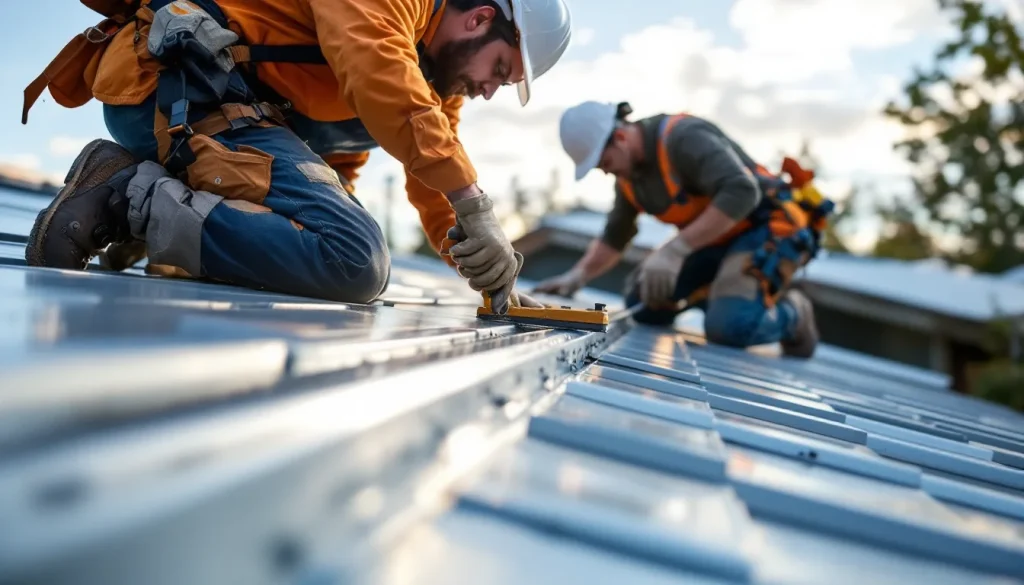
A metal roofing specialist installs metal roofs as a majority of their book of business, runs dedicated panel-forming equipment, and employs crews trained on hand seamers, flashings, and the panel coverage math that drives the order. That kind of hands-on skill is the focus of METALCON’s expanded 2026 education program. A generalist installs whatever the customer asks for and may subcontract the metal install to a specialist crew or handle it in-house with a learning curve. Both can do the work, but the failure rate on the second category is markedly higher because metal does not forgive small errors the way asphalt does.
The diagnostic question to ask any roofer pitching a metal install: how many metal roofs did you install last year, and how many did you install five years ago. A real specialist will give you a number in the dozens or hundreds. A generalist will give you a single-digit number or pivot to talking about their general roofing experience. Both answers are honest. Only one is the right contractor for a 50-year metal investment.
What metal roofing actually is in 2026
Most residential metal roofing in 2026 is one of three formats. Standing seam panels with vertical legs that interlock and are mechanically seamed on-site, typically 24-gauge Galvalume with a Kynar 500 PVDF finish. Exposed-fastener corrugated or ribbed panels with screws through the face into the substrate, typically 26-gauge painted steel. Stamped metal shingles, tile, or shake profiles that install in interlocking courses and are usually stone-coated or solid PVDF over Galvalume. Each format has a different specialist pool, a different per-square cost, and a different failure profile. Our background piece on metal roof cost and the broader metal vs asphalt shingle roof comparison cover the material economics.
Standing seam is the most installation-sensitive of the three, which is why standing seam specialists are the narrowest pool in the contractor market. Our walk-through of standing seam metal roof cost covers the dollars-per-square math.
The manufacturer authorization signal
Major metal roofing manufacturers run authorized installer programs that gate access to certain extended warranties, panel allocations, and proprietary clip systems. McElroy Metal authorizes installers on its Maxima and Medallion-Lok panels. MBCI authorizes on BattenLok HS, LokSeam, and SuperLok. Englert authorizes on the A1000, S1300, and S2000 series. ATAS International authorizes on Multi-Vee, Field-Lok, and DutchSeam profiles. Sheffield Metals, Drexel Metals, and AEP Span run similar programs. A contractor showing one of these authorizations on the panel system in your quote has demonstrated training and is eligible to deliver the extended warranty.
If your quote specifies a specific panel system (say, McElroy Maxima 1.5) and the contractor is not a McElroy authorized installer, that is a flag. Either the panel is being sourced through a distributor without manufacturer support, or the contractor will be installing without the manufacturer’s training, or both. The extended warranty terms typically requiring authorization include the substrate warranty (the steel under the paint) and the finish warranty (the Kynar 500 against chalk and fade). Without authorization, you get the standard manufacturer warranty, which is shorter and limited.
The seam profile decision
Standing seam panels come in three primary seam profile families: snap-lock, mechanical lock at 90 degrees, and mechanical lock at 180 degrees (double-lock). Snap-lock panels press together by hand without a seamer tool. Mechanical lock requires a powered hand seamer that folds the seam over after the panels are placed. Snap-lock is faster to install, cheaper in labor, and adequate for slopes of 3/12 and steeper. Mechanical lock is required for low-slope applications (down to 1/4:12 for double-lock) and is the durable choice when wind uplift, ice damming, or coastal salt air is a concern.
A specialist will recommend snap-lock or mechanical lock based on your pitch, your climate, and the substrate. A generalist may default to whichever profile their supplier stocks. Ask which profile is in your quote and why. The answer reveals whether the contractor is making an engineering decision or a logistics decision. For coastal homes, hurricane zones, or slopes below 4/12, double-lock mechanical seam is the right answer in almost every case.
Panel coverage math and ordering
Metal panels are ordered in custom lengths from the manufacturer or roll-formed on-site from coil stock. A roll-forming truck on-site cuts panels to the exact eave-to-ridge length, eliminating horizontal seams. Pre-cut panels from the manufacturer come in standard lengths and may require horizontal seams on long runs, which is acceptable on shallow slopes but a leak risk on steep slopes if the seam laps are not properly detailed. The decision depends on the panel system, the roof geometry, and the contractor’s equipment.
Coverage math: panel widths vary from 12 inches effective coverage (narrow profile, more aesthetic) to 18 inches effective coverage (wide profile, more economical). A 30-square roof (3,000 square feet) at 16-inch coverage needs 2,250 linear feet of panel, allowing for overlap and waste. A 10 percent waste factor is standard. If your contractor’s panel order does not include this waste factor, expect a change order when they run short. Ask to see the panel ordering math in writing before the panel order is placed. Mistakes at the order stage become weeks of delay when re-orders queue behind active production.
Substrate, underlayment, and the substrate decision
Metal roofing installs over a solid deck (plywood or OSB) with a synthetic underlayment, or over open purlins (typical on agricultural and some residential applications). Solid deck is the residential default. The underlayment beneath metal is not the standard 15-pound felt used on asphalt. High-temperature synthetic underlayments rated to 240 F (Grace Ice and Water Shield HT, Sharkskin Ultra SA, Titanium PSU30) are required because the bottom side of a metal panel in direct summer sun can exceed 180 F and conventional felt will degrade. Our breakdown of best synthetic underlayment brands covers the products that hold up.
Ask which underlayment is being installed and verify it is rated for metal roof temperatures. A generalist installing metal over standard 15-pound felt has set up a 5-to-8-year underlayment failure that will be invisible until water shows up at a flashing.
Thermal expansion and clip selection
Metal panels expand and contract more than asphalt or wood. A 40-foot panel can move 1/2 inch from January to August. The standing seam clip system accommodates this movement by allowing the panel to slide while the clip stays fixed to the substrate. Fixed-clip systems anchor the panel at one point (usually the ridge) and let the rest of the panel slide. Sliding-clip or floating-clip systems allow continuous panel movement.
The wrong clip on a long panel produces oil-canning (the visible waviness in the panel face), seam stress at the eave, and over time, fastener back-out. A specialist runs the clip math on every job. A generalist may use whatever clip the manufacturer ships in the panel box. Ask whether the panels on your roof have any single-length exceeding 30 feet and which clip type is being used. Long panels need floating clips. Short panels can accept fixed clips. The wrong answer is one of the most common metal-roof failure modes in the field.
Ventilation: the forgotten failure mode
Metal roofs need attic ventilation the same way asphalt roofs do, but the consequences of inadequate ventilation manifest differently. Trapped attic heat causes ice dams at the eave, sweat condensation on the underside of the panel in winter, and accelerated failure of the underlayment. The right ventilation strategy depends on the attic geometry, but ridge venting, soffit intake, and continuous insulation matter at least as much on a metal roof as on a shingle roof. Our deep-dive on metal roof condensation covers what happens when the ventilation gets it wrong.
A specialist asks about your attic ventilation during the estimate walk-through. A generalist focuses entirely on the panel and finishes. If your roofer has not discussed soffit intake, ridge venting, and vapor barrier with you before quoting, the install is incomplete.
The flashing question
Metal roof flashings, valleys, ridge caps, eave trim, gable trim, and pipe penetrations are where the install actually wins or loses. Panel runs are mechanically straightforward. Flashing details require fabrication, hand-bending, soldering on some metals, and a finishing eye. A specialist crew has a dedicated brake on the truck and someone who hand-bends flashings to fit the specific roof geometry. A generalist may use pre-formed manufacturer flashings that fit most situations but require silicone fill on the geometries they do not fit. Silicone is not a long-term flashing material on metal. Visible silicone on a five-year-old install is a sign the flashings were not properly executed.
For pipe penetrations, EPDM rubber boots are the residential standard, with manufacturer-specific options like Dektite Premium for higher temperatures. Lifespan on the rubber boot is 15-20 years, vs 50+ on the panel. Plan for boot replacement on a separate maintenance cycle and ask whether the contractor will return for paid boot service when the time comes.
Installation method: the install crew vs the sales crew
Some metal roofing companies sell heavily through sales reps and install through subcontracted EPC crews. Others run integrated sales-and-install teams. The integrated model is correlated with install quality because the same team that sold the job is accountable for the work. If your salesperson cannot name the lead installer who will run your job, that is a flag. Ask to meet the lead installer before signing. Ask how long the crew has worked together. Crews that have rotated through three companies in five years are signal that the install team is itinerant rather than rooted.
Our broader framework for vetting any roofer applies here too. The questions in how to choose a roofing contractor and questions to ask roofing contractor filter out the obvious problem contractors. Layer the metal-specific questions on top.
Warranty: the layered structure
A residential metal roof in 2026 carries three warranty layers. First, the substrate warranty from the steel mill, typically 25-40 years against perforation of the Galvalume coating. Second, the finish warranty from the paint manufacturer (Sherwin-Williams Fluropon, PPG Coraflon, AkzoNobel Trinar), typically 30-40 years against chalk and fade above industry-standard thresholds. Third, the workmanship warranty from your contractor, typically 1 to 25 years depending on whether they hold manufacturer authorization. The 25-year workmanship warranty is the gold standard and is available only through authorized installer programs.
Read the substrate warranty carefully. Most are prorated, meaning the manufacturer pays a declining share of repair costs over the warranty term. A 40-year warranty that pays 100 percent for the first 10 years and prorates to 50 percent by year 25 is structurally different from a 25-year warranty paying 100 percent for the full term. Compare the actual coverage curves, not the headline term length.
Color and finish considerations
Kynar 500 PVDF is the residential premium finish standard. It resists chalk, fade, and chemical attack better than standard polyester. Silicone-modified polyester (SMP) is the next step down in finish quality and cost. SMP is fine on outbuildings and barns. On a 50-year residential investment, Kynar 500 is the right answer. Our piece on best roof color covers the color-fade math.
Energy-efficient cool roof finishes carry higher solar reflectance index (SRI) values, qualifying for ENERGY STAR roof products and meeting Title 24 in California or the Cool Roof Rating Council criteria in other markets. The cool roof finish typically costs 5-10 percent more and is worth it in hot-climate markets where attic temperature drives summer cooling cost.
What a real quote looks like
A standing seam Galvalume residential install in 2026 with 24-gauge panels, Kynar 500 finish, high-temperature synthetic underlayment, mechanical-lock seam profile, and a 25-year workmanship warranty from an authorized installer runs $12 to $18 per square foot installed. Stamped metal shingles run $10 to $15. Exposed-fastener corrugated panels run $7 to $11. The walk-through detail is in metal roof installation.
Quotes significantly below this range are usually 26-gauge instead of 24, SMP finish instead of Kynar, exposed-fastener instead of standing seam, or a 1-year workmanship warranty rather than the authorized installer extended warranty. The headline panel system may be the same. The underlying spec is not. Insist on a line-by-line written spec that lists gauge, finish, seam profile, panel system, manufacturer authorization, underlayment product, and workmanship warranty length. Compare apples to apples or do not compare.
Commercial and outbuilding contractor pool
If your project is a metal building, agricultural structure, or commercial roof rather than residential, the contractor pool shifts. Commercial metal contractors install through systems like Butler Manufacturing, Varco Pruden, and Nucor Building Systems, and the contractor authorization is different from residential. Our coverage of commercial metal roof and single slope metal building roof walks through what to look for in the commercial pool. The roofers who do residential standing seam well are not always the ones doing commercial metal building work well, and vice versa.
For agricultural and pole-barn applications, the contractor pool overlaps with the metal building installers more than with the residential standing seam specialists. The product is usually exposed-fastener corrugated or ribbed panel, and the install practices are different. Background on the product side is in corrugated metal roofing.
Watch for the scams
The metal roofing market has its share of the same problem contractors that work the asphalt market. Storm-chaser crews after a hailstorm, door-knocker sales reps offering steep discounts for signing today, and operators who collect deposits and disappear before the panels arrive. Our piece on roofing scams and red flags roofing contractor covers the patterns. The metal-specific scam variant is the contractor who promises a manufacturer warranty they cannot deliver because they are not authorized. Verify authorization directly with the manufacturer, not through the contractor’s printed brochure.
Pricing benchmarks and market context
For 2026 pricing context, see our 2026 Roofing Cost Report, which covers asphalt vs metal cost spreads, regional labor variations, and material trend data. For the broader contractor market, our 2026 Roofing Contractor Industry Report covers the consolidation trends and what they mean for warranty-backing reliability. Metal contractors are a smaller subset of that broader market, but the same M&A pressures and labor shortages apply.
The bottom line
A good metal roofing contractor in 2026 is one who installs metal as a majority of their work, holds manufacturer authorization on the panel system in your quote, runs panel-forming equipment or knows when to use it, makes engineering decisions on seam profile and clip selection rather than logistics defaults, addresses attic ventilation in the estimate walk-through, and delivers a written 25-year workmanship warranty as part of a layered manufacturer warranty package. Filter out the generalists, the dealer-only sales operations, and the contractors who cannot show authorization documentation. Get three quotes from specialists, compare line-by-line specs not headline prices, and verify references on roofs that have been in service at least five years. Done right, the metal roof outlasts two asphalt cycles. Done wrong, it leaks like any other roof, only the repair bill is significantly higher.