
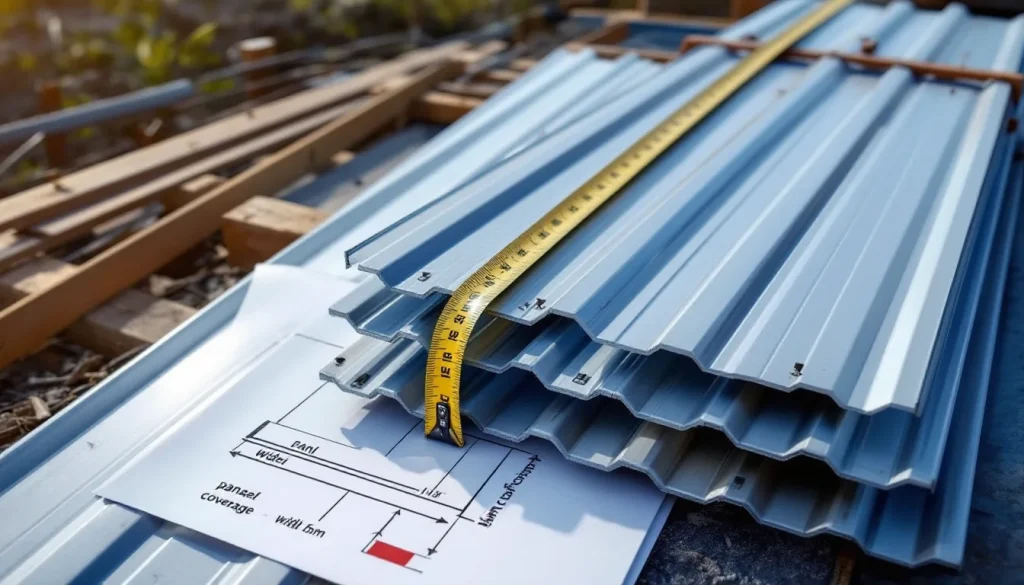
A metal roofing calculator works on three inputs: roof area in square feet, panel coverage width, and panel length. The math is straightforward (divide roof width by panel coverage width to get panel count, then multiply by panel length to confirm coverage), but most online calculators stop there and ignore the trim list that makes or breaks the order. A real metal roof bill of materials includes ridge cap, eave trim, gable/rake trim, valley flashing, sidewall flashing, endwall flashing, panel closures, fasteners, butyl tape, and pipe boots. Forget any of those and the job stalls at the supplier counter. This guide gives you the panel math, the trim list, the waste factors that actually match reality, and a side-by-side material comparison so you order once and order right.
The short version
- Panel count = roof width (inches) divided by panel coverage width (typically 24, 26, or 36 inches), rounded up.
- Standard coverage widths: 36 in for exposed-fastener ag panel, 24 to 26 in for standing seam, 26 in for 5V-crimp, 24 in for snap-lock standing seam.
- Add 10% waste on simple gables, 15% on complex roofs with hips, valleys, and dormers.
- The trim list (ridge, eave, gable, valley, sidewall, endwall) typically runs 15% to 25% of total panel cost.
- Order panels to the next full foot, not the next 6 inches. Mill cuts are usually 12-in increments.
- Fasteners run roughly 80 to 100 screws per square (100 sf) for exposed-fastener, 40 to 60 clips per square for standing seam.
What the calculator actually needs (inputs)
Every metal roofing calculator boils down to four inputs and one decision. The inputs are roof area, panel profile (which determines coverage width), panel length, and pitch/complexity. The decision is whether to order panels to exact length (mill-cut, no field cutting) or stock length (cheaper, field-cut to fit). Most residential metal roofs use mill-cut panels because field-cutting a 24-foot panel on a 9/12 pitch is a recipe for cut edges, rust, and waste.
If you don’t have your roof area yet, run the math first in our roof square footage guide or use the field-measurement method in how to measure a roof. A metal calculator built on a wrong area number propagates the error through the entire trim list.
The core panel math
Take the roof’s eave-to-ridge length (panel run length) and the eave width (horizontal). Divide eave width in inches by panel coverage width in inches. Round up. That’s your panel count for one slope. Repeat for each slope. Multiply each panel count by the eave-to-ridge length plus 2 inches of overhang at the eave. That’s panel order length per slope.
Example: a 30-foot-wide gable roof with a 16-foot eave-to-ridge run. Panel coverage width is 36 inches. 30 ft x 12 in = 360 in. 360 / 36 = 10 panels per slope. Panel length is 16 ft + 2 in eave overhang = 16 ft 2 in, round up to 17 ft mill length. 10 panels per slope x 2 slopes = 20 panels at 17 ft each. Total linear panel feet = 340 ft. Total coverage = 340 x 3 ft = 1,020 sf. Roof area was ~960 sf, so the 60 sf overage is your built-in 6% waste before any cuts.
Panel coverage width chart
Coverage width is not panel width. Panel width is the actual sheet width before overlap. Coverage width is what you get after the panels lap. Always calculate on coverage width.
| Panel profile | Panel width | Coverage width | Typical use | Fastener type |
|---|---|---|---|---|
| 3 ft ag panel (R-panel/PBR) | 38 in | 36 in | Barns, sheds, commercial, low-end residential | Exposed screws |
| 5V-crimp | 27 in | 24 in or 26 in | Coastal, traditional residential | Exposed screws |
| Snap-lock standing seam | 17 to 19 in | 16 to 18 in | Mid-tier residential | Concealed clips |
| 1.5 in mechanical-lock standing seam | 18 to 21 in | 16 to 20 in | Premium residential, commercial | Concealed clips |
| Wide standing seam | 26 to 28 in | 24 to 26 in | Modern residential, commercial | Concealed clips |
| Corrugated 7/8 in | 27 in | 24 in or 26 in | Agricultural, industrial | Exposed screws |
For exposed-fastener panels, see our corrugated metal roofing guide. For standing seam, see metal roof installation.
Waste factors that actually match reality
Online calculators love to default to 10% waste. That’s right for a clean gable with two slopes and no penetrations. For anything more complex, the real waste numbers run higher:
- Simple gable, no hips, no dormers, panel runs match eave-to-ridge: 5% to 8%.
- Gable with 1 to 2 penetrations (vent stack, chimney): 10%.
- Hip roof, 4 slopes: 12% to 15%.
- Hip + valley + dormer: 15% to 20%.
- Complex L-shape with multiple valleys, dormers, skylights: 20% to 25%.
- Field-cut from stock length (not mill-cut to size): add 5% over any of the above.
The waste comes from two places: panel start/end cuts at hips and valleys, and the trim that gets discarded when ordering trim in 10-foot stock lengths and using only 7 feet of it. Standing seam wastes more than exposed-fastener because seam pans can’t be flipped or shared between slopes the same way.
The hidden trim list most calculators ignore
Panels are half the bill. The other half is trim. Every metal roof needs at least six trim profiles, and most need eight to ten. Order them all together or you’ll be making a second supplier trip.
| Trim piece | Where it goes | Typical length | Profile |
|---|---|---|---|
| Ridge cap | Top of every gable or hip ridge | 10 ft 6 in stock | Vented or solid |
| Eave trim (drip edge) | Bottom of every slope | 10 ft 6 in stock | Hemmed Z or D-style |
| Gable/rake trim | Sloped edge of gable | 10 ft 6 in stock | Outside corner |
| Valley flashing | Internal valley between slopes | 10 ft 6 in stock | W-valley |
| Sidewall flashing | Where slope meets vertical wall (uphill) | 10 ft 6 in stock | L or Z |
| Endwall flashing (head wall) | Where slope ends into vertical wall (top) | 10 ft 6 in stock | Continuous Z |
| Hip cap | External hip line | 10 ft 6 in stock | Closed |
| Inside corner / pitch break | Pitch transition or wall | 10 ft 6 in stock | Hemmed inside |
| Panel closures (foam) | Under ridge cap, at eaves on profiled panel | 3 ft strips | Profile-specific |
| Pipe boots (EPDM or silicone) | Every roof penetration | 1 per stack | Sized to pipe OD |
Trim cost typically runs 15% to 25% of total panel cost on a residential roof. Forget to order it and the panel job stalls at day 2.
Material comparison: aluminum vs steel vs zinc vs copper
The substrate decision drives panel cost, lifespan, and aesthetics. Below is the comparison most calculators bury or skip entirely.
| Material | Gauge/thickness | Cost (panel only, $/sf) | Lifespan | Best for | Watch out for |
|---|---|---|---|---|---|
| Galvalume steel (G-90 or AZ50/AZ55) | 24, 26, 29 ga | $2.50 to $5.50 | 40 to 60 yr | Most residential and ag | Cut-edge corrosion if field-cut |
| Galvanized steel (G-90) | 24, 26, 29 ga | $2.00 to $4.50 | 30 to 50 yr | Ag, sheds, outbuildings | Lower corrosion resistance than Galvalume |
| Painted Kynar 500 / Hylar 5000 steel | 24, 26 ga | $3.50 to $7.50 | 40 to 60 yr | Premium residential | Touch-up paint required at cuts |
| Aluminum 3003-H14 or 5052 | 0.032, 0.040 in | $4.50 to $8.50 | 50+ yr | Coastal (within 1 mile of saltwater) | Softer; dents easier; cost |
| Zinc (VMZinc, Rheinzink) | 0.7, 0.8 mm | $10 to $18 | 80 to 100+ yr | High-end architectural | Cost; needs ventilated underside |
| Copper (16 or 20 oz) | 16 oz, 20 oz | $15 to $25 | 100+ yr | Heritage, ultra-premium | Cost; staining of substrates below |
For the broader cost picture (panels + labor + tear-off + trim), see our metal roof cost guide. For the metal-vs-shingle decision, see metal vs asphalt shingle roof.
Calculator sequence (5 steps)
- Step 1: Get accurate roof area. Either measure on-roof using the method in our how to measure a roof guide, or use satellite measurement (EagleView, GAF QuickMeasure, RoofR) for $20 to $40. Online square-footage estimators based on house footprint are wrong by 15% to 30% on any pitched roof.
- Step 2: Choose panel profile and pull coverage width. From the table above, decide between exposed-fastener (cheaper, faster install, shorter lifespan), snap-lock standing seam (mid-tier), or mechanical-lock standing seam (premium, longest lifespan).
- Step 3: Calculate panel count per slope. Eave length (inches) divided by coverage width (inches), round up. Repeat for each slope. Add panels for any slope cut into by hips or dormers (typically 1 to 2 extra panels per affected slope).
- Step 4: Calculate panel length per slope. Eave-to-ridge measurement plus 2 in eave overhang and 1 in ridge clearance, rounded up to next full foot (mill increment). Standing seam single-run lengths over 40 ft start to need expansion clip systems.
- Step 5: Build the trim list. Measure every ridge, eave, rake, valley, sidewall, endwall, and hip in linear feet. Divide by 10 (stock length), round up. Add 1 extra piece per profile for splice waste. Add foam closures (1 per panel rib at ridge and eave on profiled panels) and pipe boots (1 per stack penetration).
Fastener counts
Fastener counts are where panel-only calculators undercut the order. For exposed-fastener panels (ag panel, 5V-crimp, corrugated), screws go through the panel face into the deck or purlins. Spacing is roughly every 12 to 24 inches along each rib. Plan on 80 to 100 #10 or #12 self-driller screws per square (100 sf) of roof area, with neoprene-bonded washers sized for the panel rib spacing.
For standing seam, fastening is through concealed clips that lock into the seam. Clip count is 40 to 60 per square depending on panel profile and pitch. Each clip uses 2 wood screws into the deck (or pancake-head screws into purlins on commercial). Add 10% for shipping damage and field error.
Underlayment and accessories
Metal panels need a high-temp underlayment because metal roof deck temperatures hit 160 to 180 degrees F. Standard 15 lb felt fails under metal. Specify a high-temp synthetic underlayment rated to 240 to 260 degrees F (Owens Corning ProArmor HT, Tyvek Protec 200, Sharkskin Ultra SA). Add high-temp peel-and-stick (Grace Ultra, MFM Wind & Water Seal HT) at eaves, valleys, hips, and around penetrations.
Underlayment coverage: divide roof area by roll coverage (typically 1,000 sf per synthetic roll) and add 15% for overlap. Most metal manufacturers void warranties without their approved underlayment, so check spec sheets before ordering generic.
Common calculator mistakes
- Using panel width instead of coverage width. A 38-inch ag panel covers 36 inches. Calculating on 38 leaves you 5% short on panel count.
- Forgetting overhang. Eave overhang is typically 2 inches past the fascia. Calculating panel length flush to fascia leaves the gutter without a drip path and shortens panel life.
- Skipping the trim list. The cost of trim runs 15% to 25% of panel cost. Forgetting it means a second supplier trip and a stalled job.
- Wrong gauge for span. 29 gauge is fine for sheds and roofs with sub-2-ft purlin spacing. 26 gauge is the residential minimum on direct-to-deck. 24 gauge is required for standing seam over 2-ft clip spacing.
- Ignoring panel run length limits. Standing seam over 40 ft needs expansion-clip systems. Exposed-fastener over 30 ft accumulates thermal movement noise.
- Mill-cut vs stock-length confusion. Mill-cut (custom length) adds 10% to 15% cost but eliminates field cuts. Stock-length is cheaper but creates cut edges that need touch-up paint.
- Wrong closure for the profile. Foam closures are profile-specific. Ag panel closures don’t fit 5V-crimp or standing seam. Order by part number, not generic.
- Missing pipe boots. Every vent stack and pipe penetration needs an EPDM or silicone boot sized to the pipe OD. Boots run $25 to $45 each.
Cost of a fully-loaded order
For a 2,400 sf residential roof in 2026:
- Exposed-fastener Galvalume 26 gauge: panels $3.50/sf = $8,400 + trim $1,800 + fasteners $400 + underlayment $600 = $11,200 material.
- Snap-lock standing seam 24 gauge painted Kynar steel: panels $5.50/sf = $13,200 + trim $2,400 + clips/fasteners $800 + underlayment $700 = $17,100 material.
- Mechanical-lock standing seam aluminum 0.032 in Kynar: panels $7.50/sf = $18,000 + trim $2,800 + clips/fasteners $900 + underlayment $700 = $22,400 material.
- Copper 20 oz standing seam: panels $20/sf = $48,000 + trim $4,500 + clips/fasteners $1,200 + underlayment $800 = $54,500 material.
Labor (residential install crew) runs $3 to $6 per square foot for exposed-fastener and $6 to $14 per square foot for standing seam. Total installed cost for a 2,400 sf job lands between $18,000 (basic) and $80,000 (premium copper) in 2026.
Shingle bundle vs metal panel math
If you’re still deciding between metal and asphalt, the bundle math runs differently. See our shingle bundle calculator for the asphalt side. The short version: shingles sell in bundles that cover 33 sf each (3 bundles per square). Metal sells in linear-foot panels covering coverage-width x length. The unit conversion alone trips up first-time metal estimators.
For small structures (sheds, lean-tos, single-slope buildings), see our single slope metal building roof guide, where the panel math simplifies to one rectangle and no hips.
Frequently asked questions
How do I calculate metal roof panels for a gable roof?
Eave length in inches divided by panel coverage width in inches, rounded up. That’s panels per slope. Multiply by 2 for the two slopes. Panel length is eave-to-ridge plus 2 inches of overhang, rounded up to the next full foot for mill-cut ordering.
What is the typical coverage width of a metal roofing panel?
3-foot ag panel covers 36 inches. 5V-crimp covers 24 or 26 inches. Snap-lock standing seam covers 16 to 18 inches. Wide standing seam covers 24 to 26 inches. Always calculate on coverage width, not the panel’s actual edge-to-edge width.
How much waste should I add to a metal roof order?
5% to 8% for a simple gable, 10% with 1 to 2 penetrations, 12% to 15% for a hip roof, 15% to 20% with valleys and dormers, 20% to 25% on complex L-shape roofs. Mill-cut panels waste less than field-cut from stock length.
What gauge metal should I use for residential roofing?
24 gauge is the residential standard for standing seam. 26 gauge is acceptable for exposed-fastener panels direct to deck. 29 gauge is sheds and outbuildings only. Aluminum panels are spec’d in thickness (0.032 or 0.040 inch); 0.032 is the residential standard.
Do I need to add trim to my metal roof calculator?
Yes. Ridge cap, eave trim, gable/rake trim, valley flashing, sidewall flashing, endwall flashing, hip cap, panel closures, fasteners, and pipe boots all need to go on the order. Trim cost runs 15% to 25% of panel cost. Calculators that skip trim are panel-only estimators.
Bottom line
A metal roof calculator that gives you only panel count is half a tool. The full calculation needs panel coverage width (not panel width), realistic waste factor based on roof complexity, the full trim list, fastener count by panel type, high-temp underlayment, and pipe boots. Build all of those in one order. Order panels mill-cut to the next full foot. Pad waste based on actual roof complexity, not a default 10% across the board. Get the trim list right the first time and the job runs smooth from delivery to ridge cap.