
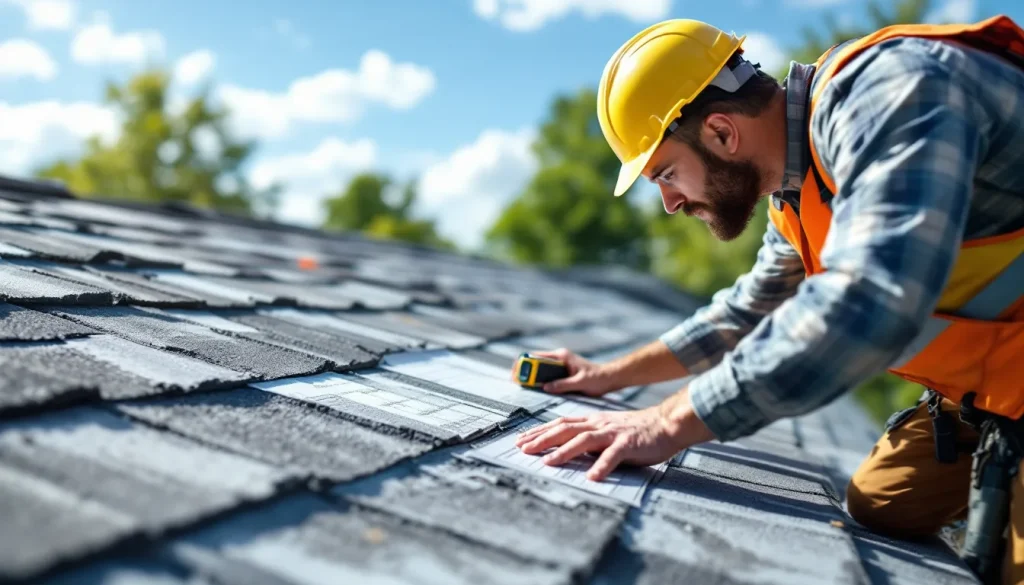
The how to measure a roof question splits into five practical methods in 2026, each with its own accuracy and risk profile: ground tape and footprint math (free, ~10% accuracy), attic from inside (free, ~15% accuracy), satellite reports from Google Earth Pro or EagleView (free to $195, ~5% accuracy), pitch gauge plus footprint math (free phone app to $50 tool, ~5% accuracy), and direct rooftop measurement with a tape measure (free if you already own a harness, the only true ground truth). Most professional contractors use EagleView or GAF QuickMeasure for the initial bid and verify with a roof walk on the day of tear-off. Homeowners checking a quote should use Google Earth Pro plus a pitch estimate. Below is the full method (see our the calculator method guide) breakdown with worked examples and the tools each one uses.
The short version
- 5 methods: ground tape, attic-from-inside, satellite, pitch gauge plus footprint, direct rooftop.
- EagleView Premium ($79 to $195) is the contractor default. Hover ($29 per home) is the homeowner alternative.
- Google Earth Pro is free, accurate within 5%, and works for most US suburban homes.
- Smartphone pitch apps (Pitch Gauge, RoofR, Smart Tool Pitch Locator) measure pitch in 10 seconds without climbing.
- Direct rooftop measurement is most accurate but requires a harness above a 6/12 pitch.
- Always measure twice. Apply 7% to 15% waste before ordering shingles.
The math (formula)
Every method (see our roof size calculator method) ends at the same equation. You need projected area (the horizontal footprint of what the roof covers) and pitch (rise over run). The pitch multiplier converts the projected area to actual sloped roof area.
Roof area = Projected footprint x Pitch (see our roof pitch calculator) multiplier
Pitch multiplier = sqrt(1 + (rise/run)^2)
4/12 = 1.054, 6/12 = 1.118, 8/12 = 1.202, 10/12 = 1.302, 12/12 = 1.414
Direct rooftop measurement (for the full data set, see our the 2026 Aerial Roof Measurement Software Report) skips the pitch multiplier because you are measuring the actual sloped surface. Every other method gives you projected area, which has to be converted. The conversion table below has the multipliers for every standard pitch.
Conversion table: pitch to multiplier
| Pitch (rise/run) | Pitch multiplier | Degrees | For a 2,400 sq ft footprint |
|---|---|---|---|
| 2/12 | 1.014 | 9.5 | 2,434 sq ft |
| 4/12 | 1.054 | 18.4 | 2,530 sq ft |
| 5/12 | 1.083 | 22.6 | 2,599 sq ft |
| 6/12 | 1.118 | 26.6 | 2,683 sq ft |
| 7/12 | 1.158 | 30.3 | 2,779 sq ft |
| 8/12 | 1.202 | 33.7 | 2,885 sq ft |
| 9/12 | 1.250 | 36.9 | 3,000 sq ft |
| 10/12 | 1.302 | 39.8 | 3,125 sq ft |
| 12/12 | 1.414 | 45.0 | 3,394 sq ft |
Worked example: 2,400 sq ft ranch with 6/12 pitch
Walk through the full measurement using all five methods for the same house: a 40 ft x 60 ft ranch with a 6/12 pitch and an 18 inch eave overhang. The roof is a simple gable roof.
Method 1 (ground tape): measure the exterior walls. 40 ft x 60 ft = 2,400 sq ft. Add the overhang: (40 + 3) x (60 + 3) = 2,709 sq ft. Multiply by 1.118 = 3,029 sq ft. The 6/12 pitch comes from a smartphone app or a level-and-tape estimate from the gable end.
Method 2 (Google Earth Pro): trace the roof outline. Get 2,720 sq ft projected. x 1.118 = 3,041 sq ft.
Method 3 (EagleView): order the report. The PDF says 3,037 sq ft of roof surface, broken into 2 planes of approximately 1,520 sq ft each.
Method 4 (direct rooftop): climb up, measure each plane. Plane 1 is 63 ft x 24.1 ft = 1,518 sq ft. Plane 2 is 1,520 sq ft. Total 3,038 sq ft.
The four numbers (3,029, 3,041, 3,037, 3,038) agree within 0.5%. That is what good measurement looks like. The roof is 3,038 sq ft, or 30.38 squares. Round up to 31 squares. Apply 7% gable waste: 33 squares of shingles to order (99 bundles). For the full worked math on turning square footage into a bundle count, see how to estimate the shingle bundles needed. The same workflow drives our how to calculate roof square footage guide.
Method 1: ground tape estimate (free, ~10% accuracy)
The cheapest and most homeowner-friendly approach. Walk the perimeter of the house with a 100 ft tape, measure the exterior wall lengths, multiply length x width to get the footprint (see our roof area vs footprint method), add the overhang, then multiply by the pitch multiplier.
What you need
- 100 ft tape measure (a 25 ft tape will produce too many segment errors)
- A helper to hold one end
- A pitch estimate (from a smartphone app or a level-and-tape from the gable)
- Paper and pen for sketching
What this method misses
- Overhangs vary by elevation (front vs back, eave vs rake). Measure several to get an average.
- Attached garages or porches with different pitch need separate calculation.
- Bump-outs and bay windows can change the footprint.
- Dormers add area not visible in the ground footprint.
Accuracy: 8% to 12% on a simple roof, 15% on a complex one. Good enough to sanity-check a contractor’s quote, not good enough to order shingles (see our how to measure a roof for shingles guide).
Method 2: attic from inside (free, ~15% accuracy)
Useful if the house is two stories and you cannot easily measure the footprint from outside. From inside the attic, measure the rafter run (eave to ridge) and the ridge length. Multiply by 2 for a gable roof to get total sloped surface area. This gives you the actual sloped area, no pitch multiplier needed.
The attic workflow
- Find the longest unbroken rafter from eave to ridge.
- Measure that rafter length (the slope of the roof above).
- Measure the length of the ridge from inside.
- Multiply: rafter length x ridge length = area of one plane.
- Multiply by 2 for a gable, by 4 for a hip (planes will be triangular, calculate separately).
The attic method is harder than it sounds because attics are dark, insulation gets in the way, and the rafter is rarely a clean straight line you can pull a tape across. Use a laser distance measurer (Bosch GLM 50 C, $99) instead of a tape. Accuracy: 10% to 15% if you can get clean measurements.
Method 3: satellite reports (EagleView, GAF QuickMeasure, Hover, Google Earth Pro)
The professional default in 2026. There are two tiers: paid commercial reports (EagleView, Hover, GAF QuickMeasure, RoofR) and free DIY (Google Earth Pro).
Paid commercial reports
- EagleView Premium: $79 to $195. The most detailed: every plane, ridge, valley, hip, eave, and rake measured to the inch. Sells only to verified contractors and insurance carriers.
- Hover: $29 for basic measurement, $79 for the full 3D model. Sold direct to homeowners.
- GAF QuickMeasure: free for GAF Master Elite certified contractors. Less detailed than EagleView but accurate.
- RoofR Pro: $99 per month, bundles measurement with quoting software. Contractor tool.
For homeowners, the cleanest workflow is to ask the contractor to share the EagleView PDF as part of the quote. Reputable contractors will. If the contractor refuses, get a Hover report yourself for $29 and compare.
Google Earth Pro (free)
Google Earth Pro is the free desktop application that traces polygons on satellite imagery and outputs area in square feet. Accuracy depends on imagery resolution. For most US suburban areas, accuracy is within 5% of the contractor’s commercial report.
- Download Google Earth Pro (desktop, not the browser version).
- Search your address.
- Click the polygon tool.
- Set the dialog to measure in square feet.
- Trace each roof plane by clicking each corner.
- Read the area in the dialog.
- Repeat for every plane and sum.
- Multiply by the pitch multiplier (Google Earth measures projected, not sloped).
Method 4: pitch gauge plus footprint (smartphone era)
The pitch is half the measurement. Once you have it, the footprint method becomes accurate to within 5%. Smartphone apps in 2026 make pitch measurement trivial.
The pitch tool options
- Pitch Gauge app (free, iOS and Android): hold the phone against any sloped surface, read pitch in rise/run, degrees, and percent.
- RoofR app (free with paid Pro tier): pitch measurement plus satellite measurement.
- Smart Tool Pitch Locator ($40 to $60, physical tool): a magnetic level with a pitch dial. Stick to any steel rafter or roof deck and read directly.
- Bosch GAM 220 MF Digital Angle Finder ($90): digital readout, useful for steeper pitches where reading a dial is awkward.
- Level and tape (old school): hold a 12 inch level against the rake, measure how far the eave-end of the level is from the roof surface in inches. That number is the rise. Rise over 12 = pitch.
For homeowners staying off the roof, hold a smartphone running Pitch Gauge against a gable rake board from a ladder. Pitch measurement does not require walking the roof. The full method is in our how to calculate roof pitch guide.
Method 5: direct rooftop measurement (most accurate, only for harnessed pros)
The ground truth method. Walk the roof, measure each plane with a 50 or 100 foot tape (or a laser distance measurer), and sum. No pitch multiplier needed because you are measuring the actual sloped surface.
The rooftop workflow
- Set up fall protection: a harness anchored to a ridge anchor, roof ladder for anything above 6/12, and a spotter on the ground.
- Sketch the roof: number each plane.
- For each plane, measure the eave length and the rake length. Area = eave x rake for a rectangular plane.
- For triangular planes (hip ends), area = 1/2 x base x height.
- For trapezoidal planes (hip sides), area = 1/2 x (sum of parallel sides) x height.
- Sum all planes for total roof area.
This method is only sensible for trained roofers with proper fall protection. A homeowner climbing (see our roof safety harness guide) a steep roof without a harness is gambling for marginal accuracy gain over what Google Earth Pro can deliver from the desk.
How roof shape changes the measurement workflow
| Roof type | Planes to measure | Easiest method |
|---|---|---|
| Gable roof | 2 rectangles | Footprint x pitch multiplier (most accurate of free methods) |
| Hip roof | 4 planes: 2 trapezoids, 2 triangles | Footprint x pitch multiplier still works for total area |
| Gambrel roof | 4 planes: 2 steep + 2 shallow | Calculate each pitch zone separately and sum |
| Mansard roof | 8 planes: 4 steep + 4 shallow | Satellite report only practical option |
| Hip with dormers | 4 main + 3 per dormer | Satellite report or direct measurement |
| Complex cut-up | 10+ planes | EagleView is the only practical option |
What homeowners should do (and when)
For a quote sanity check: Google Earth Pro plus a pitch app gets you within 5% of the contractor’s EagleView number for $0 and 15 minutes of work.
For getting a second opinion before signing: order a Hover report ($29) and compare to the contractor’s EagleView.
For a DIY installation (rare for homeowners but does happen with garages and outbuildings): pull the EagleView yourself if you have contractor credentials, or measure directly on the deck after tear-off (often simpler because the planes are clearly delineated).
For an insurance claim: the insurance adjuster usually uses Xactimate, which has its own measurement workflow keyed off EagleView data. Ask the carrier to share the measurement report.
What contractors should do
EagleView Premium for every bid. GAF QuickMeasure works if you are GAF Master Elite. The cost ($79 to $195) is built into the bid as a non-recoverable measurement fee. Verifying on the roof during tear-off is standard practice because aerial reports miss tree-covered planes, recently added structures, and subtle pitch changes.
The contractor measurement stack in 2026 typically runs: EagleView for the bid, RoofR or JobNimbus for quoting from the measurement, and a tape measure plus pitch gauge on the actual job day. The full equipment list is on our learn hub.
Common measurement mistakes
- Confusing the house’s interior square footage with the roof footprint. Two-story homes have half the footprint of their living square footage.
- Forgetting the overhang. An 18 inch overhang adds 3 ft to length and width, which on a 40 x 60 house adds 309 sq ft of footprint before pitch multiplier.
- Using the wrong pitch multiplier. A 6/12 multiplier on a 9/12 roof underestimates area by 12%.
- Forgetting waste. Order quantity is roof area x (1 + waste factor), not just roof area.
- Counting only the main roof on a house with an attached garage or porch with separate pitches.
FAQ
Can I measure my roof from Google Maps instead of Google Earth Pro?
Google Maps does not have the polygon-area tool. Google Earth Pro (a separate free download) does. Use Google Earth Pro.
How accurate are smartphone pitch apps in 2026?
Within 0.5 degrees on a clean rafter surface. Pitch Gauge, RoofR, and the iOS Measure app all use the phone’s accelerometer, which is calibrated. Accuracy drops if the surface has roofing material that adds bumps (such as architectural shingles), so measure against the rake board or a roof deck if possible.
Does the satellite imagery in EagleView account for snow or shadow?
The imagery is usually summer or fall, snow-free. Shadow is handled by the machine vision but tree canopy can block measurement. EagleView flags any plane it could not measure clearly.
How do I measure a flat or low-slope roof?
Low-slope roofs (below 2/12) have a pitch multiplier of 1.01 or less, so footprint = roof area for practical purposes. Measure the perimeter, calculate area, and you are done. Flat roof systems use different waste factors (often 5% for TPO and EPDM) because the membrane is rolled rather than cut.
Should I measure before or after tear-off?
Bid measurement is always before. Verification after tear-off is sometimes useful for change-order discussions if hidden damage requires new sheathing. The measured area itself does not change.
Bottom line
Five methods, four pitch multipliers to memorize (4/12 = 1.054, 6/12 = 1.118, 8/12 = 1.202, 12/12 = 1.414), one formula (projected footprint x pitch multiplier = sloped roof area), and one waste factor (7% to 15%). Homeowners should use Google Earth Pro plus a Pitch Gauge app for sanity-checking quotes. Contractors should use EagleView or GAF QuickMeasure for bids and verify with a roof walk during tear-off. The cheapest method (ground tape plus pitch estimate) is accurate enough to catch contractor inflation. The most expensive method (EagleView Premium) is accurate enough to bid jobs from. Most measurement disagreements between homeowner and contractor come down to the waste factor and the overhang, not the underlying roof surface. Run the math twice, ask to see the contractor’s source, and trust the formula.