
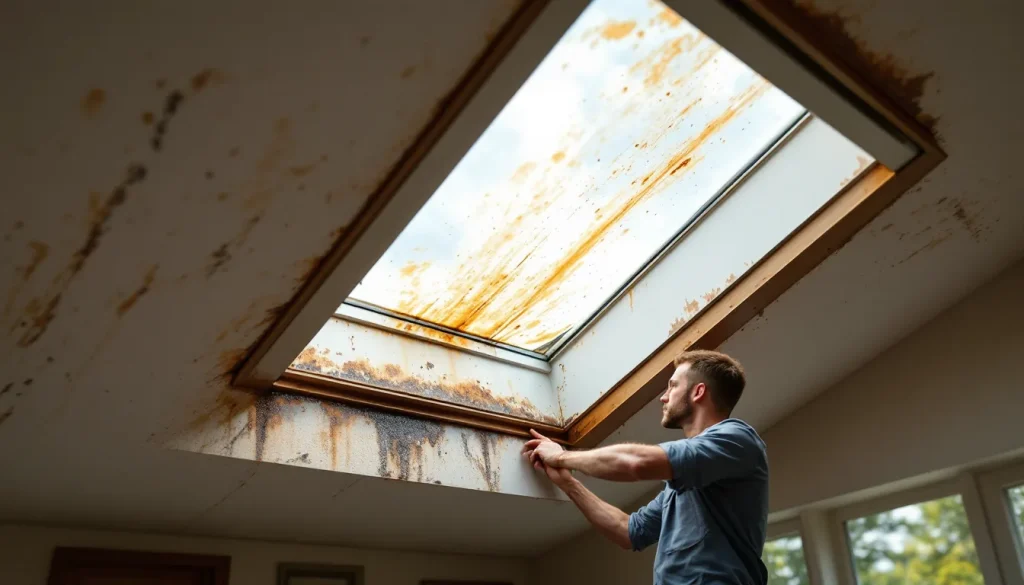
A skylight (see our skylight replacement cost) leak comes from one of seven distinct sources: gasket failure on the glazing unit, dried sealant at the head or apron flashing, ice damming forcing water back under the head flashing, kicked-out head flashing on the uphill side, condensation that gets mistaken for a leak, a cracked curb, or end-of-life glazing on a fixed unit over 20 years old. Repair cost in 2026 runs from $250 for a reseal up to $3,500 for a full replacement of an older fixed unit. The diagnosis matters more than the unit because half of the calls labeled “skylight leak” are actually flashing failures around the skylight, not the skylight itself.
Last reviewed: August 2026.
The short version
- Seven leak sources: gasket failure, dried sealant, ice damming, head-flashing kick, condensation (not actually a leak), curb crack, end-of-life glazing.
- Repair cost: reseal $250-$650, flashing rebuild $500-$1,200, full skylight replacement $1,200-$3,500.
- Condensation is the most misdiagnosed “leak.” Insulating the shaft and venting the bathroom underneath fixes 60% of “winter leaks.”
- Skylight service life: 10-15 years for sealant and gaskets, 20-25 years for glazing, 25-30 years for the curb itself.
- Replacement is the right call when the unit is over 20 years old, regardless of where the leak appears.
- Modern replacements (VELUX, Fakro, Sun-Tek) cost more upfront but use better gasket systems with 10-year no-leak warranties.
The seven sources of a skylight leak
Almost every skylight leak traces to one of seven sources: gasket failure on the glazing unit, dried sealant at the head or apron flashing, ice damming, kicked-out head flashing, condensation that is not actually a leak, a cracked curb, or end-of-life glazing on a unit over 20 years old. The repair scope and cost depend entirely on which one you have.
Source 1: gasket failure on the glazing unit
Modern skylights (VELUX, Fakro, Sun-Tek, Wasco) use a perimeter gasket between the glazing pane and the unit frame. The gasket is typically EPDM or neoprene with a service life of 10 to 20 years. When it dries out and shrinks, micro-gaps open along the top edge of the glazing. Wind-driven rain pushes water through these gaps and into the unit. Visible inside as drips along the top of the glass.
Fix: gasket replacement is a manufacturer-specific service. VELUX FCM, FSR, and FS series support gasket replacement parts. Fakro FTP and FTT support full glazing-unit swap. Cost: $400 to $900 for the part plus labor. On older or off-brand units, gasket parts may not be available, which forces a full skylight replacement.
Source 2: dried sealant at head or apron flashing
The skylight flashing system has four parts: apron flashing across the downhill face, step flashing up both sides, head flashing across the uphill face, and counter flashing or gaskets bedded to the unit frame. Each junction is sealed with polyurethane or silicone. Sealants in horizontal exposure dry out at 10 to 15 years. When they shrink, water enters at the joint and tracks under the metal.
Fix: rake out old sealant, clean, reapply fresh polyurethane. The sealant grade matters here, so choose from proven roof leak repair products rather than generic hardware-store caulk. Cost: $250 to $500. Hold time: 8 to 15 years if the underlying flashing is sound.
Source 3: ice damming
In northern climates, snow on the roof melts where it sits over a warm skylight and refreezes downhill at the cold eave, forming an ice dam. The dam backs water up the roof slope, where it pushes under the shingles above the head flashing and into the unit. The leak appears at the upper interior edge of the skylight during the first January thaw and stops in spring.
Fix: the skylight is not the problem. Address the ice dam with attic insulation, sealed air leaks, balanced attic ventilation, and ice and water shield extending at least 24 inches above the skylight head. Cost: $600 to $2,500 depending on what is needed. The skylight itself stays put.
Source 4: kicked-out head flashing
Head flashing on the uphill side of the skylight has to extend at least 4 inches up under the shingles above. When installers cheap out (typically on a builder-grade install from the early 2000s), the head flashing is too short, kicks down at the top edge, and water running down the roof finds its way under. Visible signs from inside: leak appears at the top edge of the skylight shaft during normal heavy rain, not just storms.
Fix: pull shingles above the skylight, replace head flashing with an extended version (8 to 12 inches up under shingles), install ice and water shield in the same band. Cost: $500 to $1,000.
Source 5: condensation
This is the most misdiagnosed “leak.” Water appears on the inside of the glazing or runs down the skylight shaft walls in cold weather. It is not coming from outside. It is condensation forming on the cold interior glass surface from humid indoor air, especially in skylights over bathrooms or kitchens. Confirmation: the “leak” stops in summer, drips form straight down rather than tracking from a specific point, and the shaft walls show staining in a uniform vertical pattern rather than concentrated at one location.
Fix: insulate the shaft walls and ceiling, install a humidistat-controlled bathroom vent if the skylight is over a bath, run a dehumidifier in heating season. Upgrade to a double-pane low-E glazing if the unit is single pane or basic dual pane. Cost: $200 to $800 in materials, $0 in skylight repair.
Source 6: cracked curb
The curb is the wooden box that frames the skylight opening at the roof deck. On older builds (pre-2005), curbs were often site-built from 2×6 stock and prone to splitting at the corners as the unit shifted. A cracked curb opens a vertical leak path that bypasses every piece of flashing. Visible from the attic as separation at the curb corners and water staining on the curb framing.
Fix: structural repair or curb replacement. Typically the skylight has to be removed to access. Cost: $800 to $1,800.
Source 7: end-of-life glazing
Skylights over 20 years old often reach the end of glazing seal life regardless of which brand. The IGU (insulated glass unit) seals fail, the panes fog, the gaskets shrink, and water finds gaps in three or four places at once. At this point, individual repairs do not hold. The unit needs replacement.
Fix: full skylight replacement. Cost: $1,200 to $3,500 depending on size and brand.
Repair cost by source (2026)
Skylight leak repair in 2026 ranges from $250 for a simple flashing reseal to $3,500 for a full replacement of an older fixed unit. A gasket replacement runs $400 to $900, a head-flashing rebuild $500 to $1,000, and curb repair $800 to $1,800. The table below breaks down cost and expected service life by leak source so you can match spend to the actual problem. For pricing on leaks elsewhere on the roof, see our breakdown of leaking roof repair cost by source.
| Leak source | Repair scope | Cost | Service life of repair |
|---|---|---|---|
| Gasket failure | Replace perimeter gasket | $400-$900 | 10-15 years |
| Dried sealant | Reseal flashing joints | $250-$500 | 8-15 years |
| Ice damming | Insulation, ventilation, ice shield | $600-$2,500 | 20+ years |
| Kicked head flashing | Rebuild head flashing detail | $500-$1,000 | 20-25 years |
| Condensation | Insulate shaft, vent bath, dehumidify | $200-$800 | 20+ years |
| Cracked curb | Curb repair or replacement | $800-$1,800 | 25+ years |
| End-of-life unit | Full replacement | $1,200-$3,500 | 20-25 years |
How to diagnose a skylight leak without tearing the roof open
You can pin down a skylight leak source before calling a roofer by working through five no-cost checks: note when it leaks, feel where water enters the interior, inspect the attic framing, run a sectioned hose test, and read the model and age label. The same source-by-source method that works for a metal roof leak repair applies here, and it prevents paying for the wrong fix.
Step 1: when does it leak?
Pattern matters. Only during winter and only at the upper inside edge: ice damming. Only during heavy wind-driven rain: gasket failure or sealant failure. Only in cold weather without precipitation: condensation, not a leak. During normal heavy rain regardless of wind: kicked head flashing or curb crack. Constant in any rain: full unit failure or major flashing failure.
Step 2: where does the water enter the interior?
Run your finger along the interior edge of the glazing and feel for moisture along the top, sides, and bottom. Top edge wet: head flashing or upper gasket. Side wet: step flashing or side gasket. Bottom wet: apron flashing or condensation runoff. Center of glass wet: glazing seal failure. Uniform shaft wall wet: condensation.
Step 3: attic check
Go into the attic during daylight and inspect the framing around the skylight curb. Look for staining on the curb itself (curb crack), staining at the top of the curb only (head flashing), or staining on the rafters above the skylight (ice damming or upstream leak source). Photograph everything.
Step 4: hose test in sections
Have a helper inside watching the skylight while you spray each side of the unit in turn. Start with the downhill apron, then the sides, then the uphill head, then the glass itself, 5 minutes per zone. The zone where water appears inside is your leak source. If water appears only when you spray the glass directly: glazing seal or gasket. If it appears when you spray uphill of the unit but not the unit itself: kicked head flashing or upstream leak. See water stain on ceiling for tracing leaks that may not actually be the skylight.
Step 5: model and age lookup
Find the manufacturer label on the inside of the skylight frame. VELUX puts it on the upper frame. Fakro puts it on the hinge side. Sun-Tek labels are on the lower frame. Note the model, the date of manufacture, and the serial number. If the unit is over 20 years old, lean toward replacement regardless of what the hose test shows.
Real brands and what they cost in 2026
Five manufacturers dominate the US residential skylight market: VELUX, Fakro, Sun-Tek, Wasco, and generic builder-grade units. Installed replacement cost in 2026 runs about $1,400 to $2,800 for VELUX, $1,200 to $2,400 for Fakro, $900 to $1,800 for Sun-Tek, and $1,100 to $2,200 for Wasco. Parts availability and reliability vary significantly, which matters most when a unit is 15 or more years past install.
VELUX
The market leader. VELUX FCM (fixed curb-mount), VS/VSE (venting), and FS (deck-mount) are widely available with strong gasket parts support. 10-year no-leak installation warranty when installed by a VELUX Certified Installer with VELUX flashing kit. Replacement cost 2026: $1,400 to $2,800 installed for a typical 22×46 fixed unit. Glazing is laminated low-E argon-filled. Best brand for parts availability 15+ years post-install.
Fakro
Polish manufacturer with strong European market share and growing US presence. FTP and FTT venting models compete directly with VELUX VS. Generally 10 to 20% cheaper than equivalent VELUX. Parts support exists but is less developed in the US. Cost 2026: $1,200 to $2,400 installed.
Sun-Tek
Florida-based manufacturer focused on Sun Belt markets. SVE venting and SVF fixed models. Strong impact-rated options for hurricane zones. Cost 2026: $900 to $1,800 installed. Parts support is solid for active production years.
Wasco (Skyview)
Maine-based manufacturer, popular in the Northeast. Wasco E-Class and EC fixed units. Known for solid curb-mount construction in cold climates. Cost 2026: $1,100 to $2,200 installed.
Generic builder-grade units
Many homes built between 1995 and 2010 have skylights from now-defunct or generic builder-supply brands. Parts are usually not available. When these fail, replacement is the only option, and replacement requires upsizing the rough opening to a current standard size.
Resealing vs reflashing vs replacing: which is right?
Match the repair to the unit’s condition and age. Reseal only when the skylight is under 15 years old, the flashing metal is sound, and the leak is at a sealant joint. Reflash when the unit is 10 to 20 years old and the flashing is rusted, kicked, or too short but the curb is sound. Replace when the unit is over 20 years old, the glazing is fogged, or brand parts are gone.
Reseal only if
- Unit is under 15 years old
- Flashing metal is sound (no rust, no separation)
- Leak is at sealant joint, not at gasket
- No moisture between the glass panes
Reseal hold time: 8 to 15 years. Cost: $250 to $500.
Reflash if
- Unit is 10 to 20 years old
- Flashing metal is rusted or kicked
- Head flashing is too short
- Apron flashing has separated from the unit
- Curb is sound
Reflash hold time: 15 to 25 years. Cost: $500 to $1,200.
Replace if
- Unit is 20+ years old
- Glazing is fogged or has visible IGU seal failure
- Curb is cracked or rotted
- Parts are not available for the brand
- You are reroofing
Replacement hold time: 20 to 25 years on a quality brand. Cost: $1,200 to $3,500.
Why condensation gets misdiagnosed as a leak
Single-pane and older dual-pane skylights have a glazing surface temperature in winter that runs 30 to 50 degrees F below interior room temperature. Indoor humidity above 35% will condense on that cold surface. The condensation runs down the inside of the glass, pools in the bottom channel of the frame, and overflows down the shaft walls. Homeowners see water inside, assume it is a leak, and call a roofer.
Tells that you are dealing with condensation rather than a leak:
- Water appears in dry winter weather, not during rain
- Water always runs straight down, never sideways
- Skylight is over a bathroom, kitchen, or laundry
- Indoor humidity is consistently over 40%
- Unit is single pane or basic dual pane (no low-E coating)
The fix is environmental, not structural. Drop indoor humidity to 30 to 35% in heating season. Insulate the skylight shaft to R-30 or better. Vent moisture-producing rooms underneath. If the unit is single pane, upgrade to dual-pane low-E argon-filled. Modern VELUX, Fakro, and Sun-Tek units with proper glazing rarely condense at all.
Skylight replacement: what the project actually involves
A full skylight replacement is a 4 to 8 hour professional job that strips shingles for a 24-inch perimeter, removes the old unit and flashing, repairs the curb, lays fresh ice and water shield, sets the new unit with a matched flashing kit, and reshingles the perimeter. Done correctly it holds 20 to 25 years on a quality brand. The full sequence:
- Pull shingles around the unit for a 24-inch perimeter.
- Remove existing flashing.
- Remove old skylight from curb (deck-mount) or remove entire curb-mount unit including frame.
- Inspect and repair curb framing if curb-mount or replace curb framing if deck-mount.
- Install new ice and water shield on deck around the curb, extending at least 12 inches in all directions and 24 inches above on the head side.
- Set new unit per manufacturer instructions, fastening to curb or deck with manufacturer brackets.
- Install new flashing kit: apron, step flashings up the sides (one per shingle course), head flashing.
- Replace shingles in the perimeter, sealing all cuts and ensuring proper laps.
- Finish interior shaft drywall if shaft was disturbed.
If your roofer wants to set a new skylight on top of old flashing or reuse old shingles in the perimeter, they are doing the job wrong. Insist on the full sequence above. For broader contractor questions, see questions to ask a roofing contractor.
Skylight replacement during a reroof
If you have an aging skylight (15+ years) and the roof is up for replacement, do them together. The cost premium for replacing the skylight during a reroof is typically $800 to $1,400 over the unit cost, because the labor for tearing off the surrounding shingles is already paid. Replacing a skylight 3 years after a reroof costs $1,500 to $2,500 because the roofer has to redo the shingle perimeter and labor is at single-task pricing.
The signs you are due for a new roof entirely: see signs you need a new roof and asphalt shingle roof lifespan.
Common mistakes that cause “fixed” skylights to leak again
Four repeat mistakes send a supposedly fixed skylight back into leaking: caulking the glass to the frame instead of replacing a failed gasket, stacking new flashing over old, using the wrong manufacturer flashing kit, and ignoring upstream sources like a vent boot or chimney. Each masks the real fault, so the leak returns within one to three years.
Mistake 1: caulking the glass to the frame
If a roofer caulks the perimeter of the glass to the frame to “stop the leak,” they have masked a failed gasket without replacing it. The leak will return within 1 to 3 years and the gasket will be impossible to replace without scraping caulk for hours.
Mistake 2: stacked flashing
Installing new flashing over old flashing instead of removing old. Creates a second failure layer beneath the new one. Always strip back to the deck.
Mistake 3: wrong manufacturer flashing kit
Each major skylight brand has its own flashing kit designed to fit the frame profile. Using a VELUX kit on a Fakro unit (or vice versa) leaves gaps. Always use the matched kit for the brand of skylight being installed.
Mistake 4: ignoring upstream sources
Water that appears at the skylight may come from a vent boot, chimney, or other penetration uphill. Always rule out upstream sources before assuming the skylight is the source. See roof vent pipe boot and chimney flashing leak repair.
FAQ
How long should a skylight last?
A quality unit (VELUX, Fakro, Sun-Tek) lasts 20 to 30 years before the IGU and gaskets reach end of life. Flashing should last as long as the roof under it. Cheap builder-grade skylights from the 1990s and early 2000s often fail at 12 to 18 years.
Can I replace just the glass on a skylight?
On VELUX FCM and FS series, yes, the IGU is a replaceable part. On most other brands, no, the glass is permanently bonded to the unit frame and full replacement is required.
Why does my skylight only leak in winter?
Almost always ice damming or condensation. Neither is a skylight failure. Fix the attic insulation and ventilation, vent bathrooms underneath, and the “winter leak” will stop. See attic ventilation.
Are skylights worth keeping?
If they are sound, yes. Natural daylighting and ventilation add value. If they are over 25 years old, leaking, and surrounded by aging shingles, factor replacement or removal into your next reroof decision rather than chasing repairs.
Does insurance cover skylight leaks?
Storm damage to skylights is covered. Age-related gasket and sealant failure is not. If a tree branch breaks the glazing or a hailstorm damages the unit, document the storm and file a claim. See filing an insurance claim for roof damage.
Bottom line
Skylight leaks are seven different problems wearing one label. Diagnose before you pay. Walk through attic and hose tests, identify the source, and match the fix to the source. A $400 reseal solves a gasket-only problem. A $2,500 replacement solves a 25-year-old unit at end of life. Neither solves the other. If the ceiling is actively dripping while you line up a pro, a temporary roof repair keeps interior damage down in the meantime. The single largest mistake homeowners make is paying $1,200 for a flashing rebuild on a skylight that should have been replaced and dealing with a new leak 3 years later. If the unit is over 20 years old, replace it. If it is under 15 years and the gasket is shot, repair it. For broader roof leak diagnostics, see roof leak repair and how to fix a roof leak.