
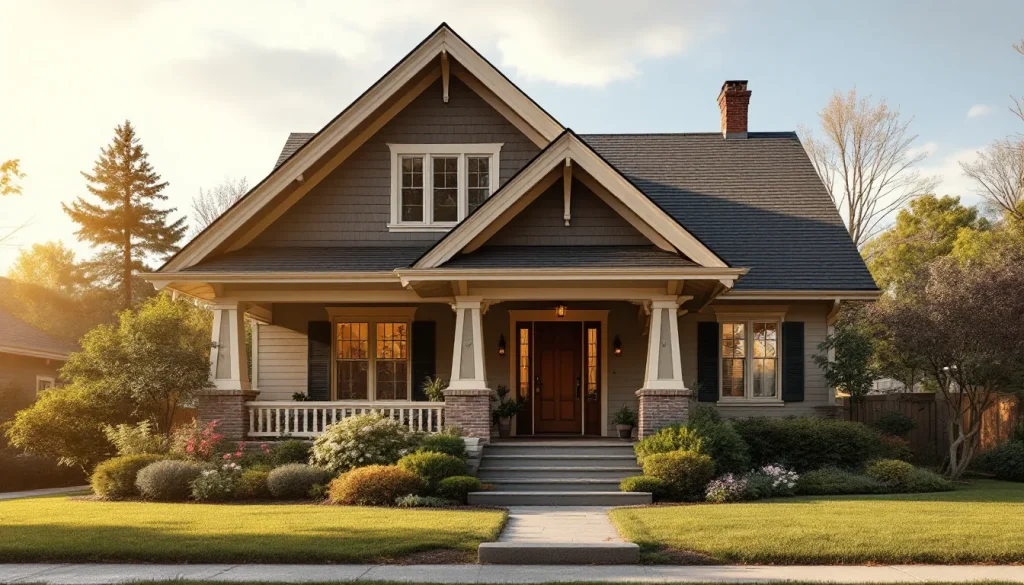
A gable roof is the simple two-sided sloped design that meets at a central ridge, creating the characteristic triangular end-walls (gables) that give the style its name. In 2026, the gable roof remains the most common residential roof style in America for three reasons: it is the lowest-cost installation of any standard roof type, it sheds water and snow efficiently, and the simple framing accommodates almost any architectural style from Cape Cod to Tudor to Dutch Colonial to Craftsman to modern minimalist. Here is the complete breakdown of cost, variants, performance, and the one place where gable roofs are actively losing ground in 2026.
The short version
- The gable is the lowest-cost residential roof style, running $5.50 to $9.00 per square foot installed for asphalt in 2026.
- Standard variants: side gable, front gable, cross gable, Dutch gable, and steep-pitch snow-country variants.
- Wind performance is the gable’s only material weakness: the vertical gable end walls present a large surface to horizontal wind and uplift forces.
- Florida Building Code and most coastal jurisdictions now favor hip roofs over gables in High-Velocity Hurricane Zones, but inland gables still dominate.
- Best applications: any architectural style, any climate except severe hurricane exposure, any budget tier from production to luxury custom.
- The cross-gable variant adds valley complexity and increases leak risk by 2 to 4 times over a simple side-gable design.
The Short Answer: Why Gable Dominates American Residential
The gable roof dominates American residential construction for three reasons that have nothing to do with style.
First, the framing is the simplest of any roof type. Rafters or trusses span from exterior wall to exterior wall with a single ridge beam at the peak. There are no hip rafters, no valley framing on a simple gable, and no complex transitions. Production builders can frame a gable on a 2,500 square foot home in two days with a four-person crew.
Second, the material is the cheapest. A gable has the least roof surface area per square foot of floor of any standard roof style. There are no wasted slopes that do not contribute to floor area, no double-pitched surfaces, and no decorative complications. You buy the minimum square footage of shingles, underlayment, and decking.
Third, the geometry is universal. A gable can be steep (10:12 or 12:12 for Tudor or Victorian), moderate (6:12 or 8:12 for Craftsman or Colonial), or shallow (3:12 or 4:12 for modern minimalist and California ranch). The same framing crew, the same materials, and the same flashing details work across the full residential pitch range.
Gable Roof Anatomy
The gable roof has five named parts that matter for any owner, contractor, or insurance discussion.
Ridge. The highest line of the roof, where the two slopes meet. The ridge runs the length of the building. In stick-framed construction it is a structural beam (the ridge beam). In trussed construction it is just the line where opposing truss top chords meet.
Eaves. The lower edges of the two sloped sides, where the roof meets the exterior walls. The eaves are where the fascia, soffit, and gutters live. They are also where most snow and ice damming happens.
Rake. The sloping edge of the roof on the gable end. The rake runs from the ridge to the eave along the gable wall. The rake board (or rake trim) is the wood or metal trim that finishes this edge.
Gable end (gable wall). The triangular vertical wall at each end of the building, framed by the rake on two sides and the second-floor or attic floor plate on the third side. The gable end is the wind-exposed wall that is the gable’s primary structural weakness.
For the complete vocabulary across all roof types, see parts of a roof.
Cost: Lowest of Major Roof Styles
The gable is the price floor for residential roof installation. Any other style adds cost relative to a gable of the same footprint and material.
| Material | Gable installed cost (2026) | Cost per 2,500 sf home | Service life |
|---|---|---|---|
| 3-tab asphalt (basic) | $4.50 to $6.50 | $11,000 to $16,000 | 15 to 20 years |
| Architectural asphalt | $5.50 to $9.00 | $14,000 to $22,000 | 20 to 30 years |
| Impact-rated asphalt (Class 4) | $7.50 to $11.50 | $19,000 to $29,000 | 30 to 40 years |
| Standing seam metal | $11.00 to $18.00 | $27,500 to $45,000 | 50 to 70 years |
| Cedar shake | $13.00 to $22.00 | $32,500 to $55,000 | 30 to 40 years |
| Slate | $22.00 to $40.00 | $55,000 to $100,000 | 75 to 100 years |
| Concrete tile | $11.00 to $18.00 | $27,500 to $45,000 | 50+ years |
These are the baseline numbers that every other roof style is priced against. A hip roof of the same materials runs 5 to 20 percent higher. A gambrel runs 10 to 25 percent higher. A mansard runs 50 to 90 percent higher. For full pricing context, see how much does a new roof cost.
Variants: Side Gable, Front Gable, Cross Gable, Dutch Gable
The gable roof has four primary variants, defined by the orientation of the ridge relative to the building’s front facade.
Side gable. The ridge runs parallel to the front facade. The gable end walls are on the left and right sides of the house. This is the standard configuration for Colonial, Cape Cod, and ranch homes. It is the simplest and cheapest variant.
Front gable. The ridge runs perpendicular to the front facade. The gable end wall faces the street. This is the Tudor, Craftsman, and Tudor Revival configuration. The exposed front gable becomes a visual feature of the facade.
Cross gable. Two or more gable roofs intersect at right angles, creating valleys at every intersection. Cross gable is the standard configuration for almost any home with a wing, a front porch covered by a separate gable, or an attached garage with a gable parallel to the house. It is more complex and more leak-prone than a simple side or front gable.
Dutch gable. A hybrid that combines a gable with a small hip section at the peak. The result is a gable with a hip-roofed cap, which provides better wind performance on the gable end while preserving the gable silhouette. Common on traditional Dutch Colonial and some Craftsman variants.
| Variant | Cost vs simple side gable | Wind performance | Best for |
|---|---|---|---|
| Side gable | baseline | Moderate (gable ends exposed to side wind) | Colonial, Cape, ranch |
| Front gable | +0 to 5% | Moderate (gable end exposed to street wind) | Tudor, Craftsman |
| Cross gable | +15 to 30% | Moderate, more leak risk at valleys | Multi-wing homes |
| Dutch gable | +8 to 15% | Better (hip cap reduces uplift) | Dutch Colonial, premium Craftsman |
Gable vs Hip: The Core Decision
The most common roof decision in residential construction is gable versus hip roof. The two styles cover the same footprint, perform the same basic water-shedding function, and accommodate the same materials. The differences are cost and wind performance.
| Factor | Gable | Hip |
|---|---|---|
| 2026 installed cost (asphalt, 2,500 sf home) | $14,000 to $22,000 | $16,000 to $26,000 |
| Cost premium | baseline | +5 to 20% |
| Framing complexity | Simplest residential | More complex (hip rafters, valley framing) |
| Wind performance | Moderate (gable end vulnerability) | Excellent (no gable ends) |
| Florida Building Code preference | Allowed, no credit | Wind mitigation credit available |
| Insurance impact in hurricane states | Higher premium | 10 to 35 percent discount available |
| Attic ventilation options | Gable vents + ridge + soffit | Ridge + soffit only |
| Best for | Most climates, all budgets | Hurricane zones, snow zones with drift |
The gable wins on cost. The hip wins on wind performance and insurance impact in hurricane states. In any zone where wind speed is below 110 mph design, the gable is usually the right answer. In hurricane zones (Florida, Texas Gulf Coast, the Carolinas), the hip is increasingly required by code or strongly incentivized by insurance pricing.
Wind Performance: The Gable Weakness
The gable end wall is the structural weakness of the gable roof. It is a large vertical surface exposed to horizontal wind, and the load path from wind pressure on the gable wall down through the structure to the foundation has historically been weak in residential construction.
Three failure modes are common in high wind events. The first is gable end wall blowout, where the wall above the second-floor plate line is pushed inward by positive wind pressure or pulled outward by suction. The second is rake overhang lift, where wind getting under the eave overhang at the rake produces an uplift force that can peel the entire gable end off the structure. The third is shingle blow-off at the gable end, where the airflow over the gable peak creates an extreme suction zone that lifts shingle tabs.
ASTM D7158 shingle wind ratings (Class D for 90 mph, Class G for 150 mph, Class H for 190 mph) are tested in conditions that approximate the suction zones at gable corners. A Class D rated shingle on a gable in a 130 mph wind zone will fail at the gable corners first, even if the rest of the roof holds.
The mitigation strategies for gable wind performance include continuous structural sheathing from the gable peak down to the foundation, hurricane clips and continuous load path hardware, and high-wind-rated shingles (Class G or H minimum in coastal zones). See hurricane proof roof for the full mitigation strategy.
Why Hurricane-Zone Builders Often Skip Gable
In Florida, Texas Gulf Coast counties, and the South Carolina coast, builders increasingly default to hip roofs on new construction even when the architectural style would conventionally use a gable. The reasons are economic.
Florida Building Code 1626 (the High-Velocity Hurricane Zone code, applicable in Miami-Dade and Broward counties) does not prohibit gable roofs, but it requires extensive structural reinforcement of gable ends that makes the gable nearly cost-comparable to a hip in HVHZ work. Outside HVHZ but still in coastal Florida, the Florida Building Code wind provisions (Chapter 16 of FBC Residential) require detailed engineering for gable ends in any structure within 1 mile of the coast.
The bigger driver is insurance. Florida homeowner insurance carriers offer wind mitigation credits for hip roofs that can reduce annual premiums by 10 to 35 percent. The credit is based on the certified hip-to-gable ratio of the roof, and a 100 percent hip roof gets the maximum credit. For a Florida home with a $4,000 annual wind premium, the hip credit can be worth $400 to $1,400 per year, which more than offsets the 5 to 20 percent installation premium within 5 to 8 years. See best roof for hurricane for the credit math in detail.
Best Material Pairings
The gable accommodates every standard residential roof material without geometric complication. Material choice is driven by climate, budget, and architectural style rather than by roof shape.
| Material | Best gable application | 2026 installed cost |
|---|---|---|
| Architectural asphalt shingles | Mainstream residential, all climates | $5.50 to $9.00 |
| Impact-rated asphalt | Hail belt (Texas, Oklahoma, Colorado) | $7.50 to $11.50 |
| Standing seam metal | Snow country, modern architecture, fire-prone areas | $11.00 to $18.00 |
| Cedar shake | Northeast Colonial, Cape Cod, Pacific Northwest | $13.00 to $22.00 |
| Slate | Historic preservation, high-end custom | $22.00 to $40.00 |
| Clay tile | Southwest, California, Florida (Spanish Colonial) | $13.00 to $25.00 |
| Concrete tile | Florida, California, Texas | $11.00 to $18.00 |
For the metal versus asphalt comparison that drives most material decisions, see metal vs asphalt shingle roof. For premium metal pricing, see standing seam metal roof cost.
Snow Country Variants: Steep-Pitch Gable
In high-snow climates (40+ psf ground snow load, including New England, Great Lakes, Rocky Mountain interior, and Sierra Nevada), the gable is the dominant style because steep-pitch geometry sheds snow before it accumulates dangerously.
The typical snow-country gable runs 10:12 to 14:12 pitch (40 to 50 degrees). At these slopes, dry snow shedding is essentially passive: the snow slides off under its own weight. Standing seam metal on a steep gable is the gold standard for snow country because the smooth surface accelerates shedding, and the absence of penetrations or shingle ridges removes the points where ice dams can form.
Snow guards (the small metal projections that prevent dangerous slide-off onto walkways and entries below) are standard on steep-pitch snow country gables. The combination of steep pitch, metal cladding, and snow guards is the highest-performing snow management system in residential construction.
Ventilation Strategy: Gable Vents vs Ridge Vents
The gable roof is the only major residential style where gable end vents are a viable attic ventilation strategy. The vents are simple louvered openings in the gable end walls, near the peak, that allow attic air to escape passively.
Modern ventilation design has largely shifted away from gable vents to continuous ridge-and-soffit ventilation, which provides better airflow across the entire attic. But gable vents remain common in retrofits, in homes where ridge venting is not practical, and as a supplement to ridge venting in hot climates.
The two strategies should not be combined without careful design. Mixing gable vents and a ridge vent on the same attic can create short-circuit airflow patterns that pull air directly from the gable vent to the ridge without ventilating the rest of the attic. The current best practice (per most major shingle manufacturers and the IRC) is to use ridge-and-soffit ventilation as the primary system and seal gable vents in retrofit situations. For the full ventilation breakdown, see attic ventilation.
Architectural Styles That Demand Gable
Certain architectural styles cannot be properly executed without a gable roof. The list includes:
Cape Cod. The defining feature is a steep side-gable roof with a centered front entry. Cape Cods built without a gable look like ranch homes.
Tudor. Multiple steep front gables, often with half-timbered gable end walls, define the Tudor style. The Tudor cannot be executed with a hip or mansard.
Craftsman. The low-pitch front gable with deep eave overhangs and exposed rafter tails is core to the Craftsman language.
Gothic Revival. Steep cross-gable roofs with decorated bargeboards are the Gothic Revival signature.
Modern Farmhouse. The current architectural movement uses a centered front-facing gable as a primary feature on almost every plan.
Modern Minimalist. Single-pitch shed gables and shallow asymmetric gables are common in modern residential architecture from the 2010s forward.
If you are restoring or building in any of these styles, the gable is non-negotiable. The AIA architectural style references and the National Park Service Preservation Briefs treat the gable form as integral to these styles.
Cross-Gable Complexity: More Leaks at the Valleys
Cross-gable roofs introduce valleys at every intersection between two gable sections. Every valley is a critical flashing detail, and valleys are the single highest-frequency leak location on residential roofs.
Industry estimates from the NAHB Cost vs Value 2024 report and from roof claim data suggest that cross-gable roofs experience 2 to 4 times the leak frequency of equivalent simple gable roofs over a 20-year service life. The leak frequency scales roughly with valley count: a single-valley cross gable has roughly twice the leak risk, a four-valley cross gable has four times the risk.
The mitigation is proper valley flashing. Best practice is a closed-cut or open metal valley with a 36-inch-wide self-adhered membrane underlayment running the full length of the valley. Cheap valley details (woven shingles, or asphalt-only valleys without underlayment enhancement) are the source of most of the elevated leak rate. See roof flashing for valley detailing.
If you are designing a cross-gable home, the cost-benefit analysis should include the increased lifetime maintenance and repair cost. A cross gable with three valleys can cost $4,000 to $8,000 more in lifetime repair over 30 years than the same home with a hip or simple gable roof.
Modern Gable: 2026 Architecture
The gable is not just a traditional form. Modern architects use the gable as a primary expressive element in three current movements.
Modern Farmhouse. The dominant new-construction residential style of the late 2010s and 2020s relies on a steep, centered front gable as the primary facade element. The interior is open and modern, the exterior is rural traditionalism, and the gable is the visual signature.
Scandinavian Modern. The clean, steep, symmetrical gable with no eave overhangs is a Northern European design language that has been adopted by progressive American architects for both residential and commercial work.
Shed and Asymmetric Gable. A single-pitch shed roof (technically a gable with one slope) or an asymmetric gable where the two slopes are different lengths and pitches is a modern minimalist signature. These forms allow large clerestory windows on the high side.
The gable’s structural simplicity makes it the friendliest roof form for the experiments of contemporary residential architecture.
Gable Roof Insurance Considerations
Outside hurricane states, the gable roof is insurance-neutral or insurance-favored. Carriers in non-hurricane states generally do not discriminate between gable and hip pricing, and the lower replacement cost of a gable can mean modestly lower premiums.
Inside hurricane states (Florida, Texas Gulf Coast, the Carolinas, Louisiana), the picture is different. Florida insurance carriers offer significant wind mitigation credits for hip roofs that gable roofs cannot get. The math is documented in the Florida Building Code’s wind mitigation form and varies by carrier, but credits of 10 to 35 percent of the wind portion of the premium are typical.
For a Florida home with a $4,000 annual wind premium, the hip credit can be worth $400 to $1,400 per year. Over the 20-year service life of a roof, the hip credit can total $8,000 to $28,000 in saved premiums, which is dramatically more than the hip installation premium.
Outside hurricane states, insurance is not a meaningful factor in the gable vs hip decision. Inside hurricane states, it usually is the deciding factor.
FAQs
Why is the gable roof so common in America?
Three reasons: lowest installation cost, simplest framing, and universal architectural compatibility. The gable works for almost any climate (with appropriate pitch and material) and any architectural style. Production builders default to it for cost and speed reasons.
How much does a gable roof cost in 2026?
For a 2,500 square foot home with architectural asphalt shingles, expect $14,000 to $22,000 installed. Standing seam metal runs $27,500 to $45,000. Slate runs $55,000 to $100,000. The gable is the cost floor; every other style adds a premium.
Is a gable roof good for hurricane areas?
Not as good as a hip. The vertical gable end walls are the structural weakness in high-wind events, and Florida insurance carriers offer wind mitigation credits for hip roofs that gable roofs do not get. In any hurricane zone, the hip is usually the better choice.
What is the difference between a side gable and a front gable?
Orientation. A side gable has the ridge parallel to the front facade with gable end walls on the sides of the house. A front gable has the ridge perpendicular to the front facade with the gable end wall facing the street.
Can I use gable vents and a ridge vent together?
Not recommended. Combining the two can create short-circuit airflow that bypasses much of the attic. The current best practice is to use either a continuous ridge-and-soffit system or gable vents alone, not both. For retrofits, seal the gable vents when you install ridge ventilation.
Why do cross-gable roofs leak more?
Valleys. Every intersection between two gable sections creates a valley, and valleys are the highest-frequency leak location on any residential roof. A cross gable with multiple valleys has 2 to 4 times the lifetime leak risk of a simple gable.
What pitch should a gable roof be?
Climate-dependent. In snow country, 10:12 to 14:12 for passive snow shedding. In moderate climates, 6:12 to 9:12 is the standard. In low-snow, low-rain climates, 3:12 to 5:12 is acceptable. Roof pitch directly affects shingle wind rating, attic volume, and material selection. See roof pitch chart for the full pitch decision framework.
How long does a gable roof last?
Service life is driven by material, not by roof style. Architectural asphalt on a gable lasts 20 to 30 years. Standing seam metal lasts 50 to 70 years. Slate lasts 75 to 100 years. The simplicity of gable framing actually extends service life slightly because there are fewer leak-prone details than on more complex roof types. See how long does a roof last.