
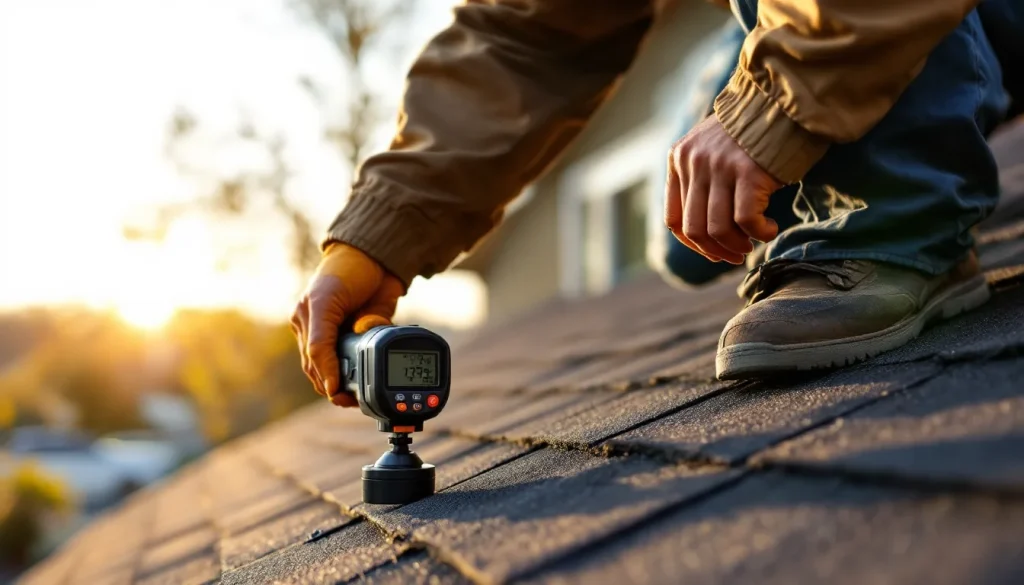
A roof pitch (see our pitch calculator method) chart converts the X/12 rise/run format used by builders to the degree angle and percentage slope formats used by architects, engineers, and code officials. In 2026, knowing your roof pitch matters for material selection (some shingles will not warrant below 2/12), walkability assessment (above 7/12 needs roof jacks or harness), and code minimums for different roofing types. Here is the complete conversion chart plus what each pitch range means for materials, code, walkability, and weather performance.
The short version
- Roof pitch is measured as rise over run, with the run held constant at 12 inches and the rise expressed as the X in X/12.
- To convert X/12 to degrees, take the arctangent of X divided by 12; to convert to percent slope, divide X by 12 and multiply by 100.
- A 4/12 pitch equals 18.43 degrees and 33.3 percent slope; a 6/12 pitch equals 26.57 degrees and 50 percent slope.
- Asphalt shingles require 2/12 minimum (with special detailing) and 4/12 minimum for standard warranty terms per IRC R905.2.
- Walkable pitches go up to 7/12 for fit installers; above 7/12 requires roof jacks, toe boards, or fall-arrest harness.
- Steep pitches above 9/12 require specialty labor at 25 to 50 percent labor premium versus standard slopes.
The Complete Pitch Chart: 1/12 Through 24/12
| Pitch (X/12) | Angle (Degrees) | Percent Slope | Slope Category |
|---|---|---|---|
| 1/12 | 4.76 | 8.33 | Low slope (membrane required) |
| 2/12 | 9.46 | 16.67 | Low slope (special details) |
| 3/12 | 14.04 | 25.00 | Conventional slope |
| 4/12 | 18.43 | 33.33 | Conventional slope (asphalt min) |
| 5/12 | 22.62 | 41.67 | Standard slope |
| 6/12 | 26.57 | 50.00 | Standard slope (very common) |
| 7/12 | 30.26 | 58.33 | Standard slope (walkable limit) |
| 8/12 | 33.69 | 66.67 | Standard slope (roof jacks) |
| 9/12 | 36.87 | 75.00 | Steep slope (specialty labor) |
| 10/12 | 39.81 | 83.33 | Steep slope |
| 11/12 | 42.51 | 91.67 | Steep slope |
| 12/12 | 45.00 | 100.00 | Steep slope |
| 13/12 | 47.29 | 108.33 | Steep slope |
| 14/12 | 49.40 | 116.67 | Steep slope |
| 15/12 | 51.34 | 125.00 | Steep slope |
| 16/12 | 53.13 | 133.33 | Steep slope |
| 17/12 | 54.78 | 141.67 | Steep slope |
| 18/12 | 56.31 | 150.00 | Steep slope |
| 19/12 | 57.72 | 158.33 | Very steep |
| 20/12 | 59.04 | 166.67 | Very steep |
| 21/12 | 60.26 | 175.00 | Very steep (specialty) |
| 22/12 | 61.39 | 183.33 | Very steep (specialty) |
| 23/12 | 62.45 | 191.67 | Very steep (specialty) |
| 24/12 | 63.43 | 200.00 | Very steep (specialty) |
How Roof Pitch Is Measured
Roof pitch is measured at any point on the roof slope by establishing a level run line and measuring the vertical drop to the roof plane below. The standard run distance is 12 inches, with the rise expressed in inches over that same 12-inch run. A 6/12 pitch rises 6 inches over a 12-inch horizontal run. The measurement is taken with a level held horizontally against the roof, a ruler or framing square measuring the rise, and a string line or chalk line marking the slope plane.
Pitch is constant across a single roof plane but varies between planes on multi-pitch roofs. A typical home with a primary gable plus a lower-pitch porch addition will have one pitch on the main roof and a second, shallower pitch on the porch. Both pitches matter for material selection because the lower pitch may not warrant the same shingle product.
Rise Over Run: The X/12 Format
The X/12 format is the builder shorthand used in the United States and Canada. The 12-inch run is the constant denominator (chosen because most framing squares have a 12-inch leg), with X representing the rise. The format is read aloud as “X in 12” or “X to 12.” A 4/12 pitch is read as “four in twelve.” Internationally, pitch is more often expressed as degrees or as a 1:N ratio (a 4/12 pitch is 1:3 in the European 1:N format).
Converting to Degrees: The Arctangent Formula
The conversion from X/12 to degrees uses the inverse tangent (arctangent) function. The formula is: degrees = arctan(X divided by 12). A 6/12 pitch converts as: arctan(6/12) = arctan(0.5) = 26.57 degrees. The conversion is symmetric: a 12/12 pitch is exactly 45 degrees because the rise equals the run, and the tangent of 45 degrees is 1.0.
Every smartphone calculator (set to degree mode) and every graphing calculator can perform this calculation. The chart above is the precomputed result for integer X values from 1 through 24. Non-integer pitches (like 4.5/12 or 7.5/12) interpolate between the chart values.
Converting to Percent Slope
Percent slope is the simpler conversion: percent slope = (X divided by 12) times 100. A 6/12 pitch is 50 percent slope. A 12/12 pitch is 100 percent slope (not 100 degrees). Percent slope is the format used in road and grading work, in ADA accessibility calculations, and in commercial roofing specifications. The format is intuitive once you internalize that 100 percent means a 45-degree angle, not vertical.
Low Slope (Below 2/12): Membrane Required
Pitches below 2/12 are classified as low slope by the IRC and most material manufacturers. Shingle products are not rated for this range because the shallow slope allows water to pond, wicks behind exposed fastener lines, and ages the material at accelerated rates. Low-slope roofs require membrane systems: modified bitumen, TPO, EPDM, PVC, or built-up roofing (BUR). The breakdown for two common membrane categories is at the modified bitumen and TPO articles published elsewhere in The Roofing Brief. Code reference: IRC R905.2.2 prohibits asphalt shingles below 2/12.
Conventional Slope (2/12 to 4/12): Material Restrictions
The 2/12 to 4/12 range is where asphalt shingles become technically allowable but with restrictive detailing. IRC R905.2.2 permits asphalt shingles on pitches as low as 2/12 with double-layer underlayment, but no manufacturer warrants the standard install at that pitch. Most product warranties (GAF, CertainTeed, Owens Corning, IKO) require 2/12 minimum with two layers of underlayment and self-adhered eave membrane extending well past the warm wall. At 3/12, single-layer synthetic underlayment becomes acceptable with most warranties.
Standard Slope (4/12 to 9/12): Most Asphalt Shingles
The 4/12 to 9/12 range is the sweet spot for residential roofing. Asphalt shingles install with full warranty terms. The slope sheds water and snow effectively without creating walkability hazards. The architectural proportions are pleasing for most house styles. The 6/12 pitch is the most-common residential pitch in the United States, balancing material economy, weather performance, and architectural proportion. The 5/12 and 7/12 pitches are nearly as common, particularly in regional styles (5/12 common in southern markets, 7/12 in northern markets and snowbelt states).
Steep Slope (9/12 to 21/12): Walkability Concerns
Pitches from 9/12 to 21/12 require roof jacks, toe boards, or fall-arrest systems for safe access. The labor cost premium runs 25 to 50 percent above standard-slope work because the install pace slows, scaffolding may be required, and OSHA fall-protection compliance adds setup time. Material choice expands at steep slopes: slate, cedar shake, and decorative tile become architecturally appropriate, and the steep slope makes the visual texture of these materials more apparent from the street.
Very Steep (Above 21/12): Specialty Work
Pitches above 21/12 (above 60 degrees) approach vertical and are treated as wall cladding from an installation standpoint. The 18/12 and steeper pitches appear on Mansard roofs (the steep lower slope is often 18/12 to 22/12), Victorian turrets, Gothic Revival churches, and modern-architectural angular roofs. The labor premium can reach 75 to 150 percent above standard slope, with specialty fall-protection equipment and rigging required. The mansard roof geometry is the most-common context for very-steep pitches.
Material Compatibility by Pitch
| Material | Minimum Pitch | Maximum Pitch | Sweet Spot |
|---|---|---|---|
| EPDM membrane | 1/4 in 12 (essentially flat) | 12/12 | 1/12 to 4/12 |
| TPO membrane | 1/4 in 12 | 12/12 | 1/12 to 4/12 |
| Modified bitumen | 1/4 in 12 | 6/12 | 1/12 to 4/12 |
| Built-up roofing (BUR) | 1/4 in 12 | 3/12 | 1/12 to 3/12 |
| Asphalt shingles (special) | 2/12 | 21/12 | 4/12 to 12/12 |
| Asphalt shingles (standard) | 4/12 | 21/12 | 5/12 to 9/12 |
| Standing seam metal (mech seam) | 1/4 in 12 | No limit | 3/12 to 12/12 |
| Standing seam metal (snap lock) | 3/12 | No limit | 4/12 to 12/12 |
| Corrugated metal through-fastener | 3/12 | No limit | 4/12 to 9/12 |
| Concrete or clay tile | 2.5/12 (special) | 21/12 | 4/12 to 7/12 |
| Natural slate | 4/12 | 21/12 | 6/12 to 12/12 |
| Cedar shake | 4/12 | 21/12 | 5/12 to 10/12 |
Code Minimums by Material (IRC R905 References)
The International Residential Code Section R905 governs material-specific roofing installation. R905.1.1 sets general slope requirements: roof coverings must be installed in accordance with the requirements of Section R905 and the manufacturer install instructions. R905.2.2 sets asphalt shingle minimum slope at 2/12 with double underlayment and 4/12 for single underlayment standard installation. R905.10.2 sets metal panel slope minimums per the manufacturer install instructions, typically 3/12 for through-fastener and 1/4 in 12 for mechanically-seamed standing seam. R905.3.2 sets concrete and clay tile minimum slope at 2.5/12 with reinforced underlayment.
How to Measure Pitch on Your Own Roof
Three methods give an accurate roof pitch measurement without climbing onto the roof itself. First, the attic method: place a 12-inch level horizontally against the underside of a rafter, mark the point 12 inches along the level, then measure the vertical distance from that point up to the rafter underside. That vertical distance is the X in X/12. Second, the gable-end method: from inside or outside, measure the horizontal width of the gable and the vertical height from the top plate to the peak. Pitch = (height divided by half the width) times 12. Third, the smartphone app method: smartphone tools like Pitch Gauge, Klein Tools Bubble Level, and the iOS Measure app use the device gyroscope to read the angle of a flat surface; the app reads the slope when held against any roof plane.
Pitch and Wind Performance
Steeper pitches have lower wind-uplift pressure on the panels and shingles because the wind component perpendicular to the roof surface decreases as the pitch increases. A 12/12 pitch experiences roughly 30 to 50 percent lower direct uplift than a 4/12 pitch in the same wind speed. The flip side is that steeper pitches have larger sail area at the gable end, increasing lateral loads on the framing and the wall anchorage. For hurricane-prone regions, the optimal pitch range balances these factors at 6/12 to 9/12, which is also the most-common pitch range in coastal residential construction. Full hurricane-zone discussion at best roof for hurricane.
Pitch and Snow Load
Steeper pitches shed snow faster and reduce ground snow load on the roof. A 4/12 pitch holds snow indefinitely in cold conditions, accumulating to the full ground snow load value. A 7/12 pitch sheds 30 to 50 percent of snow load over a typical winter. A 12/12 pitch sheds nearly all snow load, with snow guards or rails required to prevent rooftop avalanches over doorways and walkways. The IRC and ASCE 7 reduce the calculated snow load for steeper-pitched roofs through a slope factor (Cs) that decreases linearly from 1.0 at 30 degrees (roughly 7/12) to 0.0 at 70 degrees (roughly 33/12).
Pitch and Material Lifespan
Steeper-pitched asphalt shingles last 15 to 25 percent longer than the same shingle on a shallow pitch, primarily because water sheds faster (reducing wet-time UV damage and granule loss) and because temperature swings are slightly moderated by faster air movement across the slope. A 30-year shingle warranty assumes installation in the standard slope range of 4/12 to 9/12; the actual service life on a 3/12 installation is typically 18 to 24 years, while the same shingle on an 8/12 may reach 26 to 32 years. The full lifespan discussion is at how long does a roof last.
Pitch and Roofing Cost
Pitch affects total roof cost through three mechanisms: surface area (steeper roofs have more square footage to cover for the same building footprint), labor pace (steeper roofs install more slowly), and material waste (steeper roofs sometimes generate more cutting waste at hip and valley intersections). The square-footage multiplier is calculable: a 6/12 pitch roof has 1.118 times the surface area of the building footprint, while a 12/12 pitch roof has 1.414 times. Labor pace slows by 10 to 30 percent on steep slopes, with the slowdown accelerating above 9/12. Roofing cost data including the pitch multipliers is at how much does a new roof cost.
Pitch and Ventilation
Steeper-pitched roofs have a slight ventilation advantage from the stack effect: warm air in the attic rises faster through a steeper geometry, increasing the air change rate through ridge and soffit vents. The effect is real but small (typically 5 to 15 percent higher air change rates on 9/12 vs 4/12 roofs), and proper ventilation design dominates the actual performance. The complete ventilation discussion is at attic ventilation. The IRC R806 minimums (1 to 150 or 1 to 300 net free area ratios) apply equally across all pitches.
Pitch and Solar Panel Performance
Solar PV panels perform best at a tilt angle approximately equal to the site latitude for year-round generation, or angle minus 15 degrees for summer-peak generation. For a 40-degree latitude site (Denver, Philadelphia, Indianapolis), the optimal panel tilt is 40 degrees, which converts to approximately a 10/12 roof pitch. Solar installers often add tilt brackets on shallower-pitched roofs to bring the panel angle closer to optimum, with the tilt bracket cost running $100 to $250 per panel and the energy gain typically 5 to 12 percent annually compared to flush-mounted panels at the original roof pitch.
Common Pitch Errors and Misreadings
Three common errors occur when measuring or specifying pitch. First, confusing the format: a 6/12 pitch is six inches of rise per twelve inches of run, not six degrees and not six percent. The format is rise-over-run, not angle. Second, measuring on the underlayment instead of the rafter: underlayment dips slightly between rafters and over-rounds at the ridge, introducing measurement error of 0.2 to 0.5 in 12. Third, taking a single measurement on a multi-pitch roof: each plane needs its own measurement, and the main roof pitch is not the same as the porch pitch or the dormer pitch.
Pitch and Architectural Style
Different architectural styles have characteristic pitch ranges. Ranch-style homes typically use 3/12 to 5/12 for the low, horizontal aesthetic. Cape Cod homes use 9/12 to 12/12 for the steep, attic-friendly profile. Colonial homes use 8/12 to 10/12. Victorian homes use 10/12 and steeper, with turret elements reaching 18/12 to 24/12. Mediterranean and Spanish Revival homes use 3/12 to 5/12 to suit tile roofing. Modern-contemporary uses anywhere from flat (1/4 in 12) to steep angular forms (8/12 to 12/12). The pitch and shape together define the roof type at gable roof, hip roof, gambrel roof, and mansard roof articles.
Frequently Asked Questions
What is the most common roof pitch?
6/12 is the single most-common residential roof pitch in the United States, with 5/12 and 7/12 close behind. Together those three pitches account for roughly 55 percent of single-family residential roofs. Regional variation is significant: northern markets skew toward 7/12 to 9/12, southern markets toward 4/12 to 5/12.
What is the minimum pitch for asphalt shingles?
The IRC R905.2.2 minimum is 2/12 with double underlayment and special detailing. The manufacturer warranty minimum is typically 4/12 for standard install or 2/12 with the double-underlayment detail. Most reputable installers will not install asphalt shingles below 3/12 because of the early-failure risk.
What pitch is considered walkable?
Pitches up to 7/12 are walkable for fit installers in proper footwear without specialized fall protection beyond fall-arrest harness and tie-off where OSHA requires it. Pitches from 7/12 to 9/12 require roof jacks or toe boards. Pitches above 9/12 require specialty fall-arrest systems and slow the work significantly.
What is the steepest possible roof pitch?
Practical maximum residential pitches are 24/12 (63.4 degrees), used on Mansard lower slopes, Victorian turrets, and modern angular forms. Above 24/12, the surface is treated structurally as a wall, with different code and material requirements. Vertical walls clad with roofing material (slate, cedar shingles) are also occasionally seen on dormers and turrets.
How do I convert roof pitch to degrees?
Take the arctangent of (rise divided by 12). On a smartphone calculator set to degree mode: for a 6/12 pitch, enter 0.5, then press the inverse tangent (tan to the negative 1) button. The result is 26.57 degrees. The full chart above shows the precomputed conversions for X = 1 through 24.
Does roof pitch affect insurance rates?
Some carriers (particularly in hurricane and high-wind regions) offer credits for steeper pitches because of the reduced wind-uplift pressure. The credit is typically 3 to 8 percent of the wind premium portion of the policy. Other carriers offer credits for pitches in the 4/12 to 7/12 range because of better walkability for adjusters during claim inspections. Carrier practices vary widely.
What is the easiest pitch to roof?
The 4/12 to 6/12 range is the easiest to install for most roofing materials. Below 4/12, special low-slope details add labor. Above 7/12, fall protection and slower work pace add labor. 5/12 and 6/12 are the pitch sweet spot for asphalt shingle install speed and crew productivity.