
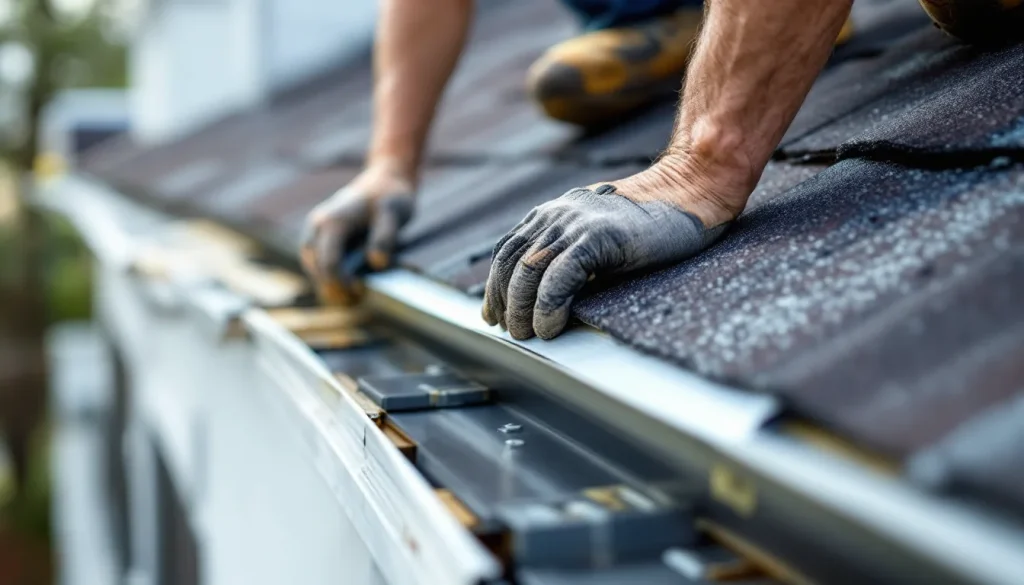
Starter shingles are the first row of shingles installed along the eaves and rakes of a roof, providing the critical adhesive seal that holds the first course of field shingles in place against wind uplift. In 2026, pre-cut starter strips cost $25 to $45 per bundle (covering roughly 100 to 120 linear feet), and skipping starter strips voids most manufacturer wind warranties. The reason: a field shingle relies on the asphalt sealant strip on its underside to bond to the shingle below. The first course at the eave has nothing below it except the underlayment. Without starter shingles to bond to, the first course lifts in the first 60+ mph gust and the whole roof unzips.
The short version
- Starter shingles cost $25 to $45 per bundle in 2026 (covers 100 to 120 LF), or about $0.25 to $0.45 per linear foot of eave plus rake.
- A typical 2,400 sq ft home needs 3 to 4 bundles of starter (200 to 280 LF of eave plus rake), totaling $75 to $180.
- The pre-cut product (GAF ProStart, Owens Corning Starter Roll, CertainTeed SwiftStart) has the adhesive strip positioned at the eave edge, where the first field shingle bonds to it.
- Cutting starter from 3-tab shingles is the historic method but voids the wind warranty on every modern architectural shingle line.
- Starter goes on after drip edge and ice and water shield, before the first course of field shingles.
- Rake starter (the gable-end run) is the most commonly skipped detail and the most common wind-failure starting point.
Short answer: what starter shingles cost and what they do
Pre-cut starter at 2026 supply pricing: GAF ProStart runs $32 to $42 per bundle (105 LF). Owens Corning Starter Strip Plus runs $35 to $48 per bundle (100 LF). CertainTeed SwiftStart runs $28 to $38 per bundle (110 LF). Atlas Pro-Cut Starter runs $25 to $35 per bundle (120 LF). Installed labor adds $0.20 to $0.50 per linear foot, putting total installed cost at $0.45 to $0.95 per LF.
The function is simple and load-bearing for the warranty: the starter strip provides the asphalt sealant bead that bonds the first course of field shingles to the eave. Every architectural shingle has a continuous sealant strip on its underside, set back from the bottom edge by about 5 to 7 inches. That sealant is meant to bond to the top of the shingle below it. At the eave, there is no shingle below; the starter strip provides the bond.
What starter shingles do: the wind uplift problem
Wind hitting a roof creates an uplift pressure zone along the eaves, rakes, and ridge. The eave is the highest-pressure zone because air accelerates as it curls under the overhang and over the edge. ASCE 7 wind loading calculations show eave uplift pressures of 50 to 90 psf in 110+ mph winds; the field of the roof sees only 20 to 35 psf in the same wind event.
A field shingle has two defenses against uplift: the four to six nails holding it to the deck, and the asphalt sealant strip bonding it to the shingle below. Both must be present. The first course at the eave has nails (it is nailed to the deck like every other course), but without a starter strip below it, the sealant has nothing to bond to. The first course flips up, the wind gets under the second course, the second course flips up, and the unzip propagates across the roof.
This is not a theoretical failure mode. Post-storm damage assessments from Hurricane Michael (2018) and the 2023 Florida tornado outbreaks consistently showed that the failure starting point on shingled roofs was the eave or rake, not the ridge, and the field shingles were ripped off course-by-course from a single unzip line.
Pre-cut starter vs DIY cut from 3-tab
Before pre-cut starter became standard around 2008, roofers cut 3-tab shingles into the starter strip by trimming off the tab portion and using the upper 7-inch strip. This still happens on budget jobs, and like cut ridge cap, it has serious problems.
The cut-3-tab method puts the sealant strip in the wrong position. A 3-tab shingle’s sealant strip is positioned to bond to the next course up, not to the eave edge. When you cut a 3-tab horizontally to use as starter, the sealant strip ends up 2 to 4 inches above the eave edge, leaving the first 2 to 4 inches of the first field shingle unsupported. That gap is exactly where wind uplift starts.
Pre-cut starter is engineered with the sealant strip 1/2 to 1 inch from the eave edge, so the first field shingle bonds tightly along its lowest edge. That difference of 2 to 4 inches in bond location is the difference between a roof that holds in 130 mph wind and a roof that unzips in 75 mph.
| Method | Sealant strip position | Bond zone | Wind rating | Warranty |
|---|---|---|---|---|
| Cut 3-tab (DIY method) | 2-4 in above eave edge | Mid-shingle, leaves bottom edge unsealed | 60-90 mph at best | Voids manufacturer warranty |
| Pre-cut starter strip | 0.5-1 in from eave edge | Full bottom edge of first course | 110-150 mph rated | Full system warranty |
| Pre-cut high-wind starter | 0.5-1 in from eave edge + double sealant | Full bottom edge + secondary bond | 150+ mph rated | Full system warranty + wind endorsement |
Brand options: the major starter products
Like ridge cap, starter is part of the matched manufacturer system. The brand must match the field shingle brand for warranty purposes.
| Brand product | Manufacturer | Coverage per bundle | Wind rating | Retail (2026) |
|---|---|---|---|---|
| GAF ProStart Starter Strip | GAF (matched to Timberline HDZ) | 105 LF | ASTM D7158 Class H (150 mph) | $32-$42 |
| Owens Corning Starter Strip Plus | Owens Corning (matched to Duration) | 100 LF | ASTM D7158 Class H (150 mph) | $35-$48 |
| CertainTeed SwiftStart | CertainTeed (matched to Landmark) | 110 LF | ASTM D7158 Class G (120 mph) | $28-$38 |
| CertainTeed High-Performance Starter | CertainTeed | 105 LF | ASTM D7158 Class H (150 mph) | $36-$48 |
| Atlas Pro-Cut Starter | Atlas (matched to Pinnacle Pristine) | 120 LF | ASTM D7158 Class G (120 mph) | $25-$35 |
| IKO Leading Edge Plus | IKO | 105 LF | ASTM D7158 Class G (120 mph) | $28-$38 |
| Malarkey EZ-Start | Malarkey | 110 LF | ASTM D7158 Class H (150 mph) | $32-$42 |
One detail to watch: GAF ProStart and Owens Corning Starter Strip Plus come as pre-cut individual strips, while CertainTeed SwiftStart and Atlas Pro-Cut come as a roll that the installer cuts to length. The roll format is faster on long straight runs but creates more waste on short eaves with multiple cuts.
Eave installation: the primary use case
Starter shingles run along the entire eave edge of every roof plane, from rake to rake. The installation sequence:
- Confirm drip edge is installed at the eave (over the underlayment if it is felt, under if it is synthetic per most manufacturer specs).
- Confirm ice and water shield is installed over the drip edge in cold climates.
- Start the starter run at one rake. Most installers start at the rake where the prevailing wind will blow over (downwind end).
- Position the starter strip with the adhesive sealant edge along the bottom (at the eave edge) and the cut edge along the top.
- Overhang the drip edge by 1/4 to 3/8 inch. This puts the starter’s sealant strip directly over the drip edge for maximum wind resistance.
- Nail the starter strip with four nails per piece, 3 to 4 inches up from the eave edge.
- Butt subsequent starter pieces (do not lap them).
- Stop the starter run flush with the opposite rake.
The starter strip’s bottom edge should align with the bottom edge of the first field shingle. Both will sit 1/4 to 3/8 inch past the drip edge.
Rake installation: the most commonly missed detail
The rake is the angled edge of a gable roof running from the eave to the ridge. Starter at the rake serves the same wind-uplift function as at the eave, but it is more often skipped because it requires hand-cutting strips to fit the rake length and orientation.
Pre-2010, most installers ran starter only at the eaves. Modern manufacturer specs (GAF, Owens Corning, CertainTeed all updated their install specs between 2010 and 2015) now require starter at both the eaves and the rakes for the enhanced wind warranty.
Rake starter installation:
- Confirm rake drip edge is installed (over the underlayment).
- Cut the starter strip lengthwise to about 8 to 9 inches wide.
- Run the cut strip up the rake with the adhesive sealant strip facing toward the rake edge.
- Overhang the rake drip edge by 1/4 to 3/8 inch.
- Nail with two nails per piece, 3 to 4 inches in from the rake edge.
The rake starter bonds the rake edges of every field shingle, preventing wind uplift on the gable end. On homes built in tornado alley, on the Gulf Coast, and on the Atlantic coast, this detail is the difference between a roof that holds and a roof that loses its leading rake first.
The adhesive strip orientation: get this wrong and starter does nothing
This is the single most common installation error: installing starter shingles with the adhesive strip facing the wrong direction (toward the ridge instead of toward the eave).
If the adhesive strip faces toward the ridge, it ends up under the upper portion of the first field shingle, where the field shingle’s own sealant strip already provides a bond. The first 5 to 7 inches of the field shingle at the eave have no bond at all. Wind goes under, lifts the first course, and the roof unzips.
If the adhesive strip faces toward the eave (correct), it sits directly under the first 1 to 2 inches of the field shingle and bonds the lowest edge to the deck. This is the only correct installation.
How to tell: the adhesive strip is the dark, slightly tacky line about 1 inch wide running the length of the starter strip. It should be visible at the eave edge when you look at the starter strip from the ground. If you see it 4 to 5 inches up from the eave, the strip is upside down. This is a fixable error during installation but invisible once the field shingles are on top.
ASTM D7158 wind requirement
The asphalt shingle wind standard, ASTM D7158, tests the entire roof system (starter, field shingles, ridge cap) under realistic wind loading. The tests measure how much wind pressure the system can handle before the bond fails and the shingle lifts. Class ratings and what each requires from the starter:
| Wind class | Wind speed | Starter required | Nail pattern | Code reference |
|---|---|---|---|---|
| Class D (basic) | 90 mph | Pre-cut starter at eaves | 4 nails per shingle | IRC R905.2.4 |
| Class G (standard) | 120 mph | Pre-cut starter at eaves and rakes | 4 nails per shingle | IRC R905.2.6 / ASTM D7158 Class G |
| Class H (premium) | 150 mph | Pre-cut high-wind starter at eaves and rakes | 6 nails per shingle | ASTM D7158 Class H |
| HVHZ (Florida) | 180+ mph | Pre-cut high-wind starter, all edges, sealant bead added | 6 nails per shingle, ring shank | FBC HVHZ R4406 |
For a shingle system to qualify for its Class H rating, the manufacturer requires the matched starter product. A GAF Timberline HDZ field roof installed with a generic starter strip is only rated to Class G even though the shingle itself can do Class H. The full Class H rating requires GAF ProStart starter, GAF Seal-A-Ridge cap, and a 6-nail install pattern (vs the standard 4-nail).
Manufacturer warranty implications
Starter is one of the four accessory products (along with cap, ice and water shield, and underlayment) required to maintain the enhanced manufacturer system warranty.
- GAF Golden Pledge / System Plus: requires GAF ProStart plus 3 other GAF accessories. Without it, you fall back to the standard limited warranty.
- Owens Corning Platinum / Preferred: requires Starter Strip Plus plus 3 other OC accessories.
- CertainTeed SureStart Plus / 4-Star / 5-Star: requires SwiftStart or High-Performance Starter.
- Atlas Signature Select: requires Pro-Cut Starter.
The math is the same warranty math: a $40 to $80 saving on starter forfeits a $4,000 to $8,000 enhanced warranty.
DIY install steps
Starter is one of the more DIY-friendly roof detail components because it is at the eave (easier access than ridge work), the cuts are minimal, and the nailing is straightforward. A DIY install:
- Measure the total eave length plus rake length. Add 10% for waste and laps.
- Buy the brand-matched starter for your field shingles.
- Confirm drip edge and ice and water shield are correctly installed.
- Lay out the first starter piece on the eave, overhanging the drip edge by 1/4 inch with the adhesive strip at the bottom.
- Nail with 1-1/4 inch coil nails, four per piece, 3 to 4 inches from the eave edge.
- Butt subsequent pieces.
- At rakes, cut the starter strip to 8 to 9 inches wide and run up the rake with the adhesive strip toward the rake edge.
The most common DIY mistake is the upside-down strip described above. Double-check before nailing.
Common starter mistakes
- Adhesive strip facing the wrong direction. Strip must face the eave/rake edge, not the ridge.
- No starter at the rakes. The most commonly skipped detail. Required for the wind warranty.
- Cut 3-tab as starter. Puts the sealant in the wrong position and voids the warranty.
- Overhanging too much. More than 3/8 inch overhang creates a wind-catch edge that lets gusts lift the starter.
- Overhanging too little. Zero overhang lets water wick back under the starter and onto the deck.
- Wrong nail position. Nails too close to the eave edge are visible from the ground after the first field course; nails too high up miss the deck and only catch underlayment.
- Mixing brands. Generic starter on a branded field roof voids the warranty.
- Skipping starter at dormers and step-ups. Every roof plane needs starter at its eave and rakes, including small dormer roofs.
Cost per home size
| Home size (sq ft) | Eave LF | Rake LF | Total LF | Bundles needed | Material cost | Installed cost |
|---|---|---|---|---|---|---|
| 1,200 (small ranch) | 120 | 60 | 180 | 2 | $56-$84 | $108-$190 |
| 1,800 (mid ranch) | 160 | 80 | 240 | 3 | $84-$126 | $144-$252 |
| 2,400 (2-story colonial) | 180 | 100 | 280 | 3 | $84-$126 | $168-$294 |
| 2,400 (hip roof) | 250 | 0 (hip has no rake) | 250 | 3 | $84-$126 | $150-$263 |
| 3,200 (large 2-story) | 220 | 140 | 360 | 4 | $112-$168 | $216-$378 |
| 4,000 (custom complex) | 280 | 200 | 480 | 5 | $140-$210 | $288-$504 |
Starter for specialty roof types: metal, hip, low slope
The pre-cut starter products described above are designed for architectural asphalt shingle roofs. Starter logic changes for other roof types:
- Metal roofs. Standing seam and exposed-fastener metal panels do not use shingle starter. The eave detail is handled by an eave trim or drip flashing that ties into the panel system. High-temp ice and water shield still goes at the eave under the panels.
- Hip roofs. Hip roofs have no rakes, so all starter goes at the eaves only. Hip roof homes typically use 30% to 40% less starter material than gable homes of the same square footage.
- Low-slope shingle sections (2/12 to 4/12). Most shingle manufacturers void the wind warranty below 4/12 pitch even with proper starter. Below 4/12, the standard practice is to use full-coverage ice and water shield, double-up the starter, and accept that the shingle is being installed in a marginal application.
- Cedar shake or wood shingle. Wood shake uses a different starter system: typically a 12 to 15 inch wide starter course of single shakes installed on a closed-deck or open-deck (skip-sheathing) substrate. Wood starter and asphalt starter are not interchangeable.
Starter in the broader roof system
Starter is one of four critical detail components (along with ridge cap, ice and water shield, and drip edge) that turn a stack of field shingles into a wind-rated, code-compliant, warranty-eligible system. Each component has a small material cost relative to the overall roof but an outsized impact on warranty coverage and wind performance. For the full system breakdown and how each detail interacts, read parts of a roof and asphalt shingle roof lifespan.
Frequently asked questions
Are starter shingles really necessary?
Yes. Without starter strips, the first course of field shingles has no sealant bond and lifts in moderate wind. Every major manufacturer requires starter for the enhanced wind warranty, and most building codes adopt the manufacturer install spec by reference.
Can I use 3-tab shingles as starter?
The historical practice is to cut 3-tab horizontally and use the upper 7-inch strip. This puts the sealant in the wrong position (too high up the shingle) and voids the wind warranty on every major architectural shingle line. Use the pre-cut matched starter product.
How many starter shingles do I need?
Measure total eave length plus total rake length. Divide by the bundle coverage (typically 100 to 120 LF per bundle) and add 10% for waste. A 2,400 sq ft home typically needs 3 bundles.
Do I need starter at the rakes or just the eaves?
Both, per modern manufacturer specs. Eave-only starter was the pre-2010 standard. Today GAF, Owens Corning, and CertainTeed all require rake starter for the enhanced wind warranty.
What is the difference between starter shingles and underlayment?
Underlayment is a water-resistive sheet covering the whole deck. Starter shingles are an asphalt shingle product running only along the eaves and rakes, providing the adhesive bond for the first course of field shingles. They serve different functions and both are required.
Can I install starter strips over existing shingles?
No. Starter (like all shingle products) must be installed on a clean deck with underlayment in place. A roof-over (new shingles over existing) is a separate scope with its own starter logic, but it is generally not recommended.
Will my roofer install starter automatically?
A reputable roofer will. A budget roofer will often substitute cut 3-tab to save $80 to $150 per job. Spec the starter explicitly in the contract: “GAF ProStart starter at all eaves and rakes” or the equivalent for your brand. See our guide on choosing a roofing contractor.