
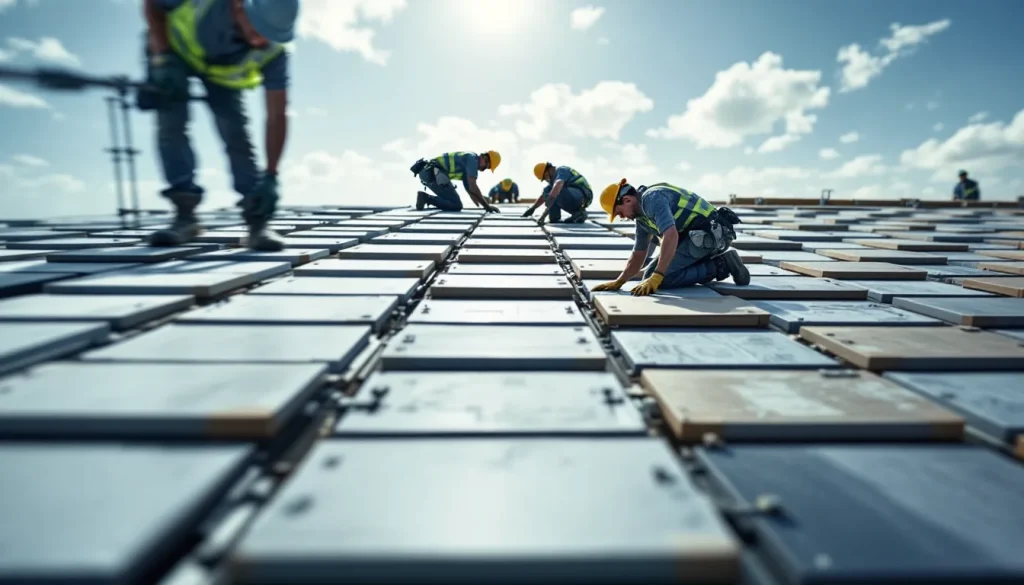
Roofing cost per square in 2026 ranges from $350 for low-end 3-tab asphalt to $1,500+ for premium standing seam metal, where one “square” equals 100 square feet of roof area (the contractor pricing unit). Material accounts for roughly 40% of that and labor (for the full data set, see the 2026 Roofing Labor and Wage Report) 60%, with regional variation of plus or minus 25%. Per-square pricing is how every commercial roofing supply house, every estimator software package, and every honest roofing contractor quotes a job, because it lets the cost scale linearly with roof size and pitch. Here is the complete 2026 per-square breakdown by material, region, scope, and roof complexity.
The short version
- One roofing square = 100 square feet of roof surface area (not floor area).
- 2026 installed pricing per square: 3-tab asphalt $350 to $500, architectural asphalt $450 to $700, premium asphalt $700 to $1,000, standing seam metal $1,000 to $1,500, tile $1,000 to $1,800, slate $1,500 to $3,500.
- Material is roughly 40% of the per-square cost; labor is 60%, including decking inspection, underlayment, flashing, and disposal.
- Regional variation runs plus or minus 25%: Northeast and West Coast highest, Southeast and Midwest lowest.
- Tear-off of existing shingles adds $100 to $200 per square; decking replacement adds $75 to $150 per sheet of OSB or plywood.
- Steep pitch (above 6/12) adds 10% to 50% to labor cost; complex hip, dormer, and valley features add another 10% to 25%.
- Per-square is the contractor unit; per-square-foot is the homeowner unit (1 square = 100 sq ft, so $500/square = $5/sq ft).
Short answer: per-square cost by material
The price-per-square chart below is the 2026 national average for an installed roof on a typical 6/12 to 8/12 pitch home with a single layer tear-off and standard accessories (drip edge, ice and water shield, underlayment, starter, ridge cap). Higher pitch, premium accessories, multiple layers to tear off, or complex roof geometry add 10% to 50% to these numbers.
| Material | Material cost / sq | Labor cost / sq | Installed total / sq | Installed total / sq ft | Expected lifespan |
|---|---|---|---|---|---|
| 3-tab asphalt shingle | $95-$140 | $255-$360 | $350-$500 | $3.50-$5.00 | 15-20 yr |
| Architectural asphalt shingle | $135-$220 | $315-$480 | $450-$700 | $4.50-$7.00 | 25-30 yr |
| Premium asphalt (impact-rated, designer) | $240-$380 | $460-$620 | $700-$1,000 | $7.00-$10.00 | 30-50 yr |
| Exposed-fastener metal (corrugated, ribbed) | $285-$450 | $365-$550 | $650-$1,000 | $6.50-$10.00 | 40-60 yr |
| Standing seam metal | $425-$650 | $575-$850 | $1,000-$1,500 | $10.00-$15.00 | 50-70 yr |
| Stone-coated steel | $385-$560 | $515-$740 | $900-$1,300 | $9.00-$13.00 | 40-60 yr |
| Concrete tile | $385-$580 | $615-$920 | $1,000-$1,500 | $10.00-$15.00 | 50+ yr |
| Clay tile | $485-$780 | $715-$1,020 | $1,200-$1,800 | $12.00-$18.00 | 75-100 yr |
| Wood shake / shingle | $385-$560 | $615-$940 | $1,000-$1,500 | $10.00-$15.00 | 20-40 yr |
| Slate (natural) | $685-$1,580 | $815-$1,920 | $1,500-$3,500 | $15.00-$35.00 | 75-150 yr |
| Synthetic slate / composite | $385-$685 | $615-$915 | $1,000-$1,600 | $10.00-$16.00 | 40-50 yr |
What “square” means in roofing
The roofing “square” is a contractor unit of measurement equal to 100 square feet of roof surface. It originated in the late 1800s when shingle bundles were manufactured to cover one-third of a square, so three bundles equaled one square’s coverage. The unit stuck.
Critical distinction: a roofing square measures the roof’s actual surface area, not the home’s floor area. A 2,400 sq ft floor-plan home with a steep 12/12 pitch roof has a roof surface area of roughly 3,400 sq ft (or 34 squares) because the steep pitch makes the roof larger than the footprint. The same 2,400 sq ft floor plan with a 4/12 pitch has a roof surface area of roughly 2,600 sq ft (26 squares).
This is why per-square pricing is more accurate than per-square-foot-of-living-area pricing: it scales correctly with pitch and overhang. A roofer quoting “$8 per square foot of your home” is either using a shortcut that loses accuracy on steep or complex roofs, or padding the price to cover the uncertainty.
How to measure your roof in squares
You can estimate your roof’s square footage three ways:
- Ground measurement plus pitch multiplier. Measure the home’s footprint in square feet (length x width). Add eaves (typically 1.5 to 2 ft overhang on each side). Multiply by the pitch multiplier from the table below.
- Aerial measurement service. EagleView, HOVER, and GAF QuickMeasure provide aerial roof measurements for $20 to $75 per home. Most professional roofers use these now.
- Walk the roof and tape-measure each plane. Most accurate but requires roof access and time.
Pitch multiplier table for ground-measurement estimating:
| Pitch (rise/run) | Angle | Multiplier | Example: 2,400 sq ft footprint roof area |
|---|---|---|---|
| 2/12 | 9.5° | 1.014 | 2,434 sq ft |
| 4/12 | 18.4° | 1.054 | 2,530 sq ft |
| 6/12 | 26.6° | 1.118 | 2,683 sq ft |
| 8/12 | 33.7° | 1.202 | 2,885 sq ft |
| 10/12 | 39.8° | 1.302 | 3,125 sq ft |
| 12/12 | 45.0° | 1.414 | 3,394 sq ft |
| 14/12 | 49.4° | 1.537 | 3,689 sq ft |
| 16/12 | 53.1° | 1.667 | 4,001 sq ft |
For a complete pitch reference and how to identify your home’s pitch from the ground, see our roof pitch chart.
Material cost per square: the detail
3-tab asphalt shingle ($95 to $140 per square material). The lowest-cost shingle option, with a single layer of granules and no laminated tab pattern. Wind rating is 60 mph (basic). The bottom of the market for new construction tract homes and budget replacements. Most major manufacturers have de-emphasized 3-tab in favor of architectural; expect 3-tab availability to shrink through the late 2020s.
Architectural (dimensional, laminated) asphalt shingle ($135 to $220 per square material). The market standard since the early 2010s. Two layers of asphalt-and-granule laminated together for a dimensional look and improved wind resistance (110 to 130 mph). Major lines: GAF Timberline HDZ, Owens Corning Duration, CertainTeed Landmark, Atlas Pinnacle Pristine.
Premium asphalt shingle ($240 to $380 per square material). Impact-rated (UL 2218 Class 4), high-wind (150 mph), or designer-look shingles. GAF Timberline UHDZ, OC TruDefinition Duration FLEX, CertainTeed Landmark Premium, GAF Camelot. Insurance discounts (typically 10% to 30% off the wind/hail portion of the premium) often offset the material upcharge in storm-prone regions within 4 to 7 years.
Exposed-fastener metal ($285 to $450 per square material). Corrugated or ribbed metal panels with the fastener heads visible on the surface. Less expensive than standing seam but the gasket washers under the exposed fasteners need replacement at 15 to 25 years.
Standing seam metal ($425 to $650 per square material). Vertical-rib metal panels with concealed fasteners. The premium metal option for residential, with 24 or 26 gauge steel or aluminum panels in PVDF (Kynar 500) or SMP paint finishes. See standing seam metal roof cost for the full breakdown.
Concrete tile ($385 to $580 per square material). Common in Florida, Texas, Arizona, and California. Long lifespan but heavy (8 to 12 psf), which often requires structural reinforcement on homes not originally designed for tile.
Clay tile ($485 to $780 per square material). Mediterranean and Spanish style roofs. Even heavier than concrete (10 to 16 psf). The premium look for high-end homes in southwestern climates.
Slate ($685 to $1,580 per square material). Natural quarried slate from Vermont, Pennsylvania, New York, or imported from Spain or Wales. The longest-lifespan roof material at 75 to 150 years.
Labor cost per square: the 60% rule
Labor typically accounts for roughly 60% of the installed per-square cost, with material accounting for 40%. The split varies by material:
| Material | Material % of total | Labor % of total | Why the labor share is what it is |
|---|---|---|---|
| 3-tab asphalt | 30% | 70% | Cheap material, standard install labor |
| Architectural asphalt | 35% | 65% | Slightly more material cost, similar labor |
| Premium asphalt | 40% | 60% | Higher material cost, similar labor |
| Standing seam metal | 45% | 55% | Expensive panels, skilled install labor required |
| Tile | 45% | 55% | Heavy material, slower install, specialized labor |
| Slate | 50% | 50% | Premium material, slowest install, master roofer required |
Labor includes the tear-off of the old roof, deck inspection and minor repair, installation of the new underlayment and flashing system, the field shingles or panels, ridge venting, ridge cap, gutter cleanout, and dump fees. Insurance, equipment overhead, and supervisor labor are included in the per-square labor rate.
Regional cost variation
Roofing cost varies plus or minus 25% by region in 2026, driven by labor rates, material freight, code requirements, and licensing/permit costs.
| Region | States covered | Architectural asphalt / sq | Standing seam / sq | vs. national avg |
|---|---|---|---|---|
| Northeast | NY, NJ, MA, CT, RI | $550-$800 | $1,200-$1,800 | +15-25% |
| Mid-Atlantic | PA, MD, DE, VA, DC | $500-$725 | $1,100-$1,650 | +5-15% |
| Southeast | NC, SC, GA, FL panhandle, AL | $425-$625 | $950-$1,400 | -5-10% |
| Florida (peninsula) | FL central, south, Keys | $525-$775 | $1,150-$1,650 | +5-15% (HVHZ code) |
| Gulf Coast | MS, LA, AL coastal, TX coastal | $475-$700 | $1,050-$1,550 | 0-10% (high-wind code) |
| Midwest | OH, IN, IL, MI, WI, IA, MN | $425-$625 | $950-$1,400 | -5-10% |
| Plains | NE, KS, MO, OK, AR | $400-$575 | $900-$1,350 | -10-15% |
| Texas (non-coastal) | TX central, north, west | $425-$625 | $950-$1,400 | -5-10% |
| Mountain West | CO, UT, WY, MT, ID | $475-$700 | $1,050-$1,500 | 0-10% |
| Southwest | AZ, NM, NV | $450-$650 | $1,000-$1,450 | 0-5% |
| Pacific Northwest | WA, OR, ID northern | $525-$750 | $1,150-$1,650 | +5-15% |
| California | CA all regions | $575-$825 | $1,250-$1,800 | +15-25% |
| Alaska / Hawaii | AK, HI | $700-$1,000 | $1,500-$2,200 | +30-50% (freight) |
The Northeast and California are the highest-cost regions because of labor rates and code overhead (state contractor licensing, insurance, prevailing wage on some jobs). The Plains and Midwest are the lowest because of competitive contractor markets and lower labor costs. Florida is higher than expected because of the High Velocity Hurricane Zone (HVHZ) code requirements in Miami-Dade and Broward counties, which mandate impact-rated shingles, 6-nail patterns, and engineered underlayment.
Tear-off cost per square
If you are replacing an existing roof, the tear-off of the old shingles is a separate per-square line item.
| Tear-off scenario | Cost per square | Notes |
|---|---|---|
| 1 layer asphalt shingle | $100-$150 | Standard tear-off, single dumpster |
| 2 layers asphalt shingle | $150-$225 | Twice the disposal weight |
| 3+ layers asphalt shingle | $225-$325 | Often hand-tear required, multiple dumpsters |
| Wood shake tear-off | $150-$250 | Lighter but more debris volume |
| Tile tear-off | $200-$350 | Heavy, slow, specialized disposal |
| Slate tear-off | $300-$500 | Hand-removal required to avoid breaking surrounding |
| Metal panel tear-off | $100-$200 | Panels often scrap-recyclable, offsets some cost |
Most building codes (and the IRC R908.3) allow a maximum of two layers of asphalt shingles before a full tear-off is required. Going to a third layer is no longer permitted in 49 states. Many homeowners choose tear-off even with one existing layer because it allows for full deck inspection and a longer warranty on the new roof.
Decking replacement add-on
Tear-off exposes the existing roof sheathing. Soft, delaminated, or rotted sheets must be replaced before the new roof goes on. Pricing in 2026:
- 7/16″ OSB sheathing: $45 to $75 per 4 x 8 sheet installed (32 sq ft, so $1.40 to $2.30 per sq ft).
- 1/2″ CDX plywood sheathing: $65 to $110 per 4 x 8 sheet installed ($2.00 to $3.40 per sq ft).
- Skip-sheathing replacement (cedar shake originals): $4 to $7 per sq ft (full re-deck with solid sheathing).
On most roofs, expect 2 to 6 sheets of decking replacement on a 25-square roof. Storm-damage replacements and homes over 25 years old often need more, sometimes a full re-deck. Contracts should specify a per-sheet allowance and the per-sheet add-on cost for sheets beyond the allowance.
Steep pitch and complexity multiplier
Steep pitch and complex roof geometry both add to labor cost without changing material cost meaningfully.
| Pitch range | Labor multiplier | Reason |
|---|---|---|
| 2/12 to 4/12 (low slope) | 1.0x baseline | Walkable, standard install |
| 4/12 to 6/12 (standard) | 1.0x baseline | Walkable, standard install |
| 7/12 to 9/12 (steep) | 1.10x-1.20x | Roof jacks required, slower install |
| 10/12 to 12/12 (very steep) | 1.25x-1.40x | Roof jacks + harness, much slower |
| 13/12 and up (extreme) | 1.50x-2.00x | Scaffold or rope access, specialized crew |
Roof complexity adds another 10% to 25% on top of pitch. Complexity drivers:
- Hip roof vs gable roof: hip adds about 5% to 10% (more cap, more cuts).
- Multiple dormers: each dormer adds about 5% labor (more flashing, more cuts).
- Valleys: each valley adds 1 to 2 hours of careful work.
- Skylights: each skylight adds 2 to 4 hours.
- Chimneys: each chimney adds 3 to 6 hours of flashing work.
- Multiple roof planes (more than 4): each additional plane adds 5% labor.
How contractors quote: per-square vs total
Different contractors present pricing differently. The three common formats:
| Format | Pros | Cons | Best for |
|---|---|---|---|
| Per-square breakdown | Transparent, comparable | Requires understanding the unit | Educated buyers, multi-bid comparisons |
| Total fixed price | Simple, locks in cost | Hides the math, harder to compare bids | Single-bid jobs, simple roofs |
| Cost-plus | Fair if material costs change | Open-ended, less budget certainty | Large complex jobs, commercial |
Honest per-square pricing should include: material cost per square, labor cost per square, tear-off cost per square, decking allowance and per-sheet add-on, pitch and complexity multipliers if applicable. If a contractor is unwilling to break out per-square pricing, that is a signal to get more bids.
Per-square vs per-square-foot terminology
The two units are easily confused but are not interchangeable:
- 1 roofing square = 100 sq ft of roof surface area.
- $500 per square = $5.00 per sq ft.
- If a contractor quotes “$8 per sq ft,” confirm whether they mean per sq ft of roof or per sq ft of floor area. The former is the legitimate unit; the latter is a shortcut that loses accuracy.
Example conversion: a 25-square roof at $500 per square = $12,500. The same job expressed per-square-foot of roof = 2,500 sq ft x $5 per sq ft = $12,500.
Per-square cost drivers beyond material and labor
Beyond the headline material and labor numbers, several smaller per-square line items affect the total quote. Most are bundled into the labor rate by reputable contractors but worth understanding when comparing bids:
- Permit fee. $150 to $800 depending on jurisdiction. Florida, California, and the Northeast tend to charge the most. Some contractors include it; others itemize it.
- Dump fee. $300 to $900 for a 25-square tear-off. Usually bundled into the per-square labor rate, but can be itemized on larger jobs.
- Equipment. Roof jacks, ladders, scaffold rental on steep jobs. $200 to $800 added to the total job, not always per-square.
- Insurance and workers comp. 10% to 20% of labor cost, embedded in the per-square labor rate. A contractor quoting significantly below market is often uninsured.
- Supervisor and project manager labor. 5% to 10% of total job, embedded in the per-square rate.
- Crew warranty / call-back reserve. 2% to 5% reserve for warranty repairs in the first 1 to 2 years.
The honest per-square rate already includes all of the above. If a quote comes in 25% below the market rate, the contractor is either skipping insurance, skipping permit, using inexperienced labor, or substituting cheaper accessory products. Get three bids and look for the cluster, not the outlier.
Asphalt cost per square: 15-year price trend and the 2026 baseline
Asphalt shingle costs have moved with the oil-product market over the last decade. The general pattern:
| Year | Architectural asphalt installed / sq | Driver |
|---|---|---|
| 2014 | $300-$425 | Post-recession low |
| 2017 | $340-$475 | Material cost rising with oil |
| 2020 | $385-$525 | Pre-pandemic baseline |
| 2021 | $425-$625 | Supply-chain disruption, material shortages |
| 2022 | $485-$700 | Peak material and labor inflation |
| 2023 | $465-$685 | Material easing slightly, labor sticky |
| 2024 | $445-$670 | Continued easing in material |
| 2025 | $435-$680 | Roughly flat |
| 2026 (current) | $450-$700 | Slight uptick from labor wage growth |
Material is roughly 12% to 18% above 2019 levels in real terms. Labor is 25% to 35% above 2019 in nominal terms. Most of the per-square cost increase since the pandemic has been labor-driven, not material-driven, and labor is unlikely to retreat. The 2026 pricing in this article is what to expect for the next 12 to 24 months barring a major economic shift.
DIY material math: what does it actually take?
If you are pricing materials for a DIY roof or want to verify a contractor’s quote, the per-square math for an architectural asphalt roof breaks down as follows:
- Field shingles: 3 bundles per square at $35 to $50 per bundle = $105 to $150 per square.
- Starter shingles: 1 bundle per 100 to 120 LF of eave plus rake. About $25 per square for typical home.
- Ridge cap: 1 bundle per 20 to 33 LF of ridge plus hip. About $15 per square for typical gable home, $40 per square for hip.
- Underlayment: synthetic at $15 to $25 per square (one roll covers about 10 squares for $150 to $250 retail).
- Ice and water shield: $35 to $60 per square (eave coverage only, not full deck).
- Drip edge: $1 to $2 per LF, or about $5 to $10 per square spread across the project.
- Flashing (step, kickout, valley): $10 to $20 per square spread across the project.
- Nails, caulk, vent boots: $5 to $10 per square.
Total material at the supply house for a DIY architectural asphalt roof: roughly $200 to $320 per square. That matches the $135 to $220 per square material figure in the main cost table after small-job markup and waste. For the full DIY cost and tradeoff analysis, read how much does a new roof cost.
Pricing in context: what a typical replacement actually costs
For a 2,400 sq ft floor-plan home with a 6/12 pitch gable roof (27 squares of roof surface), the 2026 installed cost using architectural asphalt shingles:
- Material at $175 per square x 27 squares = $4,725
- Labor at $400 per square x 27 squares = $10,800
- Tear-off at $125 per square x 27 squares = $3,375
- Decking allowance: $300 (assumes 4 sheets)
- Permit: $150 to $400
- Subtotal: $19,350 to $19,600
- Contractor overhead and profit (typically already in labor rate): included
Total: roughly $19,500 to $22,000 for a typical 2,400 sq ft architectural asphalt replacement in 2026, depending on region and complexity. For the same home with standing seam metal: $35,000 to $50,000.
The per-square framing matters because it lets you spot when a quote is wildly off. A $40,000 architectural asphalt roof on a 27-square home (= $1,480 per square) is more than double the market rate and worth questioning. A $12,000 quote on the same job (= $440 per square) is below realistic material plus labor cost and likely indicates a corner-cutting installer. The sweet spot is $500 to $750 per square for architectural asphalt in most regions in 2026.
Frequently asked questions
How many squares is a typical roof?
A typical 2,400 sq ft single-family home with a 6/12 pitch gable roof has about 26 to 30 squares of roof surface area. A 1,200 sq ft ranch has 13 to 16 squares. A 4,000 sq ft custom home with multiple gables and a steep pitch can have 45 to 60 squares.
Why do roofers price by the square instead of the square foot?
Because materials are packaged and sold by the square (one bundle of architectural shingle covers one-third of a square; one roll of underlayment covers ten squares). Pricing per square scales linearly with the unit roofers actually buy and install. It also avoids confusion with “square foot of the home” (floor area) versus “square foot of the roof” (surface area).
Is per-square pricing the same as per-square-foot pricing?
No. One square equals 100 sq ft. So $500 per square equals $5 per sq ft. Always confirm whether a contractor’s “per sq ft” quote refers to roof surface area or floor area; the two can differ by 30% or more on a steep-pitched home.
What is the cheapest roofing material per square?
3-tab asphalt shingle at $350 to $500 installed per square in 2026. But the 15-year lifespan means total cost-per-year is roughly comparable to architectural asphalt at $450 to $700 installed per square with a 25 to 30 year lifespan. Architectural usually wins on total cost of ownership.
What is the most expensive roofing material per square?
Natural slate at $1,500 to $3,500 installed per square. Imported Welsh or Spanish slate can push above $5,000 per square. Slate’s 75 to 150 year lifespan means it can still win on cost-per-year for a forever home, but the upfront cost rules it out for most replacements.
How much does a 20-square roof cost?
For architectural asphalt at $500 to $700 per square installed, a 20-square roof costs $10,000 to $14,000 in 2026, plus $2,000 to $3,000 for tear-off, plus permit and decking allowance. Realistic total: $13,000 to $18,000 in most regions.
Why is roofing more expensive in some states than others?
Labor rates, code requirements (Florida HVHZ, California Title 24, hurricane codes), licensing and insurance overhead, material freight (Alaska, Hawaii), and competitive contractor markets. The Northeast and California are typically 15% to 25% above national average; the Plains and Midwest are 5% to 15% below.
Should I get multiple bids for my roof replacement?
Yes, three bids is the standard recommendation. Ask each contractor for per-square pricing, the brand of each accessory product (starter, ridge cap, ice and water shield, underlayment), the warranty registration plan, and the dump and decking allowances. See our guide on how to choose a roofing contractor for the full bid comparison framework.