
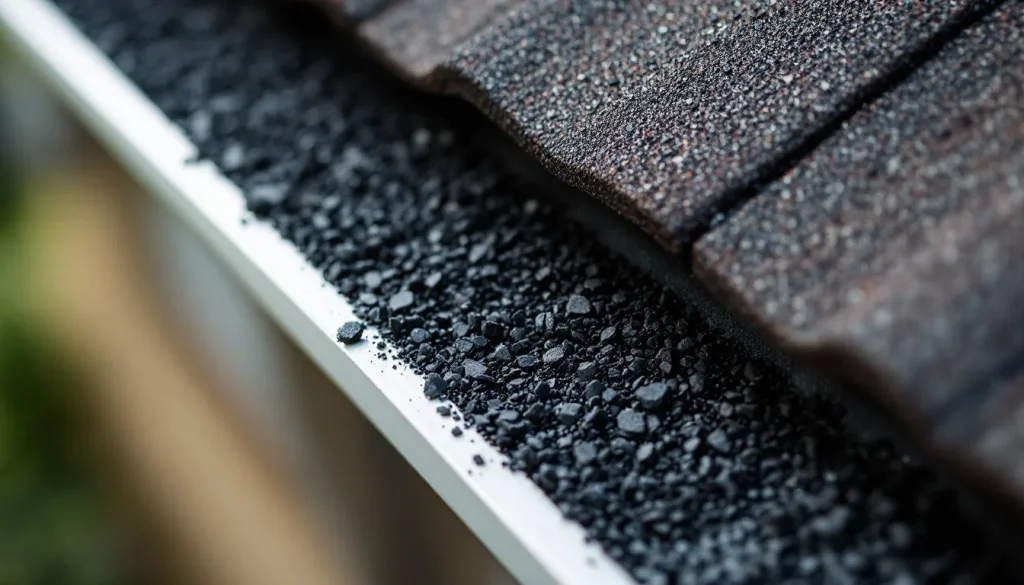
Finding roof granules in gutter troughs is one of the most common homeowner observations and one of the most misread. Granule loss is normal during the first month after install, normal in heavy quantity during the last 5 years of a shingle roof’s life, and abnormal when it appears suddenly in heavy quantity after a hailstorm or wind event on a roof less than 15 years old. The same handful of granules in your hand can mean “do nothing,” “start saving for a reroof,” or “file an insurance claim now.” The pattern, the quantity, and the timing tell you which one.
The short version
- First-month granule loss after install is normal and harmless. Light dusting in gutters for 30 to 60 days is expected.
- Light steady loss for years is normal and tracks shingle aging. No action needed before year 15.
- Heavy loss after year 15 to 20 means end of life for the shingle. Start budgeting reroof.
- Sudden heavy loss after a hailstorm or major wind event on any roof age means damage. File a claim.
- Granule loss in concentrated piles below a single area means a localized shingle failure or impact event.
- Inspection cost 2026: $150 to $300 for a documented pro report. Free from most reputable roofers after a storm.
- Granules are the UV shield on the shingle. Once they are gone, the asphalt cooks within 1 to 3 years.
Why shingles have granules in the first place
Asphalt shingles are layered: a fiberglass mat, hot asphalt coating on both sides, and a top layer of crushed mineral granules pressed into the asphalt while it is still soft. The granules serve three purposes: they protect the asphalt from UV breakdown, they add weight and impact resistance, and they provide color and fire resistance (Class A fire rating comes from the granule layer, not the asphalt).
The granules are not glued or chemically bonded. They are mechanically embedded in soft asphalt that hardens around them. Over the life of the roof, three forces work to pull them off: UV breakdown of the asphalt that holds them, freeze-thaw cycles that push the asphalt away from the granule, and physical impacts from rain, hail, branches, and foot traffic. The rate of loss depends on shingle tier (premium has more granule mass), climate exposure (UV intense in the Sun Belt, freeze-thaw intense in the North), and original install quality.
When the granule layer thins enough that asphalt is visible (called “bald spots” or “exposed asphalt”), the shingle has hit functional end of life. The exposed asphalt UV-degrades within 1 to 3 years and the shingle then cracks, curls, or blisters. Granule loss is the leading indicator. Reading it correctly tells you how much life is left in the roof.
The three scenarios: which one are you looking at?
Scenario 1: new install, first 30 to 60 days, light dusting
Normal and harmless. Manufacturers deliberately over-grain shingles so that loose granules cushion the bundle during shipping. Once the roof is installed, these loose granules wash off with the first few rains. You will see a light to medium accumulation of granules in gutters and downspout outlets for 1 to 2 months after a new roof. After that, the loss rate drops to background.
What to do: nothing. Sweep the gutter out at the next cleaning. Document the date of install so you have a baseline.
Scenario 2: aging roof, year 15 plus, steady moderate loss
Normal aging. Shingles past year 15 lose granules at a steadier rate as the asphalt UV-breakdown accelerates. You will see consistent loose granules in gutters every cleaning, no obvious bald spots on the roof yet but visible color change in some areas (lighter patches where the granule density has dropped).
What to do: start budgeting reroof. Granule loss is the early warning. Once you see bald spots from the ground, you are within 3 years of needing a new roof. See signs you need a new roof and asphalt shingle roof lifespan for the broader timeline. Start collecting quotes 12 to 18 months before you actually pull the trigger.
Scenario 3: any roof age, heavy granule loss after a storm
Damage. If you see a sudden heavy accumulation of granules in gutters after a hailstorm, wind event, or branch fall, the storm has accelerated granule loss in a way that compromises the shingle. This applies to roofs of any age, including 5-year-old roofs.
What to do: document the storm (date, NOAA records, photos of damage), get a roofer inspection, file an insurance claim if hail or wind damage is confirmed. See filing an insurance claim for roof damage and how much hail damage to replace roof for the claim process.
How to tell the three scenarios apart
| Indicator | Normal install (Scenario 1) | Normal aging (Scenario 2) | Storm damage (Scenario 3) |
|---|---|---|---|
| Roof age | 0 to 60 days | 15+ years | Any age |
| Quantity | Light dusting | Light to moderate steady | Heavy, sudden |
| Pattern in gutter | Even, all sides | Even, all sides, more on south face | Concentrated near storm-side face |
| Roof appearance | Uniform color | Lighter patches starting | Pock marks, exposed mat, splatter pattern |
| Triggered by event? | No | No | Yes |
| Insurance covered? | No | No | Yes if storm-related |
| Action | Sweep gutter | Plan reroof | File claim |
The hail damage telltale: round bruises
Hail damage looks different from normal aging. The granule loss occurs in concentrated round spots ranging from dime to quarter sized, where each hailstone struck and bruised the shingle. Each impact knocks granules loose in a circle and exposes the dark asphalt mat underneath. The visual pattern from the roof is a peppered appearance: hundreds of round bruises on the upward-facing slopes.
From the ground, you may not see individual bruises but you will see an overall texture change on the storm-side roof faces. From the gutters, granule loss will be concentrated at the downspouts that drain those faces, not evenly distributed.
Adjuster standards (Haag Engineering training, IICRC, most major carrier guidelines in 2026) typically require 8 or more hail bruises in a 100-square-foot test square to call a slope damaged. Less than 8 in a test square is cosmetic. 8 or more triggers full slope replacement, and in most cases full roof replacement because matching shingles on a partial replacement is impossible after a few years of weathering.
The wind damage telltale: missing tabs and lifted shingles
Wind damage causes granule loss too, but indirectly. The wind lifts a shingle (breaking the seal strip), folds it back, and slams it down. The fold exposes the underside of the shingle above and breaks granules off in a linear pattern at the fold line. After enough cycles, the shingle tears off entirely.
Signs of wind damage:
- Missing shingles visible from the ground (see shingles blowing off)
- Lifted shingles that have not fully reseated
- Granule loss concentrated at shingle edges, especially leading edges facing the prevailing storm direction
- Exposed nails in upper courses (see nail pops on shingles)
Wind threshold for insurance: most carriers cover wind damage at sustained gusts of 50 mph or greater, confirmed by NOAA or local weather station data on the storm date.
What “normal” granule loss actually looks like in 2026
Manufacturers publish data on expected granule loss but it is rarely cited to homeowners. Useful baselines:
| Shingle age | Expected granule loss rate | Gutter accumulation per cleaning |
|---|---|---|
| 0 to 2 months | High (shipping loose) | Light to moderate dusting |
| 2 months to 5 years | Background only | Minimal, mostly washed away |
| 5 to 10 years | Low steady | Light, mostly washed away |
| 10 to 15 years | Low to moderate steady | Light, visible in elbows |
| 15 to 20 years | Moderate steady | Visible accumulation each cleaning |
| 20+ years | Heavy steady | Heavy accumulation each cleaning |
A handful in the gutter at year 10 is not a concern. A cup full at year 12 with no storm is the early warning. Three cups at year 20 means you are close to end of life.
Diagnostic steps before calling a pro
Step 1: collect a sample
Reach into the gutter at the downspout outlet (most accumulation concentrates there) and scoop a handful of granules. Put them on a white paper towel. Color tells you a few things: matching your shingle color means current granule loss, mixed colors mean accumulated loss over months or years, very dark granules mean exposed asphalt is breaking off and the shingle is past saving.
Step 2: photograph the gutter and downspout
Wide shot of the gutter, close-up of the granule accumulation, and a separate shot at each downspout opening. Repeat for each side of the house. Concentrated loss at one or two downspouts versus all four tells you whether the source is a localized failure or roof-wide aging.
Step 3: visual roof check from the ground
With binoculars from a distance, scan each slope of the roof. Look for color variation (lighter patches mean reduced granule density), bald spots (dark asphalt visible), hail bruise patterns (round dark spots in a peppered pattern), or missing shingles. Note the orientation of the slope (south face wears fastest under UV, storm-side wears fastest under hail). For systematic checks see 30-point roof inspection checklist.
Step 4: timeline reconstruction
When did you first notice the granule accumulation? Was there a storm in the days or weeks before? Check NOAA hail and wind reports for your zip code for the past 60 days. A storm event in the past 30 days plus heavy granule loss makes it a damage call. No storm plus moderate steady loss on an aging roof makes it a planning call.
Step 5: roof age verification
Find your original roof install date (closing documents, prior owner records, permit history). Roofs over 15 years old are in the aging window where granule loss is expected. Roofs under 10 years old should not be shedding heavily without a triggering event.
When to call an inspector and what to expect
A documented professional inspection runs $150 to $300 in 2026 from an independent inspector, or free from most reputable roofing contractors after a storm event. The free contractor inspection is a sales call by nature but provides legitimate documentation. The paid independent inspection provides documentation without sales pressure and is the right choice when you suspect the roofer is overstating damage to upsell.
What an inspection should include:
- Roof walk-through with photos of all slopes
- Test square documentation (chalk-mark 10 by 10 foot squares and count damage)
- Penetration inspection (vent boots, chimney flashing, skylights)
- Gutter contents documentation
- Attic inspection if accessible
- Written report with specific damage findings and recommendations
The report becomes the basis for an insurance claim if damage is found. Without documentation, the claim is your word against the adjuster’s.
What insurance carriers actually accept in 2026
Insurance carriers have tightened roof claim standards over the past 5 years. Granule loss alone is rarely sufficient for a claim. Carriers want one of three documented conditions:
Documented hail event with bruise count
NOAA confirmation of hail of 1 inch or larger within the claim window, plus 8 or more bruises in test squares on multiple slopes. Carrier-specific thresholds vary; some accept 6, some require 10.
Documented wind event with missing or damaged shingles
NOAA confirmation of sustained gusts over 50 mph (some carriers use 60 mph) within the claim window, plus visible shingle loss or sealant failure documented on multiple slopes.
Manufacturing defect within warranty
If granule loss is severe and uniform on a roof under 10 years old without a storm event, manufacturing defect is possible. Original shingle warranty may cover this. Contact the manufacturer directly with photos and install records.
What carriers do not accept:
- Age-related granule loss without a storm trigger
- “My roof looks bad” without supporting damage documentation
- Loss on only one slope without explanation
- Bruises that do not meet the carrier’s test-square threshold
If your claim is denied and you believe damage is real, get an independent inspection. See how much hail damage to replace roof for full claim navigation.
Reroof timing when granule loss is the leading indicator
Here is the practical timeline once granule loss starts showing up consistently on a roof past year 12.
| Stage | What you see | What to do |
|---|---|---|
| Early aging (year 12-15) | Light steady granules in gutter, no roof bald spots | Annual inspection, no replacement yet |
| Mid aging (year 15-18) | Moderate granules, color patches visible from ground | Start collecting reroof quotes |
| Late aging (year 18-22) | Heavy granules, visible bald spots, possible curling | Schedule reroof within 12 months |
| End of life (year 22+) | Heavy granules, widespread bald spots, leaks starting | Reroof immediately, expect deck repairs |
Pushing past end of life adds cost. Once asphalt is exposed for more than a year, the underlying deck starts taking water damage. Reroofs at end of life regularly include 4 to 12 sheets of plywood replacement at $80 to $150 per sheet installed. Reroofs done at late aging often need none. See roof repair cost guide for broader cost context.
Granule loss myths that waste money
Myth 1: gluing granules back on works
Aftermarket “granule replacement” sprays and adhesives are sold online. They do not adhere granules well enough to restore the UV shield, they do not match the shingle color closely, and they do not extend the shingle life by any meaningful amount. The asphalt under the bald spot is already UV-damaged. You are spraying glue on dying material.
Myth 2: roof coatings restore lost granules
Elastomeric roof coatings have a place on flat and low-slope roofs (see elastomeric roof coating) but they do not extend asphalt shingle life by recoating granule loss. The shingle texture and ventilation requirements make coatings ineffective on steep-slope shingle roofs.
Myth 3: pressure washing makes the roof “like new”
High-pressure washing strips remaining granules off the shingle, accelerating end of life. Use a soft wash with low-pressure spray and surfactant if cleaning algae streaks (see algae streaks on roof). Never use high pressure on shingles.
Myth 4: more granules in the gutter than last year means immediate problem
Year-over-year increase is normal as the roof ages. The trajectory matters more than any single observation. Annual gutter cleanings tracked over 5 years tell you whether you are in the aging slope (expected) or the cliff (unexpected acceleration).
What to do with the granules in your gutter right now
Practical answer: sweep them out, weigh them if you want a baseline (most homeowners do not bother), and start your diagnostic check above. The granules themselves are not doing damage in the gutter. They can clog downspouts if accumulation is heavy, which causes overflow at the roof edge. Clean the gutter and downspouts as part of normal seasonal maintenance.
If you have gutter guards installed, granule accumulation may sit on top of the guard mesh and reduce flow. Brush the guards clean every 6 months on aging roofs.
FAQ
Are granules in the gutter always a sign of a problem?
No. Granules are normal in the first 1 to 2 months after install, normal in steady moderate quantity on roofs over year 15, and abnormal only when the quantity is sudden and heavy after a storm event or appears in heavy quantity on a young roof without a trigger.
How long does my roof have once I see heavy granule loss?
If the loss is age-related and bald spots are starting to show, plan for reroof within 24 to 36 months. If you wait until widespread bald spots and curling are visible, the deck may already be taking water damage and reroof cost goes up.
Can I file an insurance claim just for granule loss?
Not by itself. Carriers require evidence of a storm event plus documented damage that meets their threshold (hail bruise count, missing shingles, sealant failure). Pure age-related granule loss is not a covered loss.
Why are the granules different colors?
Shingles are designed with mixed granule colors for depth and aesthetic. Different colors in your gutter sample do not mean different shingles. They mean the granules came from your single shingle product.
Should I do anything different with metal shingles or tile?
Metal and tile do not have granules. The “granule loss” diagnostic only applies to asphalt shingles. For metal or tile, the equivalent indicators are paint chalking, oxidation, and cracked or slipped tiles. Different inspection process entirely.
Bottom line
Granules in your gutter are not automatically a problem. They are a data point. Combine quantity, timing, roof age, and recent weather events to read what they mean. A handful at year 10 is fine. A cup at year 18 says start budgeting. Heavy loss after a hailstorm on any age roof says document and file. Walk through the diagnostic before you call a roofer, and the call you do make will be the right one. For broader roof end-of-life signs, see signs you need a new roof and asphalt shingle roof lifespan. For negotiating a reroof when you are due, see how to negotiate roof replacement.