
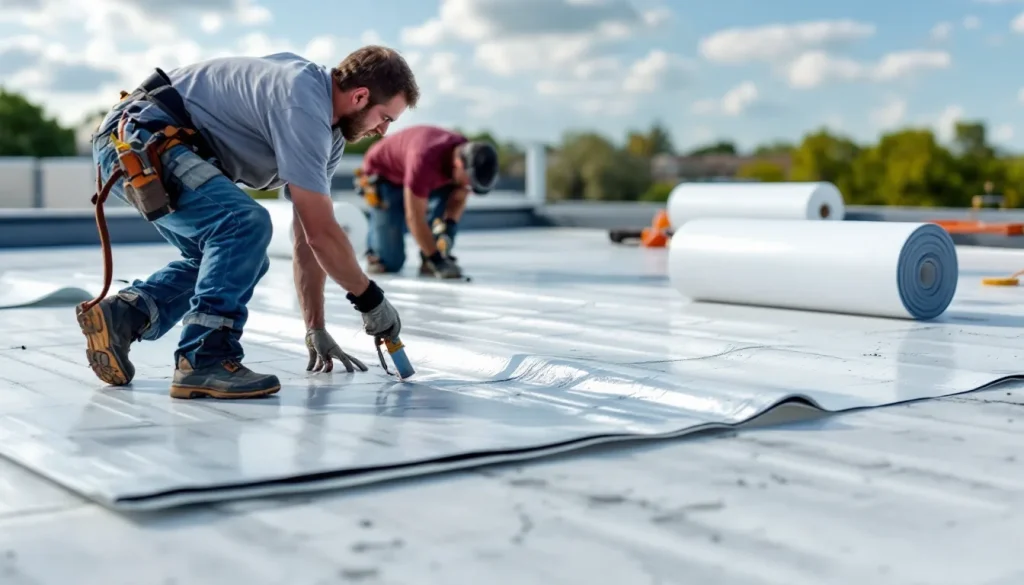
The flat roof replacement cost (for the full data set, see our the full 2026 Roofing Cost Report) in 2026 runs $5 to $15 per square foot installed depending on membrane choice: TPO $7 to $12, EPDM $5 to $9, PVC $9 to $15, modified bitumen $6 to $11, and built up roofing $5 to $10. A typical 10,000 square foot commercial flat roof replacement runs $70,000 to $150,000 total. A 500 square foot residential flat roof addition runs $3,500 to $8,000. The biggest cost drivers are membrane type and thickness (60 mil vs 80 mil), insulation R value (R 25 vs R 30 polyiso), tapered insulation for proper slope ($2.50 to $5.50 per square foot added), tear off of existing roofing ($0.75 to $2.50 per square foot), and regional labor rate. Three line items hide most of the cost variation: tear off and disposal, insulation depth, and flashing detail count.
The short version
- TPO $7 to $12 per square foot installed is the volume mid range. 60 mil is the spec sweet spot, 80 mil is the long warranty premium.
- EPDM $5 to $9 per square foot is the value leader, especially on northern and shaded roofs.
- PVC $9 to $15 per square foot is the chemical resistant premium, mandatory for restaurant and food service applications.
- Tapered insulation runs $2.50 to $5.50 per square foot on top of base costs. Required when existing slope is below 1/4 inch per foot.
- Tear off and disposal runs $0.75 to $2.50 per square foot depending on existing layers, deck condition, and dump fees.
- Insulation upgrade from R 25 to R 30 adds $0.75 to $1.25 per square foot but cuts annual HVAC load 8 to 15 percent.
Short answer: total replacement cost by roof size
The dollar amounts that matter for budgeting a flat roof replacement depend on roof size, membrane choice, and current condition of the existing assembly. The most useful summary is total cost at common roof sizes for each membrane type.
| Roof size | EPDM 60 mil | TPO 60 mil | TPO 80 mil | PVC 60 mil | Modified bitumen |
|---|---|---|---|---|---|
| 500 sq ft (residential) | $3,500 to $5,500 | $4,500 to $7,000 | $5,500 to $8,500 | $6,000 to $10,000 | $4,000 to $6,500 |
| 2,000 sq ft | $12,000 to $20,000 | $15,000 to $25,000 | $18,000 to $30,000 | $20,000 to $32,000 | $13,000 to $22,000 |
| 10,000 sq ft | $55,000 to $95,000 | $72,000 to $122,000 | $85,000 to $145,000 | $95,000 to $155,000 | $62,000 to $112,000 |
| 25,000 sq ft | $130,000 to $230,000 | $180,000 to $300,000 | $210,000 to $360,000 | $235,000 to $385,000 | $155,000 to $275,000 |
| 50,000 sq ft | $250,000 to $450,000 | $350,000 to $600,000 | $410,000 to $700,000 | $450,000 to $750,000 | $300,000 to $550,000 |
The ranges assume a typical project: tear off of one existing membrane layer, new R 25 polyiso insulation, mechanically attached or fully adhered membrane, perimeter and penetration flashing, and disposal of existing materials. Add 15 to 30 percent for tapered insulation if slope correction is needed. Add 20 to 40 percent for coastal high wind specs (Class 150 or Class 180 UL ratings). Add 10 to 20 percent for complex roofs with many penetrations, equipment curbs, or wall transitions. For the broader new roof cost picture, see how much does a new roof cost.
What is included in the per square foot price
A flat roof replacement bid should include nine line items. If your contractor’s bid (see our local commercial roofers) is missing any of these, ask why before you sign.
| Line item | Typical cost per sq ft | Notes |
|---|---|---|
| Tear off of existing roof | $0.75 to $2.50 | Higher with multiple layers or wet insulation |
| Disposal and dumpster | $0.30 to $0.80 | Highly regional, urban higher |
| Insulation (R 25 polyiso) | $1.20 to $2.20 | Higher for R 30 or tapered |
| Cover board (1/4 inch HD polyiso or gypsum) | $0.50 to $1.00 | Required by some warranties |
| Membrane (60 mil TPO) | $0.70 to $1.40 | EPDM lower, PVC higher |
| Installation labor | $1.50 to $3.00 | Regional labor rate dependent |
| Perimeter and penetration flashing | $0.40 to $1.20 | Higher with many curbs and penetrations |
| Walkway pads and accessories | $0.10 to $0.40 | Standard on commercial |
| Warranty registration and inspection | $0.10 to $0.30 | Manufacturer fee for NDL warranty |
Total for a typical 60 mil TPO spec runs $5.55 to $12.80 per square foot from these line items. The bid that lands in the middle of that range is realistic. A bid significantly under the range probably cuts insulation depth, skips cover board, or shorts the flashing detail count. A bid significantly over the range usually reflects regional labor premium or a complex roof with above average (see our national average replacement cost guide) penetration count.
Tear off cost: the line item that varies most
Tear off cost varies more than any other line item on a flat roof replacement. The drivers are existing layer count, deck condition under the existing layers, dump fees in your market, and whether the existing roof contains asbestos materials (older roofs may).
| Existing condition | Tear off cost per sq ft | Why |
|---|---|---|
| Single ply membrane, dry insulation | $0.75 to $1.25 | Cleanest tear off, single layer |
| Two layers (original plus one recover) | $1.25 to $2.00 | Double the material to remove |
| BUR with gravel | $1.50 to $2.50 | Heavy weight, gravel separates and complicates haul off |
| Wet insulation under existing roof | $1.50 to $3.00 | Heavier weight, more dumpster trips |
| Suspected asbestos materials | $3.00 to $8.00 | Abatement protocols required, specialty crew |
The wet insulation case is the one most often underestimated. A flat roof with leaks has wet insulation underneath, sometimes across more than half the roof area. Wet polyiso weighs three to five times dry polyiso, which doubles or triples dumpster trips. The tear off cost can run double the dry estimate. A moisture survey before bidding is the right move on any roof over 12 years old with known leaks. Infrared thermography or capacitance meter survey runs $0.05 to $0.10 per square foot and saves much more than that in accurate bidding.
Insulation cost: R value and tapered
Insulation is one of the largest cost categories in a flat roof replacement and one of the most underspecified by contractors trying to win on price. The IECC 2024 minimum for commercial flat roofs is R 25 (roughly 4 inches of polyiso) in climate zones 4 to 7. R 30 is required in climate zone 8 and recommended in zone 4 to 7 for energy performance.
| Insulation spec | Cost per sq ft | R value | HVAC savings vs R 19 |
|---|---|---|---|
| R 19 polyiso (3 inches) | $0.90 to $1.60 | R 19 | Baseline |
| R 25 polyiso (4 inches) | $1.20 to $2.20 | R 25 | 8 to 12 percent |
| R 30 polyiso (5 inches) | $1.50 to $2.75 | R 30 | 12 to 18 percent |
| R 38 polyiso (6.5 inches) | $1.95 to $3.50 | R 38 | 18 to 25 percent |
| R 25 polyiso plus 1/2 inch tapered (avg) | $3.20 to $5.50 | R 28 avg | 10 to 16 percent plus drainage |
| Tapered polyiso 1/4 to 1/2 inch per foot | $2.50 to $5.50 | Variable | Plus drainage correction |
The R 25 to R 30 step is almost always worth the additional cost. The premium of $0.30 to $0.55 per square foot pays back in 6 to 10 years through reduced HVAC load. On a 30 year roof, you save 20 to 24 years of cooling and heating cost at the higher R value. For commercial roofs in cooling dominant climates, the math is even stronger.
Tapered insulation cost and when it is required
Tapered insulation is factory cut polyiso at a controlled slope (typically 1/4 inch per foot or 1/2 inch per foot) that directs water across the roof to drains. It is required when the existing deck slope is inadequate (under 1/4 inch per foot to drains) or when you want to eliminate ponding water on a roof that currently ponds.
Tapered systems cost $2.50 to $5.50 per square foot installed, sitting on top of the base insulation and membrane cost. The variation comes from the average tapered thickness (a roof that needs only minor slope correction averages 0.5 to 1 inch of tapered insulation; a roof that needs major correction can average 2 to 4 inches), the layout complexity (number of crickets, valleys, and drainage areas), and the manufacturer.
| Tapered spec | Cost per sq ft added | Application |
|---|---|---|
| Crickets behind curbs only | $0.30 to $0.80 spread over roof | Localized ponding behind obstructions |
| Partial tapered (localized low spots) | $1.50 to $3.50 over affected area | One or two ponding areas to fix |
| Full tapered 1/4 inch per foot | $2.50 to $4.50 over whole roof | Whole roof has inadequate slope |
| Full tapered 1/2 inch per foot | $3.50 to $5.50 over whole roof | Aggressive slope correction needed |
For more on ponding water as the driver behind tapered insulation specs, see ponding water flat roof. For the broader drainage system design, see flat roof drainage design.
Regional cost variation in 2026
Flat roof replacement cost varies by region based primarily on labor rate, dump fees, and material supply chain. The variation between low cost and high cost markets is roughly 25 to 40 percent on the same roof spec.
| Region | Cost factor vs national average | Drivers |
|---|---|---|
| Northeast (NYC, Boston, Philadelphia) | 1.20 to 1.40x | Union labor, high dump fees, urban access |
| West Coast (San Francisco, Seattle, LA) | 1.15 to 1.35x | Labor cost, prevailing wage, seismic specs |
| Mountain West (Denver, Salt Lake) | 1.00 to 1.15x | Hail and snow load specs |
| Texas (Houston, Dallas, Austin) | 0.90 to 1.05x | Hurricane wind specs in coastal counties |
| Southeast (Atlanta, Charlotte, Nashville) | 0.85 to 1.00x | Lower labor cost |
| Midwest (Chicago, Cleveland, Detroit) | 0.95 to 1.15x | Union labor in larger metros |
| Florida (Miami, Tampa, Orlando) | 1.10 to 1.30x | Hurricane wind specs, insurance certification |
| Rural and small metro nationwide | 0.80 to 0.95x | Lower labor and dump fees |
For comparison to broader roof replacement costs across all materials, see roofing cost per square and how much does a new roof cost.
Wind rating impact on cost
Wind rating requirements drive cost on coastal and hurricane prone roofs. The standard specifications are UL 580 (overall wind uplift on the assembly) and UL 1897 (uplift on the attachment system). Together with FM Global 4470, these define the design wind load the roof must resist.
| Wind rating | Cost premium | Required where | Why |
|---|---|---|---|
| Class 90 (110 mph design wind) | Baseline | Most inland regions | Standard ASCE 7-22 minimum |
| Class 120 (130 mph) | +5 to 10 percent | Higher wind inland zones | Tighter fastener spacing |
| Class 150 (150 mph) | +15 to 25 percent | Coastal hurricane zones | Much tighter fastener spacing, edge metal upgrades |
| Class 180 (170 mph) | +25 to 40 percent | Florida Miami Dade, Texas Gulf Coast | Engineered attachment, perimeter pull tests |
The fastening density math is where the cost lives. A Class 90 roof might use one fastener per 4 square feet of field area. A Class 180 might use one fastener per 1.5 square feet, plus perimeter and corner zones with even denser spacing. The fastener and labor cost increase is real, but in a hurricane zone the alternative is the roof leaving the building during a Cat 3 storm.
Recover vs full tear off cost comparison
If your existing roof is on its first membrane, you can recover (install new membrane over existing (see our industrial roof replacement)) or tear off. Recover saves 30 to 50 percent of replacement cost but limits future options.
| Approach | Cost per sq ft | Lifespan added | Notes |
|---|---|---|---|
| Full tear off and replace | $5 to $15 | 20 to 30 years | Standard approach, allows insulation upgrade |
| Recover with new membrane | $3.50 to $9 | 15 to 25 years | Faster, lower cost, no insulation upgrade |
| Coating restoration (silicone or elastomeric) | $2.50 to $5 | 10 to 15 years | Interim measure for sound substrate |
IBC and IRC limit roofs to two total membrane layers. If you already have an original roof plus one recover, your only legal option is full tear off. If you are on the original membrane, recover is allowed. A moisture survey before recover is mandatory. Wet insulation under a recover continues degrading and shortens both layers’ lifespan. For the coating path in detail, see flat roof coating restoration and elastomeric roof coating.
Hidden costs that show up on change orders
Five line items appear regularly as change orders after the original bid is signed. Anticipate them and either get them included in the bid or budget contingency.
Deck repair or replacement. The original bid assumes a sound deck. If the deck under the existing roof is rotten, damaged, or fastener compromised, repair runs $5 to $20 per square foot of affected area depending on whether the deck is plywood, steel, or concrete.
Wet insulation removal beyond bid assumption. The original bid assumes a percentage of wet insulation based on visual inspection or a moisture survey. Actual wet area discovered during tear off can be much higher. Additional wet insulation removal runs $0.50 to $1.50 per square foot beyond the included area.
Penetration and curb count beyond bid assumption. The original bid counts roof penetrations (vents, drains, HVAC curbs) based on a roof inspection or as built drawings. Additional penetrations discovered during tear off cost $150 to $800 each to flash properly.
Asbestos abatement. Older flat roofs (pre 1990) may contain asbestos in the existing materials. If asbestos is identified during tear off, abatement protocol kicks in. Cost runs $3 to $8 per square foot of asbestos containing material removed, plus full project delay while abatement is performed.
Edge metal and coping replacement. The original bid may or may not include edge metal and parapet coping replacement. New code requires gravel stop, drip edge, and coping to current ANSI/SPRI ES-1 standards. If the existing edge metal is non compliant, replacement runs $5 to $15 per linear foot of perimeter edge. For the parapet specifics, see parapet wall roofing detail.
Financing and payment timing
Most commercial flat roof replacements over $50,000 use either commercial financing (5 to 7 year notes, 7 to 12 percent rates in 2026) or accelerated depreciation under IRS section 179 for businesses. Residential flat roof replacements over $10,000 sometimes use home equity loans or contractor financing.
Standard payment terms on commercial flat roof contracts. 10 percent deposit at contract signing, 40 percent at material delivery, 40 percent at substantial completion (membrane installed, no leaks), 10 percent retention at final completion (after manufacturer inspection and warranty registration). Variations exist by region and contractor. Avoid contracts that require more than 30 percent up front.
What to ask in a bid
Eight questions to ask when comparing flat roof replacement bids.
1. What membrane brand and thickness are you specifying? (Compare apples to apples: 60 mil TPO from Carlisle, GAF, Versico, etc.)
2. What insulation R value and is any portion tapered? (R 25 minimum, R 30 preferred, tapered required if slope is below 1/4 inch per foot.)
3. What is the warranty term and is it material only or full system NDL? (Material only is weaker; full system NDL is stronger.)
4. Does the warranty include ponding water coverage? (Almost always no by default; ask about waiver upgrade.)
5. What wind rating does the assembly carry? (UL 580 Class 90 minimum inland, higher in coastal zones.)
6. Is tear off included or recover? (Tear off costs more but lets you upgrade insulation and lasts longer.)
7. How many penetration flashings are included in the bid? (Compare counts to avoid change order surprises.)
8. What is the contingency for wet insulation or deck repair? (A bid that says zero contingency is a bid that will change order.)
FAQ
FAQs
How much does a flat roof cost per square foot?
Installed cost runs $5 to $15 per square foot in 2026 depending on membrane: EPDM $5 to $9, modified bitumen $6 to $11, TPO $7 to $12, PVC $9 to $15, BUR $5 to $10. The mid range of $7 to $9 per square foot covers most standard commercial 60 mil TPO and EPDM specs.
Why does the cost vary so much between bids?
Three line items drive most variation: tear off cost (depends on existing condition), insulation depth and tapered presence, and flashing detail count. Bids that look cheap usually cut one of these. Ask each bidder to itemize.
Is it cheaper to recover or tear off?
Recover runs 30 to 50 percent less than tear off but shortens lifespan and limits future options. Recover is only legal up to two total membrane layers. After that, tear off is required.
How much does tapered insulation add to cost?
$2.50 to $5.50 per square foot of roof area depending on average tapered thickness and complexity. On a 10,000 square foot roof, a full tapered system adds $25,000 to $55,000 to the replacement bill.
What is the cheapest flat roof material to replace?
EPDM 60 mil at $5 to $9 per square foot installed. BUR can match it in some markets at $5 to $10. Modified bitumen self adhered is the cheapest residential option for small flat sections.
Does insurance cover flat roof replacement?
Homeowner and commercial property insurance cover roof damage from covered perils (wind, hail, fire) but not wear and tear. A flat roof at end of service life with no covered cause of loss is not insurance work. A flat roof with covered hail or wind damage may be. See actual cash value vs replacement cost coverage on your policy. For the broader insurance picture, see actual cash value roof.
Bottom line
Flat roof replacement in 2026 runs $5 to $15 per square foot installed depending on membrane choice, thickness, insulation depth, slope correction needs, and regional labor rate. EPDM is the value leader at $5 to $9. TPO is the volume choice at $7 to $12. PVC is the chemical resistant premium at $9 to $15. The hidden cost drivers are tear off (varies most), insulation R value and tapered (varies second most), and flashing detail count (varies third). Get itemized bids from at least three contractors, ask the eight questions in this guide, and budget 10 to 15 percent contingency for change orders on wet insulation or deck repair. For the full material comparison, see flat roof materials compared. For the drainage requirements that drive tapered insulation specs, see flat roof drainage design. For repair pricing on roofs not ready for full replacement, see flat roof repair cost.
Related reading: all roofing guides | flat roof types 2026 | residential flat roof guide | commercial roof replacement cost | TPO roof installation cost | ponding water flat roof | roofing cost per square | how much does a new roof cost | flat roof lifespan