
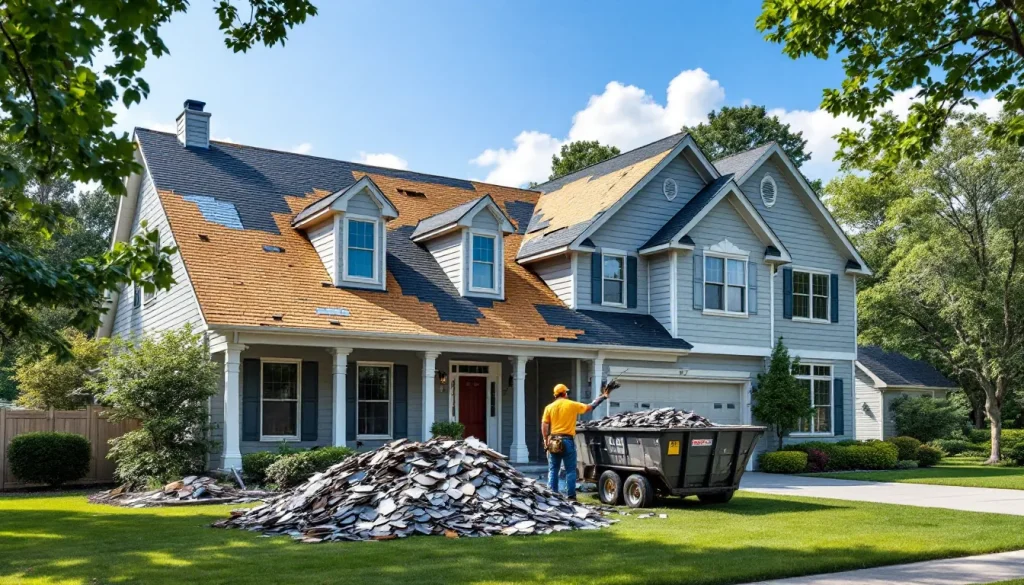
The cost to redo roof in 2026 runs $8,000 to $35,000 for asphalt shingles and $25,000 to $80,000 for metal on a typical 2,000 sq ft single-family home (see our residential roof guide by home type), with the median asphalt re-roof landing at $14,500 to $19,500. “Redo” can mean two very different things: a full tear-off (strip everything to the decking and start over) or an overlay (install new shingles on top of existing). Tear-off is the right answer in most cases, costs 40% to 60% more than overlay, and adds 8 to 15 years to the realistic lifespan because the new roof system gets installed correctly with fresh underlayment, ice and water shield, and flashing. Below is what actually drives the price in 2026: tear-off vs overlay, decking condition, pitch, complexity, region, and season. With real worked examples for the most common house sizes.
The short version
- Asphalt re-roof tear-off in 2026: $8,000 to $35,000. Median $14,500 to $19,500 on a 2,000 sq ft home.
- Metal re-roof in 2026: $25,000 to $80,000. Standing seam runs 2x to 4x asphalt.
- Overlay (install over existing) saves 35% to 50% on labor but adds risk: no decking inspection, warranty caveats, weight load.
- Six factors move the price most: tear-off scope, decking condition, pitch, complexity (valleys, chimneys, dormers), region, season.
- Tear-off adds $1,000 to $4,500 to the job depending on layer count and disposal fees.
- Decking replacement (typical: 5% to 15% of sheets) adds $500 to $4,000.
- Best time to book is October to February for 10% to 20% off summer pricing.
The short answer: tear-off vs overlay
A tear-off (see our tear-off and reroof pricing) re-roof removes everything down to the decking: old shingles, underlayment, flashing, drip edge, valley metal, vents. The decking gets inspected, bad sheets replaced, ice and water shield installed at eaves and valleys, new synthetic underlayment installed, then the new shingles, flashing, ridge cap, and ventilation. This is the standard scope for a re-roof in 2026 and is what most reputable roofers default to.
An overlay leaves the existing shingles in place and installs new shingles on top. Faster, cheaper, no decking visibility. Code allows up to two layers in most jurisdictions, three in a few, and zero in coastal hurricane zones. Overlay saves money up front but skips the decking inspection, makes future tear-off more expensive (now two layers to remove), voids most manufacturer warranties, and shaves 5 to 10 years off realistic lifespan. We cover the full overlay math in our cost to reshingle a roof guide.
2026 pricing table: redoing a roof by material and house size
| House size (sq ft of roof) | Asphalt 3-tab | Asphalt architectural | Premium designer | Standing seam metal |
|---|---|---|---|---|
| 1,500 sq ft (small ranch) | $6,500 to $11,000 | $9,500 to $14,000 | $13,500 to $20,000 | $22,000 to $42,000 |
| 2,000 sq ft (typical) | $8,000 to $14,000 | $12,500 to $19,500 | $18,500 to $28,000 | $30,000 to $55,000 |
| 2,500 sq ft (mid) | $10,500 to $17,500 | $15,500 to $24,000 | $22,500 to $34,000 | $37,500 to $68,000 |
| 3,000 sq ft (large) | $12,500 to $21,000 | $18,500 to $28,500 | $27,000 to $41,000 | $45,000 to $80,000 |
House size in this table is roof area, not floor area. A 2,000 sq ft floor area on a single-story ranch with a 6/12 pitch comes out to about 2,200 sq ft of roof area. Our guide on how to calculate roof square footage walks through the math. The numbers above include tear-off of one existing layer, standard underlayment, ice and water shield at eaves and valleys, drip edge, ridge ventilation, and pipe boot replacements. They exclude decking replacement, deck repair, chimney work, skylight replacement, and gutter work.
The six factors that drive price most
1. Tear-off vs overlay (or: layers of old roof)
Tear-off cost (for the full data set, see our the full 2026 Roofing Cost Report) is driven by layer count and disposal fees. One layer of asphalt removed runs $1,000 to $2,500 on a 2,000 sq ft roof. Two layers (an overlay job from years past) runs $2,000 to $4,500 because the work doubles and disposal weight doubles. Three layers (rare but exists) can exceed $5,000 in tear-off alone. Disposal fees vary by region: $80 to $180 per ton at the landfill, with a typical 2,000 sq ft tear-off generating 3 to 5 tons of debris.
2. Decking condition
Once the old shingles are off, the decking gets inspected. On a 15 to 25 year old roof, expect 5% to 15% of sheets to need replacement due to nail-hole rot, ice dam damage, leak damage, or general delamination. On a roof older than 25 years or one with known leak history, expect 15% to 35% of sheets to need replacement. Decking replacement runs $80 to $140 per 4×8 sheet in 2026, installed. On a typical 2,000 sq ft roof (62 sheets), that is $400 to $4,500+ depending on how bad the decking is.
Decking surprises are the single largest source of cost overruns on re-roofs. Reputable contractors will write decking replacement into the contract at a per-sheet rate (typically $80 to $120) with a maximum number of sheets included in the base bid. Anything over that maximum gets priced at the per-sheet rate with photos required.
3. Pitch (steepness)
Steeper roofs cost more to redo because they require more safety equipment, slower work pace, and often two-person teams instead of one for the same square footage. Approximate pitch surcharges in 2026:
- 2/12 to 4/12 (low pitch, walkable): no surcharge
- 5/12 to 7/12 (standard, walkable with care): no surcharge
- 8/12 to 9/12 (steep, walkboards required): +10% to +20%
- 10/12 to 12/12 (very steep, roof jacks required): +25% to +40%
- 13/12 and above (extreme, scaffolding required): +50% to +100%
4. Complexity (valleys, chimneys, dormers, skylights)
A simple gable roof with no penetrations is the cheapest re-roof scenario. Every valley, chimney, dormer, skylight, and complex flashing detail adds labor. Approximate add-ons on a typical 2,000 sq ft roof:
- Each additional valley (beyond the first two): +$200 to $400
- Each dormer (with proper flashing): +$300 to $700
- Each skylight (reflash, no replacement): +$200 to $500
- Each skylight (full replacement): +$1,200 to $3,500
- Chimney reflash: +$400 to $1,500
- Chimney rebuild crown or counterflashing: +$800 to $3,500
5. Region
Geographic variation in 2026 re-roof pricing is significant. The same 2,000 sq ft asphalt architectural re-roof can run $11,500 in rural Tennessee and $24,500 in Boston. The bulk of the difference is labor cost; materials vary by 10% to 20% region to region while labor varies by 60% to 100%.
| Region | Typical 2026 cost (2,000 sq ft architectural) |
|---|---|
| Boston, NYC metro, Bay Area, Seattle | $19,500 to $28,500 |
| LA, San Diego, DC metro, Denver, Portland | $16,500 to $24,000 |
| Chicago, Minneapolis, Philadelphia, Phoenix | $13,500 to $19,500 |
| Atlanta, Dallas, Houston, Charlotte, Nashville | $12,000 to $17,500 |
| Indianapolis, Kansas City, Memphis, Birmingham | $10,500 to $15,500 |
| Rural Midwest, Appalachia, Plains | $9,500 to $14,000 |
6. Season
Roofing is seasonal. Summer (May to September) is peak season and pricing is at its highest. Late fall through winter (October to February) is off-season and reputable contractors will discount 10% to 20% to keep crews working. The catch: cold weather installation requires hand-sealing of shingles below 50F and a careful pitch on adhesives. Reputable crews handle this fine; cut-rate crews skip it and you get blow-offs in the first wind event. If you are booking a winter re-roof, ask specifically about cold-weather installation procedures.
Material choice: what you actually pay for
Asphalt architectural shingles ($12,500 to $19,500 on a 2,000 sq ft roof)
The default for 70%+ of US single-family re-roofs in 2026. Mid-tier products (GAF Timberline HDZ, Owens Corning Duration, CertainTeed Landmark) hit the sweet spot of cost, lifespan, and warranty. Realistic field lifespan: 25 to 30 years. Wind ratings: 110 to 130 mph with proper nailing. Class A fire rating, Class 3 impact rating standard. For climate-specific selection, see our asphalt shingle lifespan guide.
Premium / designer asphalt ($18,500 to $28,000)
GAF Timberline UHDZ, GAF Camelot II, OC Duration FLEX, OC Berkshire, CertainTeed Landmark PRO, CertainTeed Grand Manor. Heavier, thicker, higher wind ratings, longer non-prorated warranty periods. Realistic lifespan 30 to 50 years. Worth the upgrade if you are staying in the home 15+ years, have hail exposure (Class 4 IR options), or want the dimensional aesthetic.
Standing seam metal ($30,000 to $55,000 on a 2,000 sq ft roof)
The default premium choice. Concealed fasteners, 24 or 26 gauge steel with Kynar 500 PVDF paint, vertical seam panels. Realistic lifespan 50+ years, warranty typically 30 to 40 years on paint and substrate. McElroy Metal Maxima, MBCI Vee, ATAS MultiSeam, Englert Series 1300 are mainstream options. For the full asphalt vs metal comparison, see our metal vs asphalt guide.
Exposed-fastener metal ($20,000 to $35,000)
The cheaper metal option. R-panel or 5V crimp panels, exposed screws with neoprene washers. Realistic lifespan 30 to 40 years but the gaskets need replacement at 15 to 20. Best for outbuildings, garages, agricultural. Increasingly used on residential in the South.
Real worked example: 2,200 sq ft asphalt re-roof in Indianapolis
A homeowner in suburban Indianapolis has a 2,200 sq ft architectural asphalt roof, 20 years old, with three valleys, one chimney, two skylights, and a 6/12 pitch. Single layer of existing shingles. Here is what the 2026 invoice looks like for a tear-off and replacement with GAF Timberline HDZ:
- Tear-off of one layer, disposal: $1,800
- Decking replacement (4 sheets, included in base bid): included
- Synthetic underlayment (GAF Deck-Armor): $850
- Ice and water shield (eaves, valleys, around penetrations): $1,200
- Drip edge (all eaves and rakes): $400
- GAF Timberline HDZ shingles (22 squares): $5,800 materials
- Starter strip, ridge cap, hip cap: $650
- Flashing (step, chimney reflash with counterflashing): $1,400
- Skylight reflash (2 units): $600
- Pipe boot replacement (4 boots, lead): $700
- Ridge ventilation: $450
- Labor (3 crew, 2 days): $4,200
- Permit and inspection: $250
- 2-year labor warranty, 50-year material warranty (GAF Golden Pledge eligible)
Total: $18,300. This is a typical mid-range tear-off in a mid-cost market. Add decking replacement beyond the included 4 sheets at $90 per sheet. Add a full skylight replacement if needed at $1,800 each. Subtract $2,500 to $4,000 if the homeowner accepted a Tamko or IKO mid-tier product instead of GAF Timberline.
Tear-off vs overlay: when overlay still makes sense
Overlay (also called a re-roof over existing) is a smaller percentage of the market every year, but it has not disappeared. The scenarios where it still makes sense in 2026:
- Single existing layer, all shingles laying flat, no curling or cupping. If anything is lifted, overlay traps moisture.
- Decking known to be in good condition (recent inspection or recent leak repairs that exposed it).
- Budget constraint where the difference between $14,500 (overlay) and $19,500 (tear-off) is a deal-breaker.
- Code allows it in the jurisdiction (most US municipalities allow up to 2 layers; coastal hurricane zones often do not allow overlay at all).
- Owner accepts the warranty caveats (most manufacturer warranties limit overlay to 25 years prorated regardless of the product’s marketed lifespan).
The scenarios where overlay is the wrong call: any visible decking damage, ice dam history, leak history, hail damage, three-layer code limit reached. Our cost to reshingle guide goes deeper on the overlay vs tear-off decision.
The decking condition wildcard
Decking condition is the largest source of cost variance on re-roofs. A roof that looks fine from the ground can have 30%+ rotten decking that only reveals itself once the old shingles come off. The variables that predict decking condition:
- Age of original roof system (15 to 25 years is the danger zone for first-generation OSB; older homes with plank decking are usually fine)
- Number of layers (more layers means more nail penetrations means more entry points for water)
- Leak history (one bad leak in year 12 can rot a 3×3 ft area unseen)
- Attic ventilation (under-ventilated attics cook decking from below and decay it from above)
- Ice dam history in cold climates (ice dam damage rots both decking and rafter ends)
A reputable contractor will give you a base bid that includes 4 to 8 sheets of decking replacement and a per-sheet price for anything beyond that, photographed and documented. A contractor who refuses to put decking pricing in writing in advance is setting you up for a fight on change orders. Decking surprise costs run $80 to $140 per sheet installed in 2026.
The math on warranty value
A re-roof resets the warranty clock. Manufacturer warranties on architectural asphalt in 2026 are typically 30 to 50 years, with the first 10 to 15 years non-prorated and the balance prorated. Premium warranties (GAF Golden Pledge, Owens Corning Platinum Preferred, CertainTeed SureStart PLUS) require installation by a certified contractor and add 5 to 10 years of non-prorated coverage. For a homeowner planning to stay 15+ years, the premium warranty is usually worth the $1,500 to $3,000 upcharge it implies (because it requires the certified installer, not because the warranty paperwork itself costs anything).
The trap: warranties only cover material defects, not installation errors. If your shingles blow off because the roofer used the wrong nail pattern, the manufacturer warranty does not pay. That is why the labor warranty matters. Get 2 to 5 years of labor warranty in writing from any contractor you hire, and check that they will still be in business in 5 years (Google reviews, BBB rating, length of time at current address).
Permits, inspections, and HOA
Most US jurisdictions require a roofing permit (see our roof permit cost guide) for a tear-off and reroof. Cost in 2026 typically runs $150 to $500. A few add a structural review fee on top. Inspections are usually included in the permit; the inspector verifies underlayment, ice and water shield placement, ventilation, and final installation. Some jurisdictions inspect at two stages, some at one, some not at all.
HOA approval is increasingly required in 2026, particularly for shingle color or material changes. Submit color samples and product specs at least 30 days before scheduled work. HOAs sometimes require specific shingle colors or brands, which can rule out the cheapest product option and add $1,000 to $2,500 to the job.
Financing and timing
A typical 2,000 sq ft asphalt re-roof in 2026 takes 1 to 3 days of crew work plus permit lead time. Metal roofs run 3 to 7 days. Most reputable contractors offer financing through Hearth, Synchrony, or GreenSky at 0% promotional rates for 6 to 18 months. Be cautious of dealer-financing where the contractor takes a 8% to 15% fee off the top to absorb the financing cost; the cash price is often quietly 8% to 15% lower than the financed price. For a deeper look at quote breakdowns, see how to read a new roof estimate.
FAQ
What is the cheapest way to redo my roof?
The cheapest legitimate option in most US jurisdictions in 2026 is a single-layer overlay with 3-tab asphalt shingles. Expect $6,500 to $11,000 on a 2,000 sq ft roof. The catch: realistic lifespan is 12 to 17 years (versus 25 to 30 for an architectural tear-off), and any future tear-off costs more. Most cost-conscious homeowners are better off with an architectural tear-off at $12,500 to $19,500 because the per-year cost of ownership is lower.
How long does redoing a roof take?
Asphalt re-roofs on a 2,000 sq ft home with a typical crew of 3 to 5 roofers run 1 to 3 days of active work. Larger or more complex homes run 3 to 5 days. Metal roof installs run 3 to 7 days. Counting permit time and weather delays, plan for a 7 to 14 day window from contract signing to project completion. Our roof replacement timeline guide walks through the full schedule.
Will insurance pay for redoing my roof?
Insurance pays for roofs damaged by covered perils: wind, hail, fire, falling objects. Insurance does not pay for roofs that have aged out. If your roof is 25 years old and worn out, that is on you. If your roof is 15 years old and a hailstorm damaged it, that is on the insurance company (subject to your deductible). See filing an insurance claim for the process.
Can I redo just part of my roof?
Yes, but it complicates things. A single-slope replacement runs $2,500 to $8,000 and is appropriate when one side has failed and the other has clear life left (often south-facing slopes fail first). Insurance carriers often push back on partial replacements during a claim, preferring full replacement to avoid shingle matching disputes. If the partial scope is over 50% of the roof, full replacement is usually the better value.
What is the best time of year to redo a roof?
Cost-wise: October through February. Schedule-wise: April through October. The trade-off is price vs weather risk. A spring or fall booking is usually the best balance: not peak pricing, low weather risk, crews available. Avoid booking during July to August in the South (heat hazards for crews mean slower work and higher quote prices) and avoid January to February in the North (cold-weather installation requires extra steps).
Bottom line
Redoing a roof in 2026 is a $14,500 to $19,500 project for a typical 2,000 sq ft single-family home with mid-tier architectural shingles, and the price moves up or down by 30% to 60% based on tear-off scope, decking condition, pitch, complexity, region, and season. Tear-off is the right answer in nearly every case, even though the upfront cost is $4,000 to $8,000 higher than overlay, because the warranty resets, the decking gets inspected, and the realistic lifespan stretches 8 to 15 more years. Get three quotes from independent contractors who put decking pricing in writing in advance, use the worked example above to sanity-check your invoice line items, and budget an extra 15% as a contingency for decking surprises. The full estimate breakdown is in our new roof estimate guide.