
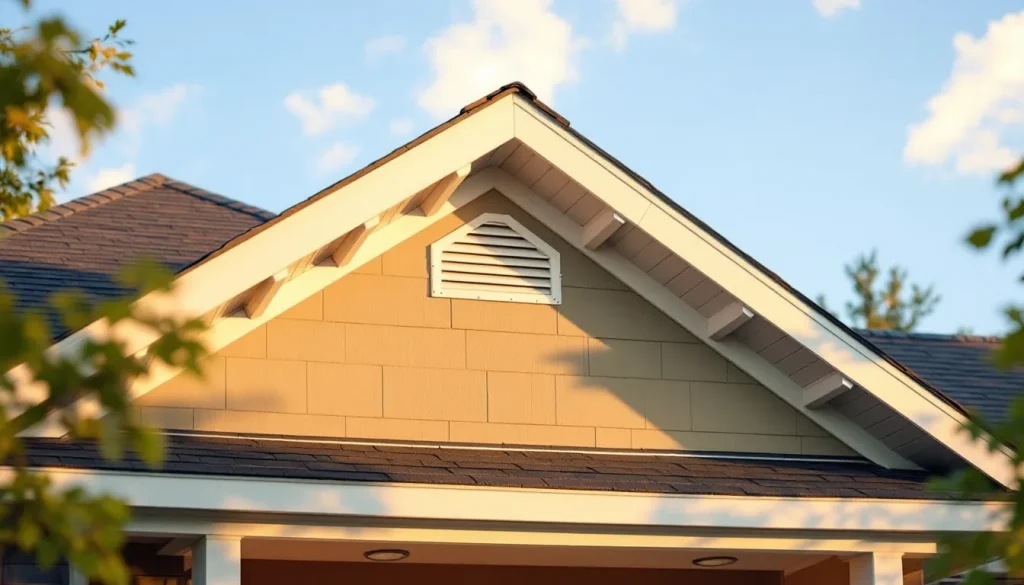
Attic ventilation in 2026 is the most overlooked factor in residential roof lifespan: poor ventilation cuts asphalt shingle life by 20 to 30 percent and voids most manufacturer warranties from GAF, Owens Corning, and CertainTeed. The IRC R806 building code 1:300 rule sets the minimum (1 square foot of net free vent area for every 300 square feet of attic floor), but actual installation requires balancing intake at the soffit with exhaust at the ridge. A house with great exhaust vents but blocked soffits ventilates worse than a house with neither. The math, the vent products, the install patterns, and the cost-to-add are all below.
The short version
- The IRC 1:300 rule requires 1 sq ft of net free vent area per 300 sq ft of attic floor (1:150 if not balanced 50/50 intake/exhaust).
- Balanced ventilation means 50% intake (soffit vents) and 50% exhaust (ridge vents). Imbalance kills performance.
- Ridge + soffit is the default modern install. Gable vents and powered fans are mostly legacy or special-case.
- Poor ventilation cuts shingle life by 20% to 30% and voids GAF, OC, and CertainTeed manufacturer warranties.
- Cost to add a balanced ridge + soffit system to an existing home: $300 to $1,500. Retrofit during a reroof for the lowest cost.
- Symptoms of bad ventilation: frost on attic deck in winter, ice dams, hot upstairs in summer, premature shingle aging.
The short answer: why it matters and the 1:300 rule
Attic ventilation does two jobs: it pulls heat out of the attic in summer (preventing shingle bake-off) and it pulls moisture out in winter (preventing condensation, mold, and rot). The International Residential Code (IRC) Section R806 codifies the minimum:
- 1 sq ft of net free vent area (NFVA) per 300 sq ft of attic floor, if at least 40% to 50% of the vent area is in the upper portion of the attic (ridge or upper gable vents) and the balance is at the eaves (soffit vents).
- 1 sq ft per 150 sq ft of attic floor if the balanced 50/50 split is not achieved, or if no vapor retarder is installed at the ceiling.
“Net free vent area” is the actual open area for airflow, not the gross dimension of the vent. A ridge vent‘s NFVA is typically printed on the carton (most products are 12 to 18 square inches per linear foot). A soffit vent‘s NFVA depends on the perforation pattern.
What attic ventilation does
Two separate mechanisms, both important.
Summer: heat removal
An unventilated attic on a sunny 90-degree day reaches 150 to 170 degrees F. The shingles above it run even hotter (180 to 200 degrees F surface temperature). At those temperatures, asphalt shingles oxidize faster, lose granules faster, and become brittle faster. ARMA technical bulletins estimate the lifespan reduction at 20% to 30% versus a properly ventilated attic.
Balanced ridge + soffit ventilation drops the attic temperature by 40 to 60 degrees F at peak summer. The mechanism is thermal stack effect: hot air rises and exits at the ridge, drawing cooler air in at the soffits. The result is constant attic air movement that prevents heat accumulation.
Winter: moisture removal
In winter the threat is condensation, not heat. Warm moist air rises from the conditioned living space into the attic (through bathroom fans, recessed lights, attic access hatches, and uninsulated gaps). If that moist air can’t escape, it condenses on the cold underside of the roof deck, then freezes. Frost on the deck thaws in warm weather, soaking insulation and rotting sheathing.
Balanced ventilation continuously exhausts that moist air before it can condense. This is why ventilation matters in cold climates even more than hot climates: the moisture problem causes structural damage; the heat problem only ages shingles.
Symptoms of poor attic ventilation
- Hot upstairs rooms in summer. Despite AC, second-floor rooms run 5 to 10 degrees hotter than the rest of the house.
- Frost on attic deck in winter. Visible white crystals on the underside of the roof sheathing during cold snaps.
- Ice dams at the eaves. Snow melts at the ridge (warm attic), runs down, refreezes at the cold eave.
- Stained or damp attic insulation. Brown or yellow staining indicates moisture cycling.
- Premature shingle aging. Curling, cracking, or granule loss 5 to 10 years earlier than expected.
- Mold or mildew smell from the attic access.
- High summer cooling bills. AC running constantly to overcome attic heat radiating through ceilings.
For the full roof-aging picture, see our asphalt shingle roof lifespan and signs you need a new roof guides.
The 1:300 rule (IRC R806)
Let’s work an example. A 2,000-square-foot single-story home with a typical attic floor area of 2,000 square feet needs:
- Total NFVA: 2,000 / 300 = 6.67 square feet = 960 square inches.
- Exhaust (ridge): 480 square inches = half of total.
- Intake (soffit): 480 square inches = half of total.
If the home has a 50-foot ridge length and we install a ridge vent with 18 square inches NFVA per linear foot, that ridge contributes 50 x 18 = 900 square inches of exhaust. More than enough.
For soffit intake, if the soffit vents provide 9 square inches NFVA per linear foot of soffit, and the home has 150 linear feet of soffit, that’s 1,350 square inches available. Also more than enough.
But: if any of that soffit area is blocked by insulation (the most common defect), the actual NFVA drops dramatically. Baffles between rafters at the eave are essential to keep the soffit-to-attic airway clear.
Balanced ventilation: intake vs exhaust
The single biggest mistake in residential attic ventilation is unbalanced systems. Common failures:
Too much exhaust, not enough intake
Symptom: ridge vent and gable vents both installed; soffit vents missing or blocked. The exhaust still works, but it draws from inside the conditioned house (pulling AC out the attic). The fix is opening or adding soffit vents.
Too much intake, not enough exhaust
Symptom: soffit vents are clear but the only exhaust is a gable vent or none. Moist warm air accumulates at the ridge and condenses. The fix is adding a ridge vent or static box vents.
Multiple exhaust types stacked
Symptom: ridge vent plus gable vents plus a powered attic fan. They short-circuit each other (one draws from the others instead of from the soffit). The fix is choosing one primary exhaust system and sealing the others.
Ridge vents (the most common modern setup)
Ridge vents are the default exhaust for asphalt shingle roofs built or reroofed since 2000. They run the full length of the ridge, capped by ridge cap shingles, and provide continuous high-point exhaust along the entire roof.
| Ridge vent product | NFVA per linear foot | Cost per linear foot installed | Notes |
|---|---|---|---|
| GAF Cobra Snow Country | 18 sq in | $8-12 | External baffle, snow-rated |
| Owens Corning VentSure | 16-18 sq in | $7-11 | Standard residential |
| CertainTeed Filtervent | 15-18 sq in | $8-12 | Filter against insects |
| Air Vent ShingleVent II | 18 sq in | $8-12 | External baffle, contractor favorite |
| Roll-out ridge vent (mesh type) | 9-12 sq in | $5-8 | Budget, no external baffle |
External baffle ridge vents
The external baffle (the small plastic deflector that sticks up above the vent) creates negative pressure on the downwind side, drawing air out even in low-wind conditions. Premium ridge vents have external baffles; budget ones don’t. The performance difference is real and worth the $2 to $4 per linear foot upgrade.
Soffit vents (intake side)
Soffit vents are the intake half of the system. They go at the eave (the underside of the roof overhang) and draw outside air into the attic to replace what the ridge vent exhausts.
Soffit vent styles
- Continuous strip: a perforated aluminum or vinyl strip running the full soffit length. Cleanest install, most NFVA. $3 to $7 per linear foot installed.
- Round circular vents: 3 or 4 inch round inserts spaced every 16 to 24 inches. Common in older homes. Often insufficient NFVA on modern code.
- Perforated soffit panels: full vinyl or aluminum panels with built-in perforations. Common in new construction. NFVA depends on perforation pattern.
- Drip edge vents: a relatively new product that integrates the intake with the eave drip edge. Useful when the soffit is too narrow for standard vents.
The baffle problem
The #1 failure mode for soffit ventilation is insulation packed against the underside of the roof deck at the eave. Insulation blocks the airway between the soffit and the attic, killing the intake even if the soffit vent itself is open. Rafter baffles (ProperVent, AccuVent) hold the airway open at the eave and route intake air past the insulation into the attic space. Baffle cost is $2 to $5 each, plus install labor. Should be installed in every rafter bay at the eave.
Gable vents (older homes)
Gable vents are louvered openings at the end gables of the attic. They were the dominant ventilation method from the 1940s to the 1990s, before ridge vents took over. They still work, but they have two problems compared to ridge + soffit systems:
- Less effective. Air movement is wind-driven, not thermal stack, so still days have minimal ventilation.
- Short-circuiting with ridge vents. If a home has both gable vents and ridge vents, the ridge vent pulls air from the gable vents (which is closer than the soffits), bypassing the attic entirely. This is why most contractors seal off gable vents when they install ridge vents during a reroof.
In older homes with gable vents only, adding soffit vents while keeping the gables can work fine. The decision to add a ridge vent should include sealing the gables.
Powered attic fans (when they help, when they hurt)
Powered attic fans (electric or solar) actively pull air through the attic. They work, but they create more problems than they solve in most installations:
Where they help
- Attics with insufficient passive ventilation that can’t easily be retrofitted
- Hot climates (TX, AZ, FL) where peak attic temperatures are extreme
- Garage and outbuilding attics where the conditioned-air-pull risk is low
Where they hurt
- Pulling conditioned air out of the house. A 1,500 CFM fan can pull AC out of the living space through every gap and recessed light, increasing cooling costs.
- Short-circuiting passive vents. The fan draws from the closest opening, often a ridge or gable vent, rather than the soffits.
- Backdrafting combustion appliances. In homes with gas water heaters or furnaces in the basement, the negative pressure can pull combustion gases back into living space.
- Operating cost. Electric fans cost $30 to $80 per year to run.
For most modern homes with proper ridge + soffit ventilation, powered fans add more problems than they solve. ARMA and most manufacturer warranties explicitly state that passive ridge + soffit is preferred.
Solar attic fans (efficiency and cost)
Solar-powered attic fans solve the operating cost problem (no electricity bill) but don’t solve the short-circuiting or conditioned-air-pull issues. They run when the sun is shining, which happens to be when the attic is hottest, so the duty cycle is appropriately matched.
| Solar fan product | CFM rating | Cost installed | Tax credit eligible? |
|---|---|---|---|
| Natural Light SAF 24W | 800 CFM | $400-700 | Yes (30% solar credit) |
| Yellowblue 32W | 1,200 CFM | $600-900 | Yes |
| Solatube SmartVent | 500-1,000 CFM | $500-800 | Yes |
| QuietCool Solar 40W | 1,300 CFM | $700-1,000 | Yes |
Solar fans qualify for the 30% federal Residential Clean Energy Credit (Section 25D) through 2032. After the credit, a typical $700 install nets to about $490.
Roof vent spacing
Static box vents (the small square hood vents seen on older roofs) are still used in some applications where a ridge vent isn’t feasible. The recommended spacing is one vent per 300 square feet of attic floor area, distributed evenly across the upper third of the roof.
| Vent type | NFVA per unit | Coverage per unit | Cost installed |
|---|---|---|---|
| Static box vent (50 sq in) | 50 sq in | ~150 sq ft attic floor | $80-150 |
| Static box vent (60 sq in) | 60 sq in | ~180 sq ft attic floor | $100-180 |
| Static box vent (72 sq in) | 72 sq in | ~220 sq ft attic floor | $120-200 |
| Continuous ridge vent | 18 sq in per lf | Replaces all of above | $8-12 per lf |
The manufacturer warranty connection
This is the part most homeowners miss. Every major asphalt shingle manufacturer (GAF, Owens Corning, CertainTeed, IKO, Atlas) explicitly requires adequate attic ventilation as a condition of warranty coverage. The specific language varies, but the substance is the same: meet the IRC 1:300 rule with balanced intake and exhaust, or the warranty is void.
What each manufacturer requires (paraphrased from 2026 warranty docs)
- GAF: “Ventilation in accordance with the requirements of the most current edition of FHA Minimum Property Standards, the local building code, or the most current edition of the ASHRAE Handbook.”
- Owens Corning: “Insufficient attic ventilation in accordance with current ARMA guidelines and applicable building codes is not covered.”
- CertainTeed: “Adequate attic ventilation must be maintained meeting current building code requirements.”
What this means in practice: if your shingles fail prematurely and the manufacturer’s inspector finds inadequate ventilation, the warranty claim is denied. This is one of the most common warranty denial reasons in the industry.
Climate-specific recommendations
Hot/dry climates (Phoenix, Las Vegas, Tucson)
Heat is the primary concern. Maximize exhaust capacity at the ridge. Light-colored shingles, radiant barrier in attic, and properly sealed soffits all help.
Hot/humid climates (Houston, New Orleans, Miami)
Both heat and moisture matter. Balanced ventilation is critical. Some Gulf Coast areas use insulated unvented attic assemblies as an alternative; consult local code.
Mixed climates (Atlanta, Charlotte, Nashville)
Standard balanced ridge + soffit works fine. Pay attention to bathroom fan venting (vent to outside, not into attic).
Cold climates (Minneapolis, Buffalo, Boston)
Moisture and ice dams are the primary concerns. Balanced ventilation plus deep attic insulation (R-49 to R-60) plus careful air sealing at the ceiling plane.
Marine climates (Seattle, Portland)
Moisture from rain and condensation. Ventilation is critical year-round. Avoid powered fans (humidity pulls into walls through gaps).
Cost to add ventilation ($300 to $1,500 typical)
Adding or upgrading attic ventilation to an existing home varies widely in cost depending on what’s already there:
| Project | Cost | When |
|---|---|---|
| Add baffles to existing soffit vents | $150-400 | Any time, attic access required |
| Add continuous soffit vent strip (retrofit) | $300-800 | Any time, exterior work |
| Add ridge vent (standalone, no reroof) | $400-900 | Roof in good shape, ridge accessible |
| Add ridge vent during reroof | $200-400 (incremental) | Best time, lowest cost |
| Full ridge + soffit retrofit (existing roof) | $800-1,800 | Significant project |
| Add solar attic fan | $400-1,000 | Supplement, not replacement |
| Add powered electric fan | $300-700 + electrical | Rarely recommended in modern homes |
The single best time to add or fix attic ventilation is during a reroof. The incremental cost is $200 to $400 versus $800 to $1,800 as a standalone project, and the integration with new shingles, underlayment, and flashing is much cleaner. See our how much does a new roof cost and felt vs synthetic underlayment guides for the broader reroof planning.
Unvented (conditioned) attic assemblies
An alternative to ventilated attics is the unvented or conditioned attic assembly. The roof deck is insulated from below with spray foam (closed-cell), the attic is brought into the building’s conditioned envelope, and no ventilation is provided to the outside. This approach has gained traction in hot/humid Gulf Coast climates and in homes with HVAC equipment located in the attic.
When unvented attics make sense
- HVAC ducts and equipment in the attic: bringing the attic into conditioned space drops energy losses dramatically.
- Hot/humid climates where vented attics struggle with moisture loading.
- Complex roof geometries where balanced ventilation is hard to achieve.
- Cathedral ceiling and skillion roof designs without traditional attic space.
Cautions
- Requires closed-cell spray foam at the roof deck (R-49 typical), costing $7,000 to $20,000 on a typical home.
- Most shingle manufacturers will warranty unvented assemblies only if specific spray foam and ventilation channels are used. Check before specifying.
- Code compliance varies by state. IRC R806.5 permits unvented assemblies under specific conditions.
- Cannot be retrofitted easily on existing homes with traditional vented attics.
Common ventilation mistakes during a reroof
The single highest-value moment to fix attic ventilation is during a reroof. The roofing material is off, the ridge is open, and access to soffits is clean. Most ventilation defects in modern homes trace back to a reroof where the crew skipped or compromised the ventilation upgrade. The most common mistakes:
- Cutting the ridge slot too narrow. The IRC and ridge vent manufacturers require a 1.5 to 2 inch slot on each side of the ridge board. A narrow slot strangles airflow.
- Installing ridge vent without sealing existing gable vents. The two short-circuit each other, leaving the soffits unused.
- Skipping rafter baffles at the eaves. Insulation blocks the soffit-to-attic airway and the soffit vents become ornamental.
- Mixing ridge vent products of different NFVA ratings. Air takes the easiest path, leaving sections of the ridge un-ventilated.
- Installing ridge cap shingles too tight. The cap shingles need to allow air movement through the vent product underneath.
- Ignoring complex rooflines. Multiple ridges, hips, and dormers each need their own ventilation strategy.
If you’re planning a reroof, make ventilation a contract line item. Specify the ridge vent product by name, specify the soffit vent linear footage to be installed or cleared, and specify rafter baffle installation in every rafter bay at the eave. See our how to choose a roofing contractor guide for vetting questions.
Bathroom and kitchen vent termination
This is the most overlooked attic moisture source in modern homes. Bathroom exhaust fans and kitchen range hoods generate significant moisture and grease. When they terminate into the attic instead of through the roof or exterior wall, the moisture loads the attic far beyond what natural ventilation can handle. Running a bathroom vent through the roof to a proper cap moves that moisture outside for good.
The correct termination
- Bathroom fans: terminate through the roof with a dedicated vent cap (not a passive roof vent), or through an exterior wall.
- Kitchen range hoods: terminate through the roof or exterior wall. Never recirculate into the attic.
- Dryer vents: terminate to exterior. Lint plus moisture is a fire and mold risk.
- Plumbing vent stacks: terminate above the roofline (these are code-required and correctly install).
Inspect existing terminations during any attic visit. A surprising percentage of older homes have bathroom fans that just dump into the attic. Retrofitting a proper roof or wall termination costs $300 to $800 per fan and is one of the highest-ROI moisture interventions available.
Signs your ventilation is adequate
- Attic temperature within 15 to 20 degrees F of outdoor temperature in summer
- Dry attic deck in winter (no frost, no condensation staining)
- Even insulation depth across the attic floor (no settling from moisture)
- Upstairs rooms within 3 to 5 degrees F of downstairs (with AC running)
- No ice dams forming at the eaves in cold-snap weather
- Shingles aging at the expected rate (see our asphalt shingle roof lifespan guide)
Frequently asked questions
How much attic ventilation do I need?
Per IRC R806: 1 square foot of net free vent area per 300 square feet of attic floor, with at least 50% of that area at the eaves (soffit) and the rest at the ridge or upper portion. For a 2,000-square-foot attic that’s 960 total square inches of vent area, split 480 intake and 480 exhaust.
Is a ridge vent enough by itself?
No. A ridge vent without matching soffit intake is worse than no ridge vent at all, because it pulls air from inside the conditioned house. Ridge vents only work in pair with adequate soffit intake.
Will adding attic ventilation lower my cooling bills?
Yes, modestly. Most studies show 5% to 15% summer cooling savings when going from poor to balanced ventilation. The bigger gain is shingle lifespan (20% to 30%) and warranty preservation.
Are powered attic fans worth it?
Usually no. They short-circuit passive vents, pull conditioned air out of the house, and can backdraft combustion appliances. For homes with adequate ridge + soffit ventilation, they add cost without much benefit. Solar fans are a partial exception in extremely hot climates.
Does my shingle warranty really require attic ventilation?
Yes. Every major manufacturer (GAF, OC, CertainTeed) requires building-code-compliant ventilation as a condition of warranty coverage. Premature shingle failure plus inadequate ventilation is one of the most common warranty denials.
Why do I have ice dams if my attic is well insulated?
Insulation slows heat loss but doesn’t eliminate it. Ice dams form when warmth from the house melts upper roof snow, and the meltwater refreezes at the cold eave. The fix is the combination of deep insulation, air sealing at the ceiling plane, AND balanced ventilation. All three are needed.
Can I install ridge vents myself?
It’s a moderately difficult DIY job that requires cutting a 1.5 inch slot in the roof sheathing along the entire ridge, installing the vent product, and capping with ridge cap shingles. Most homeowners hire this out as part of a reroof. Standalone DIY ridge vent install runs about a full weekend for a moderately experienced DIYer.