
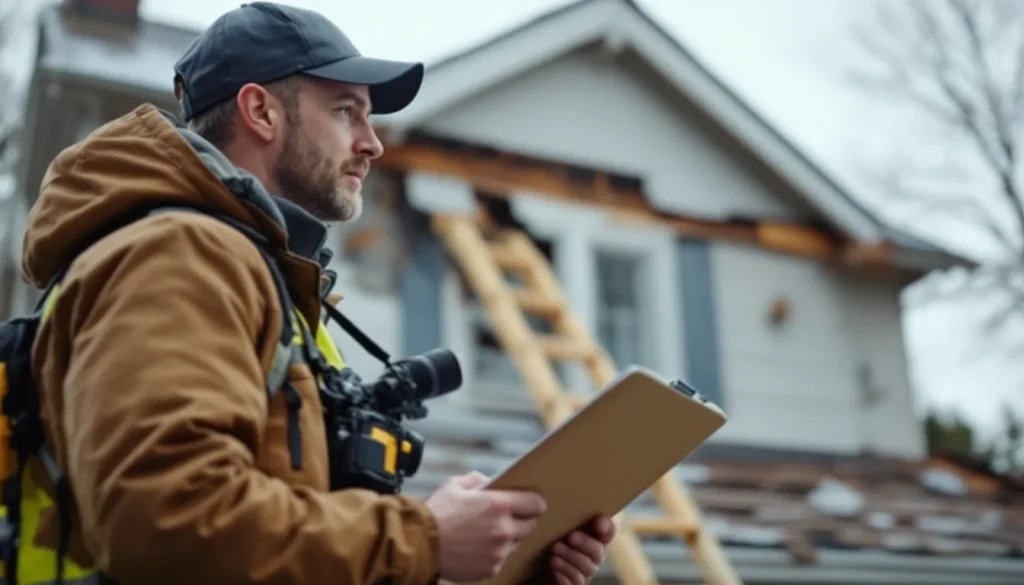
An insurance adjuster roof inspection (for the full data set, see the 2026 Permit and Inspection Database) in 2026 is the critical visit that determines whether your storm-damaged roof gets covered or denied. Adjusters use a standardized 4-square test (a 10 ft by 10 ft chalked grid on each roof slope), count 8 to 10 functional hail hits per 100 sq ft as the trigger for full slope replacement, and apply carrier-specific guidelines that vary materially between State Farm, Allstate, USAA, and Citizens Property Insurance Florida. The inspection typically lasts 45 to 90 minutes, the adjuster writes an Xactimate sketch on site, and your settlement check usually arrives 14 to 30 days after the report is filed. Here is exactly what to expect, what to document before they arrive, and what determines whether you get full Replacement Cost Value coverage or only Actual Cash Value.
The short version
- The 4-square test is the industry standard (per Haag Engineering and NRCA bulletins): adjusters chalk four 10×10 squares per slope and count functional impacts. 8 to 10 hits per 100 sq ft typically triggers full slope replacement.
- Functional damage (bruising, mat fracture, granule displacement exposing asphalt) is covered. Cosmetic granule loss alone is not, unless your policy includes a cosmetic endorsement.
- RCV pays full replacement minus deductible (most common). ACV pays depreciated value, and you only recover the difference after you complete repairs and submit invoices.
- Your roofer should be on the roof with the adjuster. Solo adjuster inspections result in 22 to 35 percent lower claim payouts based on industry public adjuster data.
- Florida policies post 2023 AOB reform have specific assignment restrictions. Read your contractor agreement before signing anything during the inspection.
- Disputes follow a 3-step path: re-inspection, appraisal clause invocation, and finally Department of Insurance complaint or litigation.
The Short Answer: What Adjusters Look For and How to Prepare
Independent and staff adjusters working for State Farm, Allstate, USAA, Liberty Mutual, Travelers, Farmers, and Citizens are trained on a similar core methodology even though each carrier has internal guidelines. The adjuster lands at your house carrying a ladder, a chalk box, a measuring wheel, an Xactimate-loaded tablet (or laptop), and a camera. They walk the roof, chalk 10 ft by 10 ft test squares on each slope, count and circle every hit they consider functional, photograph each square with a number marker, then move to the attic and interior to look for matching water intrusion.
The decision tree they apply is straightforward. Functional hail damage that meets the carrier threshold (typically 8 to 10 hits per 100 sq ft on a 3-tab or architectural asphalt shingle) gets the slope replaced. If three or more slopes qualify, most carriers approve the entire roof. Wind damage uses a different test: the adjuster looks for creased shingles, lifted tabs, missing shingles, and torn underlayment. The Insurance Institute for Business and Home Safety (IBHS) and ARMA both publish field guides that adjusters reference.
Your job before the inspection is to document the pre-loss condition, the storm date, every interior leak, and every piece of debris in the yard. If you skip this prep, the adjuster has only their 60-minute window to assess decades of roof history and acute storm damage, and the default in ambiguous cases trends toward denial or partial scope.
Before the Adjuster Arrives: Documentation Checklist
Run this checklist 24 to 72 hours before the appointment. Every item you cross off raises your settlement.
- NOAA storm verification. Pull the Local Storm Report from the National Weather Service office covering your county for the date you reported damage. Print it. Hail size, wind speed, and time of impact will be on it.
- Pre-loss photos. Scour your phone roll, Google Photos timeline, real estate listing photos, and Zillow archives for any image showing the roof intact before the storm date. Email yourself a folder.
- Post-storm walk-around photos. Date-stamped close-ups of every dented gutter, dented downspout, dented HVAC condenser fin, dented mailbox, dented patio table, cracked skylight dome, and broken window screen. These corroborate hail size and direction.
- Interior leak photos. Stained ceilings, water rings on drywall, dripping recessed light cans, attic insulation that is wet or compressed, and visible decking stains from underneath.
- Receipt history. Any roof maintenance invoices, prior inspection reports, prior insurance claims, or warranty documents.
- Roofer report. Have your contractor produce a written damage assessment (typed, on letterhead, with photos) before the inspection. Hand a copy to the adjuster when they arrive.
- Policy declarations page. Know whether you are RCV or ACV, your deductible (flat dollar or percentage-of-Coverage-A), your wind/hail deductible separately, and any cosmetic endorsement.
If you live in a state with named-storm deductibles (Florida, Texas, Louisiana, North Carolina, South Carolina, Alabama, Mississippi, Georgia), confirm whether the storm date triggered the higher deductible. A 2 percent named-storm deductible on a $400,000 dwelling is $8,000 out of pocket, versus a flat $1,000 standard deductible. That math changes whether filing makes sense at all. See our breakdown at filing an insurance claim for roof damage for the full pre-filing checklist.
The 4-Square Test (8 to 10 Hits per 100 sq ft Threshold)
The 4-square test originated with Haag Engineering’s HAAG-Certified Inspector program in the late 1990s and is now the de facto standard across the property insurance industry. Here is how it runs in the field.
The adjuster pulls out a chalk box and snaps four 10 ft by 10 ft squares on each accessible slope (one per quadrant). They walk each square systematically, counting hits that meet their carrier’s functional damage definition. A “hit” is generally a circular impact that displaced granules and either bruised or fractured the underlying asphalt mat. The adjuster circles each qualifying hit with chalk and photographs the square with a numbered placard.
| Hits per 100 sq ft (1 square) | Typical Adjuster Decision | Carrier Variation |
|---|---|---|
| 0 to 4 | Cosmetic only, no slope coverage | Some carriers require 6+ for any payment |
| 5 to 7 | Repair (replace damaged shingles only) | Patch payment, prorated |
| 8 to 10 | Full slope replacement | State Farm, USAA, Travelers typical threshold |
| 11 to 15 | Full slope replacement, often full roof | Allstate, Liberty Mutual often approve full roof |
| 15+ | Full roof replacement | Universal across major carriers |
Not every dimple counts. Bird tracks, marble drops from rooftop debris, foot scuffs from prior service techs, mechanical damage from a satellite installer, and natural granule embedment from manufacturing all get excluded. A trained adjuster can tell the difference by the impact pattern, the direction of granule displacement, and whether the bruise (a soft spot you can feel by pressing a thumb on the spot) is present.
Functional Damage vs Cosmetic Damage (The Critical Distinction)
This is where most claim denials happen. Functional damage means the impact compromised the shingle’s ability to shed water and protect the structure. Cosmetic damage means the shingle looks worse but still performs.
Functional indicators include: granule loss exposing the asphalt mat, a visible fracture in the mat (you can see it as a dark spot or crack), a bruise (you press the spot and feel a soft give), tab separation from the courses below, and creasing along the seal line from wind uplift.
Cosmetic indicators include: granule displacement that still leaves a tinted asphalt surface, surface scuffs that did not penetrate the mat, dimples without granule loss, and discoloration. Carriers will not pay to replace cosmetic-only damage unless your policy carries a cosmetic damage endorsement (some Texas, Colorado, and Kansas policies offer this for an extra premium).
| Damage Type | Functional? | Typical Coverage |
|---|---|---|
| Mat fracture with exposed asphalt | Yes | Covered, counts as hit |
| Bruise (soft spot, no visible crack yet) | Yes | Covered, counts as hit |
| Granule loss without mat exposure | No | Not covered absent endorsement |
| Creased shingle from wind | Yes | Covered as wind damage |
| Missing shingle | Yes | Covered, photographed individually |
| Lifted seal strip | Yes | Covered as wind damage |
| Tree branch puncture | Yes | Covered, separate from hail/wind |
| Foot traffic scuff | No | Pre-existing, not covered |
| Bird tracks/marble drops | No | Excluded by Haag standard |
| Granule embedment (factory) | No | Pre-existing condition |
If you only have cosmetic damage and want to dispute it, your strongest play is the cosmetic endorsement check (which most policies do not carry) or evidence that the granule loss is severe enough to materially shorten the shingle’s UV protection life. Manufacturers like GAF, Owens Corning, and CertainTeed publish material data sheets showing that granule loss exposes the asphalt mat to UV degradation that accelerates aging. Some adjusters accept this. Most do not.
What Adjusters Check on the Roof
The roof walk covers more than just shingle surfaces. Here is the typical checklist a 60-minute adjuster runs through.
| Component | What They Look For | Why It Matters |
|---|---|---|
| Shingle field | Hits per 100 sq ft, creased tabs, missing shingles | Primary damage trigger |
| Ridge and hip caps | Creased or lifted caps, missing ridge vent sections | Higher hit count typical, wind sensitivity |
| Valleys (open and closed) | Dented W-valley metal, displaced shingles, exposed underlayment | Functional water shed concern |
| Flashing | Step, counter, drip edge, chimney, skylight, dormer | Wind uplift and impact denting |
| Vents and pipe boots | Cracked rubber boots, dented metal hoods, hail-cracked plastic | Often the most visible hail evidence (see roof flashing repair) |
| Gutters and downspouts | Dents, dings, separation, debris | Hail size verification |
| Skylights | Cracked domes, broken glass, dented frames | Hail size verification and direct damage |
| HVAC condenser fins | Combed or flattened aluminum fins | Independent hail verification (no homeowner can fake this) |
| Soffit and fascia | Dents, paint chip, separation | Wind and impact secondary evidence |
| Roof decking visible through openings | Wet sheathing, sagging, fastener pops | Long-term moisture intrusion evidence |
The HVAC condenser fin check is one of the most underrated parts of the inspection. Hail dents on aluminum fins are impossible to fake and provide an independent timeline of when hail fell at the property. Make sure your condenser is accessible and not covered when the adjuster arrives. For a deeper look at how inspections are scoped from the homeowner side, see how to get a roof inspection and roof inspection cost.
What They Check in the Attic
A quick attic walk-through is part of nearly every storm claim inspection. The adjuster is looking for matching water intrusion that corroborates exterior damage.
- Underside of decking. Water staining patterns directly under damaged exterior areas. Fresh stains (still dark and damp) versus old stains (chalky, white-edged, dry).
- Insulation. Compressed, matted, or visibly wet batts indicating recent water flow.
- Rafters and truss members. Drip lines, mold initiation (typically white to gray fuzz, sometimes black), and any sagging.
- Nail pops. Fasteners that have backed out from cyclic wetting and drying, indicating chronic moisture.
- Ventilation. Whether soffit vents are clear and whether ridge or gable vents are functioning. Poor ventilation accelerates shingle failure and adjusters sometimes flag it as a maintenance issue that voids partial coverage.
If the attic shows no water intrusion but the exterior shows clear hail or wind damage, you can still get coverage. The water intrusion check is corroborative, not required. Modern shingles can be functionally damaged in ways that have not yet caused a leak.
ACV vs RCV: Coverage Math (Worked Example)
This is where homeowners lose the most money by not understanding their own policy.
Replacement Cost Value (RCV) means the carrier pays the full cost to replace the roof with materials of like kind and quality, minus your deductible. RCV is paid in two checks: an ACV check up front, and a Recoverable Depreciation check after you complete the work and submit final invoices.
Actual Cash Value (ACV) means the carrier pays the depreciated value only. You absorb the depreciation. There is no second check.
Worked example. Your roof is 14 years old (asphalt shingle with a 25-year manufacturer life). Total Xactimate replacement scope: $24,800. Deductible: $2,000. Depreciation: 56 percent (14 of 25 years).
| Step | RCV Policy | ACV Policy |
|---|---|---|
| Total RCV scope | $24,800 | $24,800 |
| Less depreciation (56%) | $13,888 | $13,888 |
| ACV (RCV minus depreciation) | $10,912 | $10,912 |
| Less deductible | $2,000 | $2,000 |
| First check (ACV minus deductible) | $8,912 | $8,912 |
| Recoverable depreciation (after work complete) | $13,888 | $0 |
| Total carrier payment | $22,800 | $8,912 |
| Your out of pocket | $2,000 | $15,888 |
The difference: $13,888. Same damage, same deductible, $13,888 swing based purely on which policy type you carry. ACV policies are cheaper to buy (typically 10 to 25 percent lower premium) but can be catastrophic on a real claim. Check your declarations page now. For replacement cost ballparks across markets, see how much does a new roof cost.
Carrier-Specific Quirks
Each major carrier has documented field practices that shape how the inspection runs.
| Carrier | Field Quirks | Typical Hit Threshold |
|---|---|---|
| State Farm | Uses Xactimate exclusively. Adjusters often staff (not independent). Strong test-square methodology. Will approve full roof at 3+ damaged slopes. | 8 hits per 100 sq ft |
| Allstate | Heavy independent adjuster network. Frequently requires re-inspections. Settles more on partial scope first. | 10 hits per 100 sq ft |
| USAA | Member-friendly reputation, fastest claim cycle (often 7 to 14 days). Strong RCV defaults. Higher willingness to approve full roof on borderline counts. | 8 hits per 100 sq ft |
| Liberty Mutual | Aggressive use of engineering reports (typically Haag or Donan) on disputed claims. Slower cycle. | 10 hits per 100 sq ft |
| Travelers | Uses field adjuster + desk reviewer split. Drone photogrammetry common (EagleView or HOVER imagery). | 8 hits per 100 sq ft |
| Farmers | Often pushes ACV settlement and requires homeowner to invoke replacement coverage. Read your policy carefully. | 10 hits per 100 sq ft |
| Citizens Property Insurance (FL) | State of last resort in Florida. Strict adherence to 2023 AOB reform rules. Mandatory carrier-managed scoping. | 10 hits per 100 sq ft |
| Florida private market (Universal, Heritage, Tower Hill, ASI Progressive) | Post-AOB landscape. Faster claim cycle but tighter scope. Often subject to mediation rights under FL 627.7015. | 10 hits per 100 sq ft |
None of this is published policy. It is observed behavior from public adjuster industry reports, NICB databases, and aggregated contractor reporting. Your specific adjuster may differ. The point is to know the carrier’s tendency before the inspection so you can prepare your evidence accordingly.
Should Your Roofing Contractor Be Present?
Yes. Public adjuster industry analysis (United Policyholders, Tampa Bay Public Adjusters Association, and others) shows that claims with a roofing contractor on site during the adjuster inspection settle 22 to 35 percent higher than solo inspections. The reasons are concrete.
- The contractor and adjuster review damage together on the roof. Ambiguous hits get discussed and resolved in real time.
- The contractor flags code-required items (drip edge upgrade, ice and water shield zones, ridge vent reinstall) that the adjuster may not include.
- The contractor verifies the Xactimate sketch matches the actual roof geometry (squares, valleys, hips, ridges). Carriers occasionally undersize roofs by 5 to 15 percent.
- The contractor advocates for line items like decking replacement, ice and water shield, synthetic underlayment, and starter strip that often get omitted from initial scopes.
- The contractor verifies tear-off, dump fees, and labor lines reflect local market rates.
Pick a contractor with insurance claim experience. Ask how many adjuster inspections they have attended in the last 12 months. Anything under 30 is a red flag in a storm-affected market. See how to choose a roofing contractor for the vetting checklist.
Florida AOB Compliance During Adjuster Inspection
Florida’s 2023 AOB reform (House Bill 837 and earlier 2019 SB 122) changed the assignment landscape materially. Contractors can still help you through a claim, but the post-reform rules limit what they can do without your written, informed consent.
- Assignment of Benefits agreements signed during or immediately after a storm now require a 14-day rescission period for residential property claims.
- The contractor must provide a written estimate before any AOB can be enforced.
- One-way attorney fee shifting (a major prior driver of litigation) has been eliminated.
- Citizens Property Insurance can require homeowners to use approved managed-repair networks in certain cases.
What this means during the adjuster inspection: do not sign anything labeled “Assignment of Benefits” or “Direction to Pay” without reading it carefully. Your contractor should be there to participate, not to take over the claim. For the full breakdown of the reform timeline, see Florida AOB roofing reform and our state license overview at Florida roofing contractor license.
The Estimate: Reading the Adjuster’s Sketch
Within 7 to 30 days of the inspection, you receive the adjuster’s report. It will include an Xactimate sketch (or Symbility or CoreLogic equivalent), a line-item scope, and a coverage summary. Here is how to read it.
The sketch shows the roof in 2D with each plane labeled (F1 front 1, F2 front 2, R1 rear 1, etc), the dimensions of each plane, the slope (4/12, 6/12, etc), and the calculated area in squares. One square equals 100 sq ft. A 30-square roof is 3,000 sq ft of surface area.
The line items typically include: tear-off shingles, install starter row, install field shingles, install ridge cap, install drip edge, install underlayment (felt or synthetic), install ice and water shield (only in cold climates per IRC R905.1.2 or where required by code), pipe boot replacement, dump fee, debris removal, permit fee, and overhead and profit (O&P) at typically 20 percent (10 percent overhead, 10 percent profit) when scope qualifies.
What is often missed in initial scopes:
- Decking replacement at 1.5 to 5 percent of total square footage (you negotiate this on actual condition after tear-off).
- Drip edge code upgrade (most jurisdictions require it per IRC R905.2.8.5 even if not present originally).
- Ice and water shield upgrade in cold climate codes (per IRC R905.1.2 in jurisdictions with January mean temp under 25F).
- Ridge vent or ridge cap install if the existing system is non-ventilated and code now requires intake/exhaust ratio per IRC R806.
- Step flashing replacement at walls and chimneys.
- Counter flashing reset at chimneys.
- Skylight flashing kits.
- Satellite dish reset.
- Gutter detach and reset.
Each missing item is money. Have your contractor compare the adjuster scope to a clean roofing scope line by line.
Common Reasons Adjusters Underpay Claims
From public adjuster industry data and state insurance regulator complaint records, the most common underpayment patterns are:
| Underpayment Pattern | Dollar Impact | How to Fight It |
|---|---|---|
| Undersized roof measurement | $500 to $3,500 | Contractor on-site measurement, EagleView or HOVER report |
| Missing O&P at 20% | $2,500 to $6,000 | Cite carrier guidelines on three-trades rule (when 3+ trades involved) |
| Missing drip edge code upgrade | $300 to $900 | Cite local code adoption of IRC R905.2.8.5 |
| Missing decking replacement | $1,500 to $5,000 | Document condition after tear-off, supplemental claim |
| ACV settlement on RCV policy | $5,000 to $30,000 | Reference policy declarations, complete work, claim depreciation |
| Partial roof when full required | $8,000 to $20,000 | Matching-shingle availability documentation, NRCA matching guidelines |
| Cosmetic-only denial on functional damage | Full claim | Bruise documentation, mat fracture photos, engineering report |
| Wind damage capped at “repair only” | $3,000 to $15,000 | Document seal strip failure across multiple courses |
The matching-shingle argument is particularly powerful. If the shingle on your roof is discontinued (Owens Corning Oakridge color changes, GAF Timberline HDZ replacing earlier lines, CertainTeed Landmark color discontinuations), the carrier may be required by state matching law (Florida 626.9744, Connecticut 38a-316e, others) to replace the full slope or full roof to achieve uniform appearance. Document the existing shingle by manufacturer wrapper or warranty paperwork before tear-off.
Disputing an Adjuster’s Findings
If you disagree with the scope or denial, you have a structured set of options.
- Request a re-inspection in writing. Send a written request to your claim handler within 30 days of the initial report. Include new evidence (contractor report, additional photos, engineering opinion).
- Submit a supplemental claim. For items discovered after work begins (rotted decking, hidden damage), submit before completion with photo documentation.
- Invoke the appraisal clause. Nearly every policy includes an appraisal provision. Each party picks an appraiser, the two appraisers pick a neutral umpire, and the trio sets the loss amount. Binding (in most states) and often faster than litigation.
- File a Department of Insurance complaint. Each state has a regulator. Florida’s is the Office of Insurance Regulation. California has CDI. Texas has TDI. Complaints are tracked publicly and pressure carriers.
- Hire a public adjuster. Licensed advocate who works on contingency (typically 10 to 15 percent of the claim, capped by state law).
- Litigation. Last resort. Florida post-AOB reform eliminates one-way attorney fees, so litigation is now harder to fund.
When to Hire a Public Adjuster
Public adjusters are licensed by each state’s insurance regulator. They represent the policyholder (not the carrier) and earn a contingency fee on the claim recovery. Most state laws cap fees at 10 to 20 percent (Florida caps at 10 percent on declared emergencies, 20 percent otherwise).
Hire a public adjuster when:
- The claim has been denied entirely on questionable grounds.
- The settlement offer is more than 25 percent below your contractor’s estimate.
- The carrier is dragging the timeline past 60 days without a decision.
- The damage is complex (multiple causes, partial collapse, interior damage exceeding $25,000).
- You are unable to advocate effectively due to time, expertise, or stress.
Do not hire a public adjuster when:
- The carrier has paid fully on the contractor estimate.
- The claim is under $5,000 (the contingency fee eats most of the upside).
- You have a strong roofer who handles the carrier negotiation effectively for no fee.
Verify any public adjuster’s license at your state’s insurance regulator website before signing a contract.
The Post-Inspection Timeline
Here is the typical timeline from inspection to final settlement for an RCV policy.
| Step | Days After Inspection | What Happens |
|---|---|---|
| Report submitted | 1 to 14 days | Adjuster files report to carrier |
| Coverage determination | 7 to 30 days | Carrier confirms covered scope and amount |
| First check issued (ACV) | 10 to 30 days | ACV minus deductible mailed or direct deposited |
| Work begins | 30 to 90 days | Contractor schedules tear-off and install |
| Supplemental claims filed (if needed) | During work | Rotted decking, hidden damage, code upgrades |
| Work completed | 1 to 3 days of install | Final invoices and photos to carrier |
| Recoverable depreciation released | 14 to 45 days | Second check issued for depreciation |
| Mortgage company endorsement | varies | If escrowed, mortgage company endorses checks after inspection |
| Final inspection | after install | Permit inspection, optional carrier QA |
If your mortgage is escrowed, both checks are typically made out to you and the mortgage holder jointly. The mortgage holder may require their own post-work inspection before endorsing the second check, which adds 5 to 21 days. Plan accordingly. For the broader resource on claims navigation, return to our learn center.
FAQs
How long does an insurance adjuster roof inspection take?
Typically 45 to 90 minutes for a single-family home. Add 30 to 60 minutes for larger homes (over 4,000 sq ft), complex roof geometry (4+ slopes, multiple dormers), and detached structures (garage, shed, pool house). Add another 30 minutes if a contractor is present and reviewing line items together.
Can I be on the roof with the adjuster?
Most carriers will not let an untrained homeowner on the roof for liability reasons. Your roofing contractor is the right party to be on the roof. You can be in the attic, in the yard reviewing exterior dents, and at the kitchen table reviewing the Xactimate sketch.
What if the adjuster denies my claim entirely?
Request a written denial letter citing the specific policy exclusion. Then request a re-inspection with new evidence (contractor report, additional photos, NOAA verification). If still denied, invoke the appraisal clause or file a state Department of Insurance complaint. Engineering reports from firms like Haag, Donan, or Rimkus carry weight on disputed claims.
Do I have to use the contractor my insurance recommends?
No. You have the right to choose your own licensed contractor in every state. Carriers sometimes maintain “preferred” or “managed repair” networks, but you are not required to use them on most policies. Citizens Property Insurance in Florida is one exception where managed-repair clauses may apply on certain claims.
What if the adjuster’s scope is lower than my contractor’s estimate?
This is normal and expected. The gap is usually $2,000 to $8,000 on residential claims. Your contractor submits a supplemental claim with documentation for each missing or undersized line item. Most gaps close to within 5 to 10 percent after one or two supplements.
What happens if hidden damage is found after the work starts?
You file a supplemental claim. Document each piece of hidden damage with date-stamped photos before covering it. Typical hidden damage includes rotted decking, damaged underlayment, and corroded flashing. Carriers pay supplements on documented work.
Will my premium go up after a claim?
Depends on the carrier and the cause of loss. Weather-related claims (hail, wind, hurricane) historically had less premium impact than fire or theft, but post-2020 hardening of the insurance market has made all claims more impactful. Expect a 7 to 25 percent premium increase at next renewal in storm-affected states. Some carriers (and some state regulators) prohibit premium increases for first weather-related claims.
How long do I have to file a roof damage claim?
Varies by state and policy. Florida shortened the statute of limitations on property claims from 4 years to 1 year (then to 2 years for supplemental claims under HB 837) effective March 2023. Texas allows 1 year for weather-related claims under most policies. California allows 12 months from the loss date. Always check your specific policy and file as quickly as possible. Many carriers require notice within 14 to 60 days of discovery to preserve coverage.
Do drones replace the in-person adjuster inspection?
Sometimes, partially. Carriers like Travelers, Allstate, USAA, and State Farm increasingly use drone or aerial imagery (EagleView, HOVER, Nearmap) for initial triage or for re-inspections. The in-person adjuster visit is still standard for first inspection on hail and wind claims. Drone-only inspections are more common on cat-event surges (large hurricanes) where carrier capacity is overwhelmed.