
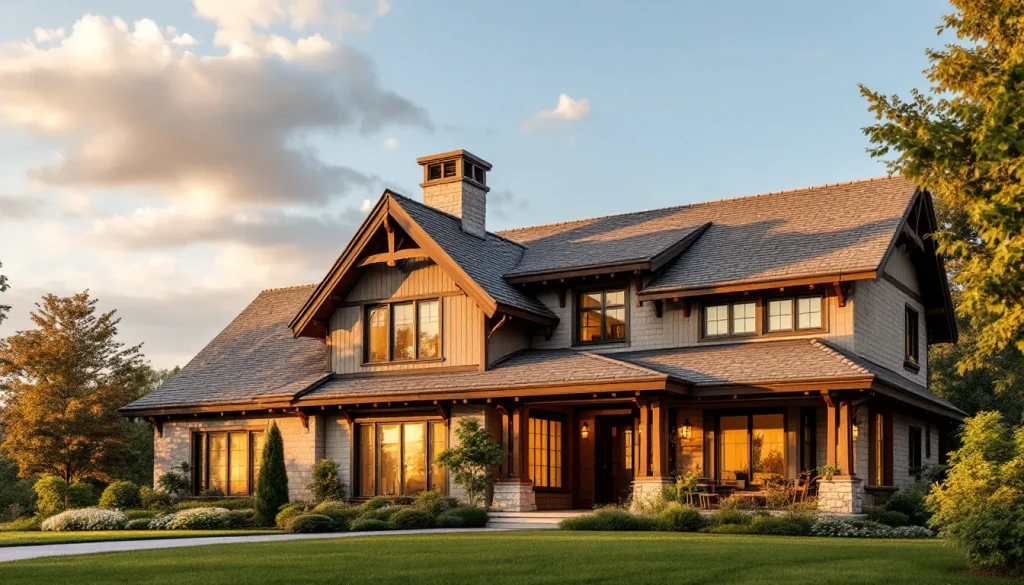
The best roof color in 2026 depends on three factors weighed in this order: architectural style of the home (see our residential roofing material by home type) (which colors look right with the siding, brick, stone, and trim), climate (light colors save 15 to 25 percent on cooling in hot regions per DOE cool roof studies, dark colors gain useful winter heat in cold regions), and resale value (weathered wood, charcoal gray, and warm charcoal consistently top NAR and Remodeling Magazine buyer-preference surveys). Here is how to balance all three, what each color category actually costs, and the regional bets that pay off for asphalt shingle, metal panel, and concrete tile roofs across the US.
The short version
- Weathered wood (a warm gray-brown blend) is the single most popular asphalt shingle color in the US in 2026, leading sales for both GAF Timberline HDZ and CertainTeed Landmark.
- Charcoal gray, slate gray, and matte black ride second through fourth across all shingle brands and most metal panel lines.
- In hot climates (CCC Zones 1 to 3, roughly TX, AZ, NM, FL, CA Central Valley), CRRC-rated cool roof colors save $40 to $300 per year on cooling per LBNL Heat Island Group estimates.
- In cold climates (Zones 5 to 7), dark roofs add roughly 2 to 4 percent to winter heat gain per ORNL simulations, modest but real.
- Resale value impact: NAR’s 2024 Profile of Home Staging found neutral roof colors (charcoal, gray, weathered wood) recovered 100 to 105 percent of cost on resale, while bright reds and blues recovered 60 to 80 percent.
- Coordinate roof with siding and trim using the 60-30-10 design rule: roof is the 30 percent supporting color, not the 60 percent dominant or the 10 percent accent.
Short answer: how to pick by priority
If you want a one-step decision tree for 2026:
- Climate first if you live in a hot market. In the southern third of the US (DOE Zones 1 to 3), the cooling savings from a cool-rated color (initial solar reflectance above 0.25 for steep-slope roofs per Title 24 and Energy Star) are large enough to override style preferences. Pick a CRRC-rated cool color in a shade your style allows.
- Architectural style next. A 1920s Craftsman bungalow with cedar siding wants a different shingle than a 2010 farmhouse with white board and batten. Style match drives buyer perception of fit.
- Resale value as a sanity check. Boring is safe. Charcoal, weathered wood, slate gray, and warm gray will not lose you money. Bright reds, blues, and greens may delight you and the next buyer, or may not.
- HOA and local context fourth. Many HOAs publish a roof color palette. Verify before you order.
Climate factor: cool roof colors
The Lawrence Berkeley National Lab (LBNL) Heat Island Group and the Cool Roof Rating Council (CRRC) have measured residential (see our residential roof guide guide) roof temperature differentials for two decades. The baseline finding: a roof reaches 150 to 190 F on a hot summer day in the South. A cool-rated roof reaches 110 to 140 F under the same conditions, a 30 to 60 degree difference. That difference shows up in the attic and conducts through the ceiling into the cooled living space below.
DOE’s residential cool roof calculator (available at energystar.gov) estimates annual cooling savings of:
- Phoenix AZ: 18 to 28 percent reduction in cooling load.
- Houston TX: 15 to 22 percent.
- Atlanta GA: 10 to 16 percent.
- Los Angeles CA: 12 to 18 percent.
- Memphis TN: 11 to 17 percent.
- Las Vegas NV: 18 to 26 percent.
For a 2,000 square foot single-family home with $1,800 annual cooling bills in Phoenix, that is $325 to $500 per year saved. Over a 25-year asphalt roof lifespan, $8,000 to $12,500. Over a 40-year standing seam metal roof, $13,000 to $20,000.
The CRRC publishes the Rated Products Directory at coolroofs.org. Look for asphalt shingles with an initial solar reflectance above 0.25 (steep slope) or above 0.65 (low slope). For metal panels, the PVDF (Kynar 500) “cool” pigment palettes from Englert, McElroy, MBCI, and Sheffield Metals routinely hit 0.30 to 0.65 SRI on colors as dark as bronze and dark gray. See standing seam metal roof cost for the metal pricing picture and metal roof colors for the specific cool palette breakdown.
Architectural style match
The fit between roof color and house style is the most underrated factor. A “popular” color on the wrong style reads as wrong even to non-designer buyers. The classical pairings (with the brand color names that hit them):
| Architectural style | Best roof colors | GAF HDZ examples | CertainTeed Landmark examples | What to avoid |
|---|---|---|---|---|
| Craftsman / Bungalow (1900-1930) | Weathered wood, hickory, brown blends | Weathered Wood, Hickory, Barkwood | Weathered Wood, Burnt Sienna, Resawn Shake | Cool grays, pure black |
| Colonial / Cape Cod | Charcoal, slate gray, weathered wood | Charcoal, Slate, Pewter Gray | Moire Black, Pewter, Driftwood | Bright reds, blue tones |
| Modern Farmhouse (2010-present) | Matte black, charcoal, dark gray | Charcoal, Pewter Gray, Patriot Red (rare) | Moire Black, Charcoal Black | Brown blends, beige |
| Mid-Century Modern | Slate gray, charcoal, oxidized copper | Slate, Charcoal | Pewter, Moire Black | Variegated browns |
| Mediterranean / Spanish Revival | Terra cotta, clay red, sand | Patriot Red, Sunset Brick | Burnt Sienna, Resawn Shake | Black, dark gray |
| Tudor | Dark brown, gray-brown, charcoal | Hickory, Charcoal, Barkwood | Burnt Sienna, Moire Black | Bright colors, light shades |
| Cottage / Folk Victorian | Weathered wood, hunter green, dark brown | Hickory, Slate, Weathered Wood | Hunter Green, Burnt Sienna | Pure black |
| Contemporary / Modern | Matte black, slate, dark gray, white (cool) | Charcoal, Slate, Cool Series whites | Moire Black, Cool Roof Solaris | Brown blends |
| Ranch (1950-1970) | Pewter, weathered wood, dark gray | Pewter Gray, Weathered Wood, Hickory | Pewter, Driftwood, Weathered Wood | Bright reds |
| Coastal / Cape | Cedar weathered, slate, light gray | Weathered Wood, Slate, Pewter Gray | Driftwood, Cobblestone Gray | Black (too hot in coastal sun) |
Resale value by color
The National Association of Realtors 2024 Profile of Home Staging surveyed listing agents on which exterior elements most affected buyer perception. Roof color was one of seven exterior factors tracked. Results:
- Neutral roofs (charcoal, gray, weathered wood, slate): 92 percent of agents said positive impact on perceived value, 6 percent neutral, 2 percent negative.
- Brown blends (barkwood, hickory): 81 percent positive, 16 percent neutral, 3 percent negative.
- Bright colors (red, blue, green): 22 percent positive, 38 percent neutral, 40 percent negative.
- Pure black: 76 percent positive in northern markets, 41 percent positive in southern markets (where buyers associate it with heat).
- Terra cotta / Spanish red: 88 percent positive in Mediterranean style markets (FL, AZ, CA, NM, TX), 35 percent in other styles.
Remodeling Magazine’s 2024 Cost vs Value Report estimates a midrange asphalt shingle replacement at $30,000 recoups roughly 60 to 70 percent at resale on average; choosing a neutral-favored color pushes that figure to the top of the range. A faddish color caps the recovery at the bottom.
If you plan to sell within 5 years, lean neutral. If this is a forever home, pick what you love.
Energy savings: light vs dark math
The physics is straightforward and the cost differential at the meter is measurable. Per LBNL and DOE Building Technologies Office modeling for a 2,000 sq ft attic with R-30 insulation:
| Region | Cooling cost (dark roof) | Cooling cost (cool roof) | Heating cost (dark roof) | Heating cost (cool roof) | Net annual savings |
|---|---|---|---|---|---|
| Phoenix AZ | $1,800 | $1,350 to $1,450 | $280 | $300 | $330 to $430 |
| Houston TX | $1,500 | $1,170 to $1,280 | $520 | $540 | $200 to $310 |
| Atlanta GA | $1,200 | $1,010 to $1,080 | $880 | $910 | $90 to $160 |
| St Louis MO | $950 | $830 to $890 | $1,180 | $1,220 | $20 to $80 |
| Boston MA | $640 | $580 to $610 | $1,640 | $1,690 | ($20) to $0 |
| Minneapolis MN | $420 | $390 to $410 | $1,920 | $1,980 | ($50) to ($30) |
The crossover line runs roughly through St Louis and Indianapolis. South of the line, cool roof pays. North of the line, dark roof is a net plus on annual energy if your heating costs more than your cooling.
Top 5 colors by region
| Region | #1 | #2 | #3 | #4 | #5 |
|---|---|---|---|---|---|
| Northeast (NY, NJ, PA, MA, CT) | Charcoal | Weathered Wood | Slate Gray | Moire Black | Pewter |
| Southeast (GA, FL, NC, SC) | Weathered Wood | Driftwood | Charcoal (cool) | Pewter | Burnt Sienna (Mediterranean) |
| Midwest (IL, OH, MI, IN, WI) | Weathered Wood | Charcoal | Hickory | Slate | Pewter |
| South Central (TX, OK, LA) | Weathered Wood (cool) | Driftwood (cool) | Pewter | Hickory | Cobblestone Gray |
| Mountain (CO, UT, NM, AZ) | Weathered Wood (cool) | Driftwood | Hickory | Sunset Brick (SW style) | Slate |
| West Coast (CA, OR, WA) | Charcoal | Weathered Wood | Cool whites and grays | Driftwood | Slate |
| Pacific NW (WA, OR cooler zones) | Moire Black | Charcoal | Weathered Wood | Hunter Green | Slate |
| Plains (KS, NE, IA, ND, SD) | Weathered Wood | Hickory | Charcoal | Pewter | Barkwood |
Most popular 2026 colors
Aggregate sales data from GAF, CertainTeed, Owens Corning, and Atlas (the four largest US asphalt shingle manufacturers) puts the 2026 popularity order at:
- Weathered Wood (a warm gray-brown with cedar tones). Roughly 22 to 27 percent of asphalt shingle sales nationally.
- Charcoal Gray (deep neutral with no brown). 14 to 18 percent of sales.
- Pewter Gray (lighter cool neutral). 9 to 13 percent.
- Hickory (warm brown). 8 to 11 percent.
- Slate Gray (cool blue-gray). 7 to 10 percent.
- Moire Black (matte deep black). 5 to 8 percent.
- Driftwood (light beige neutral). 4 to 7 percent.
- Barkwood (medium brown). 3 to 6 percent.
- Cool Series whites and silvers (Energy Star rated). 2 to 5 percent, growing.
- Terra cotta / Burnt Sienna / Patriot Red. 2 to 4 percent, concentrated in SW and FL.
The trend over the past 5 years: weathered wood and charcoal each gaining share, the bright reds and greens declining outside Mediterranean style markets, and Cool Series whites doubling share in TX, AZ, and CA. See GAF Timberline HDZ review for the specifics of the most-sold shingle line in 2026.
Colors to avoid (faddish)
A few colors look great on the showroom sample and age badly on the actual roof. Avoid:
- Bright primary red (not terra cotta): dates the home to a specific decade and reads as schoolhouse or barn.
- Pure royal blue: rare and almost never harmonizes with siding.
- Variegated multi-color blends with strong contrast: photograph badly, look busy from the street.
- Algae-prone light colors without copper or zinc strips: light tan and beige roofs streak with black algae growth in humid Southeast and Midwest markets within 3 to 5 years if the shingle does not include algae-resistant granules. See how to remove moss from roof.
- Colors that no longer match the manufacturer catalog: if you ever need to replace a section after wind damage, a discontinued color cannot be matched and the new shingles will stand out.
Color and shingle brand
Each major asphalt manufacturer has slight differences in how its colors render. Within a “weathered wood” or “charcoal,” the actual blend of granule colors varies:
- GAF Timberline HDZ Weathered Wood: warm brown undertone, cedar-toned highlights. The most popular shingle color in America. See GAF Timberline HDZ review.
- CertainTeed Landmark Weathered Wood: slightly grayer than GAF, with a more uniform appearance.
- Owens Corning Duration Driftwood: lighter as a whole, with more silver in the blend.
- Atlas Pinnacle Pristine Weathered Wood: deeper saturation, more contrast between granule colors.
- GAF Timberline HDZ Charcoal: cooler, deeper charcoal with subtle black highlights.
- CertainTeed Landmark Moire Black: the deepest matte black on the market. Note Moire Black does not include Cool Roof technology and runs hot in the South.
Always look at a full-bundle sample on your actual roof slope, not the 4-inch chip in the dealer showroom. Granule color reads differently at 30 feet and at a steep angle than it does on a flat counter at 18 inches.
Trim color coordination
The roof is one of three or four exterior colors the eye registers. The classical balance rule (60-30-10):
- 60 percent: dominant color, usually siding.
- 30 percent: supporting color, often the roof, sometimes secondary siding (stone, brick base).
- 10 percent: accent color, doors and trim.
For the roof at 30 percent, the goal is to harmonize with siding without competing. Two reliable strategies:
- Same family, deeper value: gray siding plus charcoal roof. Beige siding plus weathered wood roof. Reads as cohesive and intentional.
- Complementary contrast: white or cream siding plus matte black roof. Sage green siding plus driftwood roof. Reads as designed.
Avoid analogous-but-different (brown roof with reddish-brown siding) which reads as a near-miss the eye cannot resolve. When in doubt, pull a fan deck of siding colors from your paint store and lay the shingle sample on top in natural daylight, not under the showroom fluorescents.
HOA considerations
Most planned developments restrict roof colors to a published palette of 3 to 12 approved shingle codes. Get the current palette from the management company before placing the order, not after. Common HOA gotchas:
- The palette references a specific manufacturer (GAF Timberline HDZ Charcoal) and a substitute from a different brand requires a written variance.
- The palette excludes Cool Series colors even where they would save the homeowner significant cooling costs. Some HOAs in Phoenix, Las Vegas, and Austin have started adding Cool Series approvals; ask.
- The palette includes specific premium designer shingles (CertainTeed Presidential, GAF Camelot) that cost 50 to 100 percent more than the standard architectural. Confirm before budgeting.
- Metal roof installations may require special approval even when an asphalt shingle color is approved.
Always file your color choice in writing with the architectural review committee and keep the approval letter. If you sell the home, the future buyer will want to see it. For broader contractor selection see how to choose a roofing contractor.
Color and shingle profile (3-tab vs architectural vs designer)
The shingle profile changes how the color reads. A flat 3-tab shingle shows the granule color as a uniform field. An architectural (laminated) shingle creates shadow lines that deepen perceived contrast. A designer shingle (CertainTeed Presidential, GAF Camelot, Atlas Castlebrook) uses two or three laminate layers to mimic shake or slate and dramatically amplifies color depth.
| Profile | How color reads | Best colors | Best avoided |
|---|---|---|---|
| 3-tab | Flat, uniform, low contrast | Solid grays, weathered wood, light browns | Complex multi-tone blends (washes out) |
| Architectural (laminated) | Moderate depth, visible shadow lines | All standard colors work | Pure black (can look heavy) |
| Designer (shake-look) | High depth, strong contrast | Variegated browns, weathered wood, dark gray | Solid bright colors (clash with shadow lines) |
| Designer (slate-look) | Stone-like, formal | Slate gray, charcoal, moire black | Brown blends (looks wrong) |
| Impact-rated Class 4 | Same as architectural | Same as architectural | Same as architectural |
The designer shake-look category is the fastest-growing premium asphalt segment in 2026, with manufacturer reports showing 20 to 35 percent year-over-year growth in select markets (TN, NC, NJ). Weathered wood in the designer profile reads almost like real cedar shake from the curb at $130 to $190 per square ($30,000 to $48,000 installed on a typical 25-square home).
Color and roof slope
The pitch and visibility of the roof slope changes how much the color choice matters in curb appeal. A steep front-facing gable (8/12 pitch or steeper, see roof pitch chart) is one of the dominant visual elements of the front elevation; a low slope hidden behind a parapet barely registers. Where the color matters:
- Steep front-facing gables, hip roofs visible from curb: roof color is roughly 30 percent of the home exterior. Style match and tone harmony are critical.
- Gambrel and mansard roofs: the lower steeper slope acts almost as siding. Color choice carries more weight than on a standard gable.
- Shallow ranch slopes (3/12 to 5/12): roof visible from the curb at an oblique angle. Tone of color matters more than saturation.
- Hidden low-slope behind parapets: color choice is purely functional. Pick a cool roof rating if in the South, otherwise the cheapest manufacturer-stock color.
Algae resistance and color longevity
Black algae (Gloeocapsa magma) is the streaky discoloration that turns light-colored roofs in humid climates into striped messes. Once it starts (typically 3 to 5 years on a non-algae-resistant shingle in the Southeast, Midwest, or Pacific Northwest), the streaks darken the visible color and concentrate on the north and shaded slopes.
All major manufacturers now offer algae-resistant (AR) shingles as standard or premium. GAF StainGuard Plus uses copper granules; CertainTeed StreakFighter and Owens Corning AlgaeGuard use a similar approach. The AR option adds $5 to $15 per square ($125 to $375 on a typical reroof) and the warranty against streaking runs 10 to 25 years depending on brand.
Color implications:
- If your home is in a high-humidity market (FL, GA, AL, MS, LA, eastern TX, Pacific NW), specify the AR upgrade regardless of color. The cost is small and the streak damage is permanent.
- Light colors (driftwood, pewter, cool whites) show algae streaks worst. Dark colors hide them better but still suffer.
- Verify the AR warranty period before signing. A 10-year AR warranty on a 30-year shingle means the last 20 years are uncovered for streaks.
See how to remove moss from roof for the maintenance path on existing algae streaks.
How color affects roof temperature and asphalt lifespan
Asphalt shingles soften and become more brittle when the surface temperature stays above 160 F for extended periods. NRCA field studies in Phoenix and Houston have documented that dark non-cool shingles on south and west exposures can reach 175 to 195 F at peak summer afternoon, accelerating granule loss, mat embrittlement, and edge curling.
Per ARMA’s 2022 technical bulletin on shingle aging:
- A dark non-cool asphalt shingle in Phoenix loses about 15 to 25 percent of its expected lifespan from heat aging alone.
- A cool-rated dark asphalt shingle in Phoenix loses about 5 to 12 percent.
- A light-color shingle in Phoenix sees minimal heat-related life loss.
- In Minneapolis or Boston, the differential is negligible (cooling season is short).
Translation: in the South, choosing a cool-rated color extends roof life and reduces cooling costs in the same decision. The combined value over a 25-year roof is real. See asphalt shingle roof lifespan for the broader life math and signs you need a new roof for end-of-life cues.
Putting it together: a 2026 decision framework
Step through these in order:
- Get the HOA palette in writing if applicable. Eliminate non-compliant colors.
- Identify your climate zone. South of St Louis, prioritize cool colors. North of that line, dark colors are fine and may save a small amount on heating.
- Identify the architectural style of the home. Pull the matching color list from the style table above.
- Pull the local “top 5” list for your region.
- Compare against your siding, trim, and brick. Lay actual samples on the roof at midday.
- Within the intersection of those filters, pick the one you find most attractive. Resale value at neutral is approximately equal across the top 5 in most markets.
For broader cost context across the whole reroof, see how much does a new roof cost. For roofs lasting decades the right color is the one you will not regret looking at every day for 25 to 40 years. See how long does a roof last.
FAQs
Does a dark roof really make the house hotter inside?
Yes, measurably. LBNL Heat Island Group field studies in Sacramento, Houston, and Atlanta documented attic temperature differences of 20 to 50 F between dark and cool roofs on identical homes. The conducted heat through the ceiling raises cooling loads 10 to 25 percent in the South. The effect is smaller in the North because cooling season is shorter.
Will a black roof void my warranty in a hot climate?
No. Manufacturer warranties are not voided by color choice. However, the warranty assumes proper attic ventilation, which is harder to deliver in practice on a dark southern roof. Verify ventilation meets IRC R806 (1:300 with balanced soffit and ridge) before committing to a black shingle in TX, AZ, or FL.
Is weathered wood really popular or is that just GAF marketing?
It is genuinely the best-selling asphalt shingle color in the US, sold under that name by GAF, CertainTeed, Atlas, IKO, and Malarkey (Owens Corning calls a similar blend “Driftwood”). Industry estimates put it at 22 to 27 percent of all asphalt shingle sales nationwide in 2026.
Do cool roof colors look chalky or washed out?
Modern cool roof technology uses specialized infrared-reflective pigments that allow dark visible colors with high infrared reflectance (for the full data set, see the 2026 Roofing Material Carbon Report). A 2026 GAF Timberline HDZ Cool Series Antique Slate or CertainTeed Landmark Solaris Burnt Sienna looks visually identical to the standard version while reflecting 20 to 40 percent more solar heat. The chalky white “cool roof” appearance is mostly a low-slope commercial issue, not a residential pitched-roof issue.
Should I match my neighbor’s roof color?
Match the architectural style and the streetscape rather than the specific neighbor. A row of identical roof colors looks like a planned development, not a neighborhood. Choose a color that fits the era and style of your home and harmonizes with the broader palette of the street.
What is the best roof color for resale in 2026?
NAR survey data points to charcoal gray and weathered wood as the safest picks for resale. Both score 90+ percent positive buyer perception across regions and styles. Pewter gray and slate gray follow closely.
Does roof color affect home insurance rates?
Color itself does not. Material does (impact-rated shingles in hail markets earn 10 to 30 percent discounts, see how much hail damage to replace roof). Some FL and TX carriers do credit Energy Star rated cool roofs by 1 to 3 percent for reduced cooling-season fire risk in WUI zones; ask your agent.
Can I see the color on my house before I commit?
Most major manufacturers offer a free online “visualizer” tool where you upload a photo of the house and overlay shingle colors. GAF Virtual Home Remodeler, CertainTeed ColorView, and Owens Corning Design EyeQ are the leading three. The visualizer is useful for screening colors but the final pick should always be reviewed against a physical bundle sample on the actual roof.