
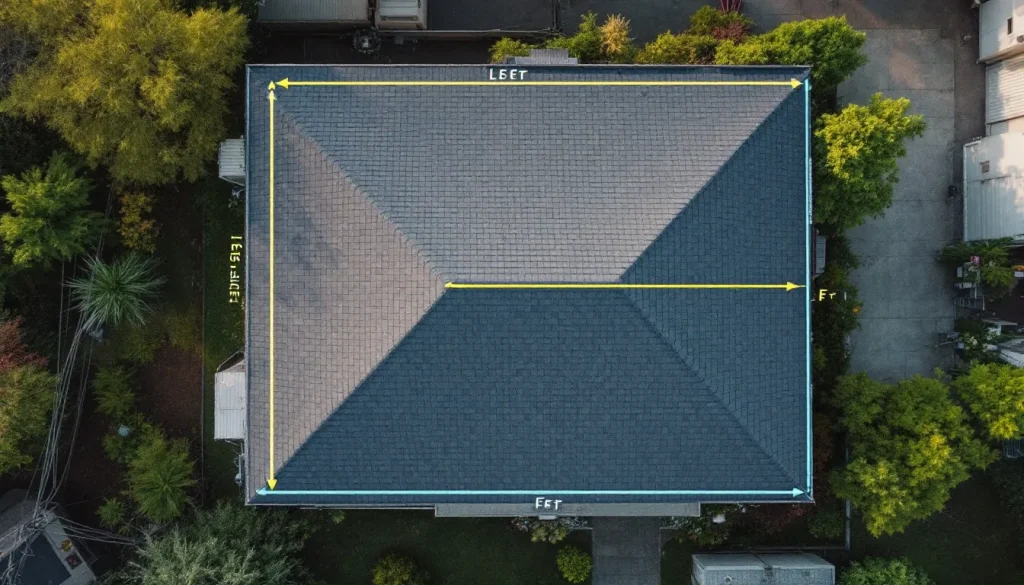
The how to calculate roof square footage question has four real answers in 2026: pull an aerial report from EagleView or GAF QuickMeasure (most accurate, costs $29 to $195), multiply your home’s footprint by a pitch multiplier (see our the pitch multiplier method guide) (good for a quick estimate, free), measure each plane on Google Earth Pro (accurate within 5%, free), or climb up with a tape measure (most accurate if you actually get every plane, but it requires a roof walk). Most contractors in 2026 use a satellite report for the bid and verify with a roof walk on the day of the tear-off. Homeowners doing a sanity check on a quote usually start with the footprint and pitch multiplier method because it takes 30 seconds and gets you within 10% of reality.
The short version
- Quick method: home footprint square footage x pitch multiplier (4/12 = 1.054, 6/12 = 1.118, 8/12 = 1.202).
- For a 2,400 sq ft footprint house with a 6/12 roof: 2,400 x 1.118 = 2,683 sq ft of roof.
- EagleView Premium ($79 to $195) and GAF QuickMeasure (free for certified contractors) deliver PDF reports with every plane measured.
- Google Earth Pro is free and accurate to within 5% if you trace every plane carefully.
- Roofing squares: divide square footage by 100 (one square = 100 sq ft of roof area).
- Add 7% waste for a simple gable, 10% for a hip, 15% for a cut-up roof with valleys and dormers.
The math (formula)
Every method (see our roof size calculator method) ends at the same equation. You need the horizontal footprint of the area the roof covers, and you need the pitch (rise over run). The pitch multiplier converts the flat ground area to the actual sloped roof area.
Roof area = Footprint x Pitch (see our roof pitch calculator method) multiplier
where Pitch multiplier (see our roof area vs footprint calculator) = sqrt(1 + (rise/run)^2)
For a 6/12 pitch: sqrt(1 + (6/12)^2) = sqrt(1.25) = 1.118
The pitch multiplier comes from basic geometry. The roof is the hypotenuse of a right triangle, the footprint is the horizontal run, and the pitch tells you the rise. The Pythagorean theorem does the rest. You do not have to do the math yourself. The conversion table below has the multiplier for every standard pitch from flat to 12/12.
Conversion table: pitch to multiplier to degrees to percent slope
| Pitch (rise/run) | Pitch multiplier | Degrees | Percent slope | Walkable? |
|---|---|---|---|---|
| 1/12 | 1.003 | 4.8 | 8.3% | Yes |
| 2/12 | 1.014 | 9.5 | 16.7% | Yes |
| 3/12 | 1.031 | 14.0 | 25.0% | Yes |
| 4/12 | 1.054 | 18.4 | 33.3% | Yes |
| 5/12 | 1.083 | 22.6 | 41.7% | Yes (caution) |
| 6/12 | 1.118 | 26.6 | 50.0% | Yes (caution) |
| 7/12 | 1.158 | 30.3 | 58.3% | Marginal |
| 8/12 | 1.202 | 33.7 | 66.7% | Marginal (harness) |
| 9/12 | 1.250 | 36.9 | 75.0% | No (harness required) |
| 10/12 | 1.302 | 39.8 | 83.3% | No (harness required) |
| 11/12 | 1.357 | 42.5 | 91.7% | No (harness required) |
| 12/12 | 1.414 | 45.0 | 100.0% | No (harness required) |
If you need a fuller breakdown by visual appearance, our roof pitch chart shows what every pitch looks like in profile and how it changes the silhouette of the house.
Worked example: 2,400 sq ft house with a 6/12 roof
This is the example most homeowners actually need. A 2,400 sq ft house typically has a 40 ft by 60 ft footprint, give or take. Assume a simple gable roof with a 6/12 pitch and no dormers.
Step 1: confirm the footprint. The footprint is the ground floor area the roof covers, not the total interior square footage (for the full data set, see our the 2026 Aerial Roof Measurement Software Report). A two-story house with a 1,200 sq ft footprint stacked twice gives you 2,400 sq ft of living space but only 1,200 sq ft of roof footprint. For our example, the house is a one-story ranch so the footprint matches the living area: 2,400 sq ft.
Step 2: pull the pitch multiplier. A 6/12 pitch has a multiplier of 1.118 (see the table above).
Step 3: multiply.
2,400 sq ft x 1.118 = 2,683 sq ft of roof
Step 4: convert to squares. A roofing square equals 100 sq ft. 2,683 / 100 = 26.83 squares. Round up to 27 squares for bid purposes.
Step 5: add waste. For a simple gable, add 7% waste: 27 x 1.07 = 28.89 squares. Order 29 squares of shingles. Our shingle bundle calculator walks the same math from squares to bundle count.
Method 1: EagleView or GAF QuickMeasure satellite report
The professional default in 2026. EagleView, Hover, GAF QuickMeasure, and RoofR all pull high-resolution aerial imagery and use machine vision to measure every plane of your roof. The output is a PDF with each plane’s area, pitch, ridge length, valley length, eave length, hip length, and total square footage. EagleView Premium runs $79 to $195 depending on detail level. GAF QuickMeasure is free for GAF Master Elite certified contractors and is the reason most reputable contractors quote off a satellite report. Hover charges $29 per home for a basic measurement, $79 with full 3D model. RoofR Pro bundles satellite measurement with quoting software at $99 per month.
For homeowners these reports are usually inaccessible directly. EagleView sells only to verified contractors and insurance carriers. The workaround: ask the contractor to share the satellite report PDF as part of the quote. Reputable contractors will. If a contractor refuses to share the satellite report, that is a signal worth weighing.
Why satellite reports are not always perfect
- Tree canopy cover blocks portions of the roof and the software has to estimate.
- New construction not yet in the aerial database may not generate a report.
- Detached structures (garages, accessory dwelling units) may be missed unless ordered separately.
- Solar panels in 2026 imagery can confuse plane detection.
Method 2: footprint x pitch multiplier (the home owner’s friend)
This is what we used in the worked example above. The advantage is it takes 30 seconds, requires no tools, and gets you within 10% of reality on a simple roof. The disadvantage is it gets less accurate as the roof gets more complex.
To get the footprint, pull your home’s property record from the county assessor (most are online and free), or measure the outside walls of the ground floor and multiply length x width. For an irregular footprint, break it into rectangles, measure each one, and add them up. Then multiply by the pitch multiplier from the table.
The catch: this method assumes the entire footprint has the same pitch. A house with a main 6/12 roof and a 3/12 porch roof needs two separate calculations added together. A house with a hip on one side and a gable on the other can be calculated with the same multiplier because both have the same pitch, but if the hip section drops to a lower pitch, calculate separately.
Method 3: Google Earth Pro (free and accurate to 5%)
Google Earth Pro is the free desktop application that lets you trace polygons on satellite imagery and read the area in square feet. The accuracy depends on the resolution of imagery in your area but most US suburban areas have updated imagery accurate to within 1 foot.
The Google Earth Pro workflow
- Download Google Earth Pro (free).
- Type your address into the search bar.
- Tilt the view to roughly overhead but verify you are seeing the roof, not the side of the house.
- Click the polygon tool (the icon that looks like a hexagon).
- In the polygon dialog, switch the Measurements tab to square feet.
- Click each corner of one roof plane, then close the polygon by clicking the first corner again.
- Read the area in the dialog.
- Repeat for every plane.
- Add the planes together. This gives you the projected (footprint) area of the roof.
- Multiply by the pitch multiplier for your roof pitch.
Why this matters: Google Earth measures the flat projected area, not the sloped area. You still have to apply the pitch multiplier yourself. A roof that measures 2,400 sq ft of projected area with a 6/12 pitch is still 2,683 sq ft of actual roof surface.
Method 4: tape measure on the roof (most accurate, most risky)
This is the ground truth method. You climb up, measure each plane (length x width), and add them together. The result is the actual roof surface area, no pitch multiplier needed. The risk is obvious: anything above a 6/12 pitch is genuinely dangerous without a harness, and even a 4/12 in wet weather is no joke.
If you are doing this, use a 50 ft or 100 ft long tape rather than a 25 ft hardware-store tape. Trying to measure a 40 ft rake length in 25 ft increments compounds error. A laser distance measurer (Bosch GLM 50 C, $99) does the job from one corner of the plane to the other in seconds.
What to write down per plane
- Length along the eave
- Length up the rake (from eave to ridge)
- Area = length x length
- Note the pitch (you will need it for waste and bundle math)
- Note any penetrations (vents, chimneys, skylights) for the waste calculation
Hip roofs, mansards, gambrels: the multi-plane wrinkle
A simple gable roof has two planes. A hip roof has four. A mansard roof has eight (four steep planes and four shallow planes on top). A gambrel roof has four (two steep and two shallow per side). The pitch multiplier method still works but you have to calculate each plane separately because they have different pitches.
For a hip roof, the footprint method still gives you a good estimate because all four hip planes share the same pitch. A 2,400 sq ft hip with a 6/12 pitch is still roughly 2,683 sq ft, same as a gable. The shape of the planes differs (triangles and trapezoids instead of rectangles) but the total area is the same.
For a mansard, calculate the lower steep planes (often 22/12 or steeper, multiplier ~1.85) and the upper shallow planes (often 3/12 or 4/12) separately, then add. A satellite report is much faster than doing this by hand.
The waste factor: why your bid is bigger than your math
The roof area you calculate is the surface area to be covered. The shingle order (see our measure a roof for shingles guide) is bigger than that because shingles get cut at valleys, hips, ridges, and around penetrations. The cut pieces usually cannot be reused. Typical waste factors:
| Roof complexity | Typical waste | Why |
|---|---|---|
| Simple gable, no dormers, no valleys | 5% to 7% | Only rake and ridge cuts. |
| Hip roof, no dormers | 10% to 12% | Hip cuts on all four corners. |
| Hip with 1-2 dormers | 12% to 15% | Valley cuts add waste. |
| Cut-up hip with multiple valleys, dormers, skylights | 15% to 20% | Multiple cut directions. |
| Steep roof requiring scaffolding | Add 2% on top | More cutting waste from working position. |
For a 2,683 sq ft hip roof with two dormers, you would order 2,683 x 1.13 = 3,032 sq ft, or 31 squares (round up to the nearest bundle, which usually means 30 squares plus 3 extra bundles = 93 bundles total). The shingle bundle calculator handles the bundle math end to end.
Converting square footage to roofing squares
The whole reason pros use “squares” is that it makes the bundle math easier. One square = 100 sq ft of roof surface, and architectural shingles ship 3 bundles per square. So 27 squares = 81 bundles, plus waste. Our explainer at how many square feet in a roofing square covers why pros use the unit and how to convert quotes.
Squares = Roof area (sq ft) / 100
Bundles (architectural) = Squares x 3
Bundles (Class 4 impact) = Squares x 4
What this costs
Once you have an accurate square footage, the cost calculation gets straightforward. Asphalt shingle replacement runs $5 to $10 per sq ft installed in 2026 for a mid-tier architectural shingle. For our 2,683 sq ft example, that is $13,400 to $26,800 installed. The full breakdown is in our roof cost per square foot guide, and the roof replacement cost calculator runs the math by ZIP code.
Sanity-checking a contractor’s number
When a contractor sends a quote that says “Your roof is 32 squares, $19,200 installed,” you have three sanity checks. First, run the footprint x pitch math: does 32 squares (3,200 sq ft) match what you would expect for your home? Second, ask for the satellite measurement PDF. Reputable contractors share it. Third, compare to neighbors of similar size and pitch.
The most common ways contractors inflate measurements: padding the waste factor (claiming 20% on a simple gable when 7% is realistic), counting the full pitched area when the contractor only owes you the projected area for some accessories, or using “rounded up to nearest 5 squares” rather than honest numbers. The footprint x pitch math catches all three.
FAQ
How accurate is the footprint x pitch multiplier method?
Within 10% on a simple roof, within 15% on a complex one. The error comes from assumptions about the footprint (overhangs, attached garages, porches) and from rough pitch estimation. Accurate enough for a sanity check, not accurate enough for an order.
Do I need to add the eave overhang to my footprint?
Yes. The roof extends beyond the exterior walls of the house, typically by 12 to 24 inches. A 40 ft x 60 ft house with 18 inch overhangs has a roof footprint of 43 ft x 63 ft, or 2,709 sq ft, not 2,400. Satellite tools include the overhang automatically. The footprint method misses it unless you add it manually.
How do I measure a roof I cannot see clearly on Google Earth?
Tree cover or low-resolution imagery in some rural areas blocks the satellite method. Use the footprint method (county assessor record + pitch estimate from the ground) or ask the contractor for the EagleView report.
What pitch multiplier do I use if my roof has different pitches?
Calculate each plane separately. The main roof at 6/12 gets multiplier 1.118, the porch roof at 3/12 gets 1.031, the lower mansard at 22/12 gets 1.842. Calculate the projected area of each, multiply by the corresponding multiplier, and sum.
Is roof square footage the same as living square footage?
No. Living square footage is interior conditioned space. Roof square footage is the actual sloped roof area. A 2,400 sq ft two-story house with a 1,200 sq ft footprint and a 6/12 pitch has 1,200 x 1.118 = 1,342 sq ft of roof, not 2,400 sq ft.
Bottom line
Calculating roof square footage is footprint x pitch multiplier, with a satellite report for accuracy or a tape measure for ground truth. The pitch multiplier table is the part most homeowners miss: a 6/12 pitch adds 11.8% to the projected area, an 8/12 pitch adds 20.2%, a 12/12 pitch adds 41.4%. Once you have the area, divide by 100 for squares, multiply by 3 for architectural bundles, and add 7% to 15% waste depending on roof complexity. Then check against the contractor’s quote. The math works out within 10% of any honest bid. If the bid is off by more than 15%, ask to see the satellite report.