
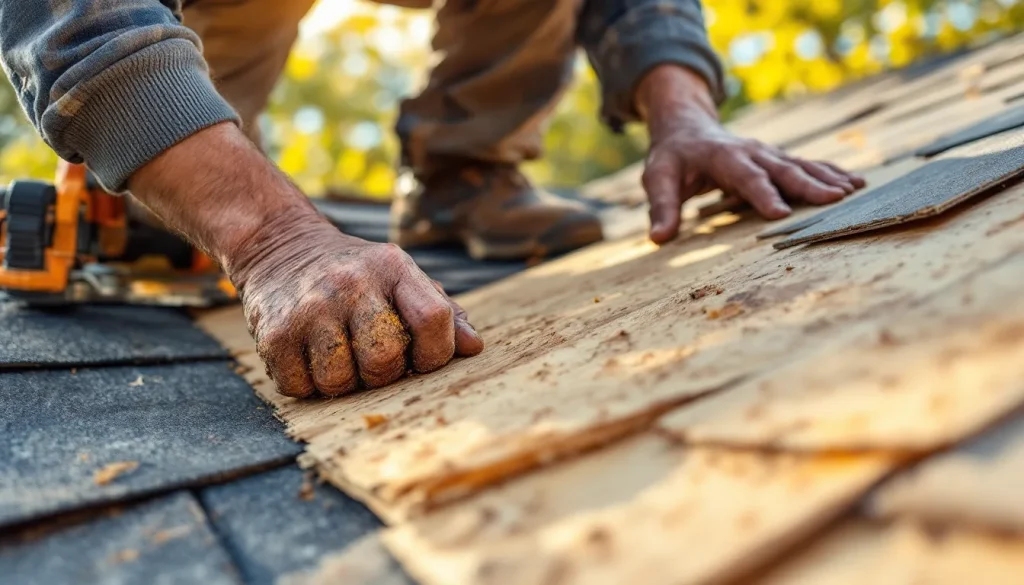
Roof decking replacement cost in 2026 runs $50 to $100 per single sheet for spot repair of rotted plywood or OSB on a residential reroof, and $2,500 to $6,500 for full re-decking on a typical 2,400 square foot single-family home. The wide range on full re-deck pricing reflects the cost difference between OSB and plywood, the regional labor variation across the U.S. market, the building’s existing structural condition, and whether the project also includes ice and water shield, drip edge, and synthetic underlayment replacement that often gets bundled with a deck rebuild. This guide breaks the 2026 deck replacement cost picture by sheet type, by failure pattern, and by the code-required nailing and structural inspection work that any honest re-deck job includes.
Last reviewed: August 2026.
If you are looking at a sagging or visibly damaged roof and trying to decide between spot repair and full replacement, our sagging roof repair guide and our rotted roof decking piece walk through the diagnosis framework. If you are pricing the broader reroof job that the deck replacement is part of, our 2026 Roofing Cost Report covers the full-system pricing across all the major residential roof materials.
Single-sheet replacement: $50 to $100 per sheet
Single-sheet roof decking replacement costs $50 to $100 per 4 ft by 8 ft sheet in 2026, covering the OSB or plywood panel, the cutout and nailing labor, and disposal of the rotted sheet. The most common deck repair scenario is a spot replacement of one or a few rotted sheets discovered during a tear-off. A roofer pulls the old shingles, finds a soft spot under a former leak (typically around a chimney flashing, a plumbing vent boot, a valley, or an ice dam zone in cold climates), cuts out the rotted sheet, and replaces it with a new one before the new shingle install proceeds.
The single-sheet replacement cost in 2026 breaks down to: the OSB or plywood sheet itself at $30 to $55 for a 4 ft by 8 ft sheet (OSB cheaper, plywood premium), the labor for cutout, framing inspection at the bearing edges, fitting, and nailing at $20 to $45 per sheet, and the disposal fee for the rotted sheet at $5 to $10. Total per-sheet cost lands at $50 to $100 in most U.S. markets, with the high end in coastal and high-cost-of-living metros and the low end in low-cost markets.
Most reroof bids in 2026 will include a per-sheet decking replacement line item in the contract that activates if the tear-off reveals rotted sheets. A typical residential reroof contract will allow for 1 to 3 sheets at the per-sheet rate without changing the base contract price, and bill additional sheets at the per-sheet rate above that threshold. A roof that comes apart at tear-off and reveals 15+ rotted sheets is no longer a spot-repair job; it has crossed into the full re-deck zone, and the contract math changes substantially. For the shingle work above the deck, our shingle replacement guide walks the repair, spot, or full-replace decision. Our roof deck repair cost guide covers the spot-repair pricing in more detail.
Full re-deck: $2,500 to $6,500 on a 2,400 sq ft house
A full roof re-deck on a 2,400 square foot single-family home costs $2,500 to $4,500 installed with OSB and $3,500 to $6,500 installed with plywood in 2026. A full re-deck means stripping the existing deck entirely off the rafters or trusses and replacing every sheet. The job becomes necessary when the existing decking is below code thickness, when more than about 25% of the sheets show rot or delamination, or when the building is being substantially renovated and the deck rebuild is part of the broader scope of work.
The 2026 full re-deck cost picture on a 2,400 square foot single-family roof:
OSB re-deck: $2,500 to $4,500 installed. The OSB sheet cost runs $30 to $40 per 4 ft by 8 ft sheet (about 75 sheets on a typical 2,400 square foot roof, so $2,250 to $3,000 in material), plus labor for tear-off, fitting, and nailing at $1,500 to $2,500 depending on roof complexity, plus disposal at $200 to $400.
Plywood (CDX or RTD) re-deck: $3,500 to $6,500 installed. The plywood sheet cost runs $45 to $65 per 4 ft by 8 ft sheet ($3,375 to $4,875 in material on the same 75-sheet roof), plus the same labor and disposal costs.
| Deck material | Per 4 ft by 8 ft sheet | Material (75 sheets) | Installed re-deck (2,400 sq ft) |
|---|---|---|---|
| OSB | $30 to $40 | $2,250 to $3,000 | $2,500 to $4,500 |
| Plywood (CDX or RTD) | $45 to $65 | $3,375 to $4,875 | $3,500 to $6,500 |
Most residential re-decks in 2026 specify OSB because of the cost differential and because OSB has dominated residential new construction since the mid-1990s. The plywood premium is typically justified only when the building is in a hot-humid climate where the moisture exposure exceeds OSB’s tolerance, when the buyer specifically wants the moisture-resistance characteristics of CDX or RTD plywood, or when the structural engineer has specified plywood for a load-rating reason.
OSB vs plywood: the 2026 decision framework
OSB is the cheaper roof decking spec and plywood is the moisture-resistant premium. OSB runs roughly 30% to 40% less than equivalent-thickness plywood, while CDX or RTD plywood recovers its dimensions better after moisture exposure. For a side-by-side on the two panels, see our OSB vs plywood roof decking breakdown. OSB (oriented strand board) is manufactured from wood strands oriented in layers and bonded with phenol-formaldehyde adhesive. Standard OSB roof decking is 7/16-inch thick for 24-inch on-center rafter or truss spacing, with 5/8-inch OSB specified for wider spacing. OSB is roughly 30% to 40% cheaper than equivalent-thickness plywood, which is why OSB has been the volume-leader residential roof decking material in the U.S. since the mid-1990s.
The trade-off is moisture tolerance. OSB exposed to standing water or prolonged high humidity will swell, with edge swelling typically the first failure mode and full delamination following on extended exposure. Standard OSB recovers some of its original dimension after drying, but the structural integrity is permanently compromised once edge swelling has occurred. The newer Advantech OSB (Huber Engineered Woods) and Edge Gold OSB (Weyerhaeuser) use modified adhesives and surface treatments that improve moisture tolerance substantially, at a cost premium of $10 to $20 per sheet over standard OSB.
Plywood (specifically CDX or RTD plywood for roof decking) is manufactured from wood veneer layers cross-laminated with exterior-grade adhesive. CDX (C-grade face, D-grade back, exterior adhesive) is the historic residential roof decking standard, and RTD (Resin Treated Decking) is a moisture-resistance upgrade that holds up better under wet-condition exposure. Both are about 30% to 40% more expensive than equivalent-thickness OSB and recover their original dimensions better after moisture exposure.
The 2026 spec decision typically goes:
OSB is the right spec for: dry-climate roofs with proper ventilation, new construction in cost-driven markets, reroofs where the building’s existing OSB has performed well and the moisture management is good.
Plywood (CDX or RTD) is the right spec for: hot-humid climates (Gulf Coast, Southeast), roofs with marginal ventilation (see our attic ventilation guide for the framework), buildings with leak history where deck moisture exposure is likely to recur, and projects where the building owner specifies the plywood premium.
The Advantech and Edge Gold OSB upgrade can split the difference. The moisture-tolerance characteristics are competitive with plywood at a smaller cost premium over standard OSB, which is why these specialty OSB products have grown share in the residential reroof market over the past five years. Our roof sheathing overview covers the broader sheathing decision framework including the OSB grades and the plywood alternatives.
Code requirements: IRC R803.1 and IBC 2304
The building codes that govern roof decking in 2026 are the International Residential Code (IRC) section R803.1 for residential and the International Building Code (IBC) section 2304 for commercial and multifamily. Both codes establish minimum sheet thickness based on rafter or truss spacing, fastening pattern, and panel edge support.
For residential 24-inch on-center rafter or truss spacing (the dominant spec in U.S. residential construction), the IRC requires minimum 7/16-inch OSB or 15/32-inch plywood (which is what is commonly called half-inch plywood). For 16-inch on-center spacing, the minimum drops to 3/8-inch plywood or 7/16-inch OSB.
The nailing pattern code requirement in IRC R803.2.3 specifies 8d common nails (2.5 inch length) at 6 inches on center along panel edges and 12 inches on center in the field, with closer spacing in high-wind zones (3 inches along edges and 6 inches in field in hurricane zones per IBC 2304.9). Re-deck jobs that skip the code-required nailing pattern are common shortcuts that compromise wind uplift resistance and can void manufacturer shingle warranties.
The H-clip requirement for OSB at unsupported panel edges is another commonly overlooked code requirement. IRC R803.1 requires H-clips between rafters or trusses on OSB panels where the panel edges are not supported by blocking. The H-clips prevent panel edge deflection under load and are required for code compliance. A re-deck job that omits H-clips on the long edges of OSB sheets is non-code-compliant, even if the inspector misses it on the final inspection.
Structural inspection: what gets checked during deck replacement
A re-deck job is the one time in a roof’s serviceable life when the rafters or trusses are fully exposed and inspectable, so a good roofer uses that tear-off window to catch structural problems that are invisible with the deck on. The checks below cover framing damage, bearing-edge fasteners, insulation, ventilation, and the original leak points that caused the rot.
Rafter or truss damage: sagging, cracks, splits, beetle or termite damage, or moisture intrusion that has compromised structural members. Damaged rafters or trusses need sistering (adding a parallel member alongside the damaged one) or replacement before the new deck goes on. Our sagging garage roof fix guide walks through the sistering process for garage and accessory structure roofs.
Fastener integrity at bearing edges: the connections between rafters or trusses and the top plate of the wall framing. Hurricane straps or hurricane clips that have rusted out, withdrawn, or were never installed properly are common findings, especially in coastal markets where the building code requires them.
Insulation condition: attic insulation that has compressed, settled, or become water-damaged often becomes visible when the deck is off. A re-deck job is the natural moment to upgrade attic insulation if the existing R-value is below current code minimums.
Ventilation pathways: the soffit-to-ridge ventilation pathway in the attic is fully visible during a re-deck. Blockages at the soffit baffles, ridge vent obstructions, or missing ventilation altogether show up clearly and can be corrected before the new deck and roofing go down. Rotted soffit and fascia along the eave often surface at the same time, and our soffit and fascia replacement cost guide prices that repair per linear foot. The full ventilation framework is in our attic ventilation guide.
Plumbing vent boots and chimney flashings: the failure points that caused the original deck rot. A re-deck job that does not address the root-cause failure point is going to produce the same rot pattern again in 8 to 12 years.
Regional cost variation: where re-deck pricing diverges
Roof deck replacement labor runs $35 to $50 per hour in low-cost markets, $50 to $70 per hour in most U.S. metros, and $70 to $100 per hour in high-cost coastal markets, putting full re-deck labor on a 2,400 square foot roof between $1,500 and $4,800 depending on region. These rates vary substantially across the U.S. market. The 2026 regional spread:
Low-cost markets (rural South, parts of Midwest): labor rates run $35 to $50 per hour for skilled roofing labor, putting full re-deck labor on a 2,400 square foot roof at $1,500 to $2,200.
Mid-cost markets (most U.S. metros): labor rates run $50 to $70 per hour, putting full re-deck labor at $2,200 to $3,200.
High-cost markets (coastal California, NYC metro, Seattle, Denver, Boston): labor rates run $70 to $100 per hour, putting full re-deck labor at $3,200 to $4,800.
Material costs are more uniform across the U.S. than labor, with OSB and plywood pricing varying by 10% to 20% across regions. The regional cost variation in total re-deck pricing is therefore mostly a labor story, not a material story.
When deck replacement is mandatory vs optional
The decision between spot deck repair and full re-deck depends on the percentage of deck that is failed and the condition of the rest of the deck. Under 10% of sheets failed points to spot repair, 10% to 25% is a judgment call, and 25% or more calls for a full re-deck. The 2026 rule of thumb:
Under 10% of sheets failed: spot repair. The cost of replacing 5 or 6 sheets on a 75-sheet roof is small relative to the cost of full re-deck, and the existing decking is generally still serviceable.
10% to 25% of sheets failed: the gray zone where the decision goes either way. If the failures are concentrated in one area (around a chimney, in a valley, at an ice dam zone), spot repair plus an investigation of the root cause is the right path. If the failures are scattered across the roof, suggesting systemic moisture management issues, full re-deck is the better economic decision because the remaining sheets are likely to fail within the new roof’s lifespan.
25%+ of sheets failed: full re-deck. The cost-benefit math favors stripping everything and starting over rather than replacing sheets piecemeal.
The other scenario that forces full re-deck is below-code deck thickness. Houses built before the early 1990s sometimes have 3/8-inch OSB or plywood roof decking that is below the current IRC R803.1 minimum for 24-inch on-center rafter or truss spacing. A reroof on such a building can technically install new shingles over the existing thin deck without code intervention (existing-condition grandfathering applies), but the manufacturer shingle warranty is typically voided by thin decking, and most professional roofers will recommend a re-deck during the reroof to bring the deck up to current code minimum. The full residential reroof framework is in our average cost to replace a roof guide, and the broader deck-failure diagnosis is in our how to fix a roof leak piece.
What re-deck adds to the broader reroof bid
A re-deck on a residential reroof typically adds 30% to 50% to the total project cost compared to a reroof on a sound existing deck. A 2,400 square foot single-family asphalt shingle reroof at $14,000 to $20,000 on a sound deck becomes $17,000 to $28,000 with a full re-deck. The math is straightforward: the deck work is $2,500 to $6,500, and the labor productivity on the shingle install is slightly lower over fresh decking because of the time spent verifying nailing patterns and panel alignment. To sanity-check these totals against a per-100-square-foot benchmark, see our roof replacement cost per square breakdown.
For most residential reroof scenarios, the deck inspection happens during tear-off and the deck-related contract scope adjusts at that point. Building owners should expect to see a per-sheet pricing line item in the original contract, and should ask the contractor at the bid stage what the threshold is for triggering full re-deck pricing rather than per-sheet pricing. Our 2026 Roofing Cost Report walks through the full reroof cost framework including the deck-replacement contingency, and our 2026 Roofing Material Lifespan Report covers the lifespan math that drives the reroof timing decision in the first place.
Roof decking replacement: frequently asked questions
How much does it cost to replace one sheet of roof decking?
Single-sheet roof decking replacement runs $50 to $100 per 4 ft by 8 ft sheet in 2026. That breaks down to $30 to $55 for the OSB or plywood panel, $20 to $45 for the cutout, fitting, and nailing labor, and $5 to $10 for disposal of the rotted sheet. The high end applies in coastal and high-cost-of-living metros, the low end in low-cost markets.
What does a full roof re-deck cost on a 2,400 square foot house?
A full re-deck on a 2,400 square foot single-family roof costs $2,500 to $4,500 installed with OSB and $3,500 to $6,500 installed with plywood in 2026. A typical roof takes about 75 sheets, so material runs $2,250 to $3,000 for OSB or $3,375 to $4,875 for plywood, plus $1,500 to $2,500 labor and $200 to $400 disposal.
Should I use OSB or plywood for roof decking?
OSB is the cheaper spec, running 30% to 40% less than equivalent-thickness plywood, and it dominates residential construction. Plywood (CDX or RTD) costs more but recovers its dimensions better after moisture exposure, so it suits hot-humid climates and roofs with leak history. Upgraded OSB such as Advantech or Edge Gold splits the difference at $10 to $20 more per sheet.
When is a full re-deck required instead of spot repair?
Under 10% of sheets failed points to spot repair, since the rest of the deck is still serviceable. Between 10% and 25% is a judgment call driven by whether failures are concentrated or scattered. At 25% or more failed, full re-deck is the economic choice. Below-code deck thickness, such as 3/8-inch panels on older homes, also forces a re-deck.
What thickness of roof decking does code require?
For 24-inch on-center rafter or truss spacing, IRC R803.1 requires a minimum 7/16-inch OSB or 15/32-inch plywood (commonly called half-inch plywood). For 16-inch on-center spacing, the minimum drops to 3/8-inch plywood or 7/16-inch OSB. Code also requires H-clips at unsupported OSB panel edges and 8d nails at 6 inches on edges, 12 inches in the field.
How much does a re-deck add to a reroof bid?
A re-deck typically adds 30% to 50% to the total reroof cost compared with a reroof on a sound deck. A 2,400 square foot asphalt shingle reroof at $14,000 to $20,000 on a sound deck becomes $17,000 to $28,000 with a full re-deck, since the deck work alone is $2,500 to $6,500 and shingle-install productivity dips slightly over fresh decking.