
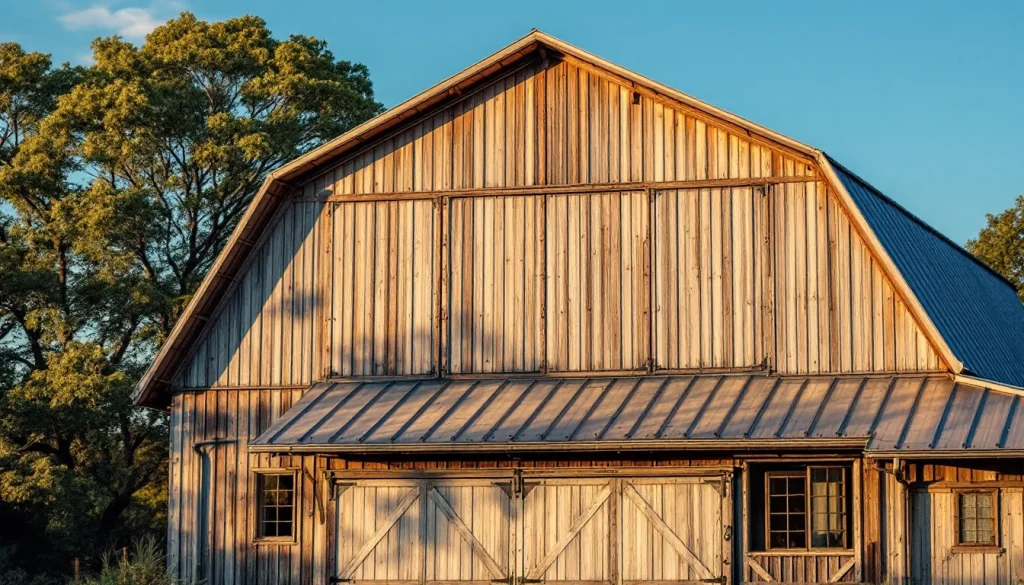
Corrugated metal roofing is the wavy-profile galvanized steel or aluminum panel system that became dominant in agricultural and industrial roofing for one reason: it is the cheapest metal roofing option, installing at $5 to $12 per square foot. In 2026, corrugated panels remain popular for barns, sheds, workshops, and budget-conscious residential reroofs, but the install economy comes with tradeoffs in panel-fastening visibility and through-fastener leak risk that buyers should understand before signing a contract.
The short version
- Corrugated metal roofing installs at $5 to $12 per square foot, roughly 30 to 50 percent less than standing seam.
- R-Panel, U-Panel, 5V crimp, and standard corrugated are the four profiles you will see at a yard or a contractor bid.
- 26-gauge steel is the residential standard; 29-gauge is the bargain version used on sheds and outbuildings.
- Through-fastener installation is what keeps the price down and what creates the long-term leak risk at every screw head.
- Lifespan runs 40 to 60 years with a Kynar 500 paint finish and proper gasketed screws replaced every 20 years.
- Hurricane-rated assemblies need ASTM E1592 uplift testing and UL 580 wind ratings to satisfy Florida and Gulf Coast codes.
The Short Answer: Cost and Best Applications
Corrugated metal roofing wins on two metrics: upfront cost and install speed. A 26-gauge galvanized steel panel in the R-Panel profile lands at $1.20 to $2.20 per square foot for the panel itself, with installed pricing of $5 to $12 per square foot once labor, underlayment, fasteners, and trim are added. By comparison, standing seam metal sits at $10 to $25 per square foot installed. That gap matters most on agricultural buildings, where roof areas of 4,000 to 20,000 square feet make the per-foot savings consequential.
The best applications are barns, pole buildings, equipment sheds, workshops, commercial warehouses, and detached garages. Residential use is growing but still niche. The honest assessment is that corrugated metal looks industrial, and most homeowners who want the metal-roof lifespan choose standing seam instead. For a full lifespan comparison across roofing types, the breakdown at how long does a roof last covers expected service life for every material category.
Corrugated vs Standing Seam
The structural difference is fastening. Corrugated panels are attached with exposed screws driven through the panel face into the deck or purlins below. Standing seam panels are attached with hidden clips that lock under raised seams, with no penetrations through the water plane. That single difference drives almost every secondary tradeoff: cost, leak risk, lifespan, aesthetics, and resale value. The full cost breakdown for the premium option is documented at standing seam metal roof cost, and the side-by-side comparison against asphalt is at metal vs asphalt shingle roof.
Profile Options: R-Panel, U-Panel, 5V Crimp, and Standard Corrugated
Four profiles dominate the market. R-Panel is the trapezoidal ribbed profile common on commercial buildings, with 36-inch coverage and 1.25-inch ribs spaced 12 inches apart. U-Panel is similar but with a slightly different rib shape that gives a softer commercial look. 5V crimp is the residential-friendly profile with five small ribs per panel, originating in coastal Florida architecture. Standard corrugated is the classic wavy sine-wave profile used on barns and outbuildings since the 1850s.
R-Panel: The Commercial and Industrial Workhorse
R-Panel is the most-installed metal roofing profile in North America. The trapezoidal ribs give the panel rigidity, allowing 24-inch purlin spacing and longer unsupported spans than corrugated. R-Panel covers 36 inches per panel, with 1.25-inch ribs at the seams. Galvalume-coated 26-gauge R-Panel runs $1.50 to $2.40 per square foot at the yard, and the installed price on a commercial building lands at $5 to $9 per square foot.
U-Panel: Slightly Better Looks, Same Economics
U-Panel is functionally identical to R-Panel but has a more squared rib profile that some architects prefer for light commercial buildings. Pricing is within 5 percent of R-Panel, and most metal roofing yards stock both profiles. The U-Panel is sometimes specified for retail buildings, small office buildings, and equipment buildings where appearance matters slightly more than pure utility.
5V Crimp: The Coastal Florida Favorite
5V crimp is named for the five V-shaped ribs spaced across each 24-inch-coverage panel. The smaller ribs give a more residential appearance, which is why 5V dominates traditional Florida Cracker-style architecture, Caribbean construction, and coastal historic districts. The 5V crimp panel is typically 26-gauge or 24-gauge Galvalume, and the installed price runs $7 to $13 per square foot. For storm-rated installations on the Gulf Coast and Atlantic Coast, the assembly must meet the testing requirements covered at best roof for hurricane.
Material: Galvanized Steel vs Galvalume vs Aluminum
Three substrate metals account for nearly all corrugated panels sold in 2026. Galvanized steel is steel with a zinc coating, the original metal roofing material. Galvalume is steel with a zinc-aluminum-silicon alloy coating developed by Bethlehem Steel in the 1970s, offering 2 to 4 times the corrosion resistance of plain galvanized at roughly the same price. Aluminum is non-magnetic, non-ferrous, and immune to red rust, making it the standard near salt water but at a 40 to 60 percent price premium.
Cost Per Square Foot Installed
| Profile + Material | Panel Cost / sq ft | Installed Cost / sq ft | Typical Application |
|---|---|---|---|
| Standard Corrugated 29-ga Galvanized | $0.95 to $1.40 | $4.50 to $7.00 | Sheds, agricultural |
| R-Panel 26-ga Galvalume | $1.50 to $2.40 | $5.00 to $9.00 | Commercial, industrial |
| U-Panel 26-ga Galvalume Painted | $1.80 to $2.80 | $6.00 to $10.00 | Light commercial |
| 5V Crimp 26-ga Galvalume Painted | $2.20 to $3.40 | $7.00 to $13.00 | Coastal residential |
| R-Panel 26-ga Aluminum Painted | $3.20 to $4.80 | $9.00 to $15.00 | Coastal, salt-air |
| Standing Seam (for comparison) | $3.50 to $7.00 | $10.00 to $25.00 | Premium residential |
Cost data is composited from NAHB 2025 builder cost reports and direct supplier pricing from MBCI, McElroy Metal, and Englert Inc. For a full materials-and-labor breakdown across all roofing categories, see how much does a new roof cost.
Gauge: 26-Gauge vs 29-Gauge
Sheet metal gauge is counterintuitive: lower numbers mean thicker metal. A 26-gauge panel is 0.0179 inches thick, while a 29-gauge panel is 0.0142 inches thick. That 20 percent difference matters more than it sounds. The 26-gauge panel resists hail dents better, holds fastener pullout strength longer, and resists oil-canning across wide spans. The 29-gauge panel is the budget version, suited to sheds, chicken coops, and short-span agricultural buildings. Residential metal roofing should be 26-gauge minimum, with 24-gauge specified for storm zones and longer spans.
Paint Finishes: Kynar 500 PVDF, SMP, and Polyester
Three paint systems dominate, and they are not interchangeable. Kynar 500 PVDF (polyvinylidene fluoride) is the premium architectural finish, carrying 30 to 40-year color and chalk-and-fade warranties, with the AAMA 2604 and AAMA 2605 specifications setting the performance bar. SMP (silicone-modified polyester) is the mid-grade finish at roughly half the upcharge of Kynar, with 25 to 30-year warranties typical. Polyester is the bargain finish used on agricultural panels, with 10 to 15-year warranties and noticeable chalking by year 7 in high-UV climates.
Through-Fastener Installation: The Leak Risk
Every screw through a corrugated panel is a potential leak path. The rubber gasket under each screw head is the only thing keeping water out, and that gasket has a measurable service life. EPDM gaskets last 15 to 20 years before UV degradation cracks the rubber. By year 25, most through-fastener roofs need a gasket replacement campaign: every screw pulled, replaced, or backed out and resealed. A typical 2,400-square-foot R-Panel roof has 4,800 to 7,200 screw penetrations, and the replacement labor at year 20 runs $1,800 to $3,500.
Two installer (see our metal roofing contractor finder) errors create early-life leaks. Over-driving the screw crushes the gasket and tears the EPDM, creating an instant water path. Under-driving leaves the gasket uncompressed, allowing capillary draw. The correct compression is roughly 50 percent of the gasket thickness, visible as a slight bulge of rubber around the screw head with no cracking. Trained installers use adjustable-clutch screw guns that disengage at the correct torque.
Underlayment Requirements
Code requires underlayment under all metal roof panels, but for metal the underlayment choice matters more than under asphalt shingles. High-temperature synthetic underlayment is required because metal panels can reach 160 to 180 degrees Fahrenheit in summer, and standard asphalt-saturated felt will bleed adhesive into the metal panel. The complete underlayment comparison is at felt vs synthetic underlayment. For metal roofs, products like Sharkskin Ultra SA, Titanium PSU30, and Grace Ice and Water Shield HT are the safe specifications.
Best Applications: Barns, Sheds, Workshops, and Pole Barns
Agricultural and outbuilding applications are where corrugated metal is unambiguously the right choice. Pole barns, equipment sheds, equestrian arenas, machine shops, hay barns, and detached workshops all benefit from the install economy, the long service life, and the resistance to fire from sparks. A 60-by-100-foot pole barn roof at $5 per square foot installed costs $30,000 in metal versus $42,000 to $48,000 in asphalt shingles, with the metal expected to last 50 years versus 18 to 22 years for the shingles.
Residential Corrugated: When It Makes Sense
Residential corrugated metal makes sense in three scenarios. First, ranch-style and farmhouse-style homes where the agricultural aesthetic fits. Second, modern cabin and modern-farmhouse architecture where the exposed-fastener look is intentional. Third, budget reroofs where the homeowner wants metal-roof lifespan without the standing-seam price tag. Outside those three contexts, most residential buyers choose standing seam, stone-coated steel, or premium asphalt shingles instead.
Lifespan: 40 to 60 Years with Proper Maintenance
Corrugated metal roofing service life depends on three variables: substrate (galvanized vs Galvalume vs aluminum), paint finish, and maintenance discipline. A Galvalume R-Panel with a Kynar 500 finish will reach 50 to 60 years in most climates. A polyester-painted galvanized panel will need replacement at 25 to 35 years. Aluminum coastal installations regularly reach 60 to 70 years. The single most important maintenance task is the year-20 fastener review: pull a few screws, inspect the gaskets, and budget for a full re-screw if the EPDM is hardened or cracked.
Snow Country Considerations
Metal roofing sheds snow well, which is both a feature and a hazard. Snow guards or snow rails are required above doorways, walkways, decks, and parking areas to prevent the rooftop avalanche that buries cars and injures pedestrians. Pad-style snow guards screwed into the panel ribs add $0.40 to $0.80 per square foot. Continuous snow rails add $1.20 to $2.20 per square foot. In the snowbelt states, the code-required ice-and-water shield at eaves must extend 24 inches inside the warm wall line, and the underlayment specification typically calls for full-deck self-adhered membrane rather than synthetic.
Hurricane-Rated Corrugated Assemblies
Hurricane-rated metal roofing is not a single product, it is an assembly. The panel, the fastener pattern, the underlayment, the deck, and the deck-to-rafter attachment all combine into a tested assembly with a documented uplift rating. The two key tests are ASTM E1592 (static air pressure uplift testing for metal panels) and UL 580 (uplift resistance testing for roof assemblies, with Class 30, 60, and 90 ratings). Florida High Velocity Hurricane Zone (HVHZ) jurisdictions require Miami-Dade NOA (Notice of Acceptance) approval for the specific assembly. The full hurricane-zone discussion is at best roof for hurricane.
Choosing an Installer
Corrugated metal installation looks simple, which is why so many residential leaks come from improper installs. The framework at how to choose a roofing contractor applies to metal as much as to asphalt, with one addition: ask for the installer manual the contractor follows. MBCI, McElroy Metal, and Englert all publish detailed installation manuals, and a contractor who cannot name the panel manufacturer and the corresponding install manual is improvising.
Galvalume vs Galvanized Steel: Why the Coating Matters
Bethlehem Steel commercialized the Galvalume coating system in 1972 as an alternative to plain hot-dipped galvanized. The coating chemistry is 55 percent aluminum, 43.4 percent zinc, and 1.6 percent silicon by weight, with the aluminum providing barrier protection (it forms a stable aluminum oxide skin) and the zinc providing sacrificial protection (it preferentially corrodes to protect exposed steel at cut edges). The combination outperforms plain galvanized by a factor of 2 to 4 in corrosion testing per ASTM B117 salt-spray.
The practical implication is service life. A G90 hot-dipped galvanized R-Panel installed in a moderate climate reaches 30 to 40 years before red rust appears at cut edges and fastener holes. The same panel in AZ55 Galvalume reaches 50 to 60 years under the same conditions. The Galvalume premium at the panel level runs 8 to 15 percent, which pays back many times over across the install lifecycle. Galvanized is still appropriate for budget agricultural use where the planned replacement horizon is 25 to 30 years.
The Oil-Canning Question
Oil canning is the visible waviness or distortion in flat areas of metal panels, most apparent on standing seam panels with wide flat fields between ribs. Corrugated panels are largely immune because the continuous rib pattern provides stiffness across the entire panel width. R-Panel and U-Panel show some oil canning between the ribs in low-angle sunlight but the effect is muted compared to architectural standing seam. For buyers who care about flatness, the corrugated profile choice helps: more ribs (smaller pan width between ribs) means less visible oil canning.
Cut-Edge Protection at Field Cuts
Every field cut exposes bare steel that the original coating system did not protect. On Galvalume panels, the sacrificial zinc in the surrounding coating protects the cut edge through galvanic action, with the protection radius extending roughly 1/8 to 1/4 inch from the coated edge into the exposed steel. Cuts on plain galvanized have a similar but shorter sacrificial radius. The cut-edge guidance from the manufacturers is consistent: avoid cutting if possible (order panels to length from the supplier), use abrasive saws or shears rather than abrasive grinders (which throw hot particles that damage adjacent finish), and brush off cut shavings immediately to prevent rust staining.
Ventilation Profile Compatibility
Ridge ventilation is straightforward on corrugated metal but requires the correct profile match. Continuous ridge vents are sold in metal versions formed to match R-Panel, U-Panel, 5V, and standard corrugated profiles, with integrated insect screen and weather baffles. Off-the-shelf shingle-style ridge vents will not work because they require a flat ridge field that metal does not provide. Box vents and turbine vents are field-installed with rubber gasketed boots cut to the corrugated profile. The full ventilation context is at attic ventilation.
Maintenance Across the 50-Year Life
A well-maintained corrugated metal roof has a predictable maintenance schedule across its 50-year life. Year 1 through 5: visual inspection annually for loose or backed-out screws, with re-tightening as needed (typically 1 to 5 screws across a residential roof). Year 5 through 15: continued annual inspection plus debris removal from rib valleys, particularly in tree-heavy environments where pine needles and leaves can pack into the lower ribs and trap moisture. Year 15 through 20: gasket inspection (pull 3 to 5 representative screws from different roof zones, inspect EPDM condition), with full re-screw campaign planned for the back half of year 20. Year 20 through 35: continued debris clearing, sealant tape replacement at end laps where visible, and touch-up paint at any rust spots from coating damage. Year 35 plus: budget for substrate decision; well-maintained Kynar Galvalume can extend through year 50 to 60 with no panel replacement.
Recyclability and End-of-Life
Metal roofing is among the most-recyclable building materials. End-of-life corrugated panels are 95 percent recyclable at any scrap metal yard, with the recycled steel feeding directly back into new coil production at electric arc furnace mills. Aluminum corrugated panels are 100 percent recyclable with no quality loss across the recycling stream. Asphalt shingle competition typically goes to landfill (though shingle recycling for asphalt road pavement is growing in some metro markets). For LEED-certified projects and BREEAM-rated buildings, the recyclability and recycled content of steel panels (typically 30 to 70 percent recycled coil content) is a documented points contributor.
Insurance Considerations
Homeowner insurance carriers treat metal roofing favorably in most markets because the impact resistance, fire resistance, and wind resistance reduce claim frequency. Many carriers (USAA, State Farm, Allstate, Travelers, Liberty Mutual) offer metal-roof discounts of 5 to 25 percent on the wind and hail portion of the policy. The Class 4 impact rating (UL 2218 testing) achieved by most 26-gauge corrugated panels qualifies for the maximum hail discount in Texas, Oklahoma, Colorado, and Kansas markets. Fire-resistance Class A ratings (UL 790) qualify for additional discounts in wildfire-prone California, Oregon, Washington, and Idaho markets. The insurance savings often offset 30 to 50 percent of the install cost premium over asphalt across a 30-year ownership window.
Comparing Corrugated to Stone-Coated Steel
Stone-coated steel is a related but distinct metal roofing category, with the steel panel formed in a shingle or shake profile and coated with stone granules bonded by acrylic resin. The visual outcome resembles asphalt shingles or cedar shake more than corrugated panels, and the install method is panel-by-panel rather than continuous-run. Cost is higher than corrugated (typically $9 to $16 per square foot installed) but lower than premium standing seam. The stone-coated steel category is the answer for buyers who want metal roof lifespan with a traditional shingle aesthetic, while corrugated remains the answer for buyers who accept or prefer the industrial-panel look.
Building Codes and Local Restrictions
The IRC permits corrugated metal roofing in all residential zones, but local ordinances and HOA covenants sometimes restrict the aesthetic to specific neighborhoods. The most common restrictions are in historic districts (where standing seam may be permitted but corrugated may not), in planned communities (where HOA architectural review committees may require asphalt shingles), and in some master-planned suburban subdivisions. Before specifying corrugated metal for a residential project, verify the HOA covenants and the local design review board requirements. Agricultural and commercial zones have far fewer restrictions, which is part of why corrugated dominates those markets.
Frequently Asked Questions
Is corrugated metal roofing cheaper than asphalt shingles?
Per square foot installed, corrugated metal is roughly equal to or 10 to 20 percent more than mid-grade asphalt shingles, but the lifespan is 2 to 3 times longer. The lifetime cost per year of corrugated metal is lower, but the upfront cost is higher than the cheapest asphalt shingle tier.
How long do the screws in a corrugated metal roof last?
The screws themselves last 50 years or more. The EPDM rubber gaskets under the screw heads last 15 to 20 years before UV degradation requires replacement. Plan for a full re-screw campaign at year 20.
Can I install corrugated metal directly over existing shingles?
Some manufacturers approve installation over a single layer of asphalt shingles using purlins or a metal lath spacer, but the practice voids most warranty terms and creates fastener-pullout concerns. The strong recommendation is to tear off existing shingles and install over a clean deck.
What is the minimum roof pitch for corrugated metal?
Most through-fastener corrugated panels are rated to a 3/12 minimum pitch. Below 3/12, the manufacturer typically requires lapped seam sealant tape and a step up in underlayment specification. The full pitch-to-material compatibility chart is at roof pitch chart.
Will corrugated metal make my house hotter?
No. Painted metal roofing reflects 30 to 70 percent of solar heat depending on color, which is higher than dark asphalt shingles. Light-colored Kynar finishes can meet ENERGY STAR cool-roof requirements and reduce attic temperatures by 8 to 12 degrees Fahrenheit compared to dark asphalt.
Do corrugated metal roofs attract lightning?
No. Metal roofs do not increase lightning strike probability. Independent testing by the Metal Construction Association and the Lightning Protection Institute confirms the building’s height and surroundings drive strike probability, not the roof material. If lightning does strike, a metal roof distributes the charge better than a combustible roof.
How loud is rain on a corrugated metal roof?
Quieter than most people expect. Modern installations include synthetic underlayment, attic insulation, and a deck of OSB or plywood, all of which dampen rain noise. The exposed-rafter barn experience is loud. The fully-built residential install is comparable in noise to an asphalt shingle roof.
Can corrugated metal be painted in the field?
Factory finishes like Kynar 500 are vastly superior to field-applied paint. Field painting is sometimes done as a refresh at year 25 to 35 when the original finish has faded. The surface must be power-washed, primed with a galvanized-metal-compatible primer, and finished with an exterior acrylic or DTM (direct-to-metal) paint. Field-applied paint has a 7 to 12-year service life.
Corrugated metal roofing remains the install-economy answer for agricultural, light commercial, and budget-conscious residential reroofs. The savings are real, the lifespan is excellent, and the tradeoffs (exposed fasteners, gasket maintenance at year 20, industrial appearance) are documented and predictable. For installations, the install process is detailed step by step at metal roof installation, and the sheathing requirements that sit beneath the panels are covered at roof sheathing.