
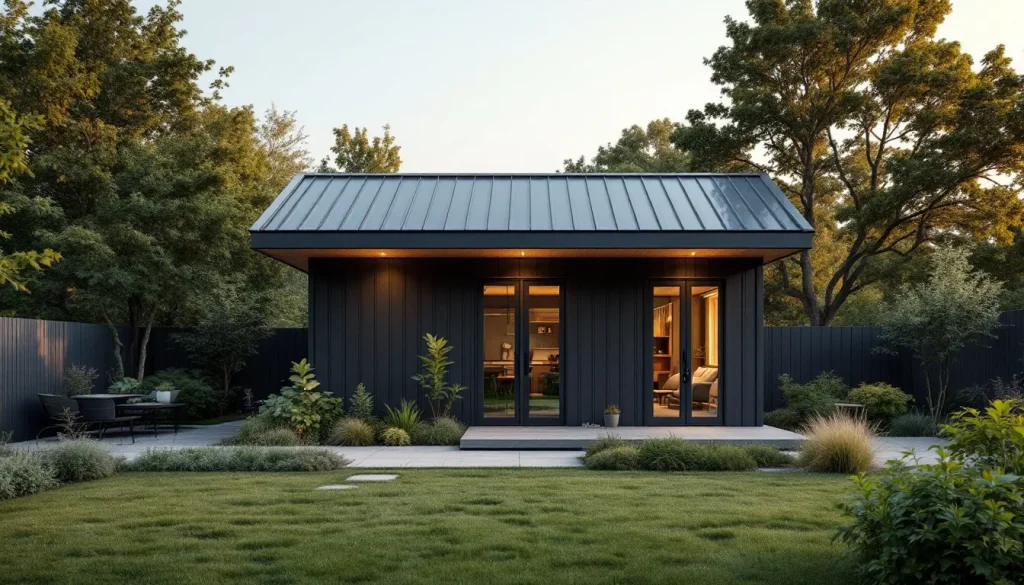
A shed (see our lean-to metal roof) roof in 2026 means two different things depending on context: a single-slope roof style used on small structures and modern homes, or the roof on a standalone backyard shed. Both follow the same material and slope-minimum rules from IRC R905. Build cost for the structure ranges from $200 for a 10×12 DIY shed using rolled asphalt and 2×4 framing, up to $4,000 for a 12×20 shed with standing seam metal panels and engineered trusses. For the roof style on a small house addition or accessory dwelling, expect $6 to $14 per sq ft installed for materials and labor. Here is everything you need to know about shed roofs in both senses: framing geometry, material choices by slope, code minimums, permit thresholds, and the DIY install sequence.
The short version
- “Shed roof” means a single-slope roof, period. One plane sloping from a higher wall to a lower wall.
- Slope minimums per IRC R905: 2/12 for asphalt shingles with double underlayment, 3/12 for exposed-fastener metal panels, 1/4 inch per foot (2 percent) for membrane systems.
- Material cost for a 10×12 shed roof: $150 to $400 for rolled asphalt or 3-tab, $400 to $900 for corrugated metal, $800 to $1,400 for architectural shingles plus all accessories.
- Framing options: stick-frame rafters at 16 or 24 inches on center, or pre-engineered trusses (more expensive but faster install).
- Most jurisdictions exempt sheds under 120 sq ft from permits but check setback rules; sheds in HOA neighborhoods almost always need review.
- The two most common DIY shed roof mistakes: skipping drip edge and using interior-grade OSB for sheathing. Both fail within 5 years.
Short answer: two meanings of “shed roof”
The phrase “shed roof” is used two ways in residential construction and homeowner conversation. Both are correct.
Meaning 1: a roof shape. A shed roof is a single sloped plane, with a higher wall on one side and a lower wall on the other side. There is no ridge. There are no opposing rafters. It is the simplest roof shape that exists. You see shed roofs on modern and contemporary houses, on additions (where the shed roof slopes off the main house wall), on dormers, on porches, on lean-to garages, and on accessory dwelling units (ADUs). A detached garage roof often uses this same single-slope framing.
Meaning 2: the roof on a standalone backyard shed. A garden shed, tool shed, or storage shed. Most backyard sheds use a gable roof (two opposing slopes meeting at a ridge), but plenty of small sheds use a literal shed roof (single slope) or a saltbox (gable with one longer slope). The rules and materials are the same; the structural footprint is smaller and the permit threshold is usually lower.
This article covers both meanings. Material and slope rules from IRC R905 apply identically: a 3/12 single-slope porch roof and a 3/12 garden shed roof both need the same products. The difference is scale, framing complexity, and permit path.
Shed roof as a style: single-slope architecture
A shed-style roof has had three waves of popularity in American residential design. First in the 1950s Mid-Century Modern era. Second in the 1970s when low-slope, low-budget tract construction expanded shed roofs in starter homes and additions. Third now, where shed and butterfly roofs dominate Modern Farmhouse, Contemporary, and ADU design.
Why architects pick it: clean visual line, dramatic interior ceiling height when the high wall faces the main living space, easy clerestory window placement at the high wall, lower material cost (no ridge, no hip rafters, less complex flashing). Why builders pick it: faster framing, simpler structural calc, less wood waste.
The structural setup is straightforward. Rafters span from the high wall (top plate or ledger) down to the low wall (top plate or beam). The slope is determined by the height difference between the two walls divided by the horizontal span. A 16-foot span with a 4-foot height difference yields a 3/12 slope. Headroom at the low wall side becomes the design constraint: you need a minimum 7-foot ceiling at the low side per IRC R305 for habitable space.
For a 16 by 24 foot shed-style addition or ADU, expect framing material costs (rafters, ridge or upper ledger, top plates, sheathing, blocking) around $1,800 to $2,800. Sheathing, underlayment, and roofing finish runs another $2,200 to $4,500 depending on material. Labor at $3.50 to $6.00 per sq ft of roof area (more for steep slopes or complex eave details). All-in for a 384 sq ft shed-style roof on a new structure: $5,500 to $9,800.
Standalone backyard shed: structure, framing, roofing
A backyard shed for tools, lawn equipment, or outdoor storage is usually 8×8, 10×10, 10×12, 10×14, 12×16, or 12×20. The roof is gable, shed style, saltbox, or gambrel (see our gambrel roof guide for the barn-style option that maximizes loft storage).
Most prefab shed kits use trusses or pre-cut rafters at 24 inches on center (acceptable for the small spans involved). Stick-framed sheds built on site usually use 2×4 or 2×6 rafters at 16 inches on center. Sheathing is 7/16 or 1/2 inch OSB (use exterior-grade with a stamp, not interior grade) or 1/2 inch plywood. See roof sheathing for sheathing specs.
For a 10×12 shed (120 sq ft footprint) the roof area is roughly 130 to 150 sq ft including overhangs. Material cost breakdown:
- Sheathing (2 sheets of 7/16 OSB): $40 to $65
- Underlayment (1 roll of 15 lb felt or synthetic): $25 to $55
- Drip edge (40 linear feet at $1.50 to $3.50 per foot): $60 to $140
- 3-tab shingles (1.5 squares): $90 to $160
- OR architectural shingles (1.5 squares): $160 to $260
- OR corrugated metal panels (1.5 squares plus fasteners): $280 to $480
- OR rolled asphalt (1.5 squares): $50 to $90
- Roofing nails, ridge cap, starter strip: $35 to $75
Total material for a 10×12 shed roof in 3-tab asphalt: $250 to $495. In architectural asphalt: $320 to $595. In corrugated metal: $440 to $815. In rolled asphalt (cheapest, shortest life): $210 to $425.
Material choice for sheds: what makes sense at this scale
Material decisions for shed roofs follow different logic than houses because the consequences of failure are lower and the budget is smaller. A leaking shed is a maintenance annoyance, not a catastrophic insurance claim. The three credible material choices for sheds are rolled asphalt, asphalt shingles (3-tab or architectural), and corrugated metal.
| Material | Cost / 10×12 shed | Life expectancy | Min slope | Install difficulty |
|---|---|---|---|---|
| Rolled asphalt (90 lb) | $50 to $90 material | 5 to 10 years | 2/12 | Easiest. Roll it out, nail, tar seams. |
| 3-tab asphalt shingles | $90 to $160 material | 15 to 18 years | 2/12 (double underlayment to 4/12) | Easy. Most common shed roofing. |
| Architectural asphalt | $160 to $260 material | 22 to 28 years | 2/12 (double underlayment to 4/12) | Easy. Looks more substantial than 3-tab. |
| Corrugated metal (29 ga) | $280 to $480 material | 30 to 50 years | 3/12 | Moderate. Panels lift easily in wind during install. |
| EPDM rubber membrane | $220 to $380 material | 20 to 30 years | 1/4 per foot | Moderate. Glue or fully adhered. |
| Cedar shake | $420 to $680 material | 20 to 30 years | 4/12 | Hard. Time-intensive. Niche aesthetic. |
The right answer for most backyard sheds: 3-tab asphalt if you want the cheapest credible install, architectural asphalt if you want the roof to match the main house, corrugated metal if you want a 30+ year roof you do not think about again. Skip rolled asphalt unless the shed is a placeholder you expect to replace within a decade. Skip cedar shake unless the shed is visible from the house and you want it to look like a tiny barn.
For the metal vs asphalt decision in detail, see metal vs asphalt shingle roof.
Slope minimums by material (IRC R905)
Slope drives material choice more than aesthetics. Every roofing material has a minimum slope below which the manufacturer voids the warranty and the IRC prohibits installation. The full table from IRC R905:
| Material | IRC section | Min slope (no special prep) | Min slope (with enhancement) |
|---|---|---|---|
| Asphalt shingles | R905.2.2 | 4/12 | 2/12 with double underlayment |
| Clay or concrete tile | R905.3.1 | 2.5/12 | Manufacturer spec |
| Metal panels (exposed fastener) | R905.10.2 | 3/12 | Manufacturer spec |
| Standing seam metal | R905.10.2 | 1/4 per foot (2 percent) | Manufacturer spec |
| Wood shingle | R905.7.2 | 3/12 | None lower |
| Wood shake | R905.8.2 | 4/12 | None lower |
| Modified bitumen | R905.11 | 1/4 per foot | None lower |
| EPDM rubber | R905.12 | 1/4 per foot | None lower |
| TPO membrane | R905.14 | 1/4 per foot | None lower |
| Rolled asphalt | R905.5.2 | 1/12 (1 inch per foot) | None lower |
If you are building a shed and want flexibility on materials, design for 4/12 slope minimum. That keeps every credible material in play (except true flat membrane systems). If you want maximum interior space and minimum visual height, design for 2/12 with metal or membrane. See our roof pitch chart for slope conversions and visual references.
Framing: rafter vs truss
For a shed roof you have two framing approaches: stick-frame rafters cut on site, or pre-engineered trusses ordered from a lumber yard.
Stick-frame rafters are the DIY default. For a 10×12 shed with a shed-style (single slope) roof at 3/12 pitch:
- 2×6 rafters at 16 inches on center span up to about 12 feet at 3/12 in moderate snow load (verify with IRC Table R802.5.1)
- One end of the rafter sits on the high wall top plate with a plumb cut and birdsmouth
- Other end sits on the low wall top plate with another plumb cut and birdsmouth
- Overhangs extend past the wall as needed (typically 12 to 24 inches)
For gable-style sheds you have opposing rafters meeting at a ridge board, with collar ties or rafter ties handling the outward thrust. Same span tables; the geometry is more complex.
Pre-engineered trusses cost more (typically $25 to $60 per truss for shed scale, vs. $8 to $16 per rafter equivalent in raw lumber) but install faster and remove the need for span verification. For a 10×12 shed you typically order 5 to 6 trusses at 24 inches on center. The truss arrives engineered for your specific span, slope, and snow load. See roof trusses for the full truss vs. stick-frame breakdown.
The DIY shortcut: use the same 2×6 dimensional lumber for everything (rafters, top plates, bottom plates). Avoid 2×4 rafters in any snow load above 20 psf. They sag and your shed roof develops a permanent wave by year 5.
Decking: sheathing the shed roof correctly
Decking (sheathing) sits on top of the rafters and provides the structural surface for underlayment and roofing material. IRC R803 governs sheathing material and thickness.
For a shed roof with rafters at 16 inches on center, minimum sheathing is 7/16 inch OSB or 3/8 inch plywood. At 24 inches on center, jump to 1/2 inch OSB or 1/2 inch plywood. Verify with the sheathing span chart printed on the panel edge (“APA Rated Sheathing 24/16” means the panel is rated for roof framing at 24 inches on center and floor framing at 16 inches on center).
The trap: interior-grade OSB. Big-box stores stock both exterior-rated and interior-rated OSB and they look identical. Interior OSB swells, delaminates, and rots within 3 to 5 years of exposure even with intact roofing above. Always check the stamp: “Exterior” or “Exposure 1” is fine for roof sheathing. “Interior” is not.
Sheathing for a 10×12 shed roof costs $40 to $65 for two 4×8 sheets of 7/16 OSB. For 1/2 inch plywood it climbs to $75 to $110.
DIY install steps: a 10×12 shed roof from sheathing up
Assuming the rafters are framed, here is the install sequence:
- Sheathing: lay 4×8 sheets perpendicular to the rafters, staggering joints. Nail with 8d ring-shank nails at 6 inches on center on edges, 12 inches on center in the field. Leave a 1/8 inch gap between sheets for expansion.
- Drip edge at eaves: nail metal drip edge along the lower edge of the roof (the eave). Overlap pieces 2 inches. Use 1.25 inch roofing nails. See drip edge.
- Underlayment: roll out 15 lb felt or synthetic underlayment starting at the eave. Overlap upper courses 4 inches over lower courses. Staple every 12 to 24 inches. See felt vs synthetic underlayment for which to use.
- Drip edge at rakes: install drip edge over the underlayment along the rake edges (the sides). Some installers do rakes first, then underlayment. Either order works as long as the underlayment laps over the eave drip edge and under the rake drip edge.
- Starter strip: install starter strip shingles or roll-out starter material along the eave, adhesive side toward the edge. This prevents wind uplift on the first course.
- Shingles: lay shingles bottom to top. Stagger the joints by half-tab on each course. Nail in the nailing strip (per manufacturer spec, usually 4 nails per shingle in normal wind zones, 6 in high-wind zones per ASTM D7158).
- Ridge cap: only applies to gable or hip sheds. Bend shingles over the ridge or use pre-formed ridge cap pieces. Nail and seal.
- Flashing at penetrations: pipe boots for any vents, step flashing at any wall connections.
Allow 6 to 10 hours of labor for a confident DIYer doing a 10×12 shed roof in asphalt shingles. For corrugated metal the time drops to 3 to 5 hours but the precision required on panel layout and fastener placement is higher.
Cost by shed size
| Shed size | Roof area (incl. overhang) | 3-tab asphalt material | Architectural asphalt material | Corrugated metal material |
|---|---|---|---|---|
| 6×8 | ~60 sq ft | $70 to $120 | $120 to $200 | $220 to $380 |
| 8×10 | ~105 sq ft | $110 to $180 | $190 to $310 | $340 to $580 |
| 10×12 | ~145 sq ft | $150 to $250 | $260 to $410 | $440 to $760 |
| 10×14 | ~165 sq ft | $170 to $280 | $290 to $470 | $510 to $870 |
| 12×16 | ~225 sq ft | $220 to $360 | $390 to $620 | $700 to $1,200 |
| 12×20 | ~275 sq ft | $270 to $440 | $480 to $760 | $860 to $1,470 |
Material totals above include sheathing, underlayment, drip edge, fasteners, ridge cap, and the roofing material. Labor is excluded (assumes DIY). If you hire out the install, add $3 to $7 per sq ft of roof area for labor, putting a 10×12 shed roof at $700 to $1,400 installed by a pro using mid-grade asphalt.
Drip edge and underlayment
Two details separate a shed roof that lasts 20 years from one that fails at year 4: drip edge installed correctly at eaves and rakes, and underlayment that does not have gaps or tears.
Drip edge is a bent metal flashing that runs along the edges of the roof. It does two jobs: it prevents water from wicking up under the shingles and rotting the sheathing edge, and it directs water out past the fascia or wall into the gutter or onto the ground. IRC R905.2.8.5 requires drip edge at all eaves and rakes for asphalt shingle roofs. Skipping it is the single most common DIY shed roof shortcut and the most expensive to fix later.
Underlayment goes between the sheathing and the shingles. 15 lb asphalt-saturated felt is the traditional choice and costs about $20 to $35 per roll (covers 200 sq ft). Synthetic underlayment (Grace, GAF Tiger Paw, Owens Corning ProArmor) costs $45 to $80 per roll and is lighter, stronger, and walks better than felt. For a 10×12 shed, one roll of either covers the whole roof. See felt vs synthetic underlayment for the full comparison.
The double underlayment requirement for low-slope (2/12 to 4/12) asphalt roofs from IRC R905.2.2: two layers of underlayment with the upper layer overlapping the lower by 19 inches minimum. Skip this and your low-slope shed leaks in heavy rain.
Permitting for sheds: varies by jurisdiction
Permit thresholds for backyard sheds in the 2024 IRC adoption cycles:
- Sheds 120 sq ft and under: usually exempt from building permit, but still subject to setback requirements (typically 5 to 10 feet from property lines)
- Sheds 121 to 200 sq ft: varies, often a simplified permit
- Sheds over 200 sq ft: building permit required, may require foundation inspection
- Sheds on permanent foundations (concrete slab or pier and beam): may trigger property tax reassessment
- Sheds with electrical: separate electrical permit required regardless of size
HOA neighborhoods almost always require shed approval through an architectural review committee, regardless of building permit status. The HOA can ban specific materials (metal roofing, certain colors) or require the shed to match the house. Check before buying materials.
Common shed roof mistakes
From field inspections and the comment sections of DIY forums, these are the patterns that fail:
- Skipping drip edge. The corners and edges of the sheathing rot within 2 to 5 years. Repair requires partial reroof.
- Interior-grade OSB on the roof. Panel delamination, soft spots, fastener pull-through. Cost to fix: full tear-off and re-sheathing.
- Asphalt shingles below 2/12 slope. Water blows uphill under shingle laps. Roof leaks from first heavy rain.
- 2×4 rafters at 24 inches on center in snow country. Sag and ponding within 5 winters. See sagging roof repair.
- Skipping starter strip. First course of shingles lifts in wind. Eventually the whole roof unzips course by course.
- Wrong nail penetration. Nails too short do not bite the sheathing. Nails too long penetrate through the sheathing and rust. Use 1.25 inch roofing nails for 7/16 OSB plus shingles.
- No fastener on rafters at the wall connection. Hurricane ties or H-clips are cheap insurance against wind uplift. IRC R802.11 specifies the connection requirements.
- Painting metal panels with house paint. Galvanized or pre-painted panels need specialty paint if you ever recoat. House paint peels and the panel rusts faster.
- Building over a frozen ground line. Footings or post bases set above the frost line heave in winter. The shed racks and the roof tears at the corners.
When to hire a pro instead of DIY
Most backyard sheds are DIY territory for a confident builder with a circular saw, framing square, hammer or nail gun, and a Saturday or two. The roof is usually the easiest part of the shed build (the walls and floor are more time-consuming). Where pro help becomes worth it:
- Sheds over 200 sq ft (permit and inspection complexity)
- Sheds on permanent foundations with frost-line footings
- Sheds with electrical, plumbing, or HVAC (now an accessory dwelling, not a shed)
- Saltbox, gambrel, or complex gable rooflines where the cuts are non-trivial
- Sheds in HOA neighborhoods where rejection means demolition
- Cedar shake or clay tile roofing (specialty install)
For pro install, expect $1,200 to $3,500 total for a 10×12 shed (kit purchase or scratch build) including roof, walls, floor, door, and one window. The roof portion is typically $400 to $900 of that. See how to choose a roofing contractor for general roofing vetting (most roofers do not take shed jobs, but a general carpenter or handyman with roofing chops will).
Shed roof on a house: the architectural variant
If you are reading this thinking about a shed-style roof on a house addition or new build, the article ratios change. The principles stay identical (single slope, slope minimums by material, R905 code) but you now have additional considerations:
- Interior ceiling height: a shed-style roof creates dramatic interior volume on the high wall side, but headroom collapses on the low wall side. Plan furniture and traffic accordingly.
- Clerestory windows: the high wall is the canonical location for clerestory glass that brings light deep into the interior without sacrificing privacy. Common in modern design.
- Drainage planning: all roof water runs to one side. Your gutter capacity at the low wall side must handle the entire roof area, which is usually 1.5x to 2x what a gable equivalent would need on each side.
- Snow load asymmetry: snow slides downhill on the low side. Plan for snow guard installation or a roof overhang large enough to drop snow clear of the foundation.
- Visual proportion: shed roofs read as modern. A shed roof on a Colonial-style house looks wrong unless it is intentionally placed as a low-pitch porch or rear addition.
For larger shed-style structures on houses, expect $7 to $14 per sq ft installed for roof material and labor in mid-grade asphalt, $12 to $22 per sq ft for standing seam metal, and $14 to $24 per sq ft for cedar shake at the steep slopes required for cedar.
Shed roof vs. gable roof for sheds: the practical comparison
If you are building a backyard shed and trying to decide between a true shed-style roof (single slope) and a gable roof (two opposing slopes), here is the comparison:
| Factor | Shed-style (single slope) | Gable (two slopes) |
|---|---|---|
| Framing complexity | Lowest. No ridge, no opposing rafters. | Moderate. Ridge board, opposing rafters, collar ties. |
| Material cost (10×12) | ~$200 to $400 | ~$240 to $480 (more material from steeper geometry) |
| Interior loft / storage | Limited. Headroom only on high wall side. | Better. Full attic-style loft possible. |
| Water shedding | One side. All water to one gutter or drip zone. | Two sides. Water splits. |
| Snow load | Asymmetric. Snow slides to low side. | Symmetric. Even loading. |
| Aesthetic | Modern, utilitarian. | Traditional, cabin-style. |
| HOA approval | Sometimes rejected for “industrial look.” | Almost always approved. |
For most backyard sheds the gable roof wins on aesthetics, storage, and HOA acceptance. Shed-style wins on cost, build speed, and clean modern lines. The saltbox (gable with one slope longer than the other) is the niche middle ground that maximizes interior volume on one side while keeping the traditional ridge geometry.
Replacing an existing shed roof
If you have an existing shed and just need to replace the roof (the existing one is leaking, ugly, or past its life), the project simplifies. You skip framing and decking unless the rafters or sheathing are damaged. The sequence:
- Tear off the existing roofing material down to sheathing
- Inspect sheathing for soft spots, rot, fastener pull-through. Replace damaged sheets.
- Inspect rafters for sag, splits, rot at the wall connection. Sister or replace as needed.
- Reinstall drip edge, underlayment, and new roofing material per the install sequence above.
For a 10×12 shed with intact framing and sheathing, expect $200 to $500 in material and 4 to 6 hours of DIY time to replace the roofing. If you need to replace sheathing add $40 to $65 per 4×8 sheet of OSB.
Frequently asked questions
Do I need a permit to build a backyard shed?
Most jurisdictions exempt sheds 120 sq ft and under from building permits, but you still need to comply with property setback rules (typically 5 to 10 feet from lot lines). Sheds with electrical, plumbing, or on permanent foundations may require permits regardless of size. HOA neighborhoods almost always require architectural review.
What is the minimum slope for a shed roof?
It depends on the roofing material. Asphalt shingles need 4/12 minimum or 2/12 with double underlayment. Corrugated metal panels need 3/12. Standing seam metal can go as low as 1/4 inch per foot. Membrane systems (EPDM, TPO, modified bitumen) work at 1/4 inch per foot minimum slope.
How much does it cost to roof a 10×12 shed?
Material cost runs $150 to $250 for 3-tab asphalt, $260 to $410 for architectural asphalt, and $440 to $760 for corrugated metal. If you DIY the install, that is your total. Pro install adds $400 to $900 in labor on top.
Can I use leftover shingles from my house to roof my shed?
Yes, this is one of the better uses for end-of-job leftover shingles. Verify that the slope of your shed roof meets the shingle manufacturer’s minimum (usually 2/12 with double underlayment, 4/12 normal). Use the same starter strip, drip edge, and underlayment principles as a full roof.
What is the best roofing material for a shed?
Architectural asphalt shingles if you want the roof to match a house and last 20+ years for moderate cost. Corrugated metal if you want 30 to 50 year life and do not mind the industrial look. Skip rolled roofing installation unless you are building a temporary or sacrificial structure.
How many shingles do I need for a shed roof?
Calculate the roof area including overhangs (in square feet), divide by 100 to get squares (1 square = 100 sq ft of roof), and add 10 to 15 percent for waste, starter, and ridge cap. A 10×12 shed with 12-inch overhangs has roughly 1.5 squares of roof area. Buy 2 squares to cover starter, ridge cap, and waste.
Should I use felt or synthetic underlayment on a shed?
Synthetic if you can afford it ($45 to $80 per roll). It is lighter, stronger, less prone to tearing, and walks better than felt. For a $250 shed roof, the $30 to $50 cost difference between felt and synthetic is small and the install experience is noticeably better. See our underlayment comparison.
Can I put metal roofing directly on top of old shingles on a shed?
Yes for many corrugated metal panel systems, but verify with the manufacturer. The metal goes over purlins (1×4 boards screwed across the existing shingles at 24 inches on center) which lift the metal off the shingle surface and allow ventilation. Skip the underlayment if you do this. Check your local building code first since some jurisdictions require tear-off before reroof.